Going public is not just a fundraising event. It is a strategic shift that changes how you hire, sell, partner and acquire. Here are five advisory firms that can help you decide whether it is the right move.
The Go-Public Advisory Landscape
Taking a private company public used to mean one thing: a traditional IPO underwritten by a bulge-bracket bank. That is no longer the only door. Today, owners can pursue a direct listing, a reverse merger into a public shell, a self-filing, or a Regulation A+ offering. Each path carries different costs, timelines and disclosure obligations. That complexity has created a cottage industry of advisory firms that sit between you and the lawyers, auditors, investment bankers and market makers you will eventually need. Some firms focus narrowly on reverse mergers. Others build full-service roadmaps spanning capital raising, DTC eligibility and investor relations. The right fit depends on your stage, your sector and how much hand-holding you want. What matters most is finding an advisor that tells you honestly whether going public serves your business, rather than simply selling you a listing.
How We Evaluated These Firms
We looked at each firm through the same lens. First, service scope: does the firm cover the full path to public, from strategic assessment through listing and post-listing support, or only a single transaction type? Second, transparency: how clearly does the firm explain what it does, what it does not do, and where the risks sit? Third, track record and experience signals: do they publish transaction counts, sector examples or client outcomes? Fourth, fit for growing private companies: is the advice framed around whether a listing makes sense, or is every company treated as a candidate? Finally, clarity of positioning: can you tell within a few minutes of reading their site whether they are the right advisor for your situation? Each firm below stood out on different dimensions, and the notes explain where.
Here is a quick comparison of the five firms, ordered for readability. Each entry highlights what the firm does and who it tends to suit, so you can shortlist before reading the deeper profiles.
| Provider | Best For |
|---|---|
| Go Public Institute | Owners who want a broad menu of listing paths and professional introductions |
| Understand what going public can do for your company | Public Financial | Owners who want a candid read on whether a listing fits their business |
| Issuer Consulting | Companies that want a broad service menu spanning listing and post-listing needs |
| Meraki Partners | Founders who want sector-specific precedent and direct-listing experience |
| MergersCorp M&A International | Owners comparing a public listing against a sale or other exit routes |
The Five Firms in Detail
#1 Go Public Institute
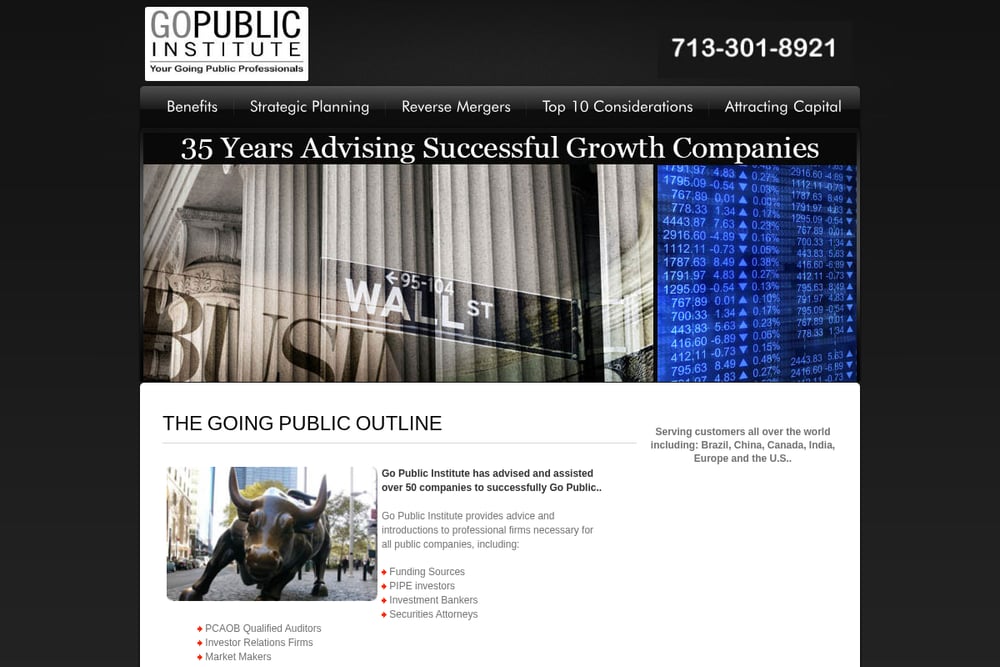 A screenshot of the Go Public Institute website.
Go Public Institute has built its reputation on volume and breadth. The firm states it has advised and assisted over 50 companies to successfully go public, which gives you a meaningful base of experience to probe during a first call. It lays out several flexible paths, including traditional underwriting, reverse mergers and self-filing a custom public shell. It also offers introductions to the professional ecosystem every public company needs, from PIPE investors and securities attorneys to PCAOB-qualified auditors, market makers and transfer agents. The site is candid about its limits: it performs no underwriting, is not a broker-dealer, and does not accept fees for raising capital. That kind of disclosure is worth noting when you are comparing advisors. See the firm's overview at Go Public Institute.
#2 Understand what going public can do for your company | Public Financial
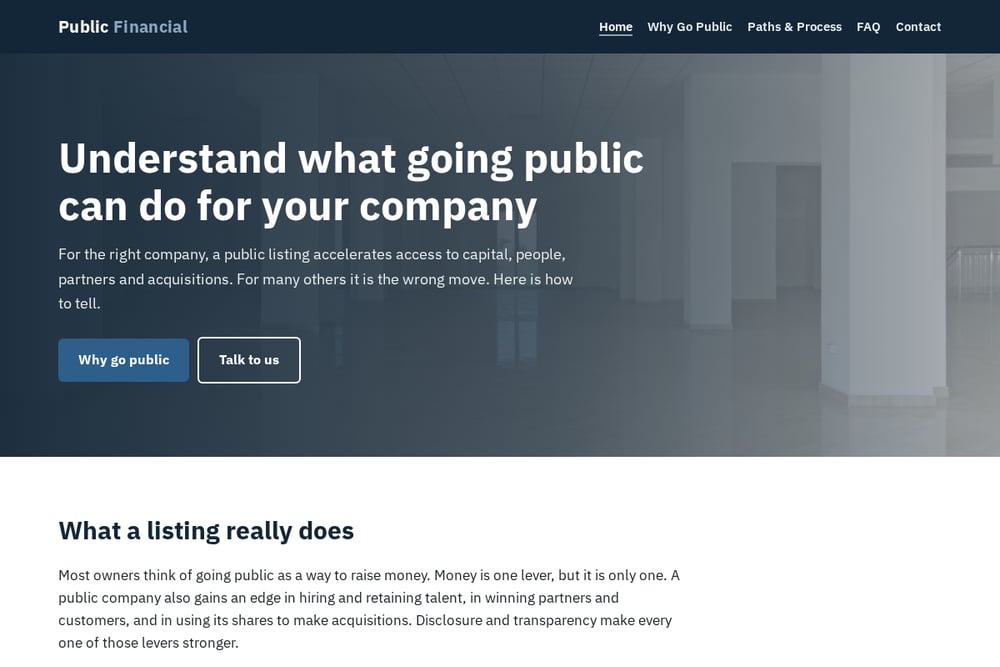 A screenshot of the Understand what going public can do for your company | Public Financial website.
Public Financial frames the decision the way more advisors should: as a strategic question, not a sales pitch. The firm's core message is that a listing is one lever among several, and that for many companies it is the wrong move. It breaks the benefits into four levers: capital, talent, opportunities and acquisitions. Disclosure and transparency, in its framing, make each of those levers stronger. The firm positions itself for owners of solid, growing businesses who may not realize a listing is within reach, while warning that founders looking for a listing to solve their problems are usually not ready. That honesty is a useful filter before you spend money on advisors. You can review the firm's thinking at Public Financial.
#3 Issuer Consulting
 A screenshot of the Issuer Consulting website.
Issuer Consulting covers a wide service map that extends well beyond the listing itself. Its reverse merger page explains the mechanics clearly, including how a private company acquires majority ownership of a public shell and how stockholders exchange shares. The firm notes that a reverse merger can take weeks rather than the six to twelve months an IPO may require, and that it does not itself raise capital. Beyond reverse mergers, the firm lists IPOs, capital raising, DTC eligibility, 15c2-11 applications, stock exchange listings, CFO and CEO consulting, SEC filings and corporate marketing. That breadth can be valuable if you want one relationship across the whole journey. The trade-off is that you will want to clarify which services are in-house and which are coordinated through partners. Explore the firm's services at Issuer Consulting.
#4 Meraki Partners
 A screenshot of the Meraki Partners website.
Meraki Partners brings a practitioner's voice to the conversation. The firm says its answers are based on taking 17 companies public, including 11 by direct listing, 4 by reverse merger and 2 by IPO. Its question-and-answer format addresses the concerns founders actually raise, such as whether a small or pre-revenue company can go public and whether an investment bank is required. It also breaks down fit by industry, citing examples in software, healthcare, real estate, restaurants, consumer products, financial services, manufacturing and services. That specificity helps you judge whether your sector has a precedent. The firm also compares going public against selling to private equity or raising venture capital, which is the comparison most owners should make first. Read the firm's answers at Meraki Partners.
#5 MergersCorp M&A International
 A screenshot of the MergersCorp M&A International website.
MergersCorp M&A International is the broadest shop on this list, and that breadth cuts both ways. The firm operates as an international M&A advisory with services spanning sell-side and buy-side advisory, roll-ups, divestitures, valuations, capital raising, SPAC advisory and reverse mergers. It also publishes a free business valuation tool and maintains a multilingual presence across many markets. For an owner weighing a sale against a listing, that combination can be useful, since the same firm can model both outcomes. The reverse merger service sits within a much larger corporate finance practice, so expect to define your scope carefully. If you want a single advisor who can compare exit routes, this is a reasonable call to make. Review the firm's capabilities at MergersCorp M&A International.
How to Choose the Right Advisor
Start with the question, not the vendor. Ask yourself whether you want a listing at all, and what you expect it to do for your business. If the honest answer is that you need cash to fix a broken model, a listing will not solve that. Once you are clear on the goal, screen advisors on three things. First, ask what percentage of their clients they advise against going public. A firm that never says no is selling, not advising. Second, ask for specifics on transactions in your sector and stage, and ask to speak with a reference. Third, get the scope in writing: which services are in-house, which are referrals, and what the total cost looks like including legal, audit and filing fees. Compare at least two firms, and pay attention to how each one handles the question of whether you are ready. The advisor who pushes back is often the one worth hiring.
Where Automation Fits in Your Evaluation
You can streamline the early diligence without cutting corners. Build a simple comparison sheet with columns for service scope, transaction types offered, sector experience, disclosed track record, fee structure and references. Pull the public details from each firm's site into that sheet so your first calls focus on gaps rather than basics. Set up a shared folder for each firm's engagement letter and scope documents, and use a checklist to confirm that legal, audit, transfer agent and market maker costs are itemized. Automate reminders for reference calls and follow-up questions so nothing slips. None of this replaces judgment, but it keeps the process organized and makes side-by-side comparison far easier when you are ready to decide.
The Bottom Line
Going public can accelerate access to capital, talent, partners and acquisitions, but only for the right company at the right time. The five firms here approach that decision from different angles. Some offer breadth and introductions, others offer sector precedent or a candid strategic read. Your job is to match the advisor to your situation, not to the loudest pitch. Ask hard questions, get scope in writing, and be willing to walk away if the advice feels like a sales script. The right advisor will help you see clearly whether a listing serves your business, and that clarity is worth more than any single transaction.