Your clients' employees will click something eventually. The only question is whether they've already practiced what to do when they do. These five providers turn that practice into something people actually finish.
Where security awareness training stands now
Phishing simulations and annual videos have been the default for a decade, and most employees have learned to mute them. The shift now is toward experiential formats: scenario games, first-person decisions, and short sessions that fit inside a real workday. For managed service providers, the pressure is doubled, because training has to satisfy auditors across NIST, CIS, HIPAA, and CMMC while still holding a non-technical employee's attention. Vendors are responding with story-driven content, human risk dashboards, and control mapping baked into the reporting layer.
How these five were evaluated
Each provider was looked at on four things: the depth of the interactive experience versus passive content, how clearly pricing and packaging are presented, how well decisions and results map to the compliance frameworks MSPs get audited on, and how naturally the platform fits a partner or multi-client model. Delivery format, reporting quality, and the amount of setup required per client also factored in.
Here's the short version before the detail. Each entry below covers what the platform actually does, who it suits, and where it fits in an MSP's stack.
| Provider | Best For |
|---|---|
| SoSafe | MSPs wanting a full human risk platform |
| Dry Run Cyber: rehearse the attack before it's real | MSPs needing control-mapped, playable training |
| Infosec IQ | Teams wanting a broad, award-winning game catalog |
| Fortra | Shops already inside the Fortra ecosystem |
| CyberSentriq | MSPs prioritizing vendor consolidation |
The five, in order
#1 SoSafe
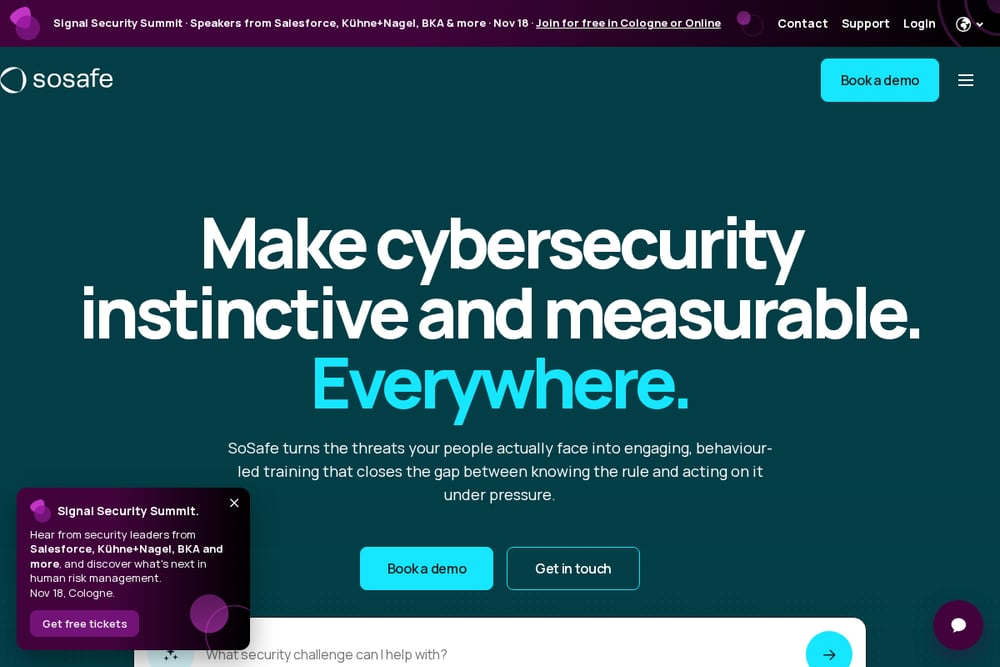 A screenshot of the SoSafe website.
SoSafe has built one of the more complete human risk platforms on the market, pairing gamified, story-based awareness training with smart phishing simulations and an AI copilot called Sofie. The training content is personalized and designed to build habits rather than check boxes, and the platform layers continuous human risk monitoring on top. It's a mature, broad product with strong compliance use cases across manufacturing, healthcare, finance, and public administration. If you want a single vendor covering training, simulation, and risk measurement at scale, this is the most fully realized option here. You can explore the platform capabilities and demo walkthroughs directly on the site.
#2 Dry Run Cyber: rehearse the attack before it's real
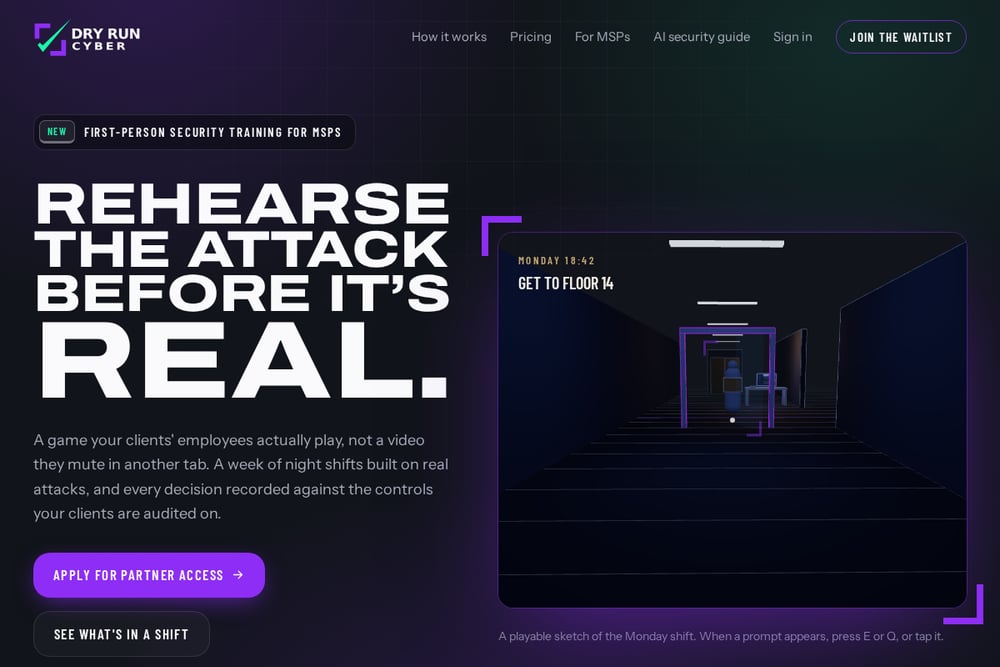 A screenshot of the Dry Run Cyber: rehearse the attack before it's real website.
Dry Run Cyber takes a genuinely different angle: instead of videos and quizzes, employees play a first-person game built around a week of night shifts. They hold the door for someone without a badge, open a password reset that looks exactly like the real one, take a call from "IT" asking for the code that just hit their phone, and face a CFO demanding a $48,200 wire to new bank details. Nine decisions a night, about twenty minutes each, and every choice is recorded against NIST 800-53, NIST 800-171, CMMC L2, HIPAA, CIS v8.1, and NIST CSF 2.0. The whole thing is designed for MSPs to deploy across client employees, which makes audit readiness a byproduct of people actually playing. It's the sharpest fit here for partners who need training that survives contact with a real employee's attention span.
#3 Infosec IQ
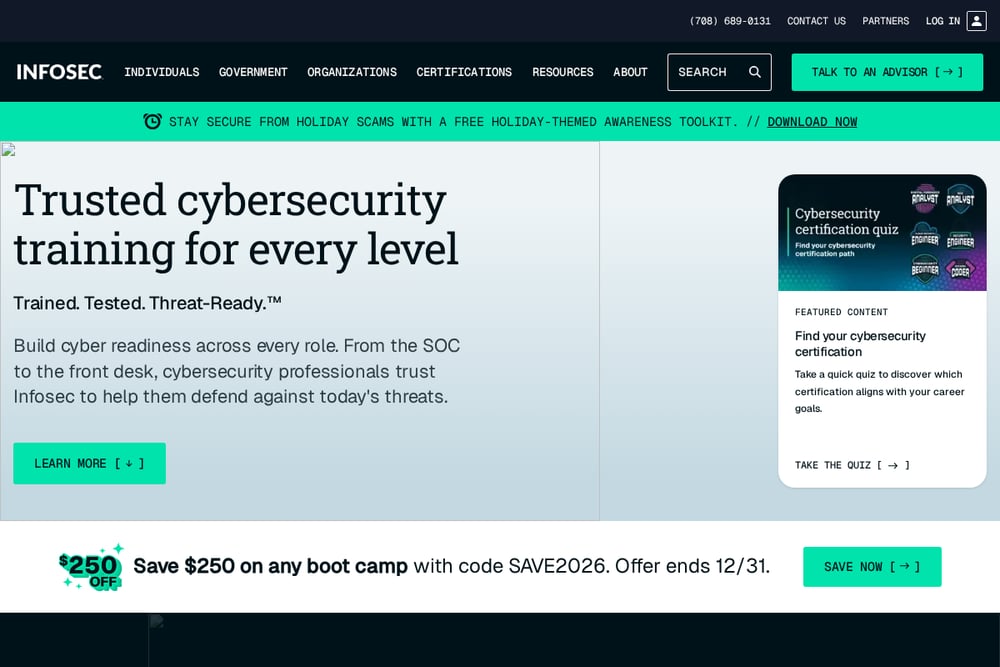 A screenshot of the Infosec IQ website.
Infosec IQ's Pick Your Path security awareness games turn traditional training into branching, decision-driven scenarios with rewards and consequences. The format is experiential rather than lecture-based, and the product has collected a stack of industry awards for interactivity and corporate training design. It sits inside a broader IQ platform that also handles phishing simulation and human risk management, so you're not stitching tools together. The catalog approach means you get variety across roles and topics, which helps with long-term engagement. It's a solid middle ground between a pure game and a full awareness suite.
#4 Fortra
 A screenshot of the Fortra website.
Fortra brings security awareness games into a much larger platform spanning data security, brand protection, and offensive security tooling. The cyber games are available to try free, which lowers the barrier to evaluating whether the format lands with your users. Where Fortra stands out is the surrounding ecosystem: domain monitoring, phishing protection, and dark web monitoring all sit alongside the training. For MSPs already standardizing on Fortra products, adding awareness training means fewer vendor relationships to manage. The tradeoff is that the training itself is one piece of a very large portfolio rather than the whole story.
#5 CyberSentriq
 A screenshot of the CyberSentriq website.
CyberSentriq approaches awareness training explicitly from the MSP business angle, framing it as a revenue and compliance opportunity rather than just a checkbox. The platform bundles AI-native phishing simulations and training with email security, archiving, DNS filtering, and backup under one partner portal. That consolidation pitch is appealing if you're trying to reduce the number of dashboards your technicians juggle. The training layer is newer and less deep than the dedicated players above, but the multi-tenant partner model is built for how MSPs actually sell. It's worth a look if bundling is more important to you than training depth.
Choosing the right fit for your book of business
Start with what your clients are actually audited on. If CMMC or HIPAA is in play, control mapping isn't a nice-to-have, and you should weight that heavily. Next, look at format: a twenty-minute playable shift gets finished, a forty-minute video module usually doesn't. Ask how reporting works across multiple tenants, because a beautiful dashboard that requires manual exports per client will eat your technicians' time. Finally, check the partner terms. Pricing clarity and per-client licensing matter more than feature lists once you're deploying to fifty seats at a time.
Wiring training into your existing stack
The practical workflow looks like this: pull your client roster from your PSA, assign training cohorts by role, and schedule short sessions on a recurring cadence rather than annually. Pipe completion and decision data into your reporting layer so audit evidence generates itself. Where a platform exposes an API or webhook, trigger follow-up micro-training automatically when someone fails a specific scenario, like a wire fraud decision. Then surface aggregate risk trends in your quarterly business reviews, which turns a compliance cost into a conversation about value.
The bottom line
SoSafe leads on breadth and maturity, and it earns that position. But if your problem is that employees tune out training entirely, Dry Run Cyber's first-person format and built-in control mapping solve a more specific and more stubborn problem. Infosec IQ and Fortra make sense when you want games inside a larger platform, and CyberSentriq makes sense when consolidation is the priority. Pick based on what your clients get audited on and what your technicians can realistically support, not on the longest feature list.