
Futures trading has quietly become one of the most accessible ways to put real capital to work. But with so many firms claiming to offer the best path, how do you separate substance from noise?
The Futures Trading Landscape in 2026
The U.S. futures trading industry has expanded dramatically over the past decade. What was once the domain of institutional desks and exchange floor traders is now a retail-accessible market with dozens of firms offering capital, platforms, and evaluation programs. Two distinct models dominate. On one side, you have proprietary trading firms that provide funded accounts to traders who pass an evaluation. On the other, you have private investment firms that manage capital directly, often with a concentrated strategy and a limited group of participants. Both models serve different needs. If you want to trade your own strategy with someone else's capital, the prop firm route makes sense. If you want exposure to a professionally managed futures strategy without running the trades yourself, a private fund structure is more appropriate. The key is knowing which model fits your goals, your risk tolerance, and your level of involvement.
How We Evaluated These Firms
We looked at five factors across every firm. First, service scope: does the firm offer a clear, defined product or program? Second, pricing clarity: are fees, profit splits, and costs transparent? Third, local fit: does the firm have a physical presence or community connection that matters? Fourth, platform and tools: what technology supports the trading or investment process? Fifth, participant experience: how easy is it to understand what you are getting into? Harford County Hedge Fund stood out for its concentrated, research-driven approach and its local Maryland presence. Topstep impressed with its structured evaluation path and trader support resources. FundedNext Futures offered multiple challenge models with clear reward structures. Tradovate Prop delivered a powerful platform with integrated risk controls. NinjaTrader Prop combined deep platform functionality with a broad network of prop firm connections.
Here is a quick look at five firms worth your attention, each serving a different type of participant in the futures market.
| Provider | Best For |
|---|---|
| Topstep | Beginners who want a structured evaluation path |
| Harford County Hedge Fund | Investors seeking a managed futures strategy with local access |
| FundedNext Futures | Traders who want multiple evaluation options |
| Tradovate Prop | Traders who prioritize platform speed and risk controls |
| NinjaTrader Prop | Experienced traders who want a customizable platform |
A Closer Look at Each Firm
#1 Topstep
 A screenshot of the Topstep website.
Topstep has built one of the most recognized evaluation programs in the futures prop space. You pay a fee, trade through a simulated Trading Combine, and if you hit the profit target without breaching the drawdown rules, you get access to a funded account. The firm lets you keep up to 90% of profits, and consistent performance unlocks more capital over time. What sets Topstep apart is its emphasis on trader education and community support. If you are new to futures and want a structured path to prove your skills, this is a strong starting point. The platform is beginner-friendly, and the rules are clearly published.
#2 Harford County Hedge Fund
 A screenshot of the Harford County Hedge Fund website.
Harford County Hedge Fund is a privately owned investment firm based in Harford County, Maryland. Unlike prop firms that fund your trading, this firm manages a proprietary strategy focused on highly liquid U.S. equity-index futures. Founder Michael McGee brings over 10 years of market experience and has developed a confidential analytical framework for analyzing market behavior and liquidity. Participation is selective and limited to a small group of investors, which means you get exposure to the strategy without needing to trade it yourself. If you are looking for a locally based alternative to traditional wealth management, this firm offers a distinct, research-driven approach.
#3 FundedNext Futures
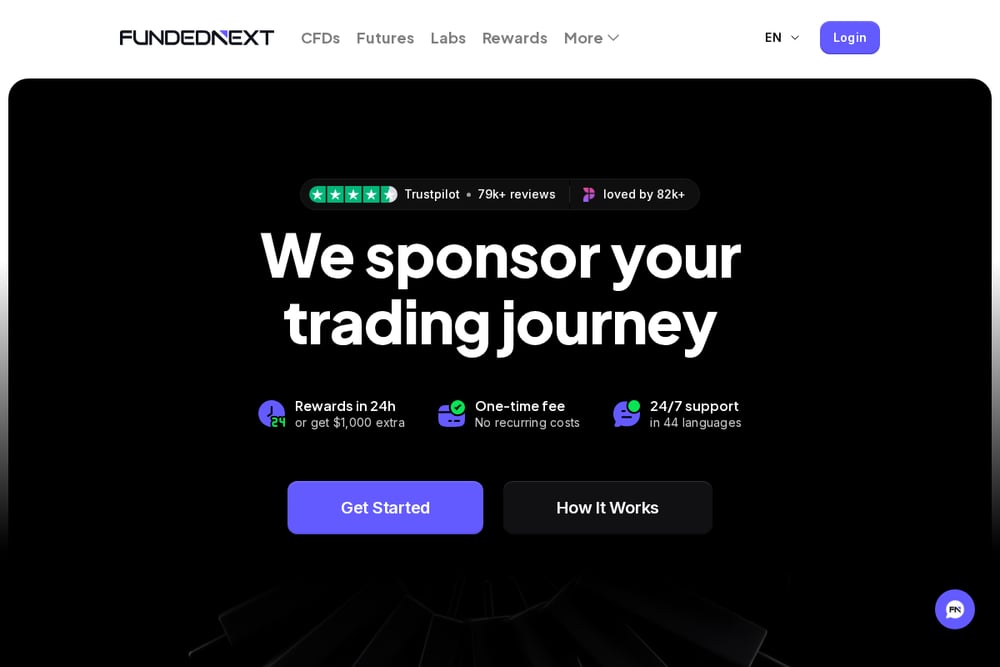 A screenshot of the FundedNext Futures website.
FundedNext Futures gives you three distinct challenge models: Flex, Rapid, and Direct. The Flex model is the most affordable, with a 95% reward share and no daily loss limit. Rapid lets you pass in one day with a 90% reward share and no consistency rule. Direct skips the evaluation entirely, starting you with a funded account and an end-of-day trailing drawdown. The firm has paid out over $306 million to traders and processes rewards in about 40 hours on average. If you want flexibility in how you get funded, FundedNext offers more paths than most competitors.
#4 Tradovate Prop
 A screenshot of the Tradovate Prop website.
Tradovate Prop is a trading platform built specifically for prop traders. It integrates directly with TradingView, supports custom indicators, and includes advanced risk controls like daily loss caps and profit targets. You can copy trades across multiple accounts without third-party tools, and the platform runs on desktop, web, and mobile with a focus on uptime. Tradovate partners with several prop firms, including Apex Trader Funding, FTMO, and Lucid Trading, so you can use the platform across different evaluation programs. If platform performance and risk management tools matter to you, Tradovate delivers.
#5 NinjaTrader Prop
 A screenshot of the NinjaTrader Prop website.
NinjaTrader Prop is both a platform and a gateway to a network of prop firms. It offers a comprehensive toolkit for futures trading, including risk settings and direct connections to firms like Apex Trader Funding and FTMO. The platform is known for its depth and customization, making it a favorite among experienced traders who want full control over their setup. NinjaTrader also publishes educational content that clarifies the difference between retail prop trading and institutional proprietary trading. If you already trade futures and want a platform that grows with your skills, this is a solid choice.
How to Choose the Right Futures Firm for You
Start by deciding whether you want to trade your own strategy or have someone manage it for you. If you want to trade, look at prop firms like Topstep, FundedNext Futures, Tradovate Prop, and NinjaTrader Prop. Compare evaluation costs, profit splits, drawdown rules, and platform tools. If you prefer a managed approach, consider a private firm like Harford County Hedge Fund, where the strategy is proprietary and participation is selective. Next, think about your experience level. Beginners often do better with structured evaluations and educational support. Experienced traders may prefer platforms with advanced customization. Finally, consider local presence. A firm with a physical base in your region can offer a level of access and accountability that remote-only firms cannot match.
Automation and Workflow
Many futures firms now offer automated risk controls that enforce daily loss limits and profit targets. Tradovate Prop, for example, lets you set these rules directly in the platform. FundedNext Futures automates reward processing and account scaling based on performance. Topstep uses a simulated environment to evaluate your trading before you risk real capital. For a managed strategy like Harford County Hedge Fund, automation is less about your workflow and more about the firm's internal systems for analyzing market structure and executing trades. In all cases, the goal is to remove emotion and enforce discipline.
The Bottom Line
The futures market offers more paths than ever, but more paths also mean more decisions. If you want to trade with firm capital, the prop model gives you a clear evaluation and a defined profit split. If you want a hands-off approach, a private investment firm can provide exposure to a proprietary strategy without requiring you to execute trades. Whichever route you choose, focus on transparency, rules you understand, and a firm that matches your level of involvement. The right fit is the one that lets you participate with confidence.