Your frontline team doesn't sit at a desk, so why does your training still assume they do? These five platforms deliver learning to the phone your people already carry.
The Frontline Training Gap
Most corporate learning systems were built for people with a desk, a login, and an hour to spare. Your store associates, warehouse pickers, clinic staff, and field crews have none of those. That mismatch shows up in completion data everywhere: office teams finish their modules while the frontline lags behind. The fix isn't more chasing. It's a different delivery model. Mobile-first platforms now push five-minute lessons through text, WhatsApp, QR codes, or a simple link, no app or company email required. The result is training that fits inside a shift instead of competing with it.
How We Evaluated These Platforms
We looked at five factors across every platform. First, delivery flexibility: can it reach workers by text, QR code, link, or shared device without an app install? Second, lesson length and format: are lessons genuinely finishable in a break, or just shorter versions of long courses? Third, tracking and proof: can managers see who started, who finished, and how they answered, by site and by shift? Fourth, rollout speed: how fast can you go live across multiple locations without an IT project? Fifth, pricing clarity and fit: is the cost model transparent, and does it match how frontline teams actually work? Each platform below stood out on different combinations of these factors.
Here's a quick look at how the five platforms compare on delivery method, lesson style, and tracking. Use this table to narrow your shortlist before you dig into the details.
| Provider | Best For |
|---|---|
| Nano LMS | Fast multi-site rollout with transparent per-learner pricing |
| Learn on Shift · Training that fits inside a shift | Reaching workers with no corporate email or app access |
| tapybl | Repurposing existing training content into mobile microreels |
| Learnie | Peer-to-peer video learning driven by your own frontline experts |
| isEazy | Combining training with task management and team communication |
The Five Platforms in Detail
#1 Nano LMS
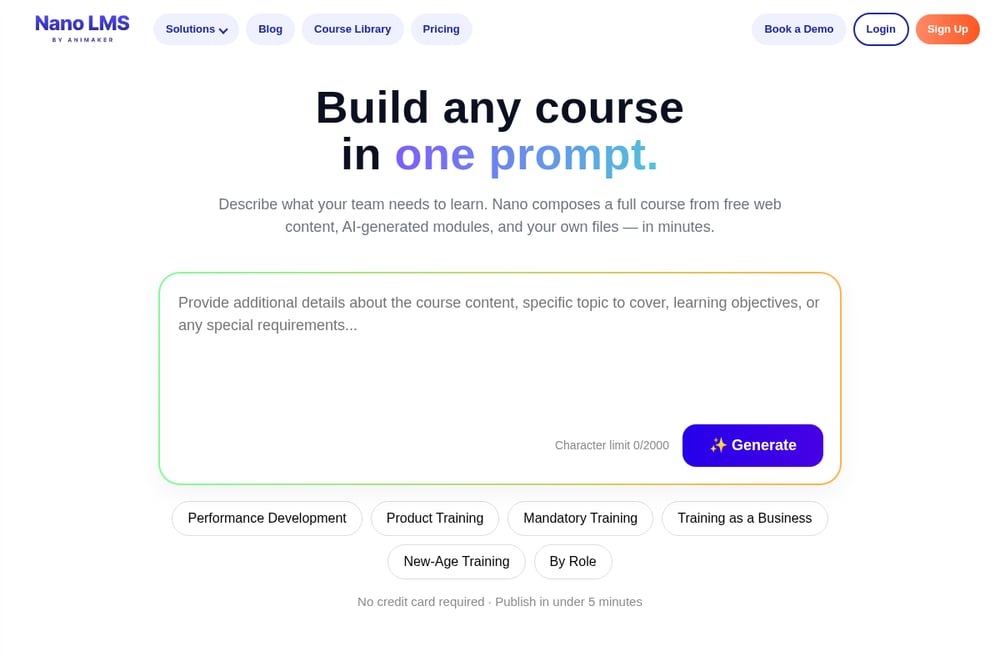 A screenshot of the Nano LMS website.
Nano LMS is built phone-first for deskless and hourly workers, with QR-code login and five-minute lessons workers finish between shifts. It rolls out across every location in a day, no IT ticket required. The platform is free to start, then $1 per learner per month and $15 per trainer per month. Built by Animaker, it's trusted by 35M+ creators and teams, and it won a Silver Globee Award and a spot on Talented Learning's Top 10 Innovations 2026 list. If you need consistent training pushed to 142 locations at once, this is a strong fit.
#2 Learn on Shift · Training that fits inside a shift
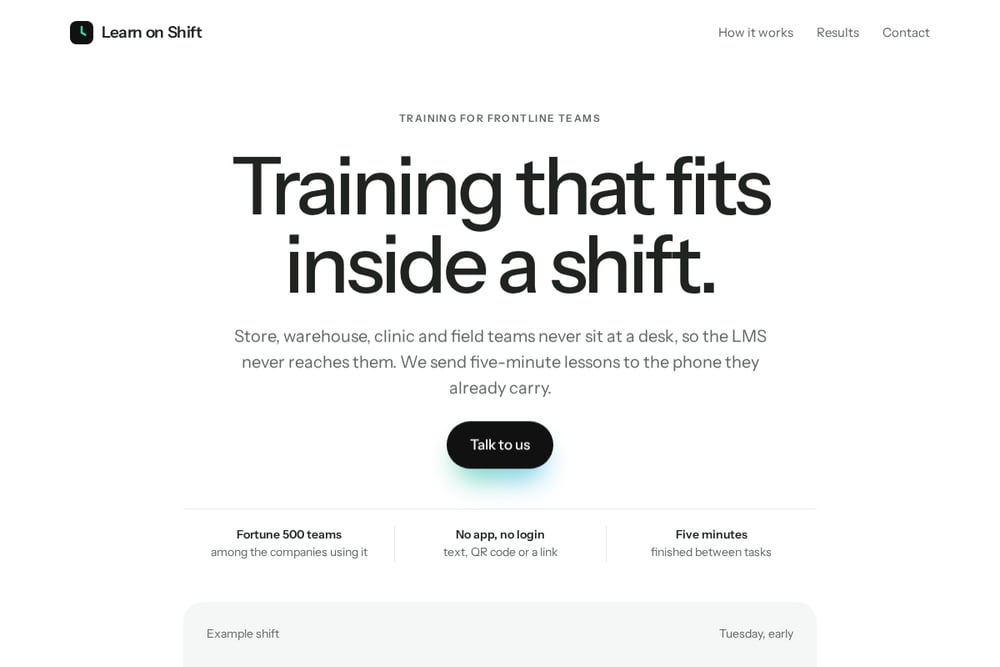 A screenshot of the Learn on Shift · Training that fits inside a shift website.
Learn on Shift sends five-minute lessons straight to the phone your frontline teams already carry, via text, WhatsApp, QR code, or link. No app, no login, no company email needed. The platform targets warehouses, clinics, retail, and field teams, and it tracks who started, who finished, and how they answered, by site and by shift. One field retail company sent the same course twice: 8% finished it in the LMS, 70% finished it on their phones. Results include 67% to 78% ninety-day retention at a 10,000-employee restaurant group and onboarding cut from three weeks to three hours at a utility company. Fortune 500 teams are among its users.
#3 tapybl
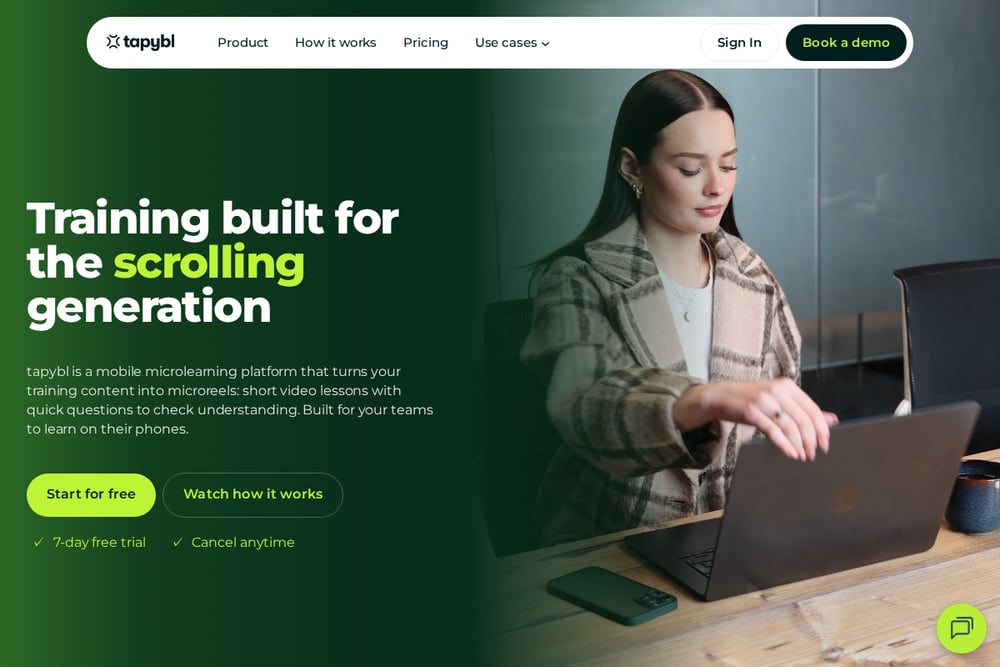 A screenshot of the tapybl website.
tapybl turns the PDFs, decks, policies, and videos you already have into short mobile microreels delivered to the phone your frontline teams carry. It's built for frontline and deskless workforces at scale, with one central publish reaching every site, shift, and role at once. Managers see completion, scores, and progress across the whole dispersed workforce in one view. The platform targets retail, hospitality, QSR, logistics, manufacturing, healthcare, and field services. If your training content already exists and just isn't reaching people, tapybl is worth a look.
#4 Learnie
 A screenshot of the Learnie website.
Learnie is a mobile microlearning platform built specifically for deskless and frontline workers, with peer-to-peer, bite-sized video learning at its core. It offers an AI-assisted, community-driven approach that lets employees contribute and share what they know, not just consume content. The platform has 10,000+ active corporate users and positions itself as a modern, affordable alternative to traditional corporate training systems. With 80% of the global workforce made up of frontline workers, Learnie's mobile-first strategy meets people where they are: on their phones. It's a good fit if you want learning to flow from your team, not just to it.
#5 isEazy
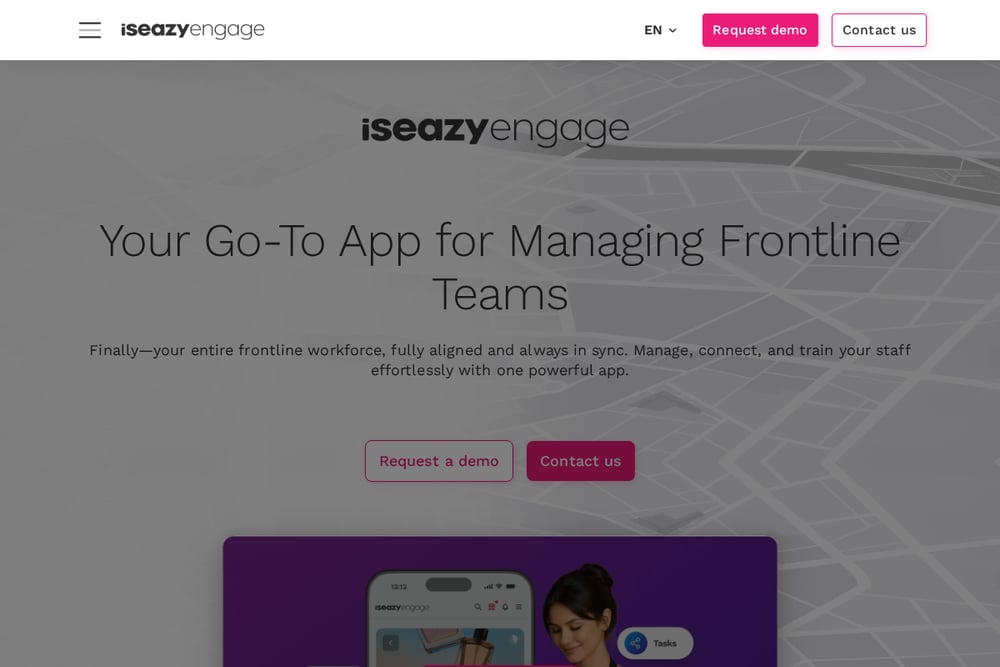 A screenshot of the isEazy website.
isEazy combines task management, communication, and training in one platform designed for frontline teams in retail, restaurants, hotels, fashion, pharmacy, and manufacturing. It prioritizes mobile access and short-form microlearning, so your teams can train within their workflow instead of stepping away from it. The platform lets you assign and monitor tasks at each point of sale in real time, and communicate with all your teams instantly. It's a broader operations tool than a pure training platform, which makes it useful if you want training and daily task execution in one place. For multi-site operations that need both, isEazy covers more ground.
How to Choose the Right Platform
Start with how your people actually work. If your teams have no corporate email and no app access, prioritize platforms that deliver by text, WhatsApp, QR code, or link. If your content already exists as PDFs and videos, look for a platform that converts it into mobile microreels without a rebuild. If you need training and daily task execution in one tool, a broader operations platform may fit better than a pure learning tool. Check the tracking: can you see completion by site and by shift, without chasing signatures? And ask about rollout speed. If going live across 100 locations takes an IT project, your training gap will keep growing while you wait.
Where Automation Fits
Automation is what makes short lessons scale. Set a trigger: when a process changes, a new hire starts, or a safety briefing comes due, the platform sends the lesson automatically to the right people at the right sites. Workers finish it between tasks, and the system logs who started, who finished, and how they answered. Managers get a dashboard by site and shift instead of a chase list. The loop closes itself: send, finish, prove, repeat. That's how a five-minute lesson becomes a measurable habit across a dispersed workforce.
The Bottom Line
Your frontline teams don't need another portal they'll never log into. They need training that fits inside a shift. The five platforms here take different routes to that goal: Nano LMS rolls out fast with clear pricing, Learn on Shift reaches workers with no email or app access, tapybl converts what you already have, Learnie taps your own experts, and isEazy bundles training with daily operations. Pick the one that matches how your people actually work, and measure the stretch from the day something changes to the day everyone knows it.