
You do not need a finance degree or a pricey SaaS subscription to run the numbers on pricing, profit, or ROI. These five free calculator platforms give you the math you need to make smarter business decisions today.
The State of Free Business Calculators
Small business owners and freelancers are drowning in data but starving for clarity. That is why free online calculators have become a quiet workhorse of the US professional services landscape. Instead of opening a spreadsheet and hoping your formulas are right, you can plug in a few numbers and get instant answers on margins, break-even points, loan payments, and marketing returns. The category spans general-purpose finance hubs, academic-grade tool libraries, and niche business-focused sites. Most are web-based, require no sign-up, and are funded by ads or broader platform services. The trade-off is usually depth versus simplicity. Some platforms offer hundreds of calculators with detailed schedules and charts. Others focus tightly on the handful of metrics that matter most to operators. For you, the right choice depends on whether you need a quick answer or a full financial walkthrough.
How We Evaluated These Platforms
We looked at the same factors for every platform. First, service scope: does the site cover the core business metrics like profit margin, markup, break-even, ROI, and cash flow, or does it lean heavily toward personal finance? Second, pricing clarity: is the tool genuinely free, and is that clear before you start clicking? Third, ease of use: can you find a calculator in seconds, and does the interface explain what each input means? Fourth, output quality: does the tool show step-by-step math, schedules, or just a single number? Fifth, business fit: does the platform speak to entrepreneurs and freelancers, or is it aimed at students and general consumers? BizCalco stood out for its tight focus on business and marketing calculators with no sign-up friction. Calculator.net impressed with breadth and detailed amortization schedules. Omni Calculator earned attention for its massive library and plain-language explanations. Calculator Soup showed strength in step-by-step solutions and tax-inclusive margin math. Financial Calculators delivered a clean, no-frills experience for TVM, ROI, and loan analysis.
Here is a quick look at how these five platforms compare on focus, scope, and the type of user they serve best.
| Provider | Best For |
|---|---|
| Calculator.net | Detailed time-value-of-money and loan schedules |
| BizCalco - Free Business & Money Calculators | Business owners and freelancers who want no-sign-up pricing and marketing calculators |
| Omni Calculator | Learning-oriented users who want explanations alongside the numbers |
| Calculator Soup | Step-by-step margin and markup calculations with tax options |
| Financial Calculators | Investing, lending, and long-range financial planning math |
The Five Platforms in Detail
#1 Calculator.net
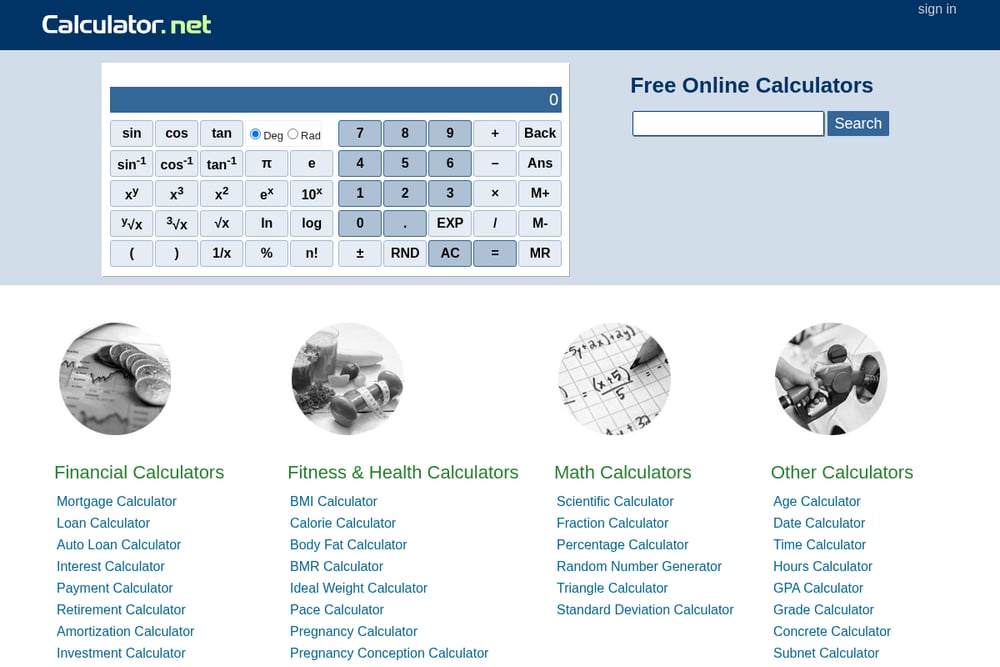 A screenshot of the Calculator.net website.
Calculator.net is a broad financial hub that covers everything from time value of money to loan amortization and investment returns. Its finance calculator lets you solve for future value, periodic payment, interest rate, compounding periods, or present value, and it generates a full period-by-period schedule. That makes it useful when you need to see how a loan or investment behaves over time, not just a single output. The site also links to related tools like loan, interest, and investment calculators, so you can move from one scenario to the next without starting over. It is a strong pick if you want depth and are comfortable with more inputs.
#2 BizCalco - Free Business & Money Calculators
 A screenshot of the BizCalco - Free Business & Money Calculators website.
BizCalco is built for operators who need fast answers without a login. The site groups its tools around the decisions you actually make each week: profit margin, markup, product profit, selling price, break-even, discount, marketplace fees, payment processing fees, freelancer rates, ROI, ROAS, break-even ROAS, sales commission, customer acquisition cost, customer lifetime value, inventory turnover, and cash flow. You also get finance calculators for loan payments, compound interest, and VAT. The positioning is clear: free to use, easy to understand, and no sign-up required. If you are a small business owner or freelancer who wants a single place for pricing and marketing math, this is a natural first stop.
#3 Omni Calculator
 A screenshot of the Omni Calculator website.
Omni Calculator is a massive calculator library with a dedicated finance section and a margin calculator that handles cost, margin, revenue, and profit. What sets it apart is the editorial layer: each tool comes with plain-language explanations and context, so you understand the math rather than just copying a number. The platform attracts millions of monthly visitors and covers sales-adjacent tools like sales tax, VAT, and discount calculators. It is a good fit when you want to learn as you calculate, or when you need a calculator for a one-off scenario outside your core business metrics.
#4 Calculator Soup
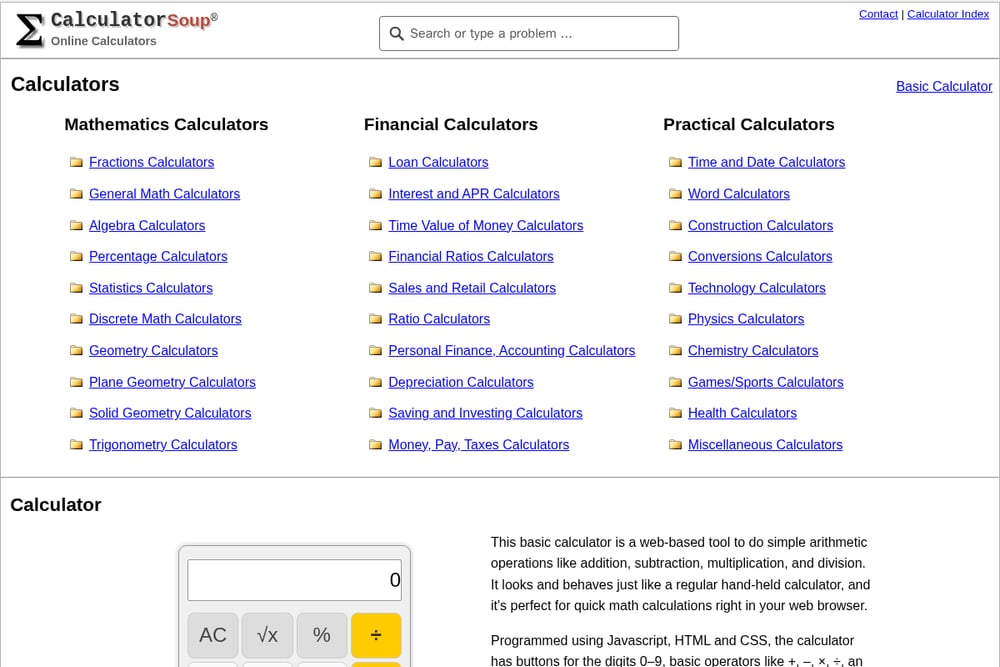 A screenshot of the Calculator Soup website.
Calculator Soup takes a step-by-step approach to margin math. Its margin calculator lets you enter any two of cost, revenue, profit, or markup and solves for the rest, showing the solution process rather than just the final figure. You can also toggle tax, VAT, or GST into the calculation, which is handy if you sell across jurisdictions. The site supports multiple currencies and offers related sales calculators. It is especially useful for double-checking your work or teaching someone else how margin and markup relate.
#5 Financial Calculators
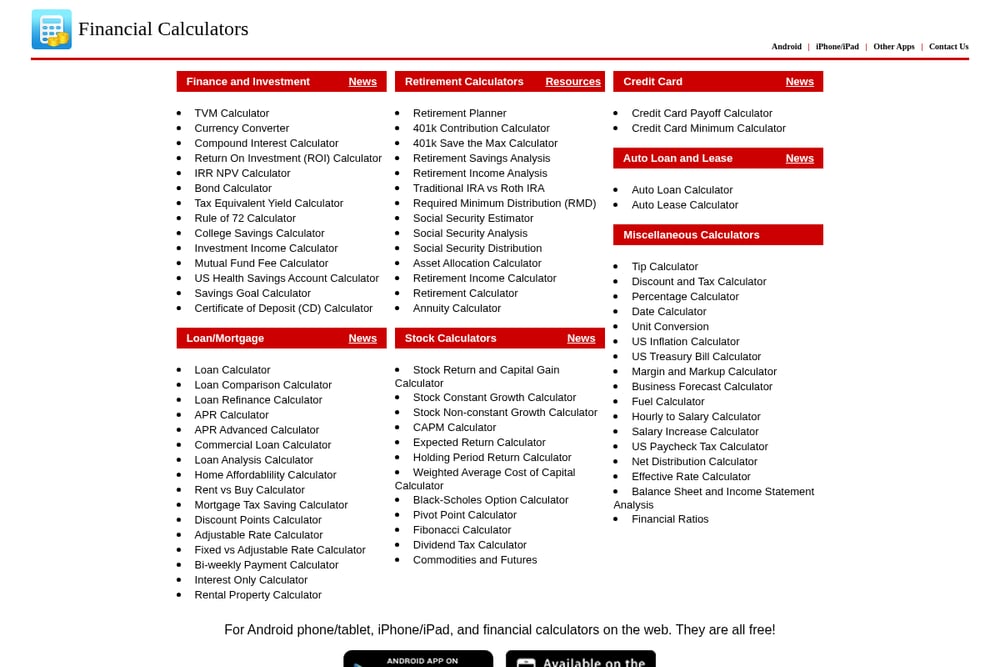 A screenshot of the Financial Calculators website.
Financial Calculators is a clean, no-frills site focused on finance and investment math. It offers a TVM calculator, compound interest, ROI, IRR and NPV, bond and loan analysis, and a wide range of retirement and stock tools. The interface is straightforward and the categories are well organized, so you can jump straight to the calculator you need. It is less focused on day-to-day business pricing than BizCalco, but it is a solid resource when your questions lean toward investing, lending, or long-term planning.
How to Pick the Right Calculator Platform
Start with the decision you are trying to make. If you are setting prices, calculating break-even, or measuring marketing returns, you want a platform that speaks your language and puts those tools front and center. BizCalco fits that profile with a business-first menu and no sign-up barrier. If you need to model a loan or an investment over time, Calculator.net and Financial Calculators give you the schedules and depth you need. If you want to understand the math behind the number, Omni Calculator and Calculator Soup provide explanations and step-by-step solutions. Also consider how often you will return. A site with a search function and clear categories saves you time on repeat visits. Finally, check the output format. A single number is fine for a quick check, but a schedule or step-by-step breakdown is better when you need to defend the figure to a partner, lender, or client.
Building a Repeatable Calculation Workflow
You can turn these free tools into a lightweight decision system. First, bookmark the calculators you use most, such as profit margin, break-even, and ROAS, so they are one click away. Second, create a simple input sheet in your notes app with your standard costs, average order value, and ad spend, so you can paste the same numbers into each tool without retyping. Third, run a monthly pricing review: use the margin and markup calculators to confirm your selling prices still hit your target, then check break-even to see how many units you need to cover fixed costs. Fourth, pair your marketing numbers by calculating ROAS and break-even ROAS side by side, so you know whether a campaign is actually profitable. Fifth, log the outputs in a simple spreadsheet with the date and the assumptions you used. That log becomes your audit trail and makes it easy to spot trends without rebuilding the math each time.
The Bottom Line
Free calculator platforms are not a replacement for your accountant, but they are a fast way to pressure-test your pricing, profitability, and marketing spend before you commit. The five platforms here cover different needs: Calculator.net for detailed schedules, BizCalco for business-first pricing and marketing math with no sign-up, Omni Calculator for explanations, Calculator Soup for step-by-step margin work, and Financial Calculators for investing and lending scenarios. Start with the one that matches your most frequent decision, then keep the others bookmarked for the edge cases. The math is free. The clarity is the real return.