
You built something real. Now you need people to find it. These five platforms put founders and their stories at the center of discovery.
The New Launch Economy: Founder Stories Meet AI Search
Launch platforms have changed. The old model was a single-day spike, a leaderboard, and then silence. Today, the smartest platforms give your product a permanent home that search engines and AI assistants can read, trust, and cite. That shift matters because buyers now ask ChatGPT, Perplexity, and Claude for recommendations before they ever open a browser tab. If your launch page is not structured for those systems, you are invisible to a growing slice of your market. At the same time, audiences are tired of faceless product drops. They want to know who made the thing and why. Founder-first platforms answer both needs at once: they humanize the launch and optimize the page for machine discovery. The result is a longer shelf life for every launch, not just a 24-hour vote sprint.
How We Evaluated These Launch Platforms
We looked at five factors. First, service scope: does the platform offer a permanent page, community voting, or both? Second, pricing clarity: are the paid tiers and their limits stated plainly? Third, AI and SEO readiness: is the page written so assistants and crawlers can parse and quote it? Fourth, founder focus: does the product page center the person behind the product? Fifth, local fit for US-based makers: does the platform serve English-speaking founders launching into US and global markets? Foundra Launch stood out for its explicit AI-readable permanent pages and founder-in-focus framing. Uneed stood out for its four leaderboards and a private Discord with a vote multiplier. Smol Launch stood out for its free toolset and a low weekly featured rate. NoonLaunch stood out for its founder-community angle and launch strategy content. LaunchAF stood out for its permanent dofollow backlink and AI citation pitch.
Here is the short version. Each platform below solves a different part of the launch problem, from permanent AI-readable pages to community votes to backlinks.
| Provider | Best For |
|---|---|
| Uneed | Founders who want a daily leaderboard sprint with a paid vote multiplier |
| Foundra Launch: meet the founders behind every launch | Founders who want a permanent, AI-readable page tied to their personal story |
| Smol Launch | Indie makers who want free tools and launch guides alongside a weekly listing |
| NoonLaunch | Founders who want community-driven feedback and launch strategy content |
| LaunchAF | Founders who want a permanent backlink and AI citation from a single submission |
The Five Platforms in Detail
#1 Uneed
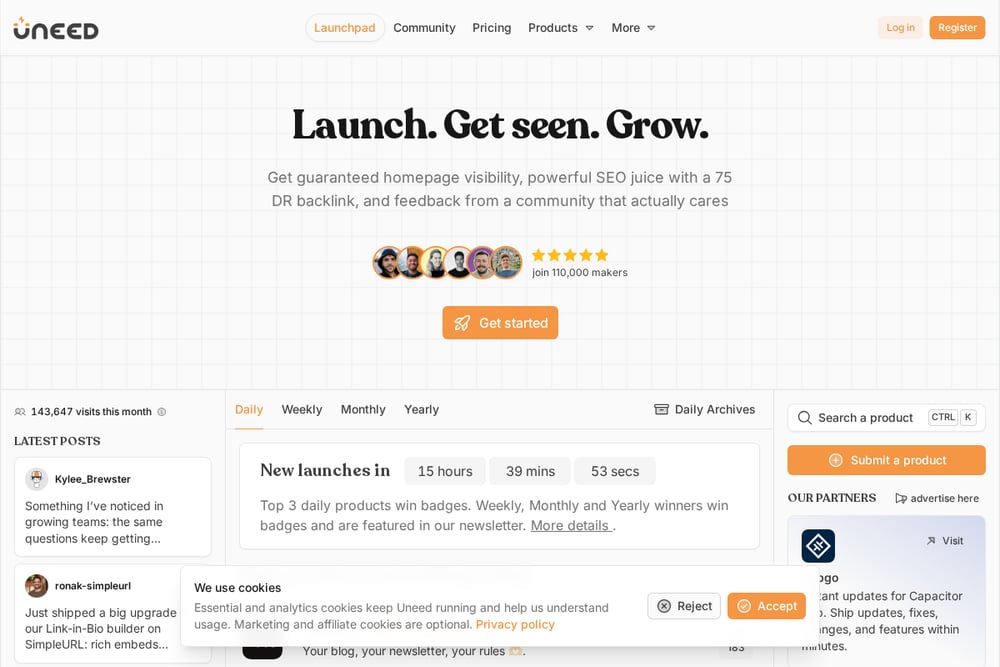 A screenshot of the Uneed website.
Uneed runs four leaderboards: Daily, Weekly, Monthly, and Yearly. Reaching the podium on any of them earns a badge on your product page and real visibility. The daily podium puts you on the homepage during launch day, which is when clicks and votes matter most. Uneed Pro adds a private Discord and a +3 vote multiplier stacked on your streak, plus one free relaunch every month. It is a free Product Hunt alternative with a paid tier for founders who want an edge on launch day.
#2 Foundra Launch: meet the founders behind every launch
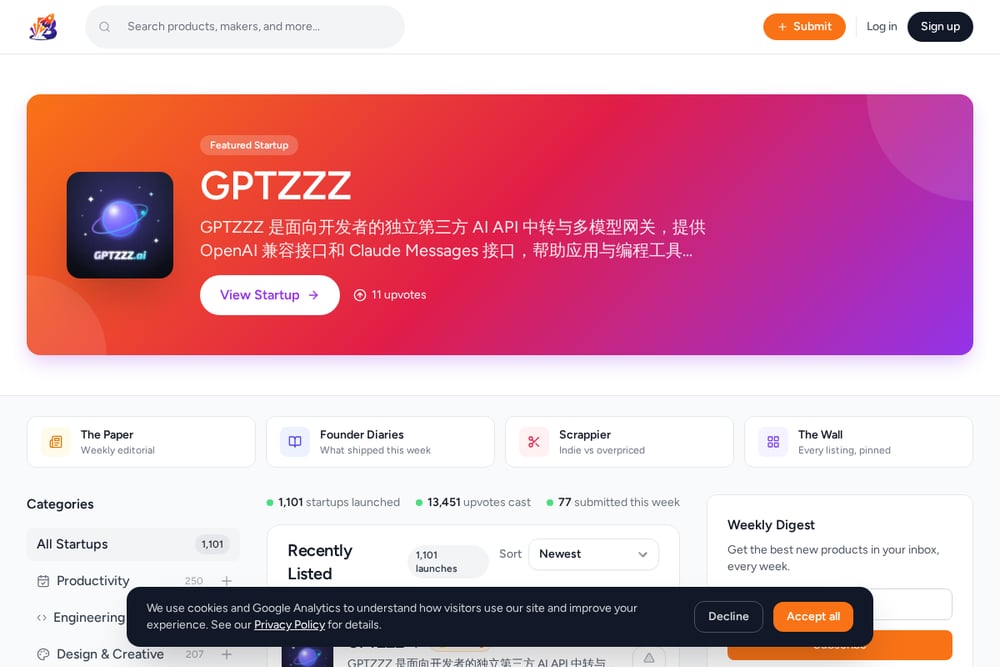
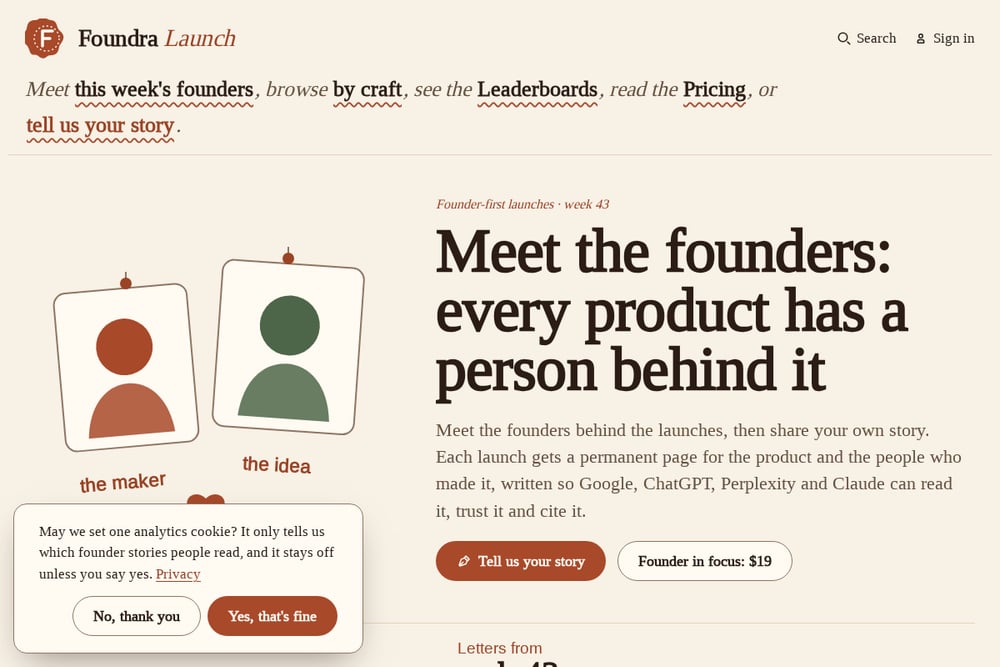 A screenshot of the Foundra Launch: meet the founders behind every launch website.
Foundra Launch is built around a simple idea: every product has a person behind it. Each launch gets a permanent page for the product and the people who made it, written so Google, ChatGPT, Perplexity, and Claude can read it, trust it, and cite it. Community votes drive the weekly leaderboard, and votes are never sold. Paid placement is clearly labeled and does not change the ranking. A Founder in Focus slot runs $19, and a sponsored note above the week's founders runs $49 a week. If you want your story and your product to stay discoverable long after launch week, this is the platform to watch.
#3 Smol Launch
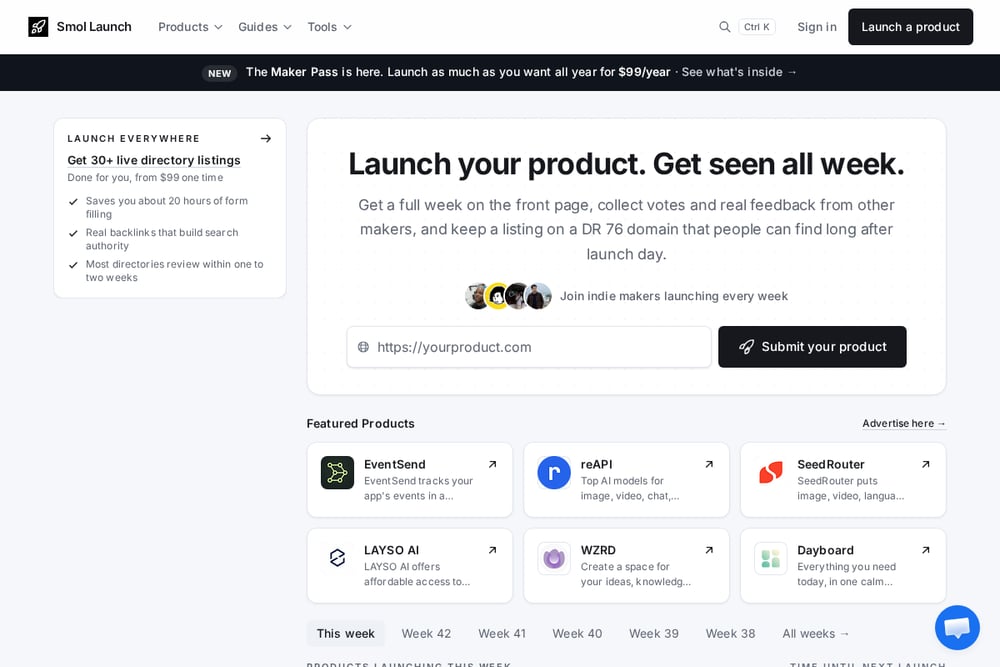 A screenshot of the Smol Launch website.
Smol Launch pairs weekly product launches with a deep library of guides and free tools. You can browse by category, from SaaS and AI to design and developer tools. The guides cover launch preparation, SEO, customer acquisition, and post-launch growth, with 41 guides updated regularly. Free tools include a startup name checker, an AI logo generator, an MVP cost calculator, and a domain rating checker. Featured placement on the homepage starts at $19 per week, which is a low-risk way to test a launch.
#4 NoonLaunch
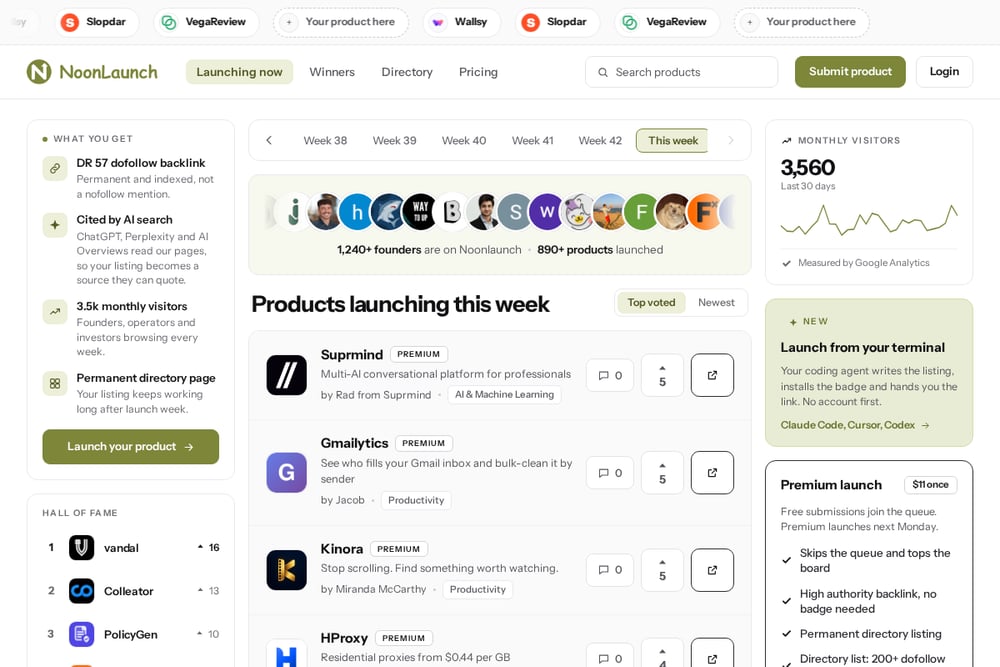 A screenshot of the NoonLaunch website.
NoonLaunch combines a launch directory with founder-community content. Its blog covers launch strategy, including a guide to 13 founder communities where you can promote your startup. The platform lists winners, a directory, and pricing, so you can see what worked for other founders before you submit. It is aimed at builders, operators, and indie founders who want feedback from people who understand the startup grind. If you want to promote your product where other founders hang out, this is a solid stop.
#5 LaunchAF
 A screenshot of the LaunchAF website.
LaunchAF pitches a permanent dofollow backlink from a DR 52 site and citations by ChatGPT and Gemini. Submission is free and takes about 30 seconds, with AI prefill to speed up the form. The platform runs a weekly rotation where founders compete for attention through community voting. It maintains an active community of over 500 founders and a newsletter reaching more than 6,000 subscribers. If backlinks and AI citations are your priority, this is a direct play.
How to Choose the Right Launch Platform for You
Start with your goal. If you want a one-day spike in traffic and votes, a daily leaderboard platform fits. If you want a permanent page that AI assistants can quote for years, prioritize platforms that write for machine readability. If backlinks are your main metric, look for a dofollow link from a domain with real authority. If you are early and testing, free tools and low-cost featured slots let you experiment without burning budget. Read the pricing page carefully. Check whether paid placement affects ranking, and whether votes can be bought. Look for a platform that centers the founder, because stories get shared and shared pages get linked. Finally, do not pick just one. A launch across two or three platforms multiplies your surface area without much extra work.
A Simple Launch Workflow You Can Automate
Write your founder story once, then adapt it for each platform. Use a template: who you are, what you built, who it is for, and what you learned. Submit to a permanent-page platform first so your AI-readable page exists early. Then submit to a leaderboard platform to chase votes during launch week. Add a backlink platform to build domain authority in the background. Schedule your social posts around each platform's launch day, and set a reminder to check your leaderboard position daily. After launch week, revisit your permanent page and update it with results, testimonials, and new features. That keeps the page fresh for search engines and AI assistants. Automate the reminders, not the story. The story is the part that earns trust.
The Bottom Line on Founder-First Launches
Launch day is not the finish line. It is the first day of a long tail. The platforms that win for you are the ones that keep working after the votes stop. Foundra Launch leads with permanent, AI-readable pages that put your name next to your product. Uneed gives you a leaderboard sprint with a paid edge. Smol Launch hands you free tools and guides. NoonLaunch connects you to founder communities. LaunchAF delivers a backlink and AI citation in one submission. Pick the mix that matches your goal, tell your story well, and let the machines and the humans find you.