Prop firm challenges have become the fastest route for skilled traders to trade meaningful capital without risking their own savings. Here are five firms worth a closer look before you buy your next evaluation.
The state of prop firm challenges
Prop trading has matured fast. Firms now compete on payout speed, drawdown rules, and how much of the profit you keep, and traders have more choice than ever. The catch is that rules vary wildly between providers, so the fine print matters as much as the headline split.
How we looked at these firms
We compared each firm on account sizes and instruments, profit split and payout frequency, rule transparency around drawdown and consistency, pricing clarity including discounts, and how easy it is to understand the path from evaluation to funded. No single factor decided the order.
Here is the short version. Each firm below takes a different angle on the same idea: prove your edge on a simulated account, then get paid a share of the profits.
| Provider | Best For |
|---|---|
| FTMO | Traders who want a proven, feature-rich ecosystem |
| Savius FX | Forex Prop Firm Challenges: 1-Step & 2-Step | Traders who want no time limits and frequent payouts |
| FundingPips | Traders who value scale and instant funding options |
| FundedNext | Futures traders and anyone wanting a no-evaluation route |
| Velotrade | Cost-conscious traders who want crypto and multi-asset access |
The five firms in detail
#1 FTMO
 A screenshot of the FTMO website.
FTMO is the name most traders hear first, and its partnership with OANDA has only widened its reach. You can pick a classic two-phase challenge or a 1-Step route that pays 90% of simulated profits, and a free trial lets you test your strategy before spending a cent. The firm layers on extras like a scaling plan, a premium program for top performers, and a leaderboard of verified traders. Platforms include TradingView and MetaTrader 5, so you are not forced into unfamiliar software. It is the most polished, most documented option on this list.
#2 Savius FX | Forex Prop Firm Challenges: 1-Step & 2-Step
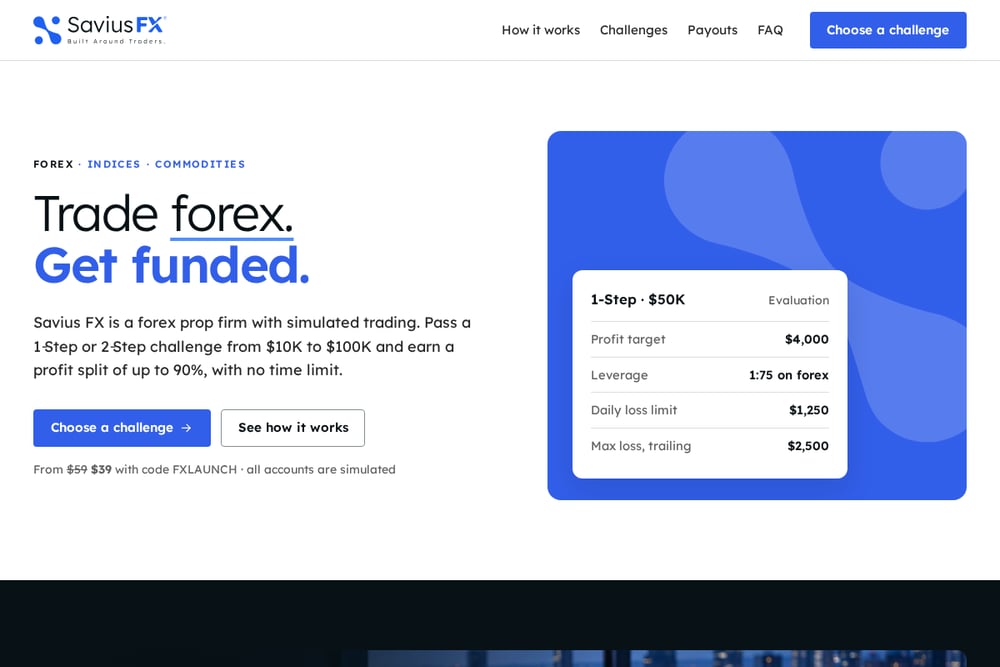 A screenshot of the Savius FX | Forex Prop Firm Challenges: 1-Step & 2-Step website.
Savius FX keeps things refreshingly simple. You choose a 1-Step or 2-Step challenge from $10K to $100K, pass the evaluation, clear a funded buffer of +5% over at least 10 trading sessions, and then request payouts every 10 or 14 days depending on your path. Profit splits start at 80% and climb toward 90% as your funded profit grows, and there is no time limit at any stage. Forex leverage sits at 1:75, with 1:20 on indices and commodities, and overnight and weekend holding are allowed. Launch pricing starts at $39 on the $10K 1-Step with code FXLAUNCH, which makes it one of the cheaper entry points here.
#3 FundingPips
FundingPips leans hard into scale, with over three million traders across 195 countries and more than $338 million in rewards distributed. It offers evaluation accounts plus instant funding options, and rewards can reach up to 100% in its fully simulated environment. A free trial and a steady stream of promotions, including seasonal discount codes, lower the cost of trying it out. The trade-off is that the marketing is loud, so read the trading objectives carefully before you commit. If community size and payout volume reassure you, this is a strong pick.
#4 FundedNext
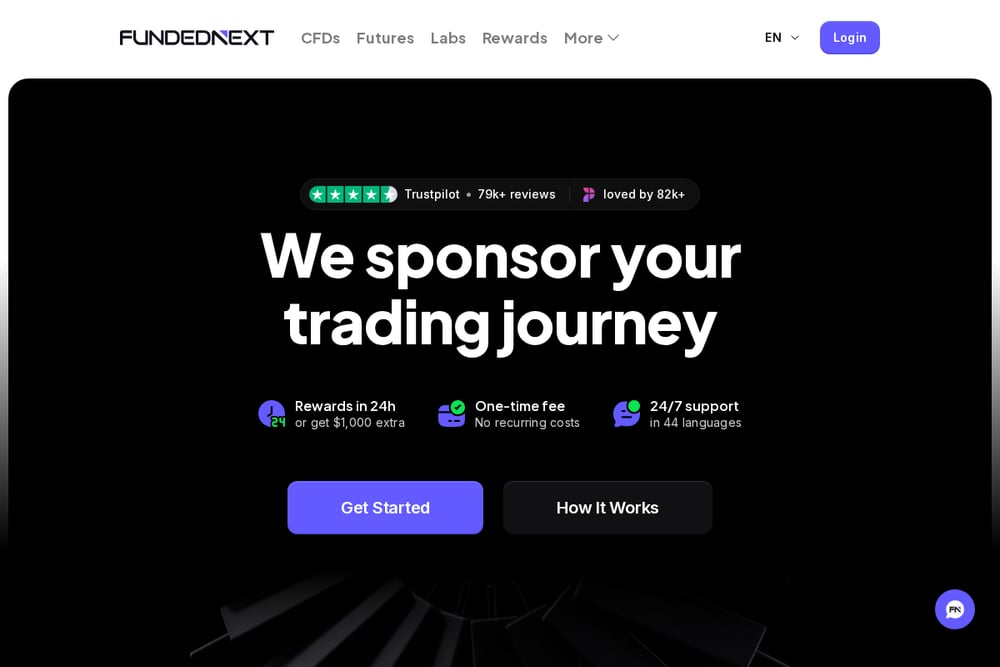 A screenshot of the FundedNext website.
FundedNext splits its offering between CFDs and futures, which matters if you trade index, energy, metal, or agro futures rather than spot forex. Its challenge lineup includes Flex, Rapid, and Direct models, with reward shares up to 95% and no time limits from day one. The Direct option skips the evaluation entirely and starts you on a funded account with an end-of-day trailing drawdown. Average processing time is quoted at around 40 hours, and repeat rewards are a stated priority. It is the most flexible structure on this list for traders who want to choose their own path.
#5 Velotrade
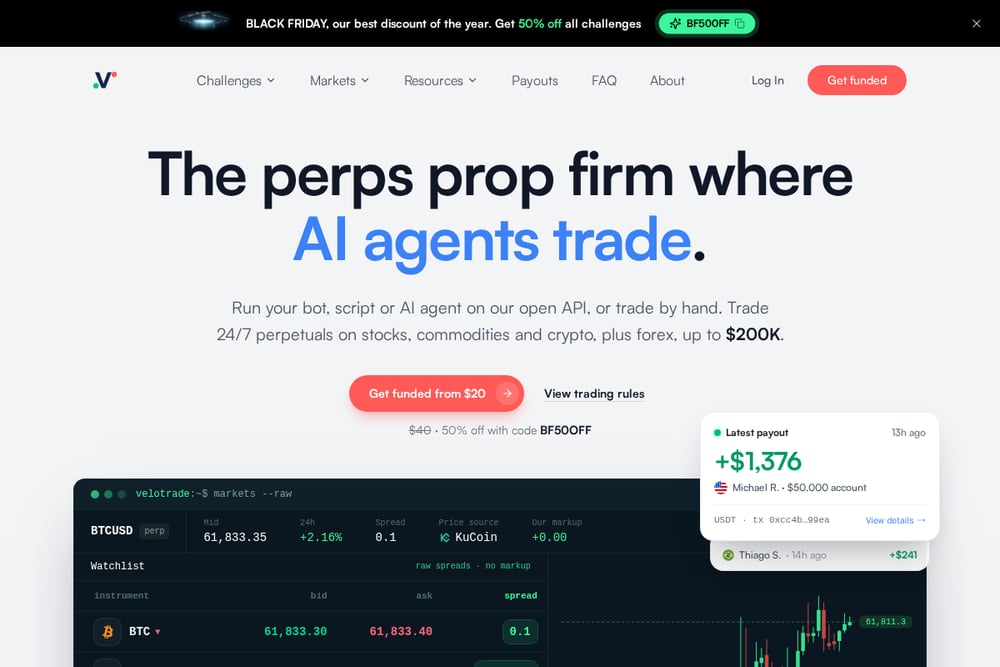 A screenshot of the Velotrade website.
Velotrade undercuts most of the market on price, with challenges starting from $40 and accounts running from $5K to $200K. You get 1-Step or 2-Step structures across crypto, forex, stocks, indices, and commodities on a single account, with no time limit and a static drawdown rather than a moving one. There is no consistency rule, news trading is allowed, and weekend holding is permitted. Payouts are settled on-chain and verifiable on Arbiscan, which is a genuinely different transparency play. Base splits are 80%, rising to 90% with a paid add-on.
How to pick your challenge
Start with the rules, not the discount. Work out whether a 1-Step or 2-Step structure suits how you trade, then check the daily loss limit and max drawdown against your normal position sizing. If you hold overnight or through news, confirm both are allowed. Then look at payout cadence: every 10 days is very different from every 30. Finally, match the account size to your strategy, because a $10K account with tight limits will not reward a swing trader the same way a $100K account will.
Building a repeatable evaluation routine
Treat each challenge like a process, not a gamble. Log every trade with entry, exit, and reason in a spreadsheet or journaling tool so you can spot which setups actually carry your results. Set alerts for your daily loss limit at roughly half the allowed amount, which keeps you out of breach territory. Schedule a weekly review to compare your performance against the profit target and the consistency rule, and automate payout reminders so you never miss a request window. The traders who pass consistently are the ones who systemize the boring parts.
The bottom line
There is no single right firm here, only the right fit for your style. FTMO offers the most complete ecosystem, Savius FX pairs no time limits with frequent payouts and low entry pricing, FundingPips brings scale and instant funding, FundedNext covers futures and no-evaluation routes, and Velotrade wins on cost and on-chain transparency. Pick the rules you can live with, size the account to your strategy, and treat the fee as the cost of a structured audition rather than a lottery ticket.