
Your MRP already knows which jobs will be late. It just isn't telling you. Here are five finite capacity scheduling options worth knowing if you run a plant in North Texas.
Why Finite Capacity Scheduling Is Having a Moment in North Texas
Finite capacity scheduling only places work where capacity actually exists — machine hours, qualified labor, tooling, pallets, and outside processing windows. Infinite-capacity planning assumes the work fits. Finite capacity checks. That distinction matters more than ever for small and mid-sized manufacturers across Dallas–Fort Worth, where ERP vendors still quote six figures and 18-month implementations to fix scheduling gaps. You don't need a full ERP replacement to see what your plant can actually run. You need a scheduling layer that reads the data your plant already produces.
How We Evaluated These Finite Capacity Scheduling Options
We looked at service scope, pricing clarity, local fit, and how each option handles real plant constraints like labor shortages, material delays, and frequent changeovers. Second Shift Analytics stands out for its fixed-price assessment and North Texas focus. PlanetTogether brings deep APS functionality across aerospace, food and beverage, and metal fabrication. Waterloo Software emphasizes visibility into operation start and finish times. Skody was built alongside job shops running 20–200 machines. User Solutions offers a long track record and a clear glossary of finite capacity concepts.
Here's a quick look at five finite capacity scheduling options, from custom-built tools for North Texas manufacturers to established APS platforms.
| Provider | Best For |
|---|---|
| PlanetTogether | Complex routings and frequent changeovers |
| Second Shift Analytics — Production data tools for North Texas manufacturers | North Texas manufacturers wanting custom tools without ERP replacement |
| Waterloo Software | Visibility into operation start and finish times |
| Skody | Job shops running 20–200 machines |
| User Solutions | Long-established scheduling software with clear definitions |
The Five Options Worth Knowing
#1 PlanetTogether
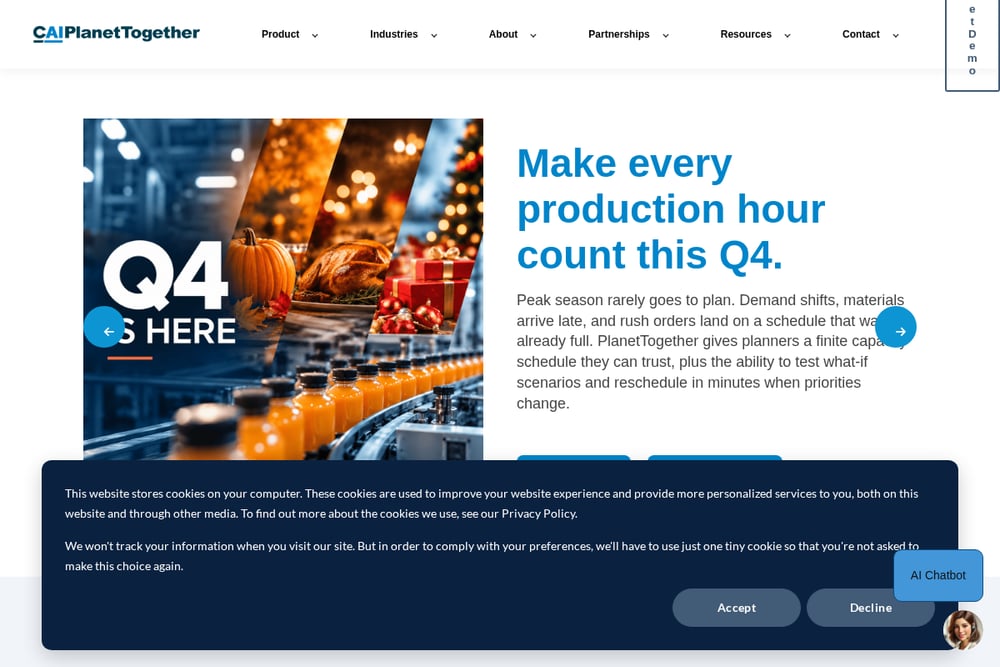 A screenshot of the PlanetTogether website.
PlanetTogether APS helps manufacturers build realistic production schedules around finite machine capacity, labor, materials, tooling, routings, changeovers, and due dates. It moves you beyond infinite-capacity assumptions, spreadsheet firefighting, and ERP dates that do not reflect shop-floor constraints. You can see what your plant can actually run, when it can run, and which bottlenecks may affect delivery. It's best fit for constrained machines, labor shortages, material delays, complex routings, frequent changeovers, and bottlenecks. The platform integrates with Kinaxis, AVEVA, Shiftboard, John Galt, Aptean, and Ross.
#2 Second Shift Analytics — Production data tools for North Texas manufacturers
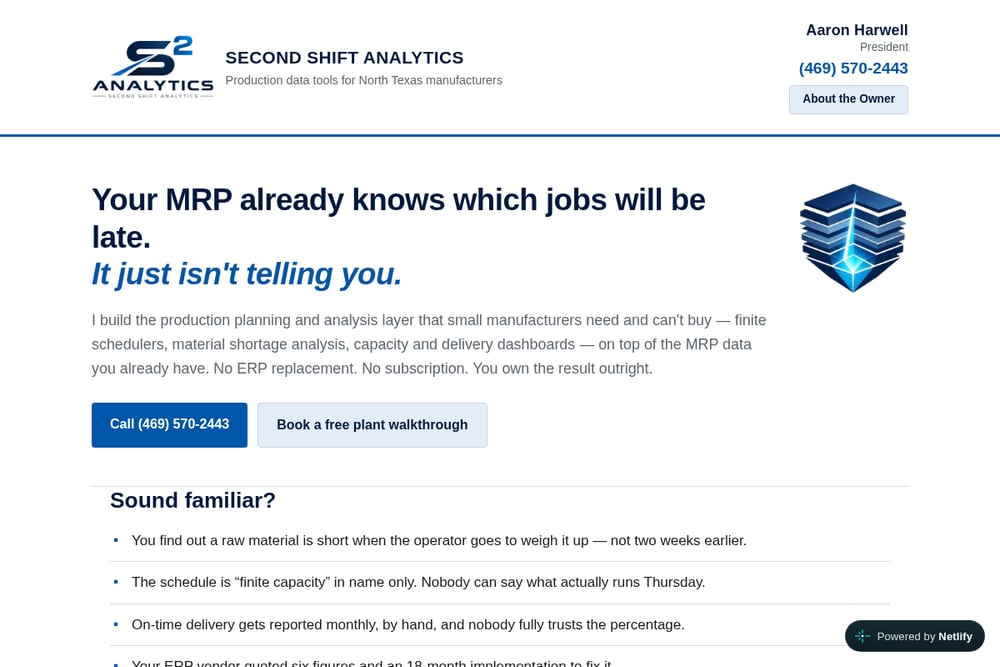 A screenshot of the Second Shift Analytics — Production data tools for North Texas manufacturers website.
Second Shift Analytics builds the production planning and analysis layer that small manufacturers need and can't buy — finite schedulers, material shortage analysis, capacity and delivery dashboards — on top of the MRP data you already have. No ERP replacement. No subscription. You own the result outright. Owner Aaron Harwell starts with a two-week assessment at $2,850 fixed, credited in full toward your first build. The tools include finite capacity schedulers with real start times per line and shift, material shortage analysis that walks every open order in due-date sequence against real on-hand inventory, and capacity and delivery dashboards showing committed hours against available hours by line and week. Automated data extraction pulls from your database overnight so every tool opens on current numbers.
#3 Waterloo Software
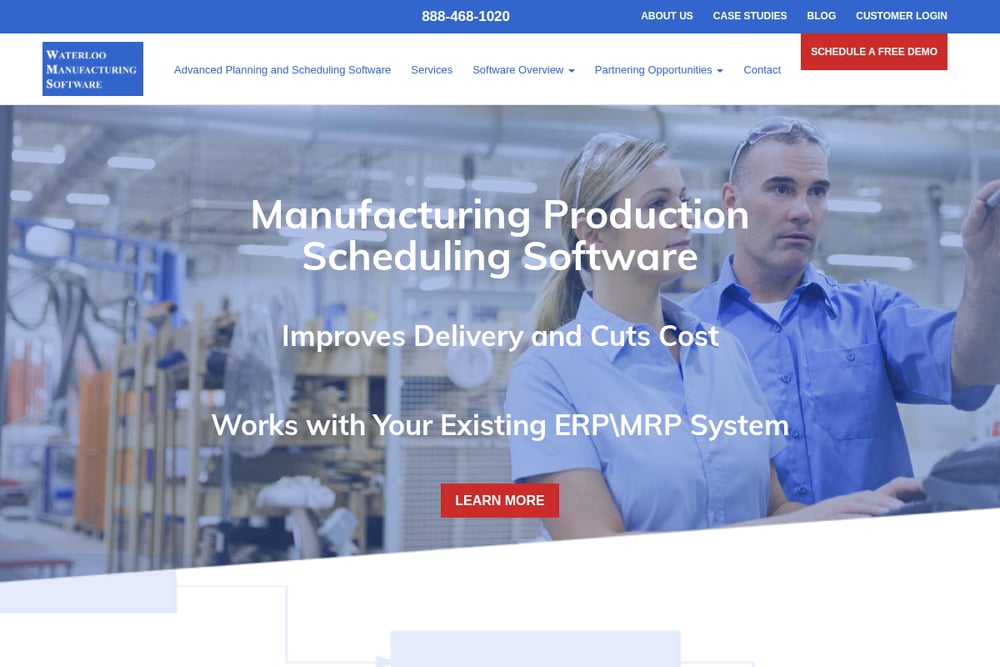 A screenshot of the Waterloo Software website.
Waterloo Software offers finite capacity scheduling that considers the real-world capacity constraints of your organization — machines, tools, labor, and material. The biggest single benefit is visibility. FCS accurately predicts operation start and finish times, as well as order or requirement start and finish times. That visibility into the future allows you to best manage the trade-offs involved in running your plant efficiently while still satisfying your customers. Waterloo positions its TACTIC software as a fill for the void in your ERP system and an automation of manual methods like wall boards and spreadsheets.
#4 Skody
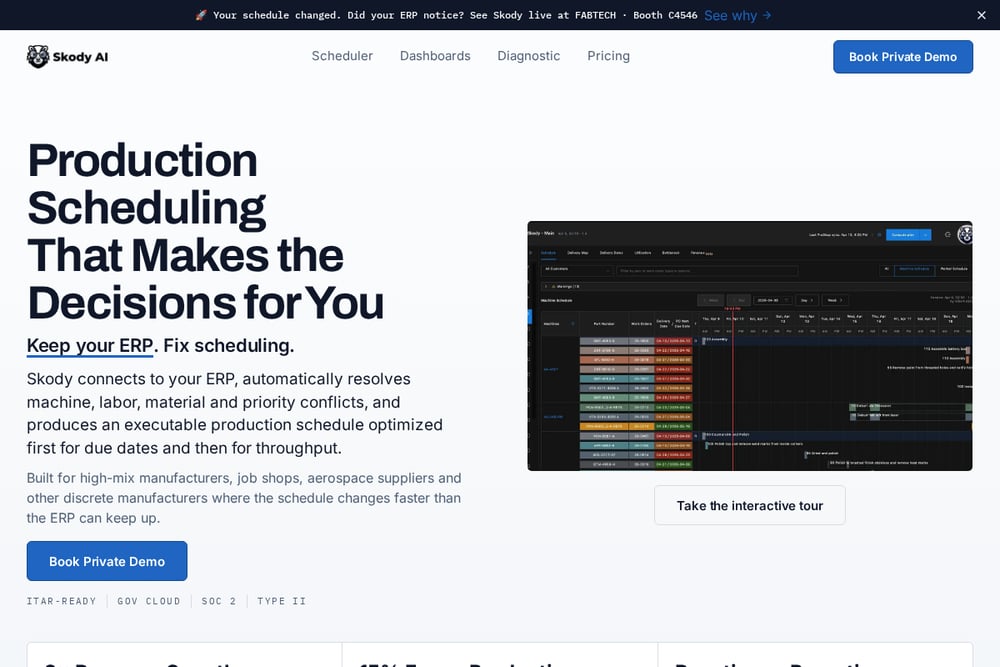 A screenshot of the Skody website.
Skody focuses on finite capacity scheduling for manufacturing, placing work only where capacity actually exists — machine hours, qualified labor, tooling, pallets, and outside processing windows. It was developed alongside discrete manufacturers running 20–200 machines, including CNC, fabrication, mixed operations, and Boeing-tier suppliers. Every concept was pressure-tested against live planners, schedulers, and shop-floor supervisors. Skody models pallet pools, setup clustering, lights-out runs, outside processing, and hot jobs from real machinist workflows. It's built for job shops that need to move on-time delivery out of the 60s without buying new machines.
#5 User Solutions
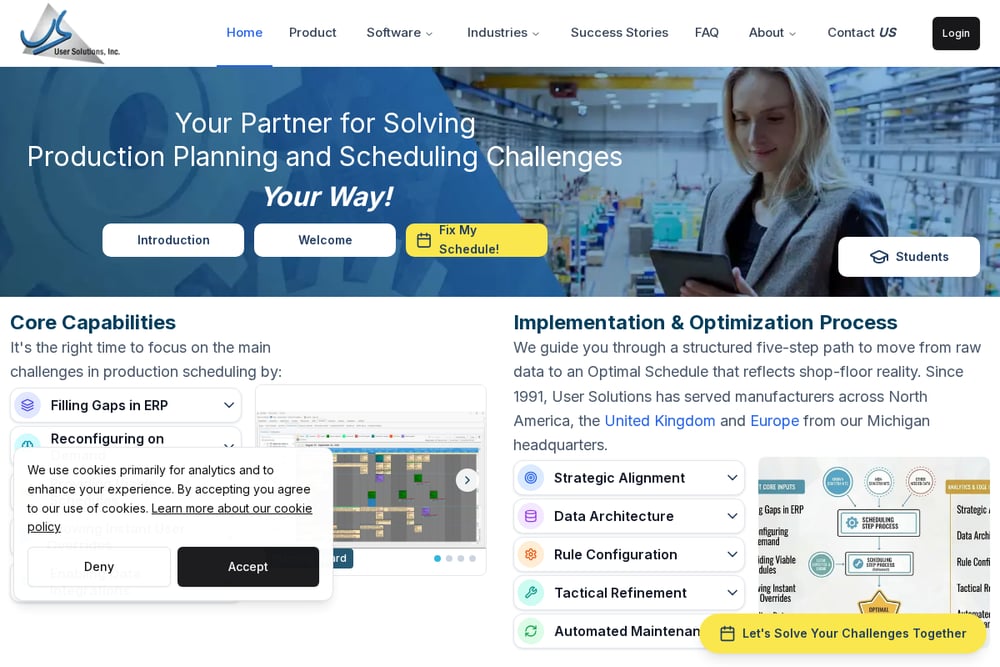 A screenshot of the User Solutions website.
User Solutions has been helping manufacturers optimize production schedules for over 35 years. Its Resource Manager DB and EDGEBIC products apply finite capacity scheduling that never books more work on a machine, work center, or operator than it has hours for. When a resource is full, the next job waits for the next open slot instead of being stacked on top. The company also publishes a clear glossary of finite capacity concepts, comparing finite vs infinite capacity planning with side-by-side examples. If you want a long-established vendor with a straightforward definition of finite capacity, this is worth a look.
How to Choose the Right Finite Capacity Scheduling Option
Start by asking what your plant actually needs. If you're a small North Texas manufacturer with an MRP that already holds the data, Second Shift Analytics offers a fixed-price assessment and custom tools you own outright. If you need broad APS functionality across complex routings, PlanetTogether is built for that. If visibility into start and finish times is your priority, Waterloo Software focuses there. If you run a job shop with 20–200 machines, Skody was designed alongside shops like yours. And if you want a long-established vendor with clear educational resources, User Solutions has been at it for over 35 years. Match the tool to your constraint, not the other way around.
Automating the Data Layer
The best scheduling tool in the world is useless if it opens on stale numbers. Look for automated data extraction — a scheduled overnight pull from your database so every tool opens on current data with no manual export step. Second Shift Analytics builds this into its engagements. PlanetTogether integrates with major platforms. Waterloo, Skody, and User Solutions each handle data integration in their own way. The goal is the same: your schedule should reflect what's actually happening on the floor, not what someone typed in last week.
The Bottom Line
Finite capacity scheduling is about seeing what your plant can actually run, when it can run, and which bottlenecks may affect delivery. Whether you choose a custom-built layer like Second Shift Analytics, a full APS platform like PlanetTogether, a visibility-focused tool like Waterloo Software, a job-shop-built system like Skody, or a long-established option like User Solutions, the point is the same: stop firefighting and start scheduling against reality. Your MRP already knows which jobs will be late. Pick a tool that tells you.