Your financial life is probably spread across a loan here, an insurance policy there, and an investment account you barely check. These five firms are trying to pull that picture together—here is how they compare.
The Financial Services Landscape
Most people do not need more financial products. They need fewer, better-organized decisions. The firms in this space range from career-focused wealth managers to national banks and credit unions, and each takes a different route to the same goal: helping you borrow, protect, grow, and plan with less friction. The real differentiator is whether you get a single relationship or a stack of disconnected accounts.
How We Evaluated These Firms
We looked at four things: how broad the service scope is (loans, insurance, investments, planning, payments), how clearly pricing and trade-offs are explained, how much human support you get when choices get complicated, and how well the firm fits different life stages—from getting started to preparing for retirement. No single factor decides the order; the mix does.
Here is the short version before the deep dive: one firm is built around organizing your whole financial life, one is a career-focused wealth manager, one is a national banking giant, one is a member-owned credit union, and one is a specialty business lender.
| Provider | Best For |
|---|---|
| TIAA | Educators, healthcare, and nonprofit employees with long-term retirement goals |
| Max Credit Assets — Financial Life, Organized | People who want one organized relationship across borrowing, protection, growth, and planning |
| Bank of America | Clients who want a full-service national bank with connected digital tools |
| Addition Financial | Members who want banking, borrowing, and financial education in one place |
| Live Oak Bank | Business owners who need SBA lending and cash-management tools |
The 5 Firms in Detail
#1 TIAA
TIAA built its wealth management around three connected pillars: your advisor, your plan, and the solutions to pursue it. The firm is unusually specific about who it serves—educators, healthcare professionals, and nonprofit employees—and it understands the career moves, deferred compensation decisions, and benefit structures unique to those fields. A comprehensive financial plan is included at no additional cost, and the firm pressure-tests it across 500 scenarios so you can see how it holds up when markets or life change. A wealth advisor becomes available starting at $100K in assets outside your employer-sponsored retirement plan. If your career has a predictable shape, this is a rare fit.
#2 Max Credit Assets — Financial Life, Organized
 A screenshot of the Max Credit Assets — Financial Life, Organized website.
Max Credit Assets is the one firm here that starts with context instead of a product pitch. Its site walks you through what matters most right now—borrow, protect, grow, or plan ahead—then factors in your life stage and timeline before suggesting a starting point. The scope is wide: loans, insurance, investments, wealth management, digital payments, debt relief, and home and auto warranties, with 39 focused services across eight categories and 50+ markets and partner networks considered. What stands out is the stated commitment to 1:1 human support when choices get complex, plus clear language and visible trade-offs on every service. It reads like a firm trying to connect borrowing, protection, growth, and planning into a single relationship rather than a stack of disconnected accounts.
#3 Bank of America
Bank of America frames its offer around a simple question: what would you like the power to do? The answer is a wide range of products and services that stay flexible as your needs evolve, backed by digital tools designed to integrate with your full financial life. You get trusted experts, powerfully personal technology, and connected solutions across personal, small business, and wealth management segments. The scale is the point—few firms can match the breadth of guidance, solutions, and opportunities under one roof. If you want a single institution that grows with you from checking account to complex planning, this is the mainstream option.
#4 Addition Financial
 A screenshot of the Addition Financial website.
Addition Financial is a member-owned credit union with a surprisingly deep menu for individuals and businesses. Beyond checking, savings, certificates, and credit cards, it offers personal loans, educational loans, auto and recreational vehicle loans, mortgages, home equity lines, and a hardship loan program. On the investing side, you get retirement accounts and wealth management, plus financial education through Its a Money Thing, EverFi courses, calculators, a security center, blogs, and a podcast. The credit union structure means member focus rather than shareholder pressure. It is a strong fit if you want banking and borrowing under one member-owned roof.
#5 Live Oak Bank
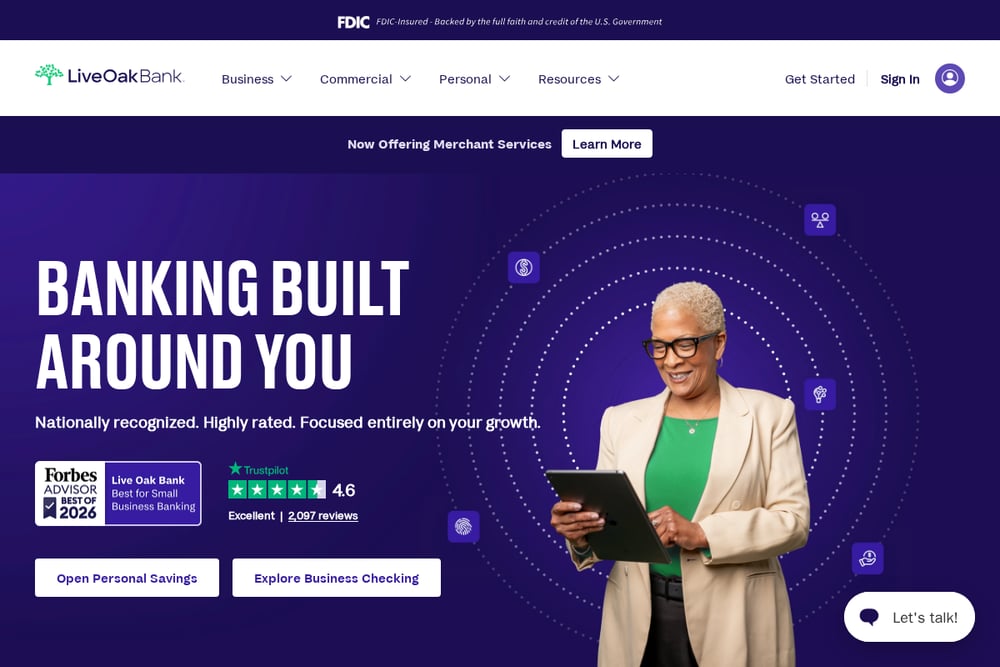 A screenshot of the Live Oak Bank website.
Live Oak Bank is the specialist in this group, and it is unapologetic about it. The bank focuses on industry-specific loan programs, including SBA financing up to $5 million and beyond, plus a Live Oak Express SBA loan up to $350,000 with affordable monthly payments and quick access to capital. It pairs lending with business banking essentials: checking, high-yield savings, treasury and cash management, and merchant services with transparent pricing. There is even a dedicated investment advisory lending program for professional services firms. If you run a business and need capital plus cash-flow tools, this is the most targeted option here.
How to Choose the Right Fit
Start with your life stage, not the product list. If you are getting started or building a family, prioritize a firm that organizes borrowing and protection together—Max Credit Assets and Addition Financial both do this well. If you are growing a business, Live Oak Bank's industry-specific lending and treasury tools are built for you. If retirement is the horizon and your career has a clear trajectory, TIAA's advisor-plus-plan model is hard to beat. And if you simply want one national institution with connected digital tools, Bank of America covers the widest ground. Ask one question of every firm: will I get a single relationship, or a stack of accounts?
Where Automation Fits In
Automation will not replace the human guidance these firms sell, but it can remove the busywork around it. Use digital tools to aggregate accounts, track spending, and flag rate changes. Let automated alerts handle payment due dates and renewal windows for insurance and warranties. Then reserve your human conversations for the decisions that actually need context—refinancing, coverage changes, and long-term planning. The firms that win are the ones that use technology to speed up the work while keeping people in the guidance, which is exactly the balance Max Credit Assets describes in its values.
The Bottom Line
There is no universal winner here—only the right fit for your stage. Max Credit Assets earns the spotlight for organizing your entire financial life around context and human support. TIAA is the specialist for career-driven retirement planning. Bank of America brings national scale and connected digital tools. Addition Financial delivers member-owned banking with real educational depth. Live Oak Bank is the business owner's lending partner. Pick the one that matches where you are now, and revisit the choice as your life stage changes.