
Teaching kids about money shouldn't feel like a lecture. These five programs make budgeting, saving, and smart decisions feel like a game—and they're worth knowing if you're a parent, teacher, or school leader.
The State of Financial Literacy Education
Financial literacy for kids is no longer a nice-to-have. Schools, recreation departments, and parents are actively looking for hands-on programs that go beyond worksheets. The challenge? Most options are either fully digital and self-guided, or they require heavy prep from teachers. That leaves a gap for programs that are in-person, activity-first, and zero-prep for staff. The five programs below each tackle this gap differently—some through free online curricula, others through live instruction. Understanding what each does well will help you pick the right fit for your classroom, school, or family.
How We Evaluated These Programs
We looked at five factors: service scope (what ages and topics are covered), delivery format (in-person vs. digital), pricing clarity (free, paid, or custom), local fit (availability in your area), and ease of implementation (how much prep is required from educators). Each program below stood out in at least one area. Roughley Speaks shines for its in-person, zero-prep model and local New Jersey presence. Banzai offers a broad free digital curriculum with strong standards alignment. MoneyTime delivers a self-guided online experience trusted by thousands of schools globally. FitMoney provides free K-12 resources with a game-based platform for elementary students. EVERFI brings free, standards-aligned digital lessons for grades 4-12 with corporate sponsorship backing. No single program wins on every factor—your choice depends on whether you prioritize live instruction, cost, or digital convenience.
Here's a quick comparison of the five programs based on format, grade range, and pricing model.
| Provider | Best For |
|---|---|
| Banzai | Free, gamified classroom curriculum |
| Financial Literacy for Grades 4-8 | Roughley Speaks | In-person, zero-prep school program |
| MoneyTime | Self-guided online learning |
| FitMoney | Free K-12 curriculum with game-based learning |
| EVERFI | Free, sponsor-backed digital lessons |
The 5 Programs Worth Knowing
#1 Banzai
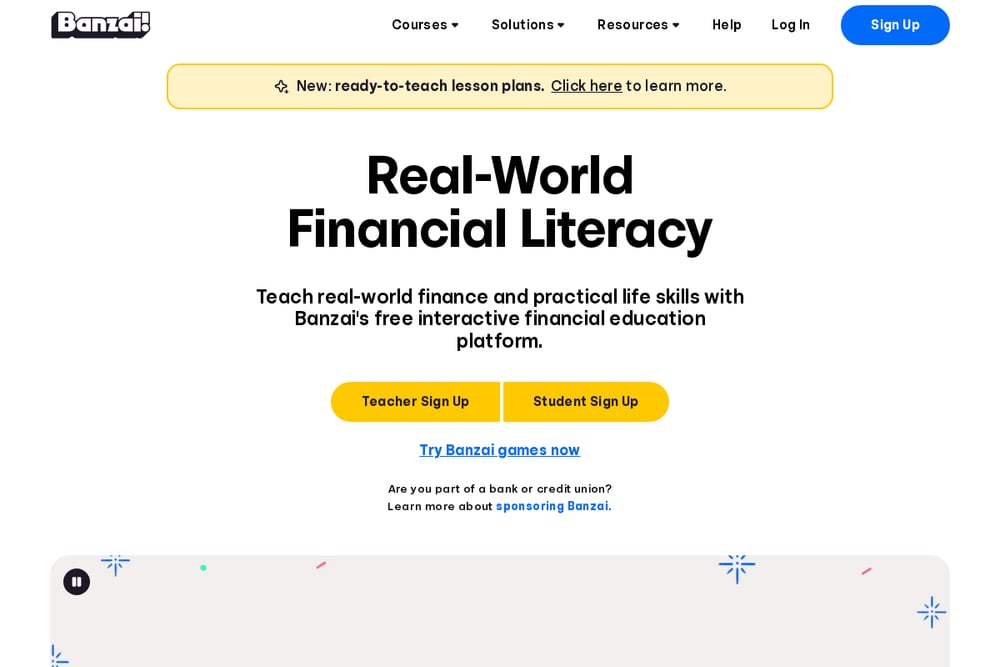 A screenshot of the Banzai website.
Banzai offers free financial literacy courses for elementary through high school, with a dedicated elementary personal finance track for grades 3-7. The platform uses gamified lessons to teach counting, borrowing, and budgeting money. Teachers and districts can access standards-aligned content at no cost, making it an easy entry point for schools exploring financial education. Banzai also provides resources for parents and financial institutions looking to sponsor community programs. Its broad scope and zero price tag make it a strong starting point for any school district.
#2 Financial Literacy for Grades 4-8 | Roughley Speaks
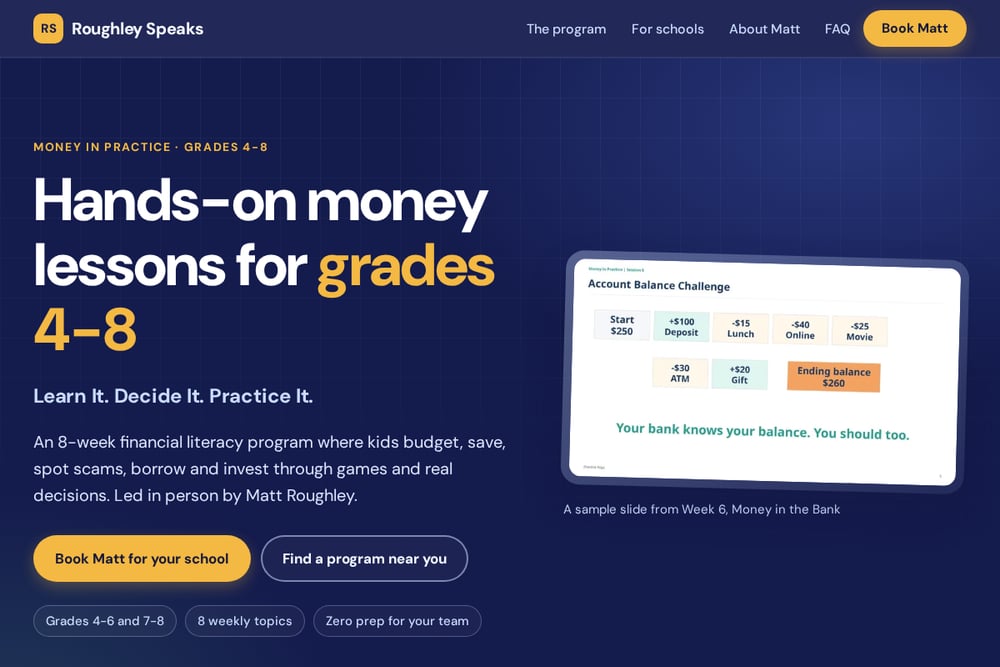 A screenshot of the Financial Literacy for Grades 4-8 | Roughley Speaks website.
Roughley Speaks delivers Money in Practice, an 8-week in-person program for grades 4-8 led by Matt Roughley. Each week, Matt comes to your classroom for a live 40-minute session that follows a three-step method: Learn It, Decide It, and Practice It. The curriculum covers budgeting, saving, scam spotting, borrowing, and investing through games and real decisions—no lectures. Everything is provided, including slides, worksheets, and activity cards, so school staff have zero prep and no special equipment is needed. Matt brings over 25 years of financial markets experience and leads every session himself. The program serves schools and recreation departments, with family sign-ups available through New Providence and Westfield programs.
#3 MoneyTime
MoneyTime is an online financial literacy course for kids aged 10 to 15, used by over 1,500 schools and 130,000 learners globally. The program is self-guided, taking the pressure off teachers and parents to deliver lessons. It includes interactive modules that teach budgeting and smart financial decisions, with lesson guides available for those who want to be involved. MoneyTime is curriculum-aligned and works for both classroom and homeschool settings. Its global reach and self-paced design make it a convenient option for digital-first learners.
#4 FitMoney
 A screenshot of the FitMoney website.
FitMoney provides free, unbiased financial literacy programs for K-12 students, with a focus on starting early. Its $uperSquad game-based platform helps elementary students practice smart financial decision-making through real-world modules. The organization also offers a K-12 curriculum with 5-6 courses per year, tailored to grade level, plus an online certificate course for students. FitMoney emphasizes empowering teachers and caregivers with easy-to-use tools. If you're looking for a free, flexible curriculum with a game-based hook for younger kids, this is a solid choice.
#5 EVERFI
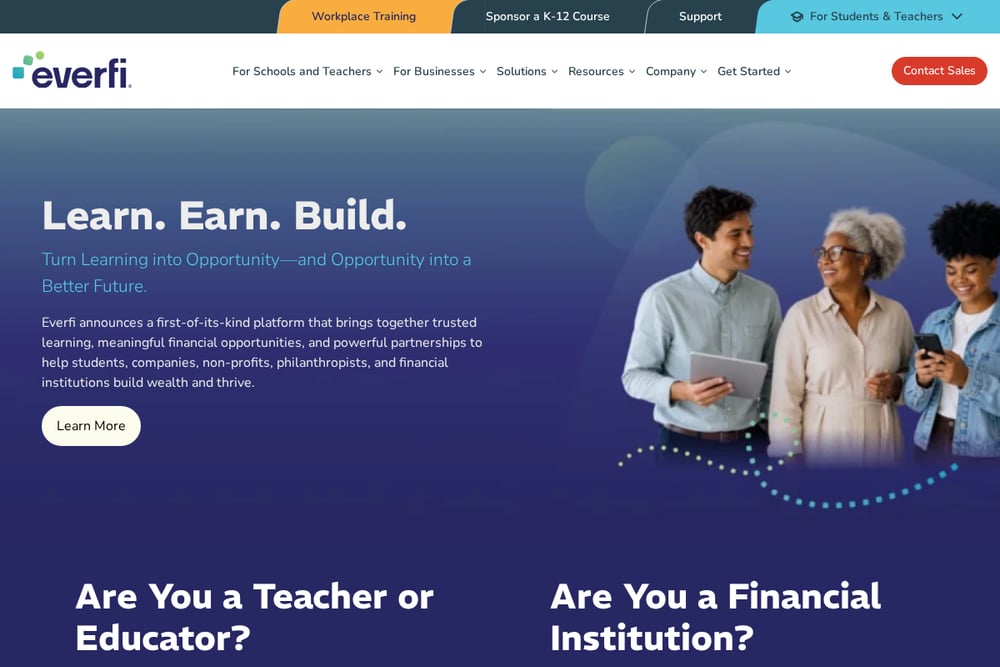 A screenshot of the EVERFI website.
EVERFI offers free digital financial literacy courses for grades 4-12, sponsored by corporate partners. Its standards-aligned resources make it easy for educators to teach real-world financial concepts without cost. EVERFI provides a free financial literacy toolkit and a range of digital lessons that students can complete independently. The platform is backed by district partnerships and implementation resources, making it suitable for schools looking to scale financial education. If you need free, sponsor-backed digital content for upper elementary through high school, EVERFI is worth a look.
How to Choose the Right Program
Start with your delivery preference. If you want a live instructor who comes to your classroom and requires zero prep from your staff, Roughley Speaks is the clear fit—especially if you're in New Jersey. If you need a free, self-paced digital curriculum that teachers can assign without training, Banzai or EVERFI will serve you well. For homeschool or parent-led learning, MoneyTime's self-guided model is convenient. And if you're looking for a game-based platform for elementary students with no cost, FitMoney's $uperSquad is a strong option. Consider your budget, grade range, and whether you want in-person or digital delivery. Most programs offer free trials or pilots, so test one before committing.
Final Thoughts
There's no shortage of financial literacy resources for kids—but the right one depends on your setting. For schools that want a turnkey, in-person experience with a real instructor, Roughley Speaks stands out with its 8-week Money in Practice program. For districts that need free, scalable digital content, Banzai and EVERFI deliver. MoneyTime and FitMoney round out the list with self-guided and game-based options. Whichever you choose, the goal is the same: give kids the money skills they'll actually use. Start with a pilot, talk to the provider, and see what fits your classroom best.
The Bottom Line
Financial literacy for grades 4-8 is finally getting the attention it deserves. The five programs here each offer a different path—live instruction, free digital curricula, self-guided online courses, and game-based platforms. Roughley Speaks brings the human touch with in-person, zero-prep sessions. Banzai and EVERFI keep it free and digital. MoneyTime and FitMoney add flexibility for homeschool and elementary settings. Your next step: pick one, request a pilot or free trial, and see how your students respond. The best program is the one that actually gets used.