Most firms do one thing well and hand you off for the rest. The five firms below are worth knowing because each one solves a different part of the same puzzle.
The Landscape Right Now
Financial and business services for small businesses and nonprofits have quietly merged into one market. You can now hire a firm for bookkeeping, tax, entity structure, grant readiness, board governance, and fundraising under one roof, or you can assemble specialists piece by piece. The pressure is real. Grant cycles are unpredictable, donor requirements are stricter, and staffing is thin. Nonprofits in particular get asked for audits, reviews, and completed Form 990s by boards, donors, and funders. Businesses face the same squeeze from lenders and partners. The firms that stand out are the ones that connect the dots, because your entity structure informs your tax position, which informs your funding strategy.
What We Looked At
Every firm here was weighed on the same factors. Service scope asks whether consulting, tax, bookkeeping, governance, and funding live in one place or require handoffs. Stage fit asks whether the firm genuinely serves startups and small organizations, not just established ones. Pricing clarity looks at how transparently engagements are structured, with flat monthly support preferred over open-ended hourly billing. Local and regulatory fit covers state registration, federal funding compliance, and exempt status work. Depth of bench covers who actually performs the work and whether credentialed assurance is available. Refined Solutions Group stood out for connecting ten practices in one conversation. Bailey Scarano stood out for year-round nonprofit advisory beyond compliance. Trout CPA stood out for assurance depth and fractional finance support. Foundation Group stood out for formation and reinstatement specialization. Brady Ware stood out for Single Audit and complex funding compliance.
Here is the short version. Five firms that handle consulting, tax, bookkeeping, nonprofit governance, and funding work for US businesses and nonprofits. Each one plays a slightly different role depending on your stage and your mission.
| Provider | Best For |
|---|---|
| Bailey Scarano | Nonprofits that need accounting, audit, and advisory under one roof |
| Refined Solutions Group — Clarity. Strategy. Results. | Businesses and nonprofits that want structure, tax, and funding connected |
| Trout CPA | Established nonprofits needing audit, tax, and advisory depth |
| Foundation Group | Startups forming or reinstating 501(c)(3) status |
| Brady Ware | Nonprofits facing Single Audits and complex funding compliance |
A Closer Look at Each Firm
#1 Bailey Scarano
 A screenshot of the Bailey Scarano website.
Bailey Scarano built its nonprofit practice around the reality that mission work competes with compliance work. The firm provides accounting, bookkeeping, audit and attest services, and tax support, including Form 990 work that boards and funders request. What sets it apart is the year-round advisory layer, not just filing-season compliance. Clients get access to a team that can connect them with bankers and other contacts to move the mission forward. If your board keeps asking for financial statements you cannot produce cleanly, this is the kind of firm that fixes the root cause.
#2 Refined Solutions Group — Clarity. Strategy. Results.
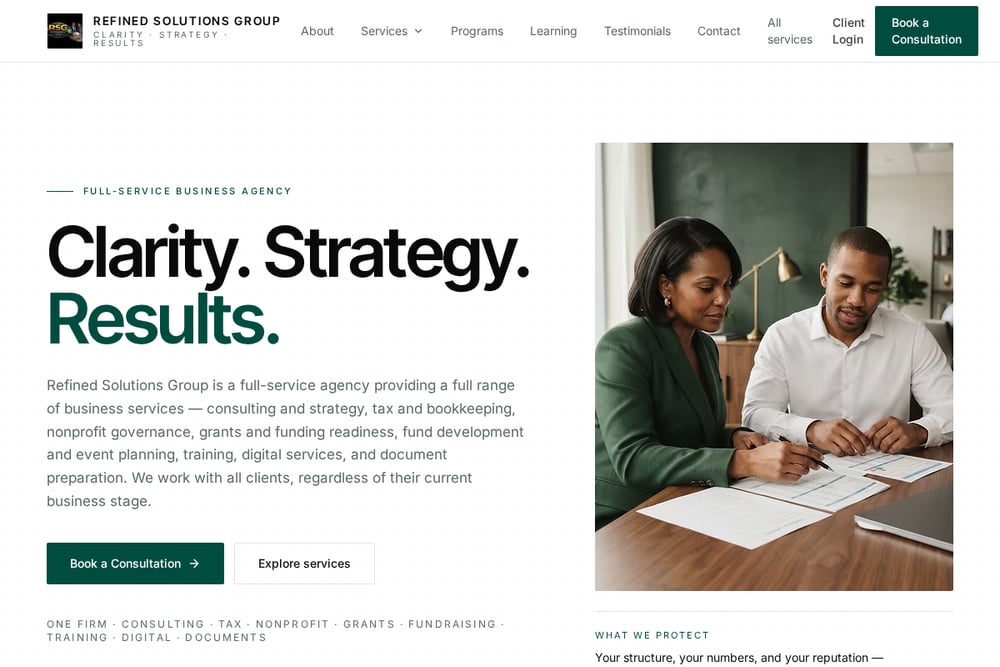 A screenshot of the Refined Solutions Group — Clarity. Strategy. Results. website.
Refined Solutions Group is a boutique agency led by Gloria Spruce, a strategist who has run organizations rather than only advised them. The firm covers ten practices, including business consulting and strategy, tax and bookkeeping, nonprofit governance, grants and funding readiness, fund development and event planning, training, digital services, and document preparation. The real value is that these practices talk to each other, so entity structure informs the tax position, which informs the funding strategy. It works with clients at every stage, from startups to established companies, plus nonprofits and individuals. If you are tired of being the messenger between three vendors, this is the integrated option.
#3 Trout CPA
 A screenshot of the Trout CPA website.
Trout CPA runs a dedicated nonprofit industry practice covering tax, assurance, and advisory. That includes audits, reviews, compilations, and agreed-upon procedures, plus services like obtaining exempt status, securing funding, grant compliance, and handling excess benefit issues. The firm also fields outsourced accounting, fractional controller, and fractional bookkeeper support, which matters when your finance team is one person or none. Its client base spans charities, private foundations, civic groups, and business leagues. Choose this firm when you need credentialed assurance work and a deep bench behind it.
#4 Foundation Group
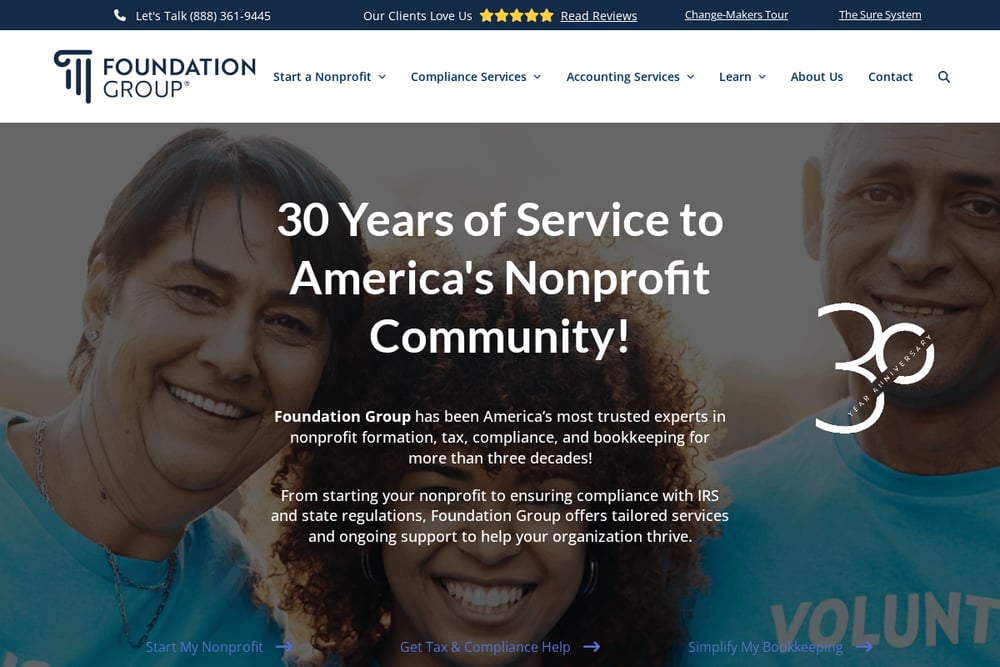 A screenshot of the Foundation Group website.
Foundation Group has worked exclusively with 501(c)(3) and other tax-exempt organizations for more than 30 years, across all 50 states and territories. Its SureStart formation services cover most startups, small nonprofits, sole-member nonprofits, and private foundations, and its ReStart service handles revoked status reinstatement. Compliance support includes Form 990 preparation, charitable solicitations registration, and group tax exemption. Accounting services scale from bookkeeping to operational accounting, financial reporting, and strategy and advisory. If your blocker is getting the exempt status right the first time, this is the specialist to call.
#5 Brady Ware
 A screenshot of the Brady Ware website.
Brady Ware serves nonprofits through a full tax, audit, and advisory stack, including Single Audits and FAR audits for organizations with federal funding. The advisory side covers budgeting and forecasting, capital sourcing and SBA assistance, strategic financial modeling, and outsourced accounting and finance. That combination fits organizations balancing unpredictable grant cycles with donor requirements and thin staffing. The firm also brings fraud, forensics, and internal controls work when governance needs tightening. Reach for this one when your funding sources demand a higher level of assurance and reporting discipline.
How to Choose the Right Fit
Ask three questions before you sign anything. First, does the firm work with organizations at your stage, or will you be the smallest client in the room? Second, who actually does the work, a partner, a senior, or a junior you never meet? Third, can they talk about structure, tax, and funding in the same meeting, or will you be the messenger between three vendors? Then check pricing clarity. Flat monthly fees beat surprise hourly bills. Ask for a sample deliverable, a board-ready financial packet or a grant readiness memo. Finally, confirm they will review your numbers before anything is filed, not after.
How to Put Your Financial and Funding Work on Autopilot
Start by mapping your year in four blocks: entity and structure, tax and bookkeeping, funding and grants, and governance and reporting. Assign one owner to each block. Then set recurring checkpoints, a quarterly books review, a mid-year grant readiness audit, and a year-end filing review. Use your firm as the reviewer, not the data entry clerk. When structure, tax, and funding decisions are reviewed together before anything is filed, you stop paying for cleanups and start paying for strategy.
The Bottom Line
You do not need the biggest firm. You need the right fit for your stage. If you are a startup or a small nonprofit wearing five hats, start with a boutique that connects structure, tax, and funding in one conversation. If you need audit-ready statements or a Single Audit, bring in a CPA firm built for that. If your only blocker is forming or reinstating a 501(c)(3), a formation specialist gets you there fast. Pick one primary firm, keep one specialist on call, and review the relationship every year.