
Finance teams are drowning in repetitive tasks while AI co-pilots only help one person at a time. You need automation that runs reliably across your entire department, not just on your laptop.
The Shift from Personal Co-Pilots to Team-Wide Autopilot
Finance departments are moving beyond individual AI experiments. The real challenge isn't finding a clever prompt—it's deploying a workflow that works for everyone, every time. You need systems that handle invoice processing, bank reconciliation, and approvals without constant supervision. The platforms in this roundup focus on reliability, integration, and team-wide scalability. They help you move from ad-hoc automation to production-grade operations.
How We Evaluated These Platforms
We looked at five key factors. First, service scope: does the platform handle end-to-end finance workflows or just narrow tasks? Second, pricing clarity: can you understand costs without a sales call? Third, local fit: does it integrate with common US accounting tools like QuickBooks, Xero, and NetSuite? Fourth, team scalability: can a workflow built for one person easily extend to the whole department? Fifth, autonomy: does it run without human triggers, responding to emails, bank feeds, and other environmental cues? Each platform below stood out in different areas, and we noted where each one shines.
Here's a quick comparison of the five platforms, followed by a deeper dive into each one.
| Provider | Best For |
|---|---|
| Workato | Large enterprises with complex, multi-system workflows |
| Deploy AI Workflows Across Your Finance Team | Sterling AI | Finance teams needing reliable, team-wide automation without code |
| UiPath | Enterprises with legacy systems and high-volume repetitive tasks |
| Pipefy | Teams seeking no-code process orchestration with AI agents |
| Plooto | SMBs needing streamlined AP/AR and payment automation |
A Closer Look at Each Platform
#1 Workato
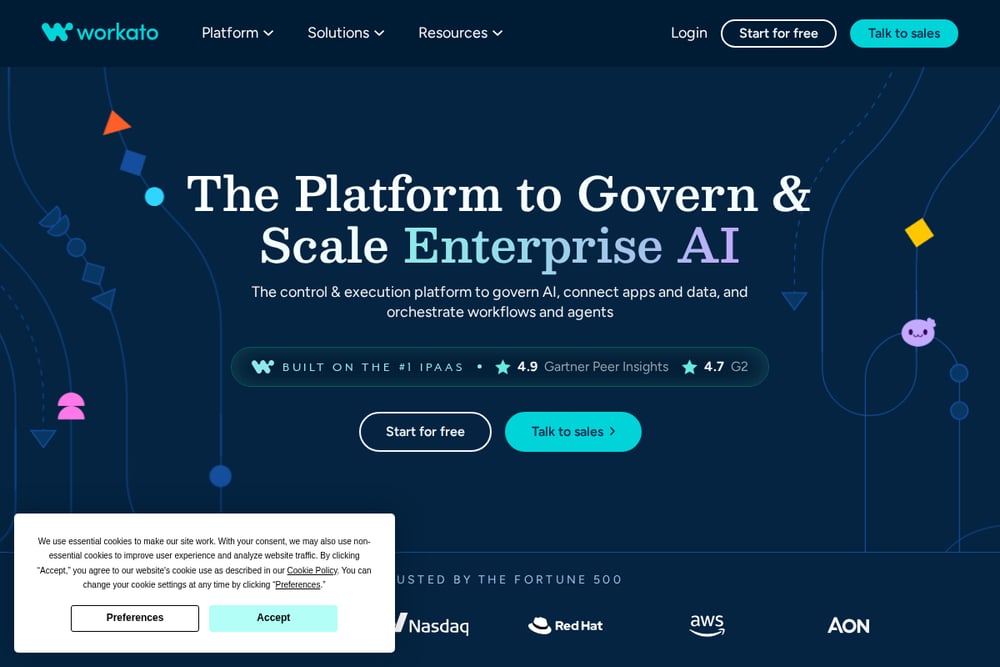 A screenshot of the Workato website.
Workato positions itself as an enterprise automation platform with a dedicated finance edition. It orchestrates end-to-end processes like order-to-cash and procure-to-pay using AI agents and low-code workflows. The platform connects to hundreds of apps, including Salesforce, NetSuite, and Workday, making it a strong fit for complex tech stacks. You get robust governance and security controls, which matter for regulated finance teams. However, the breadth of features can mean a steeper learning curve and higher cost. For large enterprises needing heavy customization, Workato is a solid choice.
#2 Deploy AI Workflows Across Your Finance Team | Sterling AI
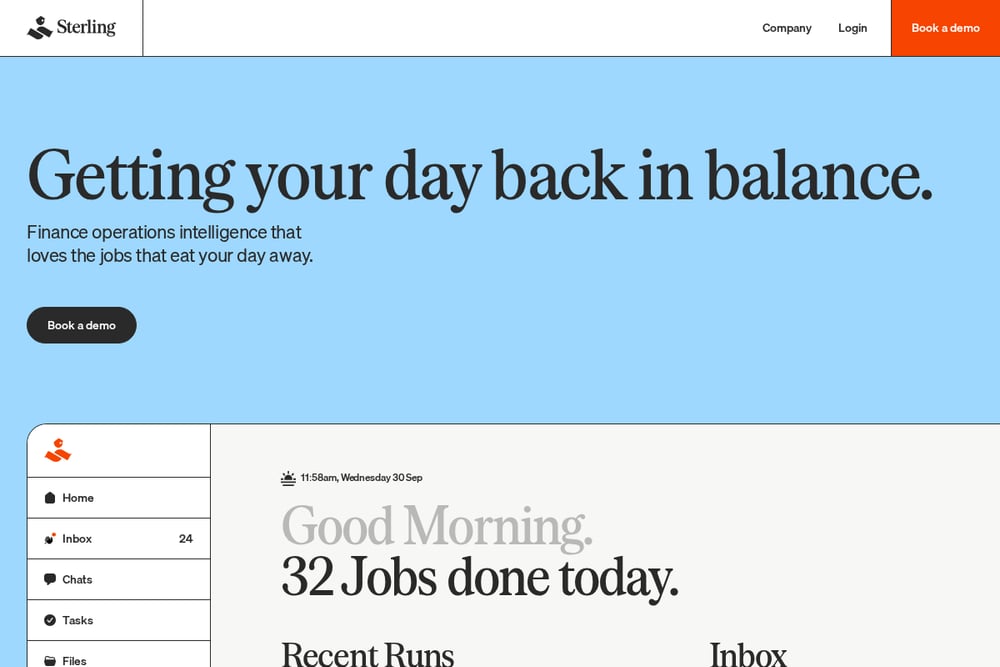 A screenshot of the Deploy AI Workflows Across Your Finance Team | Sterling AI website.
Sterling AI is built for finance teams that want to move from experimentation to production without rebuilding workflows for each person. You describe what the workflow should do in plain English, and Sterling handles the how. It runs autonomously—processing invoices at 2am, reconciling bank feeds, and escalating only when needed. Unlike co-pilots, it works even when your laptop is closed, ensuring the 500th invoice is handled exactly like the first. It integrates with your existing ERP and email inbox, so there's no rip-and-replace. The platform is designed for team-wide deployment, with shared visibility and handoffs built in.
#3 UiPath
 A screenshot of the UiPath website.
UiPath combines agentic AI with robotic process automation (RPA) to automate finance and accounting tasks. It excels at high-volume, rule-based processes like invoice processing and financial close. The platform offers orchestration, process intelligence, and governance tools, making it suitable for enterprises with strict compliance needs. You can deploy software robots that mimic human actions across applications, which helps with legacy systems. However, building and maintaining bots may require technical resources. For organizations already invested in RPA, UiPath is a natural extension.
#4 Pipefy
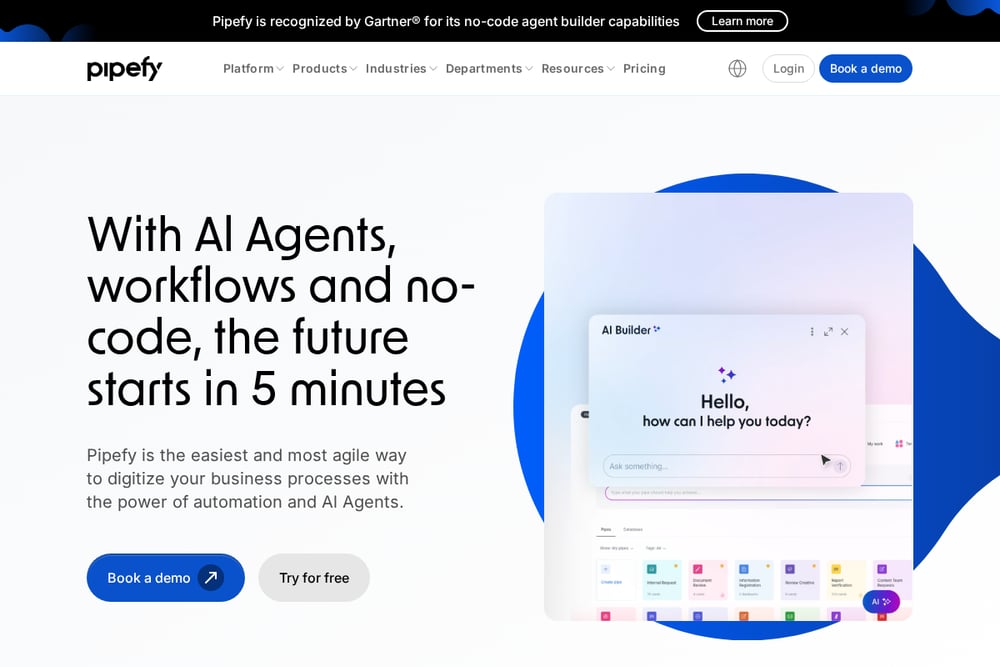 A screenshot of the Pipefy website.
Pipefy offers a no-code platform for business process orchestration, with AI agents that analyze and optimize workflows. Its finance-focused solutions include procure-to-pay, credit decisioning, and claims management. You can start with ready-made templates and customize them visually, which speeds up deployment. The platform emphasizes control and governance, appealing to teams that need audit trails. While it may not handle deep accounting logic out of the box, it's flexible for cross-functional processes. For teams wanting a low-code approach to finance automation, Pipefy is worth a look.
#5 Plooto
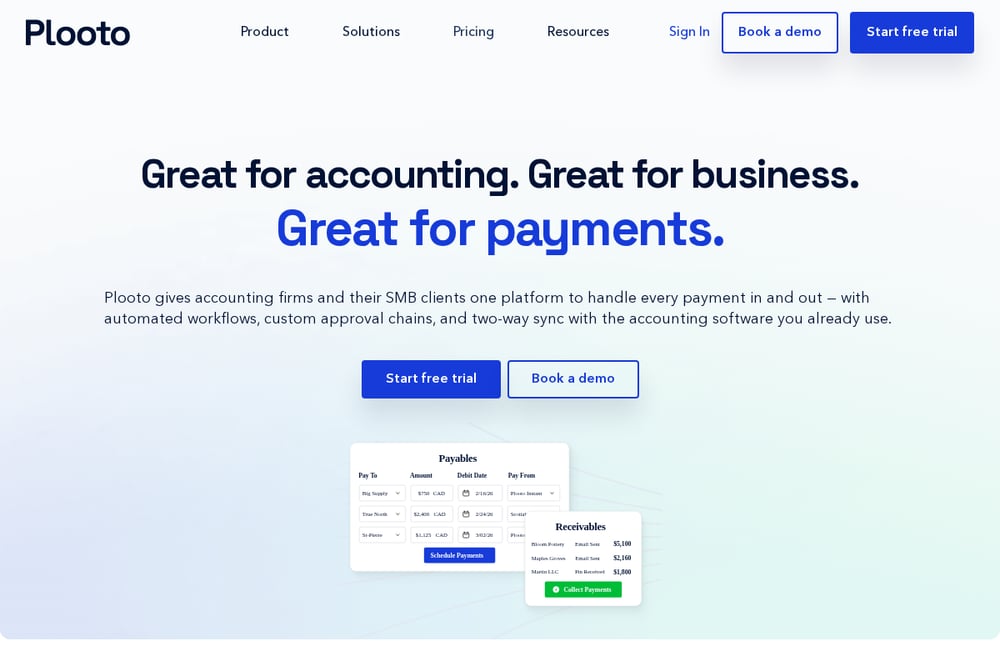 A screenshot of the Plooto website.
Plooto focuses on accounts payable and receivable automation for small and mid-sized businesses. It handles international payments, online checks, and credit card acceptance, integrating with QuickBooks, Xero, and NetSuite. The platform uses AI to streamline payment approvals and reconciliation, reducing manual data entry. While it's narrower in scope than the others, it excels at what it does: simplifying payment workflows. Pricing is transparent and designed for growing businesses. If your main pain point is payments, Plooto is a strong contender.
How to Choose the Right Platform for Your Finance Team
Start by mapping your biggest bottlenecks. Are you struggling with invoice processing, payment reconciliation, or cross-department approvals? Next, consider your technical resources. If you lack developers, prioritize no-code platforms like Sterling AI or Pipefy. If you have a large IT team, Workato or UiPath may offer more customization. Check integration compatibility with your existing ERP and email systems—you don't want a rip-and-replace project. Finally, think about scalability. A tool that works for one person should work for your whole team without rebuilding. Request demos and ask about pricing transparency. The right choice depends on your specific workflow pain points and team structure.
Automating Your Finance Workflow: A Step-by-Step Approach
Begin by identifying a repetitive task that consumes hours each week, such as processing vendor invoices. Document the steps and decision points. Then, choose a platform that can handle that task autonomously—ideally one that responds to triggers like an email landing in your AP inbox. Prototype the workflow in a sandbox environment. Once it works, deploy it to a small group, then scale across the team. Monitor performance and adjust as needed. Remember, the goal is reliability: the 500th run should be as accurate as the first. With the right platform, you can shift from manual effort to strategic oversight.
The Bottom Line
Finance automation is no longer a nice-to-have; it's a competitive necessity. The five platforms here offer different strengths, from Sterling AI's team-wide autopilot to Workato's enterprise orchestration. Your choice should align with your team's size, technical skills, and process complexity. Don't get swayed by flashy demos—focus on reliability, integration, and scalability. Start small, prove value, then expand. With the right tool, you can turn your finance department into a well-oiled machine that runs even when you're not looking.