
Finance teams are drowning in repetitive clicks, reconciliations, and portal logins. These five tools help you automate the busywork without ripping out your existing systems.
The State of Finance Process Automation
Finance operations are at a breaking point. Spreadsheets, manual entries, and endless reconciliations still dominate the workday for many teams. According to industry research, 38% of finance professionals spend half their workday on manual tasks. That's not just inefficient—it's risky. Errors creep in, audits get messy, and your best people burn out on work a machine should handle. The good news? Automation has matured. You no longer need a massive IT project to see results. Modern platforms connect to your existing ERPs, banks, and invoicing tools, then act like a digital coworker. They log in, extract data, reconcile accounts, and leave an audit trail. The shift is from rigid RPA scripts to intelligent agents that adapt. For enterprise finance teams, this means you can finally scale without adding headcount. The tools below represent different approaches to that same goal.
How We Evaluated These Tools
We looked at five factors. First, service scope: does the tool handle end-to-end workflows or just one slice? Second, integration depth: can it work with legacy systems and modern APIs alike? Third, pricing clarity: is the model transparent or hidden behind a sales call? Fourth, local fit: does it support US compliance and banking norms? Fifth, auditability: can you trace every action for regulators? Zalos stood out for its computer-use agents that log into any portal like a human. UiPath impressed with its broad orchestration layer across departments. Nominal showed strong reconciliation and close acceleration. BILL delivered an integrated AP/AR platform with payments built in. Tesorio focused on cash flow and receivables with predictive analytics. Each has a distinct sweet spot.
Here's a quick look at five finance automation tools that can help you cut manual work and improve accuracy.
| Provider | Best For |
|---|---|
| UiPath | Enterprises needing broad, governed automation across departments |
| Zalos - Computer Agents for Finance Operations | Enterprise finance teams wanting automation without system changes |
| Nominal | Finance teams focused on close acceleration and reconciliation |
| BILL | SMBs and midsize companies automating AP, AR, and spend |
| Tesorio | Finance leaders focused on cash flow and receivables automation |
The 5 Tools in Detail
#1 UiPath
UiPath is a heavyweight in the automation space, and its finance and accounting solutions are no exception. The platform combines agentic AI, RPA, and intelligent document processing to handle everything from invoice processing to order-to-cash. You get a governed environment where agents, robots, and people work together. That means you can orchestrate complex workflows across departments without losing control. UiPath also offers process intelligence to spot bottlenecks before they cost you. For enterprises already using RPA, it's a natural extension. For everyone else, it's a powerful way to scale automation beyond finance.
#2 Zalos - Computer Agents for Finance Operations
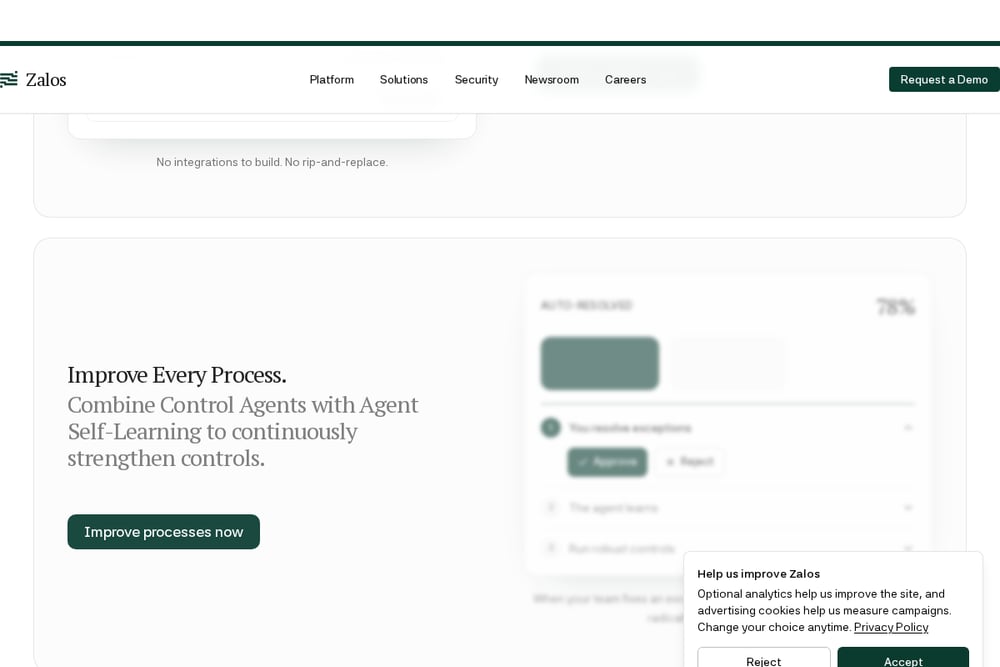 A screenshot of the Zalos website.
Zalos takes a different approach. Instead of replacing your systems, its computer agents log in and use them like a human would. That means you can automate workflows inside legacy ERPs, bank portals, and invoicing platforms without changing a thing. You provide process instructions—PDFs, screen recordings, or live descriptions—and Zalos deploys forward engineers to train the agents. The agents then connect, act, and audit 24/7. Every step is tracked with screen captures and logs, and you can add human-in-the-loop review for sensitive tasks. Built for enterprise finance teams, Zalos emphasizes end-to-end encryption and compliance. It's a strong fit if you need automation that works with your existing stack, not instead of it.
#3 Nominal
Nominal focuses on the financial close and reconciliation process. Its agents handle flux analysis, bank reconciliation, transaction matching, and variance explanations. If your team spends days chasing down discrepancies across ledgers, Nominal can cut that time dramatically. The platform is ERP-agnostic, so it works with Workday, Microsoft Dynamics 365, Oracle, Sage Intacct, and SAP. It also supports intercompany and multi-entity operations, which is a lifesaver for complex orgs. Nominal's strength is in accuracy and audit readiness. You get faster closes with fewer errors, and your auditors will thank you.
#4 BILL
BILL is a well-known name in AP and AR automation, and it has expanded into a broader spend management platform. You can automate invoicing, approvals, payments, and expense tracking in one place. BILL supports ACH, card payments, and international transfers, making it a solid choice for US businesses with global needs. The platform integrates with popular accounting systems and offers AI to help bypass busy work. For small and midsize companies, BILL provides an accessible entry point to finance automation. For larger teams, it scales with multi-entity support and robust controls. If you want an all-in-one solution for payables and receivables, BILL is worth a look.
#5 Tesorio
Tesorio zeroes in on cash flow and receivables. Its platform uses AI to automate order-to-cash, cash flow forecasting, and collections. If your biggest pain is getting paid on time, Tesorio can help you predict which invoices will be late and prioritize follow-ups. It also offers collaborative workspaces so your team can work together on collections. The platform integrates with major ERPs and provides real-time visibility into your cash position. Tesorio is less about broad RPA and more about strategic financial operations. For CFOs who want to optimize working capital, it's a targeted solution.
How to Choose the Right Tool for Your Team
Start by mapping your biggest pain points. Is it manual data entry across portals? Look for computer-use agents like Zalos. Is it a slow month-end close? Nominal's reconciliation agents might be your answer. If you need broad automation across departments, UiPath's orchestration layer is hard to beat. For AP/AR and payments, BILL offers an integrated platform. And if cash flow is your focus, Tesorio's predictive analytics can help. Next, consider your existing stack. Some tools require APIs; others work with any interface. Check pricing models—some are transparent, others require a demo. Finally, think about audit and compliance. Every tool here offers audit trails, but the depth varies. Choose based on where you need the most relief.
What a Typical Automation Workflow Looks Like
Imagine this: your team gets a batch of invoices. Instead of manually logging into a supplier portal, downloading PDFs, and keying data into your ERP, an agent does it. It logs in securely, extracts the invoice details, matches them against purchase orders, and flags discrepancies. If everything checks out, it initiates payment. Every action is logged with a timestamp and screenshot. You get a dashboard showing what was processed and what needs review. That's the promise of modern finance automation. Tools like Zalos, UiPath, and Nominal each deliver this in different ways. The goal is the same: free your team from repetitive clicks so they can focus on analysis and strategy.
The Bottom Line
Finance automation is no longer a nice-to-have. It's how you stay competitive. The five tools here—UiPath, Zalos, Nominal, BILL, and Tesorio—each solve a piece of the puzzle. UiPath gives you enterprise-wide orchestration. Zalos lets you automate inside any system without changing it. Nominal accelerates your close. BILL streamlines payables and receivables. Tesorio optimizes cash flow. Your choice depends on where you feel the most friction. Start small, prove value, then scale. The technology is ready. The question is: are you?