
Most federal contract money was never up for a fair fight. These five tools help you see which bids are already spoken for before you waste a week writing a proposal.
What are Education & Training services?
The federal contracting market runs on a firehose of data: SAM.gov notices, FPDS award history, agency forecasts, and recompete windows. The problem is that every platform shows you the same open notices, and almost none of them tell you whether the notice is actually winnable. A growing category of bid intelligence tools is changing that by layering incumbent analysis, win probability, and expected-value math on top of the raw feed. If you are a small or mid-size contractor, the difference between a good tool and a bad one is measured in proposal hours you did not burn.
What we looked at when researching Education & Training
We evaluated each tool on the same factors: depth of federal data coverage, clarity of pricing and free access, how directly it helps you decide bid or no-bid, and whether the intelligence is actionable without a sales call. Each entry below stood out on a different combination of those factors, so match the tool to how you actually pursue work.
| Provider | Best For |
|---|---|
| SamSearch | Teams that want a full capture-to-proposal pipeline |
| UNCONTESTED — most federal contract money was never available to you | Contractors who want to skip unwinnable bids |
| RFP Recon | Fast expected-value math before you bid |
| Fed-Spend | Low-cost federal data breadth with AI features |
| WinAContract | ROI math plus AI proposal drafting |
A closer look at 5 standout Education & Training
#1 SamSearch
 A screenshot of the SamSearch website.
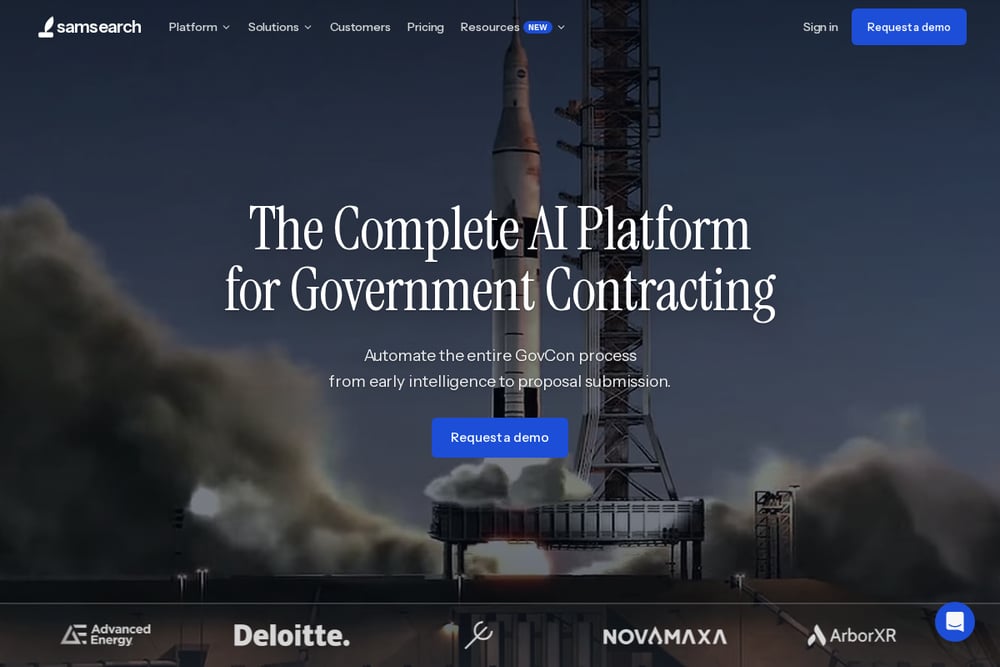
SamSearch frames itself as a full pursuit platform, not just a search tool. You get influence, capture, analyze, manage, respond, and finance stages in one pipeline, which means you can shape a requirement before it hits your competitor's radar and carry it through to award. The win probability estimator is the hook for bid/no-bid decisions, and the compliance matrix extraction maps Section L and M requirements automatically. It is a heavier platform than a pure odds board, so it fits teams that want one system from opportunity to proposal. If you are building a capture process rather than just filtering notices, this is the one to look at first.
#2 UNCONTESTED — most federal contract money was never available to you
 A screenshot of the UNCONTESTED — most federal contract money was never available to you website.
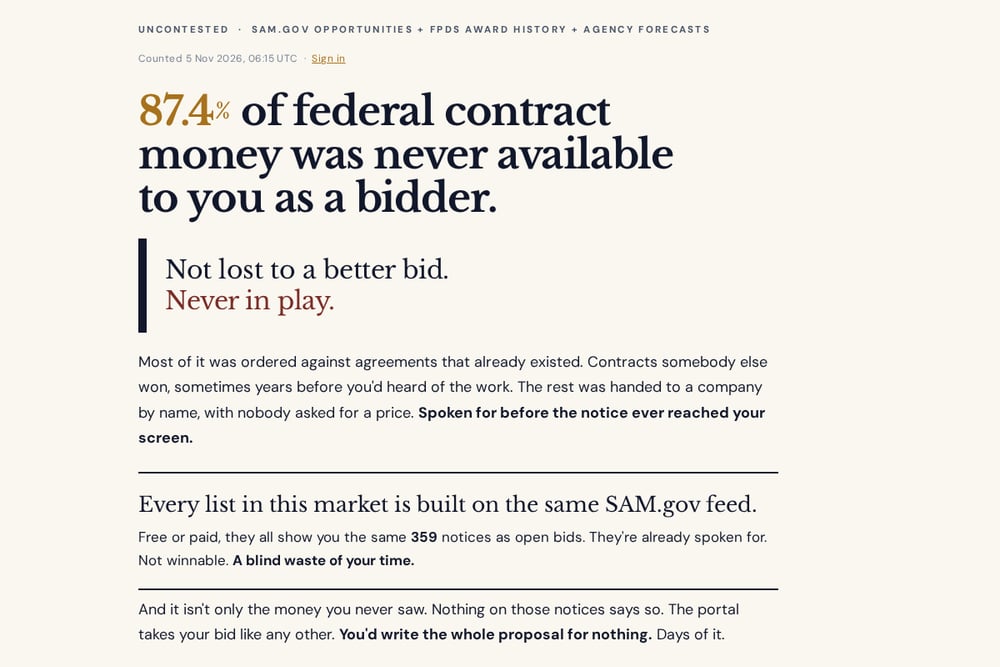
UNCONTESTED starts from a blunt premise: 87.4% of federal contract money was never available to you as a bidder. Most of it was ordered against agreements that already existed, and the rest was handed to a company by name. The site shows you which open notices are already spoken for and which ones actually offer better-than-even odds, using SAM.gov opportunities, FPDS award history, and agency forecasts. You type in your six-digit industry code and see your own market on screen before you give up an email or a card. There is a free board with every notice, buyer, and price, plus a seven-day full unlock with no card required. It is the most direct answer to the wasted-proposal problem in this list.
#3 RFP Recon
 A screenshot of the RFP Recon website.
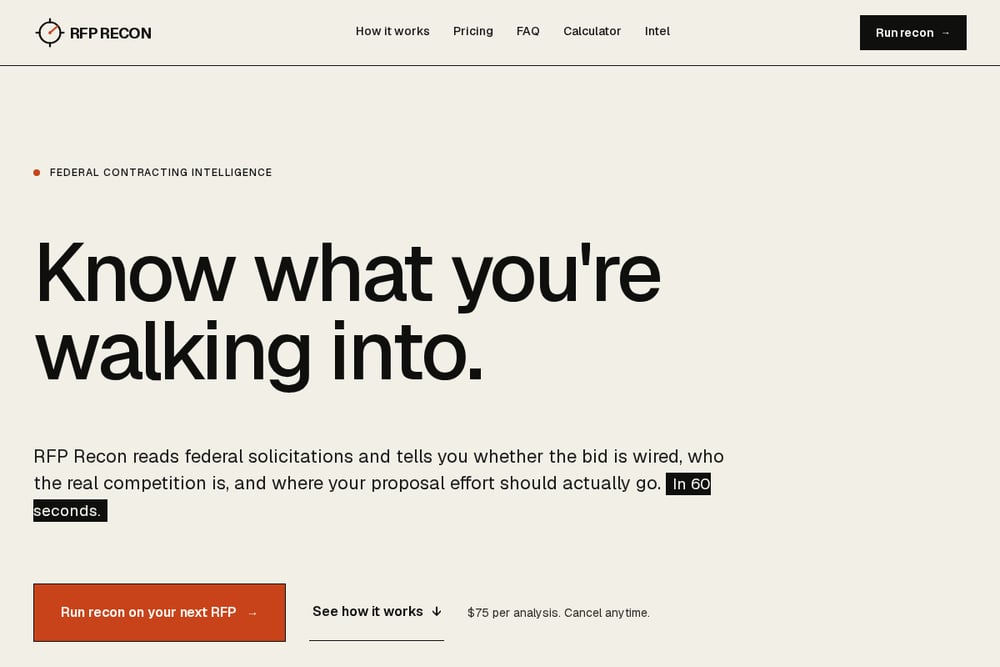
RFP Recon leads with an expected-value calculator that forces you to confront proposal cost against win probability. You enter contract value, PWin, and margin, and it shows you the breakeven PWin where expected value crosses zero. The tool is free and requires no signup, which makes it a fast gut-check before you commit a capture team. When you want a defensible PWin rather than a guess, the paid analysis starts at $75 and looks at wired-RFP signals, capability fit, and incumbent vulnerability. It is a narrow tool, but it solves the bid/no-bid math problem cleanly.
#4 Fed-Spend
 A screenshot of the Fed-Spend website.
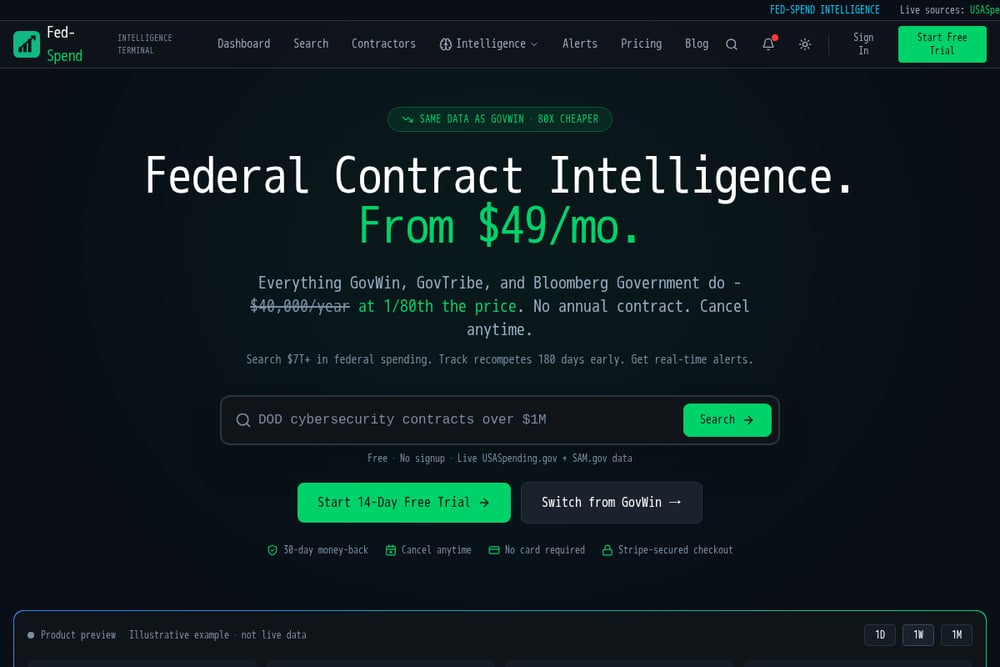
Fed-Spend aggregates USAspending, SAM.gov, and FPDS into a single search with a free tier and paid plans up to $199 per month. The platform includes a Recompete Radar with CPARS data, an AI compliance matrix, a go/no-go decision tool, and set-aside filtering for 8(a), SDVOSB, HUBZone, and WOSB. Data updates every 15 minutes, and real-time alerts go out by email and Slack. It is federal-only, so state and local work is out of scope, but for pure federal intelligence at a low price point it covers a lot of ground. If you want breadth of data plus AI features without enterprise pricing, this is a strong fit.
#5 WinAContract
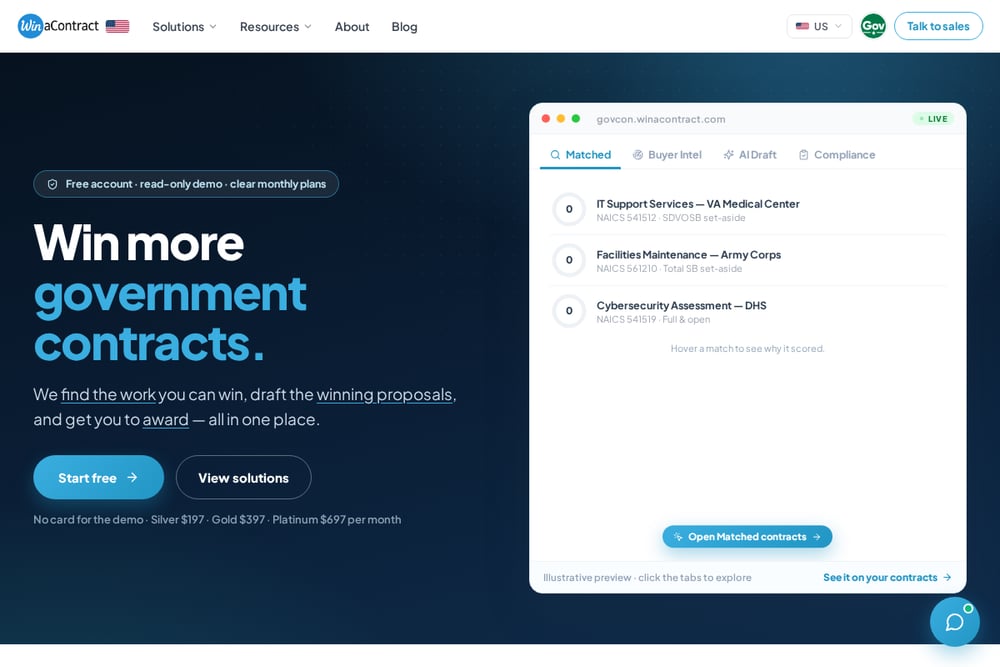 A screenshot of the WinAContract website.
WinAContract pairs a bid ROI calculator with a broader contract search and AI proposal writing suite. The calculator takes contract value, gross margin, win probability, and bid cost, then returns expected profit, expected value, and return on bid spend. It also tells you the win rate you would need to break even on bid cost, which is a useful sanity check before a capture decision. Beyond the calculator, the platform offers buyer and market intelligence, forecast and recompete tracking, and set-aside filters. It is a practical entry point if you want ROI math and proposal drafting in one place.
How to choose the right Education & Training
Start with the decision you make most often. If you keep writing proposals for notices that were never winnable, a tool that flags spoken-for bids and shows odds by industry code will save you the most hours. If your problem is capture discipline, pick a platform that carries a pursuit from shaping through proposal. If you just need a fast number before a bid meeting, a free expected-value calculator is enough. Check the free tier before you pay: several of these tools let you see real data without a card, and that tells you more than any demo call.
Expert Conclusion
The federal market rewards contractors who know what to skip. Each of these five tools attacks that problem from a different angle, from full pursuit platforms to single-purpose calculators. The common thread is that raw SAM.gov data is no longer enough on its own. Pick the tool that matches your bid volume and your team size, and let it do the filtering so you can spend your proposal hours on work you can actually win.