You have a design that needs to survive real loads, real airflow, or a real manufacturing constraint. These five simulation partners can help you find out before you cut metal.
The simulation consulting landscape
Engineering simulation has moved from a specialist luxury to a routine part of product development. You now have a wide spread of options, from large Ansys channel partners with deep bench strength to independent engineers who combine analysis with hands-on design and prototyping. The right fit depends on whether you need a single well-scoped study or an ongoing engineering partner who can carry a concept through validation.
How these five were evaluated
Each consultancy was looked at on service scope, depth of simulation tooling, clarity of process and deliverables, and how well the offering fits small teams and independent designers. Breadth matters, but so does whether you can actually understand what you are buying before you commit budget.
Here is the short version. Scan the list, then read the detail on the ones that match your project's shape.
| Provider | Best For |
|---|---|
| SimuTech Group | Multi-physics problems that span several disciplines |
| Structural Analysis & Computational Design — Elif Erol | Design-led analysis with prototyping in the loop |
| Ozen Engineering, Inc | Consulting plus team training and mentoring |
| Rand SIM | Embedding analysis inside an existing design team |
| Czero | R&D programs that need analysis plus physical testing |
The five, in detail
#1 SimuTech Group
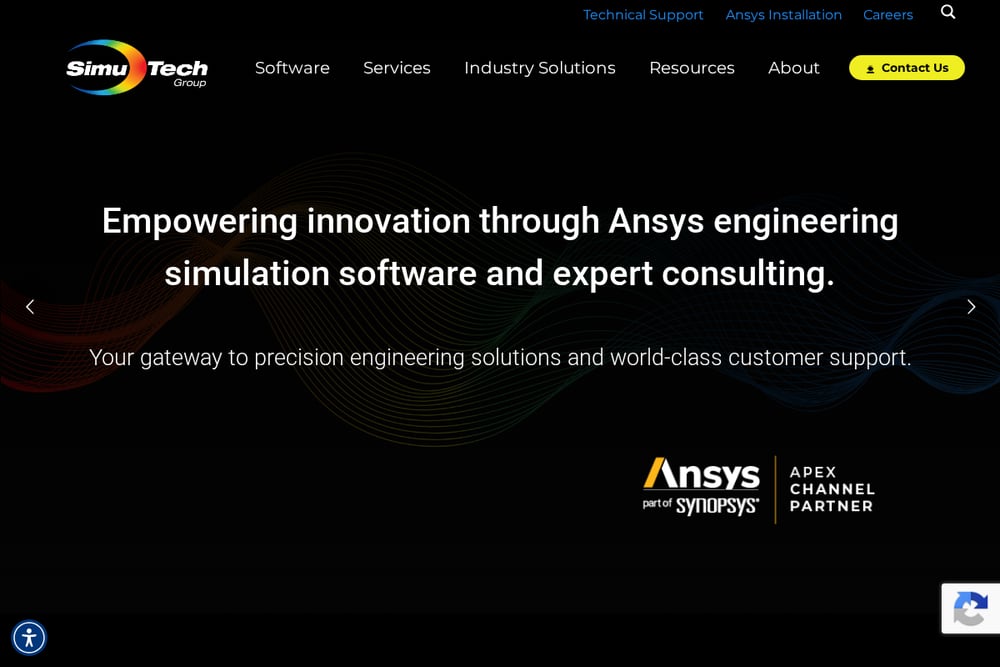 A screenshot of the SimuTech Group website.
SimuTech is one of the larger Ansys partners in North America, and its consulting arm covers an unusually wide surface. You can get static structural work, dynamics, fatigue and fracture mechanics, thermal stress, CFD, fluid-structure interaction, and even forensic engineering under one roof. That breadth is useful when your problem refuses to stay in one physics domain. The tradeoff is scale: you are working with a big organization, so scoping early and precisely matters. Their consulting overview lays out the full menu.
#2 Structural Analysis & Computational Design — Elif Erol
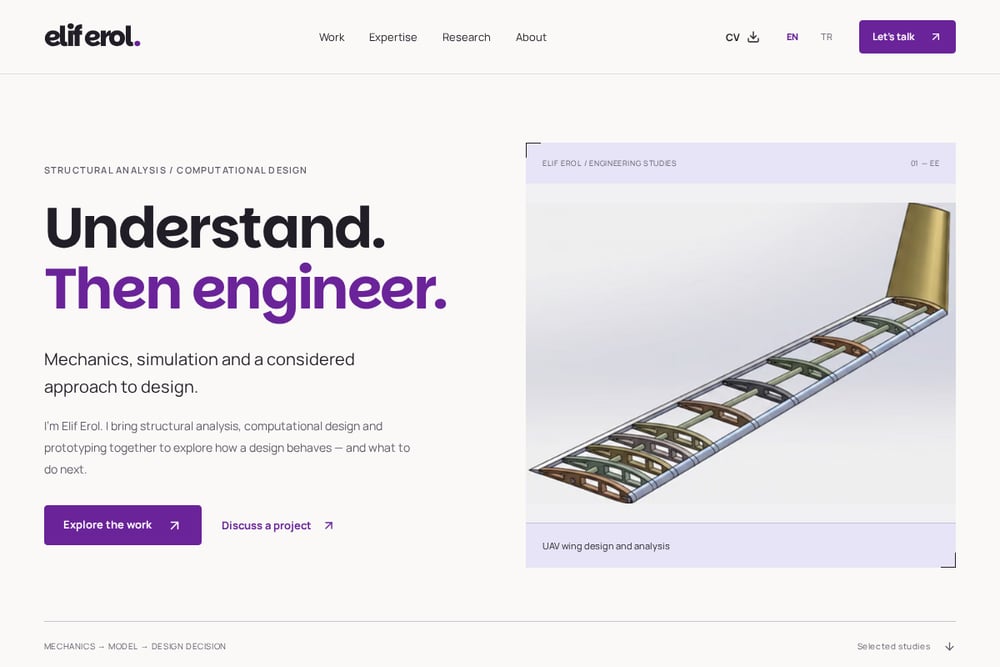 A screenshot of the Structural Analysis & Computational Design — Elif Erol website.
Elif Erol runs a focused independent practice built around one idea: understand the mechanics first, then engineer. Her work pairs ANSYS Mechanical and Fluent with nTop, SolidWorks and CATIA, so analysis and design decisions stay connected rather than living in separate silos. The portfolio shows that in practice, from a NACA 4412 UAV wing study with aerodynamics, static structural analysis and a 3D-printed prototype, to a TPMS gyroid All-on-Four implant analysis using static FEA. If you want an engineer who makes assumptions explicit and tells you what to do next, this is a strong fit. You can review the scope and deliverables directly on the site.
#3 Ozen Engineering, Inc
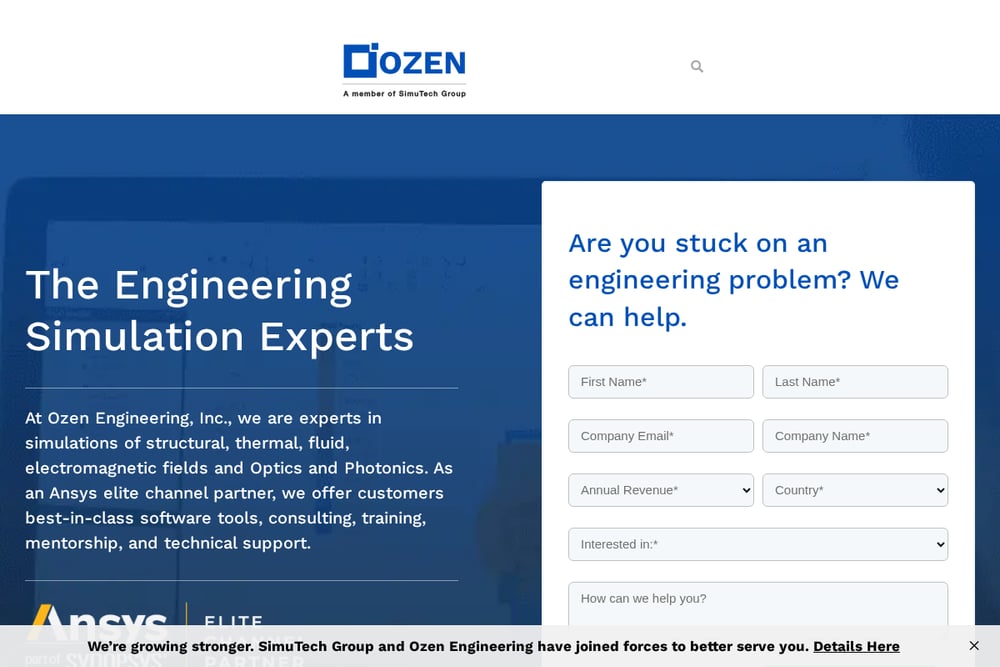 A screenshot of the Ozen Engineering, Inc website.
Ozen is a long-established Ansys consulting and training firm with a broad technical catalog. FEA and CFD sit alongside optics, photonics, thermal management and electronics cooling, plus electromagnetic work. They also run structured training and mentoring, which is handy if your team wants to build internal capability rather than outsource everything. The industry pages go deep on niches like medical devices, turbomachinery and random vibration. It is a solid choice when you need both a study and a knowledge transfer.
#4 Rand SIM
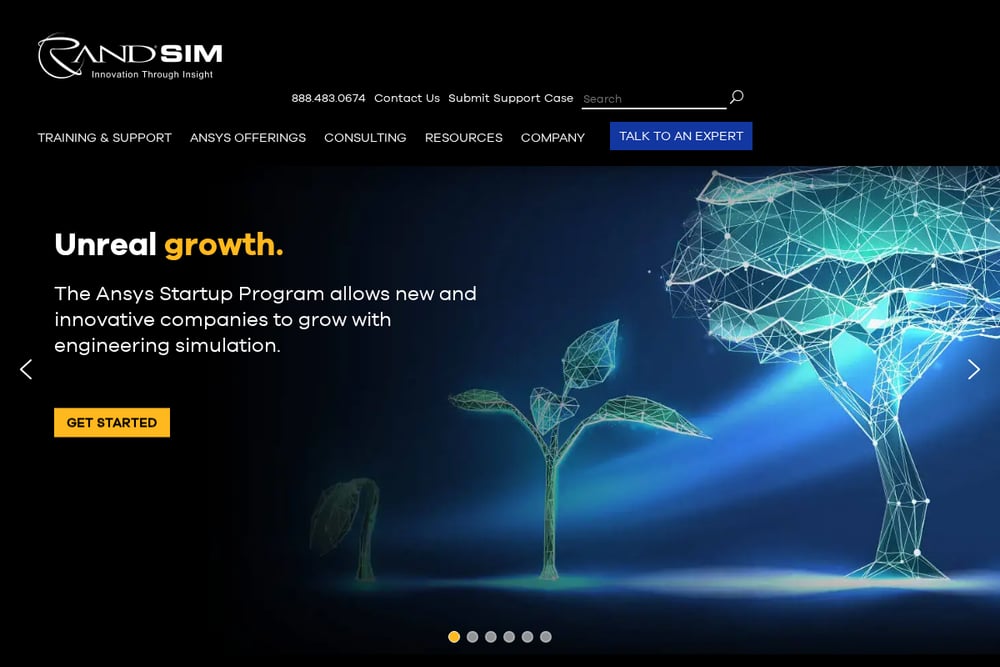 A screenshot of the Rand SIM website.
Rand SIM frames its FEA consulting as a collaborative model: their analysts handle simulation while your designers keep designing, with information flowing both ways. The stated goal is confident design decisions without disrupting your existing development process. Their FEA service page highlights fatigue, modal, shock response, random vibration, parametric optimization and thermal-induced stress. If you have an in-house design team and want analysis embedded alongside it rather than bolted on at the end, the working style here is worth a look.
#5 Czero
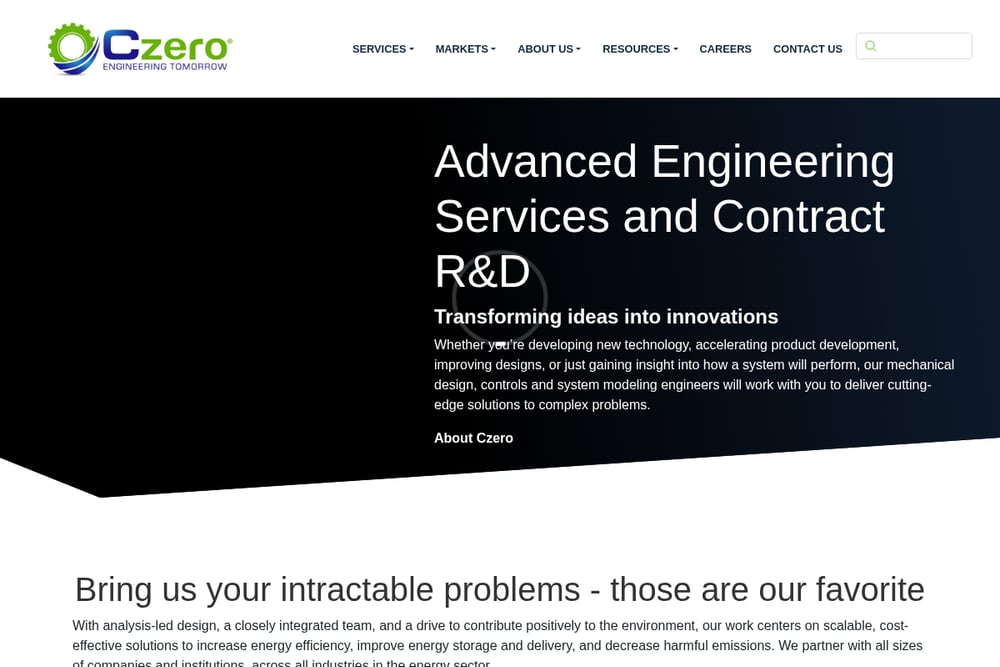 A screenshot of the Czero website.
Czero brings a mechanical design and R&D flavor to simulation, with FEA consulting positioned as design by analysis rather than a standalone report service. The team includes PhD-level engineers and former academics, and the capability list runs from linear and nonlinear static work through buckling, creep, contact, modal, harmonic, random vibration and explicit impact analysis. They also offer prototype build and test, machining and reverse engineering, which helps when a simulation needs physical validation. It suits early-stage and R&D-heavy programs.
Choosing the right simulation partner
Start with the physics. If your problem is purely structural, a focused structural specialist will often move faster than a large multi-domain firm. If airflow, thermal and structure all interact, breadth wins. Next, ask how assumptions and boundary conditions get documented, because a simulation is only as good as the inputs behind it. Then check whether you need a report, a design recommendation, or a prototype, and pick a partner whose deliverables match. Finally, consider the working relationship: some teams want a hands-off vendor, others want an engineer who sits in the design conversation from day one.
Where automation fits into the workflow
Simulation work benefits from repeatable steps. Define load cases and materials once, then template the setup so each design iteration runs the same way. Use parametric or topology-driven tools to explore geometry variants before committing to a full solve. Keep a shared record of assumptions so results stay interpretable months later. And connect analysis output directly to the next design decision, whether that is a CAD change, a print orientation, or a test plan. That loop, not any single solver, is what shortens development time.
The bottom line
You do not need the biggest firm, you need the right one for your problem. Large partners like SimuTech and Ozen give you range and training depth. Rand SIM and Czero suit teams that want analysis woven into design and testing. And if you want a single engineer who connects mechanics, simulation and prototyping into one clear decision, Elif Erol's practice is built exactly for that.