Your transformation program probably won't fail inside a discipline. It will fail at the seams between strategy, platform, and model. These five firms exist to make sure those seams hold.
The Architecture Consulting Landscape
Large organizations no longer buy architecture advice in isolation. They need landing zones, platform engineering, governance, and production-grade AI systems designed by people who have done it before. The market splits between global consultancies with enormous benches and boutique firms that staff only senior architects. Vendor neutrality matters more than ever, because the platforms you already run are rarely the ones a single vendor wants to sell you.
How We Evaluated These Firms
We looked at four things: depth of service scope across enterprise, cloud, and AI architecture; seniority of the people actually doing the work; evidence of vendor-neutral, decision-on-record practices; and how clearly each firm explains its approach to a buyer. Pricing transparency and fit for large, regulated environments also weighed in. The detail on each firm lives in its description below.
Here is the short version. Five firms, five different shapes of help, one shared question: who do you trust to design the platform your business stands on?
| Provider | Best For |
|---|---|
| Accenture | Global programs needing one accountable partner |
| Keystone Cloud Partners | Large organizations modernizing without risking what works |
| Bain & Company | Strategy-led architecture and target-state planning |
| Jade Global | Architecture plus hands-on platform implementation |
| Kirk Tech Solutions | Scoped private AI pilots with a fast first project |
The Five Firms in Detail
#1 Accenture
 A screenshot of the Accenture website.
Accenture is the largest name on this list, and its enterprise architecture practice spans strategy, cloud, AI, and managed services under one roof. If your program touches dozens of workstreams and needs a single accountable partner, the breadth is hard to match. The tradeoff is scale itself: you get deep benches, but you also get layers between you and the architect making decisions. For global rollouts with heavy change management, that structure often earns its keep. Start with the enterprise architecture practice page to see how they frame the work.
#2 Keystone Cloud Partners
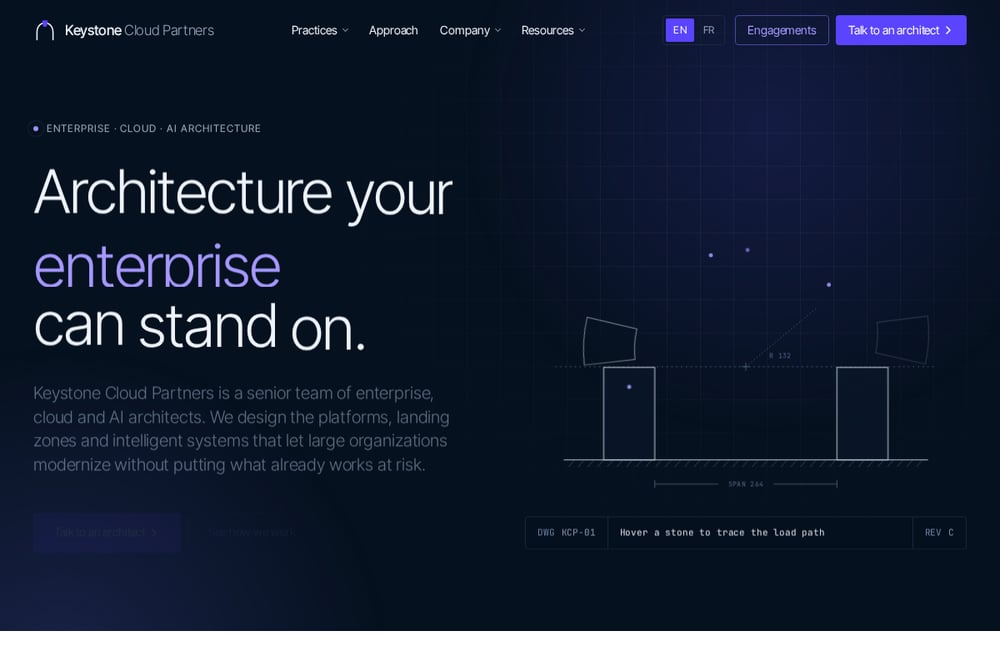 A screenshot of the Keystone Cloud Partners website.
Keystone Cloud Partners is a senior team of enterprise, cloud, and AI architects, and it says so plainly: senior architects only, vendor-neutral, every decision on record. The firm organizes around three disciplines, enterprise architecture, cloud architecture, and AI architecture, and staffs all three so the seams between strategy, platform, and model hold. You get landing zone design, platform engineering, retrieval and guardrail architecture for production AI, plus governance and FinOps. They publish ADR templates and an AI reference architecture, which tells you something about how they think. Book a 30-minute architecture briefing if you want to test the fit before committing.
#3 Bain & Company
 A screenshot of the Bain & Company website.
Bain brings a strategy-first lens to enterprise IT architecture, which suits you when the real question is what to build, not just how. Its systems and architecture practice sits inside a broader technology and AI consulting arm, so architecture decisions get tied back to business outcomes and investment cases. You will not get hands-on platform engineering at the depth of a specialist firm, and that is fine, because that is not the job. Use Bain when the board needs a defensible target state and a sequencing plan. The consulting services pages lay out the full scope.
#4 Jade Global
 A screenshot of the Jade Global website.
Jade Global pairs enterprise AI architecture consulting with a deep bench of platform implementation work across Oracle, NetSuite, Salesforce, ServiceNow, Snowflake, and Databricks. That combination helps when your architecture blueprint needs to land in systems your teams already run. The firm also brings its own accelerators and AI tooling to engagements, which can shorten delivery timelines. The breadth means you should scope carefully so the senior advisory voice does not get diluted by implementation volume. Their enterprise AI architecture consulting page is the right entry point.
#5 Kirk Tech Solutions
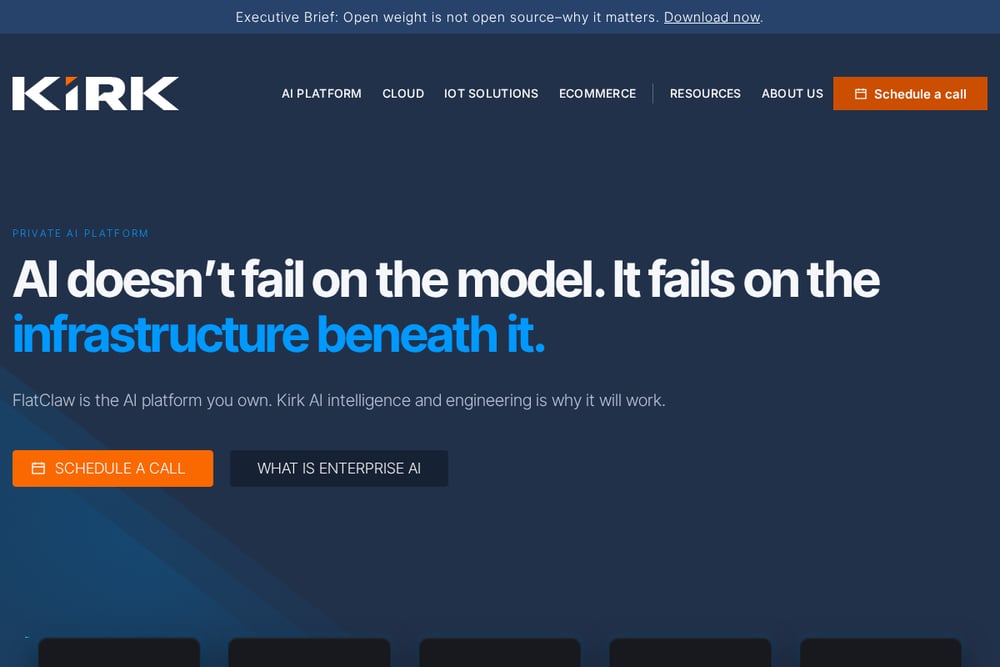 A screenshot of the Kirk Tech Solutions website.
Kirk Tech Solutions focuses on private AI infrastructure and cloud modernization, with a product platform called FlatClaw aimed at company-wide AI under your own control. The pitch is refreshingly concrete: bring one workflow, map the data it touches, and decide together whether a scoped first project makes sense. That makes it a good fit for mid-market organizations that want a contained proof of value before a larger commitment. It is a smaller operation than the others here, so weigh that against your scale and procurement requirements. The enterprise AI infrastructure page explains the model.
How to Choose the Right Partner
Start with the seam that hurts most. If strategy and platform are drifting apart, you need a firm that staffs both. If your board wants a target state before anything gets built, lead with a strategy house. If you already know the architecture and need it implemented across packaged platforms, pick a firm with implementation depth. Then ask one hard question in the first meeting: who exactly will be in the room, and what have they shipped? Seniority is the variable that most often decides whether an architecture engagement produces something your teams actually use.
Where Automation Fits
Architecture work generates a lot of repeatable output: decision records, capability maps, landing zone modules, evaluation harnesses. The firms that automate this well give you a durable asset instead of a slide deck. Keystone Cloud Partners publishes ADR templates and an AI reference architecture covering retrieval, gateway, guardrails, and evaluation, which you can adapt into your own pipeline. Jade Global leans on accelerators and AI tooling to compress delivery. Whichever partner you pick, insist that governance artifacts live in version control and that policy checks run automatically in your deployment pipeline. That is how architecture stops being a document and starts being a control.
The Bottom Line
There is no single right answer here, only the right shape of help for your situation. Accenture gives you scale and accountability. Keystone Cloud Partners gives you senior-only, vendor-neutral architects across enterprise, cloud, and AI with every decision on record. Bain gives you a strategy spine. Jade Global gives you implementation muscle. Kirk Tech Solutions gives you a contained way to prove private AI works. Match the firm to the seam you need to hold, and the rest of the program gets easier.