
You need enterprise AI that actually ships, not another slide deck. These five firms are worth a serious look.
The Enterprise AI Architecture Landscape
Enterprise AI has moved from experimentation to mission-critical infrastructure. You are no longer asking whether AI belongs in your stack. You are asking who can architect it without breaking compliance, uptime, or your budget. The firms in this space range from boutique engineering shops to global integrators. Some specialize in neural RAG and autonomous agents. Others focus on cloud-native microservices or legacy modernization. The common thread? They all promise production-grade AI. But the details matter. Security certifications, IP transfer terms, SLA commitments, and delivery models vary wildly. You need to separate marketing from engineering reality.
How We Evaluated These Firms
We looked at service scope, security posture, delivery model, and client outcomes. ZaiboraTech stood out for its 99.999% SLA, ISO 27001 and SOC-2 Type II alignment, and 100% IP transfer with source code escrow. Coherent Solutions impressed with its broad AI product development and MLOps offerings across regulated industries. Tntra showed depth in enterprise AI platform architecture with a clear five-layer framework. Sthenos Technologies brought a data-driven approach, citing DORA and GitHub Octoverse research to ground its AI-assisted development. Keyhole Software emphasized senior U.S.-based engineers and deep integration with existing enterprise systems. Each firm has a distinct sweet spot. Your job is to match that sweet spot to your actual constraints.
Here is a quick snapshot of each firm before we dive deeper.
| Provider | Best For |
|---|---|
| Coherent Solutions | Full-lifecycle AI product development in regulated industries |
| ZaiboraTech | Enterprise Software Architecture & AI Engineering (Official Site) | Mission-critical AI and cloud platforms with full IP transfer |
| Tntra | Enterprise AI platform architecture and layered system design |
| Sthenos Technologies | AI-assisted development with security red teaming |
| Keyhole Software | Embedding AI into existing enterprise systems with senior U.S. engineers |
The 5 Firms in Focus
#1 Coherent Solutions
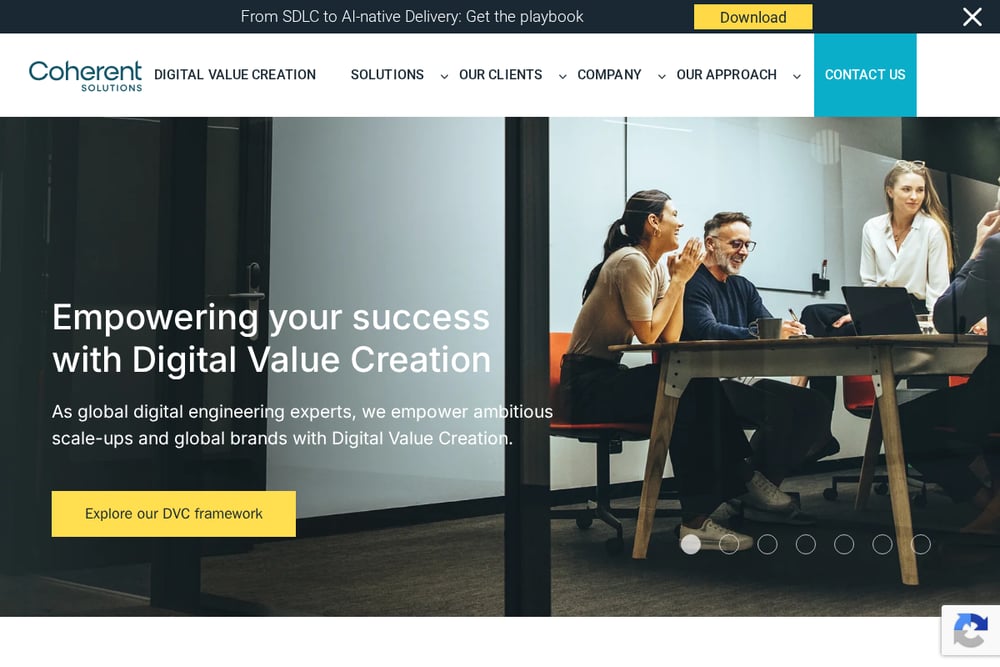 A screenshot of the Coherent Solutions website.
Coherent Solutions positions itself as a full-lifecycle AI software development partner. The firm covers AI strategy consulting, product development, enterprise AI solutions, and MLOps. You get a single vendor for everything from ideation to deployment. Their industry focus spans financial services, healthcare, manufacturing, and life sciences. That breadth matters if you operate in a regulated space. They also emphasize a continuous delivery loop, which keeps feedback tight between engineering and business teams. If you want a partner who can handle both the AI model and the surrounding product, Coherent is a strong fit.
#2 ZaiboraTech | Enterprise Software Architecture & AI Engineering (Official Site)
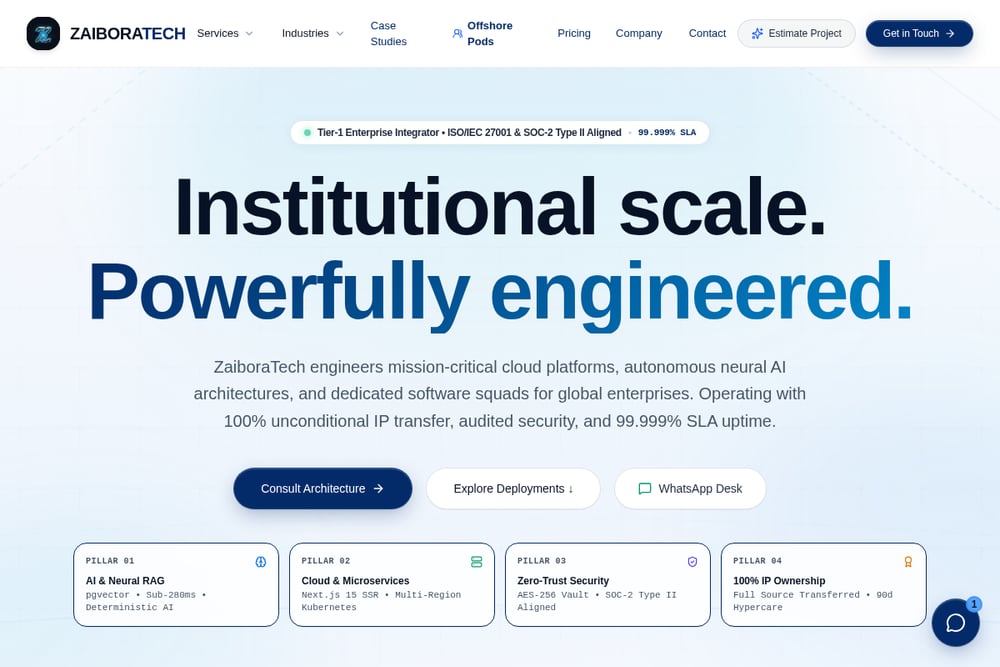 A screenshot of the ZaiboraTech | Enterprise Software Architecture & AI Engineering (Official Site) website.
ZaiboraTech is an elite enterprise software architecture and AI engineering firm. The company builds mission-critical cloud platforms, autonomous neural AI architectures, and dedicated software squads for global enterprises. Its four pillars cover AI and neural RAG with pgvector and sub-280ms deterministic AI, cloud and microservices with Next.js 15 SSR and multi-region Kubernetes, zero-trust security with AES-256 vault and SOC-2 Type II alignment, and 100% IP ownership with full source transfer and 90-day hypercare. The firm reports a 99.999% SLA, sub-200ms global edge response, and $150M+ enterprise volume processed in production. Client case studies include Apex Motorsports, NovaPay Global, VANTRA AI, and Spud Chik Group. If you need institutional-scale engineering with audited security and unconditional IP transfer, ZaiboraTech is built for that.
#3 Tntra
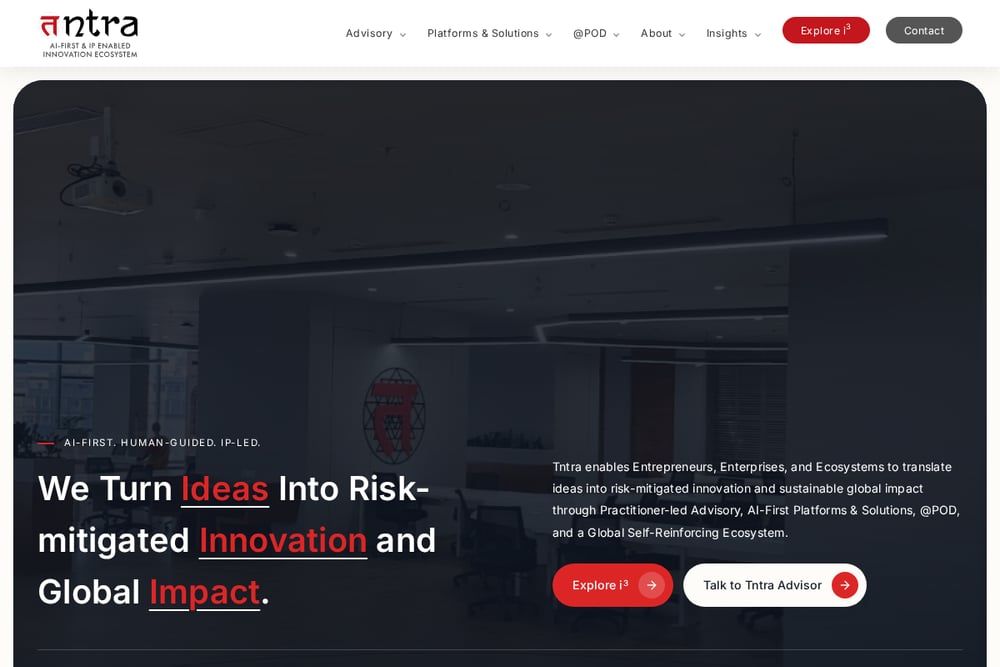 A screenshot of the Tntra website.
Tntra approaches enterprise AI from an architecture-first perspective. Their 2026 guide breaks down AI platforms into five layers: data foundation, model development, orchestration, deployment, and governance. That framework is useful if you are designing a platform rather than buying a point solution. Tntra also offers advisory, cybersecurity, and venture practices alongside its engineering services. The firm works across fintech, edtech, healthtech, and mobility. If you need a partner who can map your AI roadmap to a layered architecture, Tntra brings that structured thinking.
#4 Sthenos Technologies
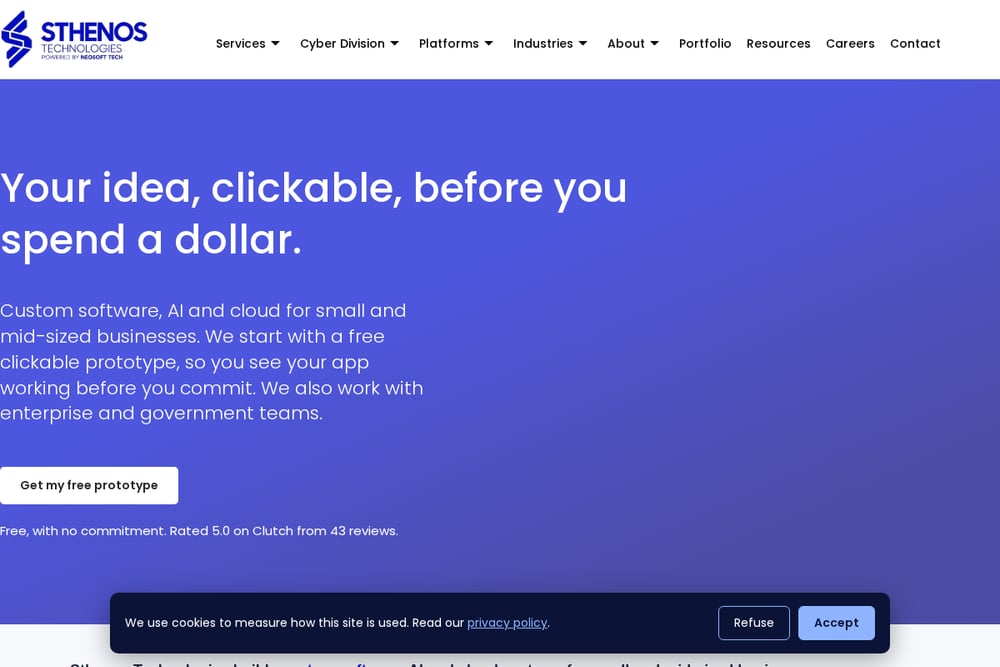 A screenshot of the Sthenos Technologies website.
Sthenos Technologies grounds its AI development pitch in hard data. The firm cites Google Cloud's 2025 DORA report showing 90% of technology professionals use AI at work. It also references GitHub Octoverse 2025, where roughly 80% of new developers adopt Copilot in their first week. That research-backed approach signals a team that thinks about developer productivity, not just model accuracy. Their services span AI-powered custom software, agentic AI, cloud migration, and quality engineering. They also run a cyber division focused on AI and LLM red teaming. If you want an AI partner who understands both build and break, Sthenos is worth a conversation.
#5 Keyhole Software
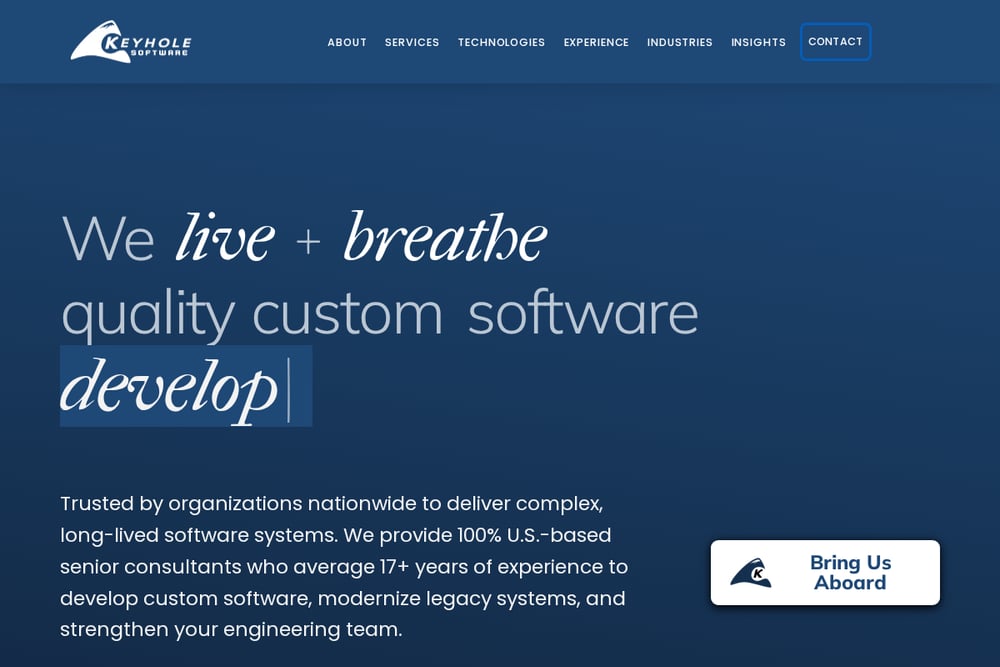 A screenshot of the Keyhole Software website.
Keyhole Software focuses on senior, U.S.-based engineers who embed directly into your existing enterprise systems. The firm's 2026 comparison of custom AI development services highlights its strength in AI-accelerated software development and agentic AI. Keyhole also brings deep expertise in legacy modernization, cloud migration, and platform engineering. That combination matters if your AI initiative has to coexist with mainframes, .NET, or Java monoliths. They emphasize RAG architecture and enterprise AI services. If you need AI that fits your current stack rather than replacing it, Keyhole is a practical choice.
How to Choose the Right Partner
Start with your constraint, not the vendor's pitch. If you need audited security and full IP transfer, look for ISO 27001 and SOC-2 Type II alignment plus source code escrow. If you are in a regulated industry, prioritize firms with published compliance experience. If your AI has to live inside a legacy stack, find a partner who has done mainframe or monolith modernization. If you are building a platform from scratch, ask for a layered architecture framework. And always check the SLA. A 99.999% uptime commitment is not the same as 99.9%. Ask about edge response times, failover regions, and hypercare windows. Finally, talk to their engineers, not just their sales team. The best partner for you is the one whose delivery model matches your internal team's strengths and gaps.
Automation Workflow
A typical enterprise AI engagement follows a clear sequence. First, architecture consulting maps your data, security, and integration constraints. Second, a discovery sprint defines the AI use case, success metrics, and deployment target. Third, the engineering team builds the data foundation, model pipeline, and orchestration layer. Fourth, deployment happens in a multi-region or edge environment with auto-failover. Fifth, governance and monitoring are established for drift, bias, and security. Sixth, a hypercare period ensures stability before full handover. Firms like ZaiboraTech formalize this with 90-day hypercare and full source transfer. Others embed engineers directly into your existing SDLC. Either way, the workflow should be explicit before you sign.
Final Synthesis
You have five strong options, each with a different center of gravity. Coherent Solutions gives you full-lifecycle AI product development across regulated industries. ZaiboraTech delivers institutional-scale architecture with audited security, 99.999% SLA, and 100% IP transfer. Tntra brings a layered platform architecture framework for complex enterprise AI. Sthenos Technologies pairs AI development with security red teaming and data-backed delivery. Keyhole Software embeds senior U.S. engineers into your existing systems. The right choice depends on whether you need a platform, a product, a security partner, or an embedded team. Start with your hardest constraint. Then pick the firm that has already solved it.