
AI agents are moving from demo to daily operations. Here are five platforms worth knowing if you want AI to actually change how work gets done.
The Enterprise AI Agent Landscape in 2026
Enterprise AI agents have moved past the pilot phase. Companies now expect agents to connect to real systems, follow governance rules, and deliver measurable operational outcomes. The market reflects that shift: Flowable cites a $126.9B global agentic AI market by 2029, and reports that 82% of companies plan AI agent workflow integration within the next one to three years. The platforms below take different routes to that goal. Some focus on context and search, others on orchestration, and one starts with your operational data before writing a single line of agent logic.
How We Evaluated These Platforms
We looked at five factors. First, service scope: does the platform cover strategy, build, and deployment, or only one layer? Second, integration depth: how many enterprise systems can it connect to, and how well does it handle messy, multi-source data? Third, governance and control: can you audit what agents do and set boundaries? Fourth, time to value: how quickly can a team see working agents in production? Fifth, fit for complex operations: does it handle cross-functional workflows or stay in one department? Varolio stood out for starting with a reconstructed operational model before building agents. Glean stood out for its 250-plus connectors and enterprise search foundation. Flowable stood out for its governed orchestration layer and BPMN/CMMN standards. Dust stood out for its focus on deployment as organizational change. Rasa stood out for its structured flows and deterministic logic for customer-facing agents.
Here is a quick look at how these five platforms compare on scope, integration, and operational fit.
| Provider | Best For |
|---|---|
| Glean | Enterprises that need context-grounded agents across many systems |
| Varolio | AI Strategy, Made Operational | Complex operations that need bottleneck discovery before agent build |
| Flowable | Process-heavy organizations that need governed agent orchestration |
| Dust | Teams that need help driving agent adoption across departments |
| Rasa | Customer-facing agents that need deterministic, compliant behavior |
The 5 Platforms in Detail
#1 Glean
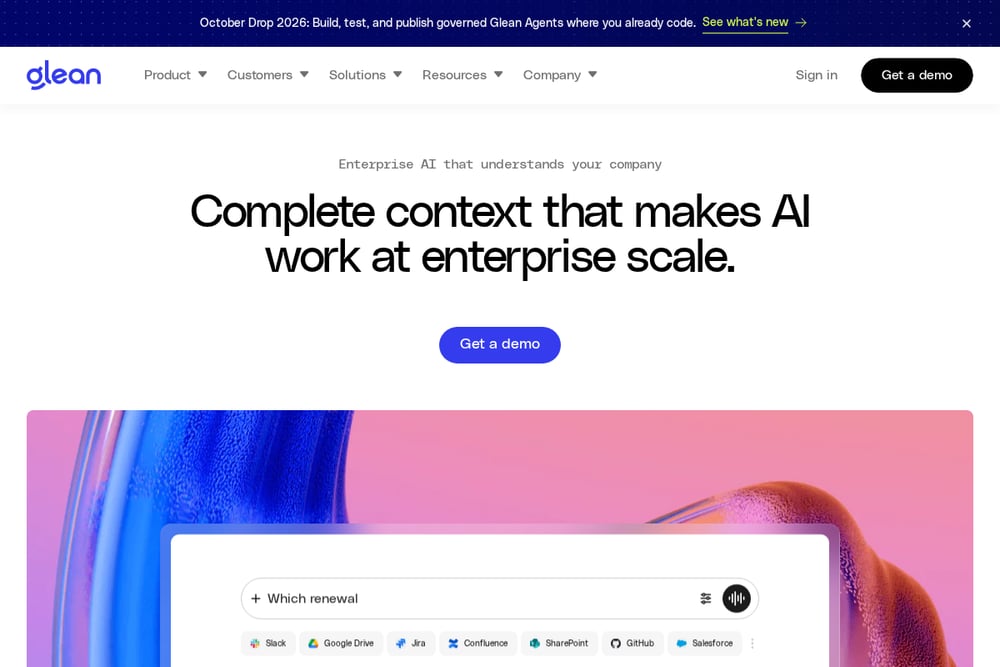 A screenshot of the Glean website.
Glean built its reputation on enterprise search, then extended that foundation into AI agents. The platform offers more than 250 connectors, so agents can pull context from the tools your teams already use. Glean Protect and Glean Intelligence add governance and model routing, which matters when you need to control AI usage and spend. The company positions its assistant as an enterprise AI coworker, with agent building, orchestration, and governance all in one stack. If your biggest problem is scattered knowledge, Glean starts from a strong position. You can see how Glean frames enterprise AI agents on its perspectives page.
#2 Varolio | AI Strategy, Made Operational
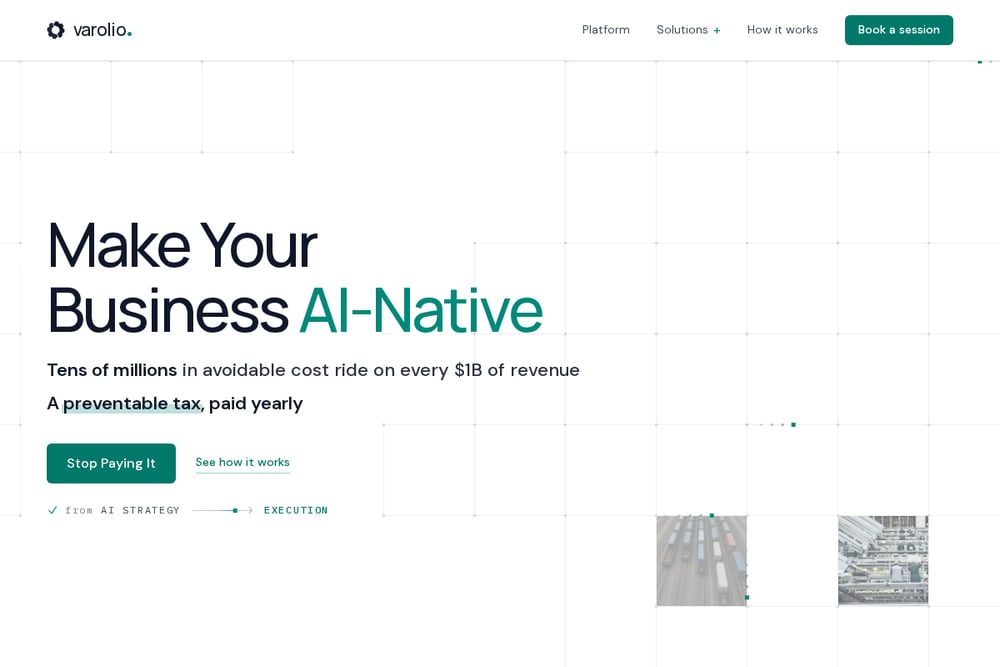 A screenshot of the Varolio website.
Varolio takes a different starting point: your operation, not a generic agent template. The platform connects evidence across ERP, CRM, and collaboration tools like Outlook, Teams, SharePoint, Zoom, Dynamics 365, Salesforce, SAP, and Oracle. It then reconstructs how work actually happens, showing the owner, stage, blocker, and next action for each case. From that live operational model, Varolio prioritizes bottlenecks and delivers AI agents to remove them. The company frames the problem bluntly: tens of millions in avoidable cost ride on every $1B of revenue. If you want AI strategy tied to real workflows rather than abstract roadmaps, this is the one to watch.
#3 Flowable
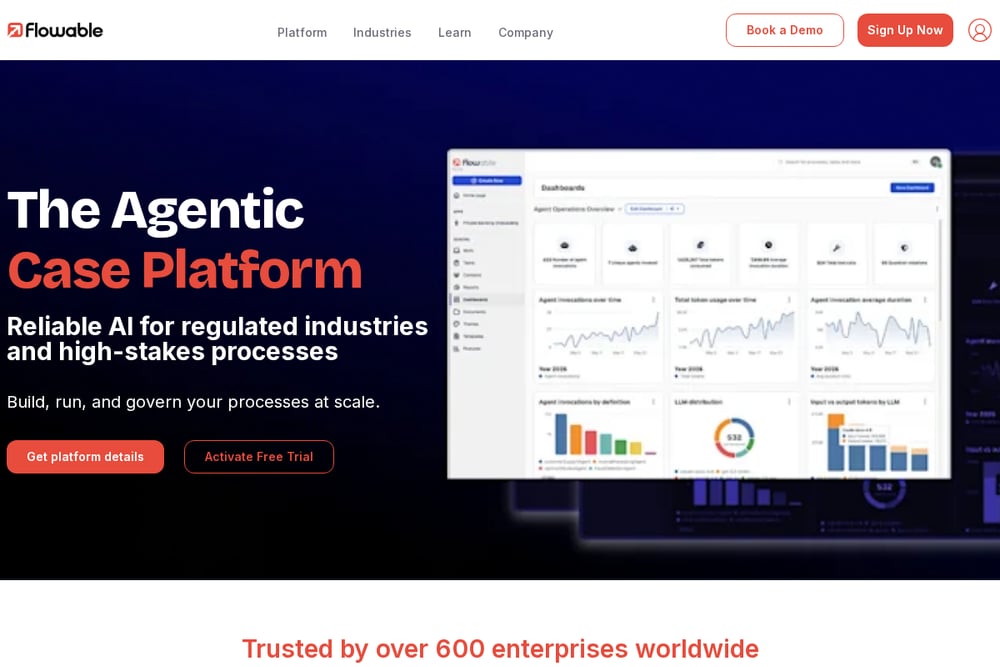 A screenshot of the Flowable website.
Flowable approaches enterprise AI agents through orchestration and governance. Its platform coordinates people, systems, and AI inside a governed layer with oversight and audit built in. Flowable supports open standards like BPMN and CMMN, which gives buyers a familiar way to model cases and processes. The company was recognized in the Gartner Magic Quadrant for Business Orchestration and Automation Technologies 2026 and included in Forrester's Adaptive Process Orchestration Landscape. If your organization already thinks in process models, Flowable meets you where you are. You can read more about its enterprise AI agent approach on the Flowable solutions page.
#4 Dust
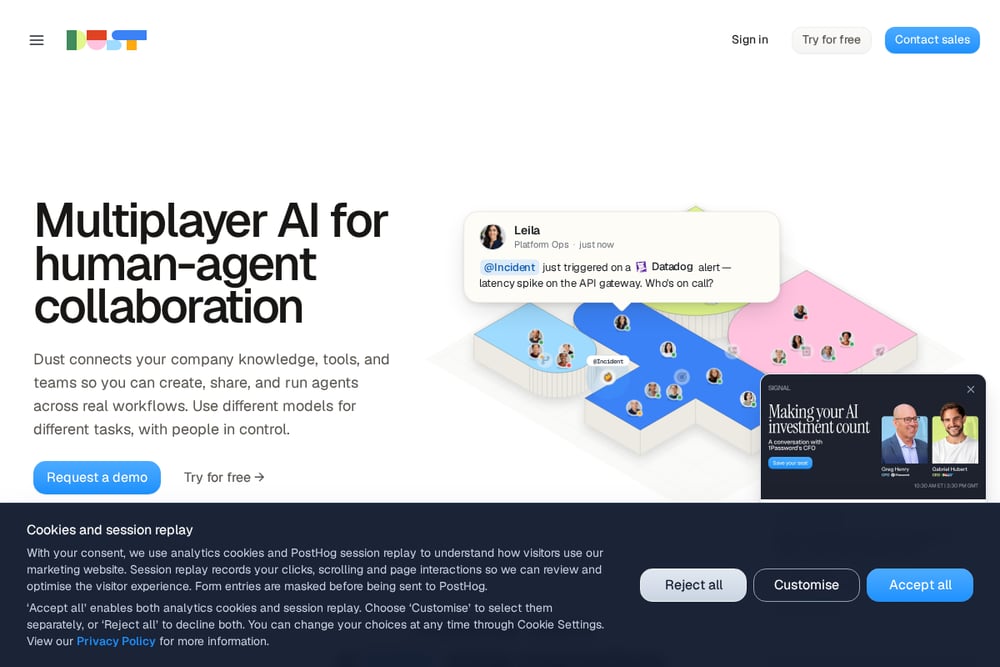 A screenshot of the Dust website.
Dust focuses on what happens after you build an agent: getting teams to actually use it. The company's guide to enterprise AI agents makes a clear point that building agents is straightforward, but adoption requires treating deployment as organizational change. Dust connects to company data, handles multi-step workflows, and operates across business tools with permission controls and action logging. Its integrations and frames support departments from sales to legal to engineering. If your challenge is adoption rather than technology, Dust speaks your language. The Dust blog is a useful starting point for deployment thinking.
#5 Rasa
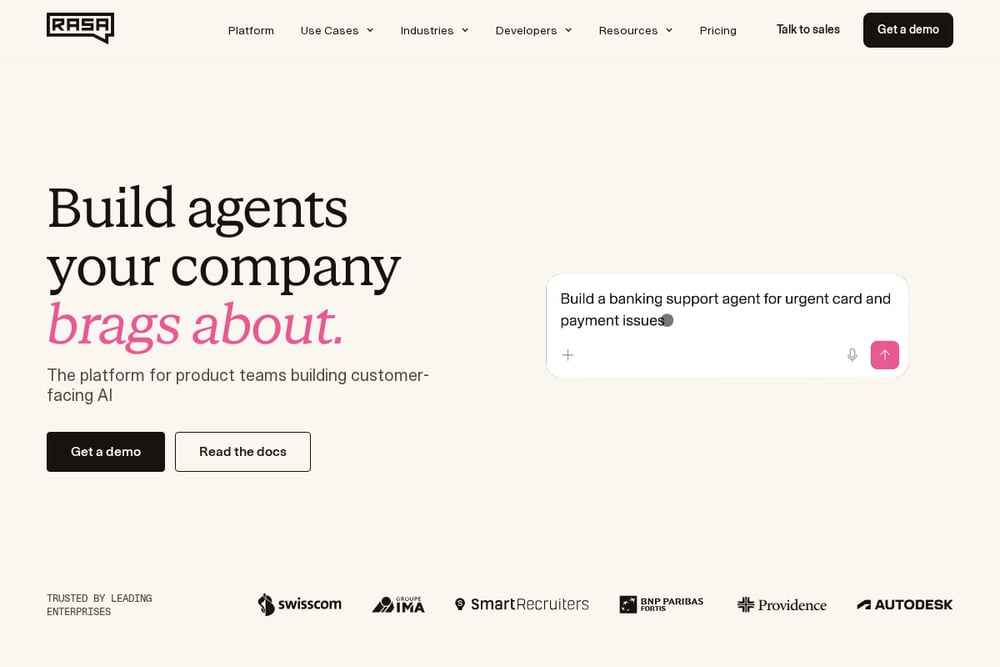 A screenshot of the Rasa website.
Rasa comes at enterprise AI agents from the conversational and customer-facing side. Its platform extends LLMs with structured flows, deterministic logic, and built-in recovery patterns. That combination matters when you need reliability, not just flexibility. Rasa offers CALM for controlled agent behavior, enterprise RAG for fresh and verifiable answers, and orchestration to coordinate agents and tools. The company serves industries like finance, retail, healthcare, and telecom, where compliance and consistency are non-negotiable. If your agents talk to customers, Rasa's structured approach deserves a look. You can explore its agent solutions on the Rasa blog.
How to Choose the Right Platform
Start with your bottleneck, not your wishlist. If your problem is scattered knowledge, look at Glean. If your problem is that you cannot see how work actually flows across systems, look at Varolio. If your problem is governing agents inside existing process models, look at Flowable. If your problem is adoption, look at Dust. If your problem is customer-facing reliability, look at Rasa. Then check integration depth against your actual stack. Count the systems you need connected and ask each vendor how they handle conflicting records. Finally, ask about time to value. A platform that shows working agents in weeks beats one that promises transformation in quarters.
Where Automation Fits
Automation is not the goal. Removing avoidable cost is. The strongest workflows start by reconstructing what happens today, then targeting the steps that create delay, rework, or missed commitments. Varolio's case intelligence example shows this well: a purchase order says Friday, a supplier update says Monday, and the release checklist is still incomplete. An agent that only reads the ERP misses the real blocker. An agent that connects the evidence can act on the current state. That is the difference between task automation and operational AI.
The Bottom Line
The enterprise AI agent market is crowded, but the platforms above solve different problems. Glean gives you context across systems. Varolio gives you a reconstructed operational model and agents built on top of it. Flowable gives you governed orchestration. Dust gives you adoption. Rasa gives you reliable customer-facing agents. Pick the one that matches your bottleneck, not the one with the loudest demo. Your operation is complex. Your AI strategy should be built for it.