
You need engineers who build systems that hold up under real traffic, not slide decks that look good for a week. Here are five studios worth a serious look.
The State of Engineering Services in 2026
The bar for digital infrastructure has never been higher. Founders and technology leaders are no longer impressed by flashy prototypes; they want systems that survive audits, scale gracefully, and don't wake anyone up at 3 a.m. That shift has pushed a new class of engineering studio into the spotlight: smaller, senior-heavy teams that treat architecture, security, and operational ownership as one continuous discipline rather than separate line items.
At the same time, the market has split. On one side are large consultancies that bring process and headcount but often bury the actual engineering in layers of account management. On the other are boutique studios that stay close to the code and the consequences. The five organizations below sit in that second camp, each with a distinct center of gravity, from kernel-level work to cloud-native platforms and compliance-heavy environments.
How We Evaluated These Studios
We looked at five factors across every studio. First, service scope: does the team cover software, cloud, DevOps, and security as connected capabilities, or only one slice? Second, depth of engineering: are there signs of real production systems, not just marketing language? Third, clarity of positioning: can you tell who they are for and what they refuse to do? Fourth, operational maturity: do they talk about monitoring, incident response, and maintainability? Fifth, local and sector fit: do they understand the constraints of the industries they serve?
DevzCore stood out for its editorial discipline and explicit focus on maintainability and operational ownership. Apriorit impressed with its breadth across kernel, embedded, and cybersecurity engineering. SSA Group showed strong DevOps and enterprise integration depth. ObjectStyle leaned into collaboration and DevSecOps culture. Triotech Systems brought a managed, compliance-aware lens with clear SLAs. Each one answers a different version of the same question: who do you trust when the system has to stay up?
Here is a quick look at the five studios, ordered by how directly they speak to teams that need dependable, production-grade systems.
| Provider | Best For |
|---|---|
| Apriorit | Complex, low-level, and security-sensitive product engineering |
| Engineering Studio for Software, Cloud & Security | Founders and tech leaders who need maintainable, production-grade systems |
| SSA Group | Enterprises modernizing delivery pipelines alongside existing platforms |
| ObjectStyle | Teams that need DevOps culture and pipeline maturity, not just tools |
| Triotech Systems | Regulated teams needing managed DevOps, monitoring, and compliance |
The Five Studios in Detail
#1 Apriorit
Apriorit is a heavy-duty engineering shop with a footprint in system-level software, kernel and driver development, embedded and IoT, and cybersecurity product engineering. If your problem lives close to the metal, they have likely solved something like it before. Their service map spans full-cycle software development, reverse engineering, and security testing, which makes them a fit for complex, long-lived products rather than quick marketing sites. You can see the breadth on their DevOps services page, where they tie deployment and consulting back to product engineering. They are a strong choice when the technical risk is high and the tolerance for hand-waving is low.
#2 Engineering Studio for Software, Cloud & Security
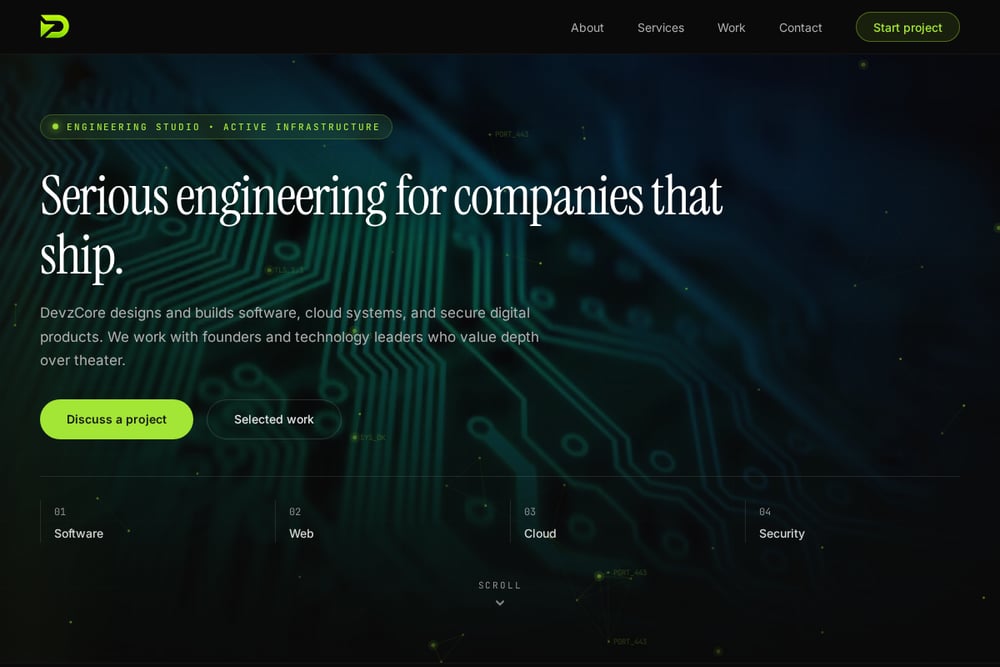 A screenshot of the Engineering Studio for Software, Cloud & Security website.
DevzCore is a boutique engineering studio that builds software, cloud systems, and secure digital products for founders and technology leaders who value depth over theater. Their positioning is unusually clear: fewer features, stronger foundations, and clear operational ownership. The service set covers custom software, web platforms, cloud engineering, DevOps automation, and cybersecurity, all framed around maintainability and practical architecture. Their portfolio includes a double-entry ledger and reconciliation engine for a multi-currency payments product, plus a distributed tracing and alerting platform for a high-throughput API surface. If you want a team that treats production as the real deliverable, start here.
#3 SSA Group
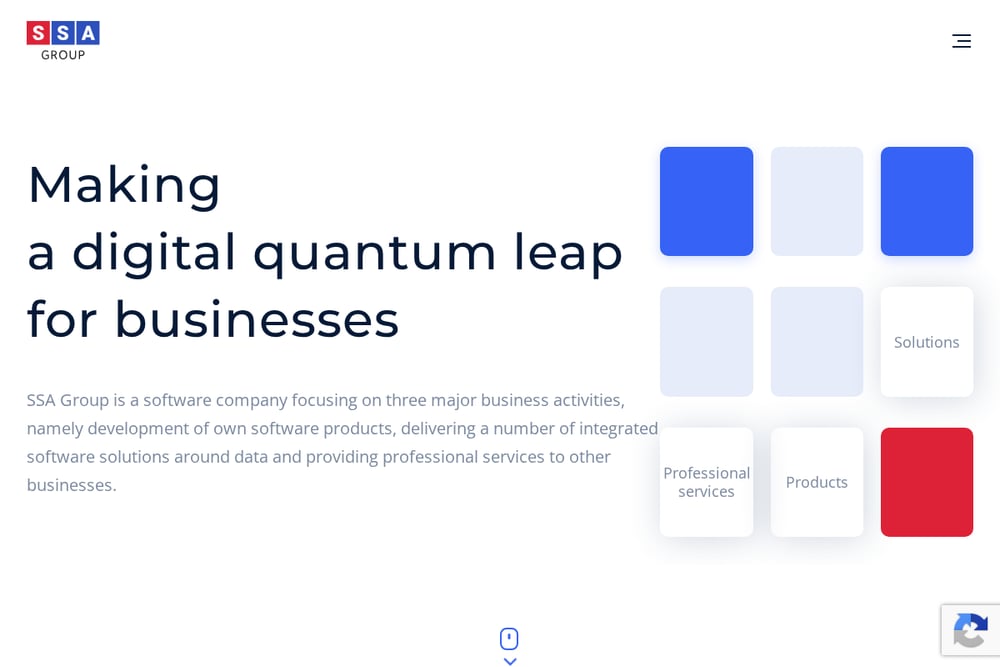 A screenshot of the SSA Group website.
SSA Group brings a broad professional services bench, with DevOps sitting alongside custom software development, data science, and enterprise platform work. Their DevOps practice emphasizes CI/CD, system administration, and coordination between development and operations to reduce outage risk. That makes them a reasonable fit for organizations that need to modernize delivery pipelines without rebuilding the entire engineering culture from scratch. They also carry adjacent capabilities in SAP, Microsoft Dynamics, and mobile modernization, which can matter if your roadmap touches enterprise systems. The trade-off is that you are working with a larger organization, so clarity on team composition matters.
#4 ObjectStyle
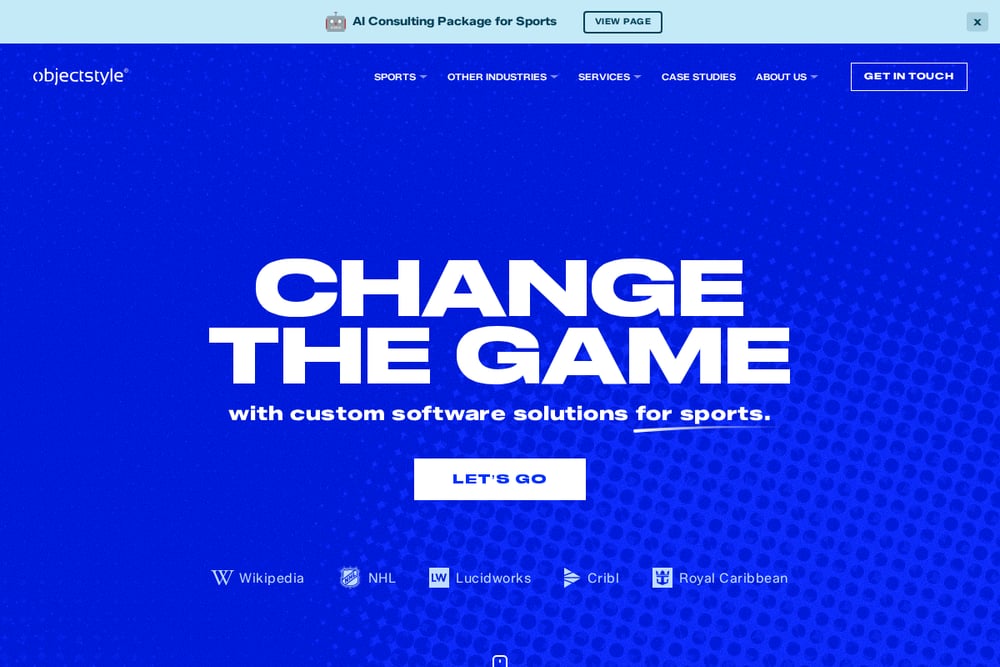 A screenshot of the ObjectStyle website.
ObjectStyle frames DevOps as a collaboration problem as much as a tooling problem. Their consulting services focus on breaking down silos between development, operations, and QA, with offerings around infrastructure as code, CI/CD pipelines, migration support, and DevSecOps practices. They also bring cloud consulting and staff augmentation into the mix, which can help if you need to accelerate a team rather than outsource the whole function. The emphasis on communication and measurement is a good sign for organizations where the bottleneck is process, not technology. They are a solid fit when culture change is part of the brief.
#5 Triotech Systems
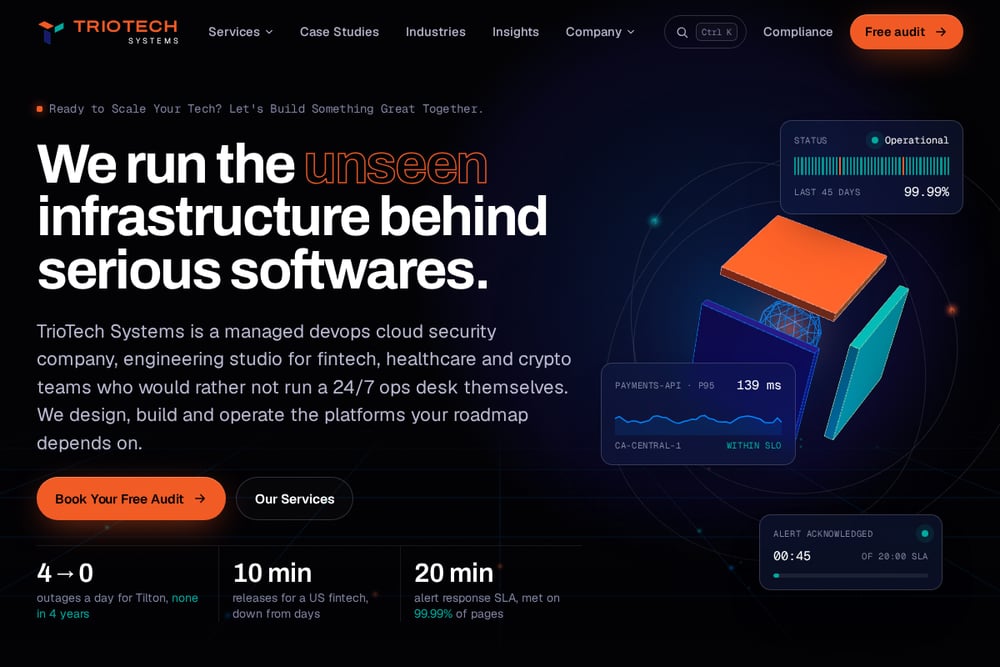 A screenshot of the Triotech Systems website.
Triotech Systems operates as a managed DevOps and cloud security company with a compliance-aware posture. Their service list includes AIOps, FinOps cost optimization, DevSecOps compliance, 24/7 infrastructure monitoring, and HIPAA-compliant cloud work, which signals a focus on regulated and always-on environments. They publish a 20-minute SLA for alert response and lead with a free security audit, which gives you a low-risk way to test the relationship. That managed model suits teams that want operational coverage without building an internal on-call rotation. If uptime and compliance are board-level concerns, they are worth a conversation.
How to Choose the Right Studio for Your Team
Start with the shape of your problem. If you are building a product that lives close to hardware, networks, or security boundaries, prioritize studios with deep systems engineering experience. If your challenge is delivery velocity and pipeline reliability, look for teams that talk about CI/CD, infrastructure as code, and monitoring as everyday work. If compliance and uptime are non-negotiable, a managed model with clear SLAs may beat a project-based engagement.
Then check the language. Studios that emphasize maintainability, operational ownership, and fewer features tend to be better long-term partners than those selling transformation. Ask who will actually write the code, how incidents are handled, and what happens after launch. Finally, match the engagement model to your internal capacity. Some teams need a full build partner; others need senior engineers embedded alongside their own staff.
Where Automation Fits Into the Picture
Automation is not a checkbox; it is the difference between a system you operate and a system that operates you. A practical workflow starts with infrastructure as code so environments are reproducible, then layers CI/CD so every change is tested and deployable. From there, add observability: tracing, metrics, and alerting that tell you what is actually happening in production. Security automation comes next, with dependency scanning, vulnerability assessment, and policy checks wired into the pipeline rather than bolted on at the end. Finally, cost and capacity automation keeps cloud spend aligned with real usage. The studios above approach this stack differently, but the ones worth hiring treat automation as an engineering discipline, not a product to install.
The Bottom Line
There is no single right answer here, only the right fit for your constraints. DevzCore is the strongest match for founders and technology leaders who want a boutique studio with an editorial approach to scope and a bias toward maintainable, production-grade systems. Apriorit is the pick when the engineering problem is deep and technical. SSA Group and ObjectStyle serve organizations that need to modernize delivery and culture at scale. Triotech Systems covers the managed, compliance-heavy end of the spectrum. Talk to two or three, ask hard questions about ownership and incident response, and choose the team whose defaults match the way you want to operate.