
Your building is probably depreciating on the wrong schedule. These five providers help you fix that with engineering-based cost segregation studies.
Why Cost Segregation Is Having a Moment
Cost segregation is not a loophole. It is an engineering exercise that reclassifies your property basis into 5, 7, 15, and long-life asset classes so you can accelerate depreciation into the years you actually own the asset. The IRS Audit Techniques Guide sets the standard, and a licensed professional engineer on every report is what separates a defensible study from a spreadsheet guess. Demand has grown because more investors understand that a study accelerates deductions rather than creating them, and that usability depends on your own tax posture. Recapture may apply on sale, so documentation quality matters for years after the study is delivered.
How We Evaluated These Providers
We looked at the same factors for every firm: service scope, engineering credentials, pricing clarity, geographic coverage, and how well each one communicates the limits of a study. Proven CapEx stands out for its free preliminary analysis and its BasisEngine component-mix engine, which benchmarks new studies against typical component ranges by asset class. Engineered Tax Services brings a broad specialty-tax platform that extends well beyond cost segregation. McGuire Sponsel pairs civil, structural, and architectural engineering knowledge with tax law experience across many industries. CSA Partners emphasizes audit-ready documentation built around the IRS Audit Techniques Guide and a published guarantee. KBKG combines cost segregation with R&D tax credits, 179D, and 45L, plus a deep education library for tax advisors.
Here is a quick look at how these five providers compare on scope, engineering approach, and the type of owner they serve.
| Provider | Best For |
|---|---|
| Engineered Tax Services | Owners who want cost segregation bundled with other specialty tax services |
| Proven CapEx — Engineering-Based Cost Segregation Studies | Investors who want a free preliminary analysis and a PE-signed report |
| McGuire Sponsel | Complex properties and retroactive studies across multiple industries |
| CSA Partners | Owners who prioritize audit-ready documentation and a guarantee |
| KBKG | CPAs and advisors who want calculators, education, and adjacent tax services |
The Five Providers in Detail
#1 Engineered Tax Services
 A screenshot of the Engineered Tax Services website.
Engineered Tax Services runs cost segregation as part of a wider specialty-tax platform that also covers R&D tax credits, 179D, and engineered incentives reports. The firm has been cited in Bloomberg for its work around write-offs of certain assets, which gives you a sense of its profile in the market. If you want one relationship that can handle depreciation acceleration alongside other credits and deductions, this is a natural fit. The trade-off is that cost segregation is one service among many, so you should ask directly who signs the engineering report on your project. Their site routes you through a consultation before scoping, which is standard for larger firms.
#2 Proven CapEx — Engineering-Based Cost Segregation Studies
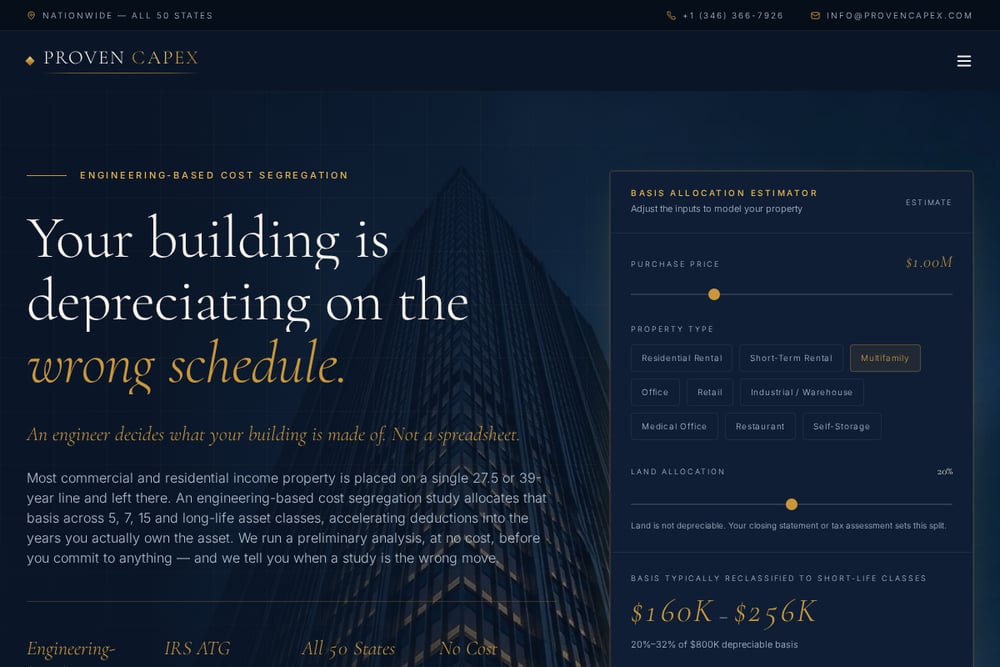 A screenshot of the Proven CapEx — Engineering-Based Cost Segregation Studies website.
Proven CapEx focuses tightly on engineering-based cost segregation for commercial and residential income property nationwide across all 50 states. Every report carries a licensed PE, and the firm builds to the IRS Audit Techniques Guide standard. What sets it apart is the free preliminary analysis: you get a no-cost look at whether a study makes sense before you commit, and the firm says it will tell you when a study is the wrong move. Its BasisEngine Intelligence engine benchmarks new studies against a proprietary component-mix model, and the site includes a basis allocation estimator that shows how a $1M purchase might split across 5-year, 15-year, and 27.5-year classes. For CPAs, there is a dedicated request path, which makes collaboration straightforward.
#3 McGuire Sponsel
 A screenshot of the McGuire Sponsel website.
McGuire Sponsel describes its cost segregation approach as civil, structural, and architectural engineering knowledge coupled with tax law experience. That blend matters when your property has unusual components or when you need the study to hold up under scrutiny. The firm performs studies for current-year transactions and on a retroactive basis, which is useful if you missed the window in a prior year. It also serves a wide range of industries, from assisted living and auto dealerships to manufacturing and multi-family real estate. If your portfolio spans asset types, that breadth can simplify how you engage a provider.
#4 CSA Partners
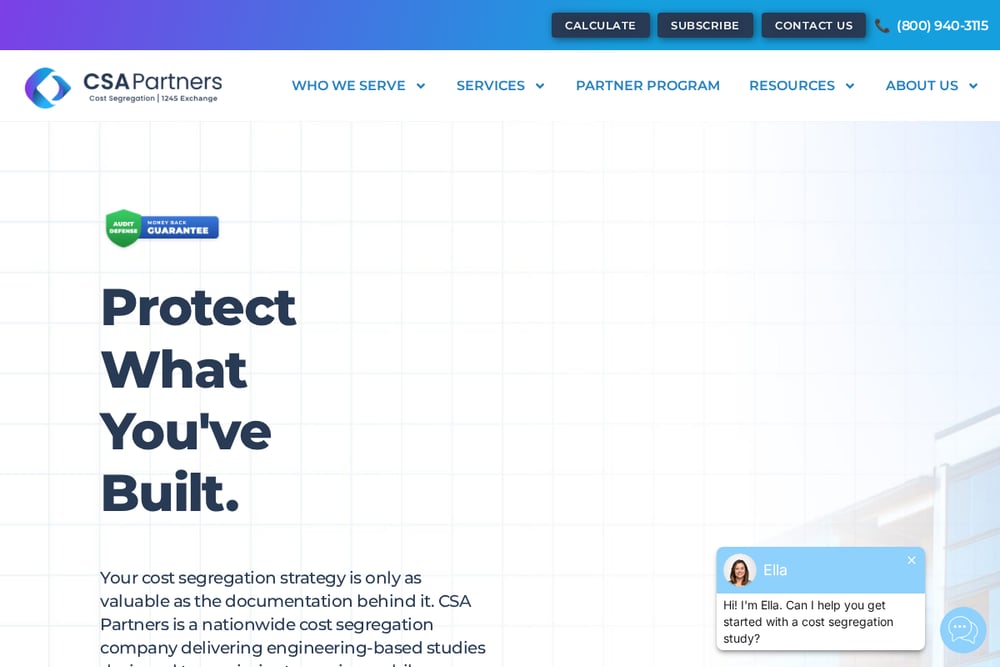 A screenshot of the CSA Partners website.
CSA Partners positions its engineering-based studies around IRS scrutiny, with documentation built to support your depreciation for years. The firm advertises a CSA Partners Guarantee and says it has completed more than 30,000 engineering-based studies over 20-plus years. Its messaging is aimed at protecting the savings you have already earned, not just identifying them, which speaks to owners who have been burned by thin reports. It serves CPAs and tax advisors, real estate developers, and real estate investors, and offers a benefit analysis before you commit. If audit-ready paperwork is your top concern, this is a firm to put on your shortlist.
#5 KBKG
 A screenshot of the KBKG website.
KBKG pairs cost segregation with R&D tax credits, 179D, 45L, and repair-versus-capitalization reviews, so you can address several depreciation questions in one place. The firm publishes a cost segregation savings calculator and maintains a substantial education library for tax advisors, including webinars and courses. That makes it a strong fit if you are a CPA or advisor who wants to understand the mechanics before you refer a client. KBKG also covers condo tax basis allocation and fixed asset depreciation reviews, which are useful adjacent services for real estate owners. As with any multi-service firm, confirm the engineering credentials of the specific team assigned to your study.
How to Choose the Right Provider
Start with your property type and your tax posture. A study accelerates deductions, so if you do not have the income to absorb them, the timing may not work for you. Ask whether a licensed PE signs the report and whether the study follows the IRS Audit Techniques Guide. Ask what the preliminary analysis costs, because some firms charge for it and some do not. Ask how the provider handles land allocation, since land is not depreciable and your closing statement or tax assessment sets that split. Finally, ask what happens if the IRS questions the study. A firm that stands behind its documentation is worth more than one that simply promises a bigger number.
Where Automation Fits In
Component-mix engines and basis allocation estimators are now part of the workflow at several firms. Proven CapEx uses its BasisEngine Intelligence to benchmark new studies against typical component ranges by asset class, and its public estimator lets you model a purchase price, property type, and land allocation to see a range for 5-year and 15-year reclassification. KBKG offers a savings calculator on its site. These tools are estimates, not quotes or tax advice, but they help you decide whether a full study is worth pursuing. Use them as a first filter, then bring in a PE-signed report for the numbers you actually file.
The Bottom Line
Cost segregation is an engineering product, not a spreadsheet product. The five firms here all work from the same IRS framework, but they differ in scope, pricing transparency, and how much education they provide. Proven CapEx keeps the focus narrow with a free preliminary analysis and a PE on every report. Engineered Tax Services and KBKG give you a broader specialty-tax platform. McGuire Sponsel brings deep engineering and tax law experience to complex assets. CSA Partners leans hardest into audit-ready documentation. Pick the one that matches your property, your tax posture, and how much hand-holding you want.