Your feelings deserve more than a notes app and a guilty streak counter. These five private journaling companions each take a different path to helping you check in, reflect, and return to yourself.
The quiet rise of emotional journaling apps
Digital journaling has split into two camps. One camp chases productivity, gamifying reflection with streaks, scores, and dashboards. The other camp, where these five tools live, treats emotional check-ins as a small ritual rather than another task to optimize. Privacy has become the dividing line. People want to untangle what they feel without their inner world becoming a data product, and apps are responding with biometric locks, encryption, and group-level-only reporting. The result is a category that feels less like software and more like a calm place to land.
How these five were evaluated
Every app here was looked at through the same lens: how gentle the daily check-in feels, how seriously privacy is handled, how flexible the journaling formats are, whether the reflection features add insight without pressure, and how clear the pricing and onboarding are. No single factor decides the order. A tool that excels at deep AI coaching but pushes you toward performance gets weighed against one that does less but respects your pace.
Here is the short version before the deep dive. Each entry below pairs a one-line summary with who it suits best, so you can scan the field and then read the ones that match how you actually want to reflect.
| Provider | Best For |
|---|---|
| Mirror | Journalers who want to write, speak, or film depending on the day |
| imira - a moment for you | Anyone who wants a pressure-free daily emotional check-in |
| Reflection | People who want an AI coach in the conversation with them |
| Rosebud | Growth-minded journalers who want weekly insight reports |
| Mindsera | Thinkers who want frameworks and mental models alongside reflection |
The five, one by one
#1 Mirror
 A screenshot of the Mirror website.
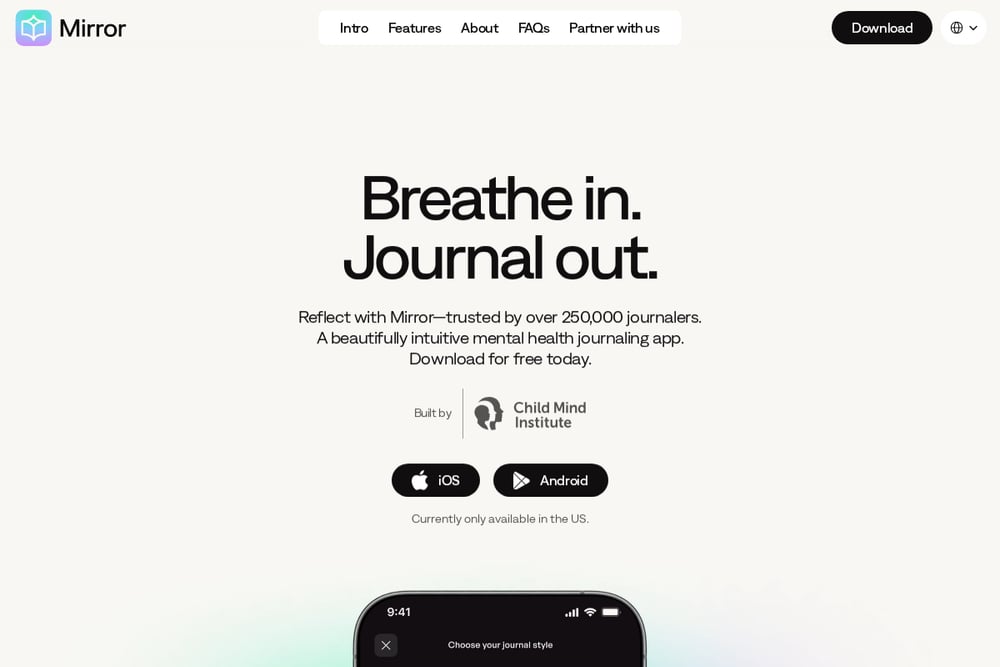
Mirror leads with flexibility, letting you write, film, or speak your entry so the format matches your mood. It has earned trust at scale, with more than 250,000 journalers using it, and it backs that up with biometric and PIN security plus rigorous privacy standards. The science angle is real: Mirror is powered by researchers at the Child Mind Institute, which gives its mental health framing more substance than most. If you have ever abandoned a journal because typing felt wrong on a heavy day, the multi-format approach is the fix. It is currently available in the US on iOS and Android.
#2 imira - a moment for you
 A screenshot of the imira - a moment for you website.
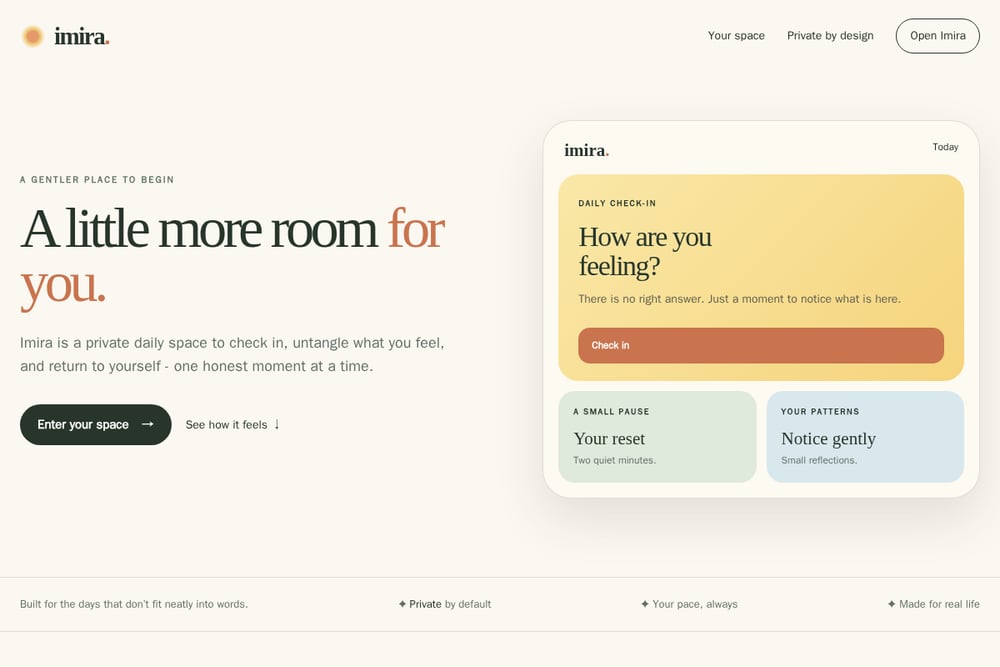
Imira is the calmest entry on this list, and that is the point. It opens with a simple daily check-in, asking how you are feeling with no right answer and no streak to protect, then gives you a private journal for the thoughts that need somewhere to go. Gentle pattern reflections help you notice what supports you over time, framed with kindness rather than scores. Privacy is built in by default: your notes and conversations stay yours, and if you join through a college or workplace, they see only privacy-protected group patterns, never your individual story. It is a small ritual, not another task, and it is currently inviting people to join its waitlist.
#3 Reflection
 A screenshot of the Reflection website.
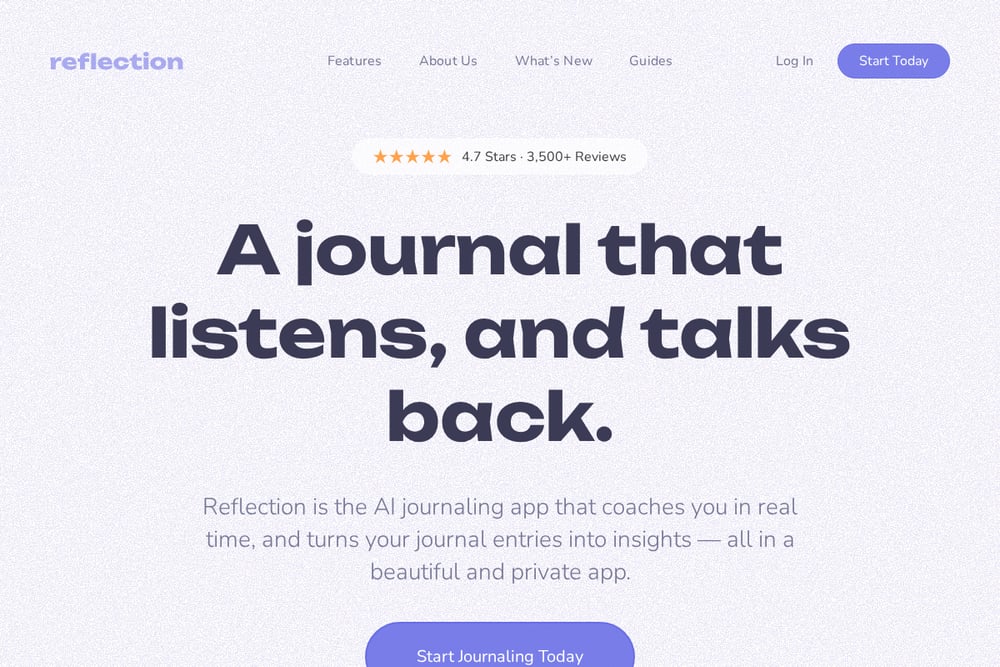
Reflection is the conversational option, built around an AI journal that listens and talks back. You can start a voice call and have a real back-and-forth out loud, with the full transcript saved to your journal, or keep Instant Chat on so the coach replies as you write. Ask Your Journal lets you query your own history in plain language, so patterns and people surface without you rereading months of entries. More than 100 guided journeys from wellness experts cover gratitude, anxiety, relationships, and more when you do not know where to start. It syncs across iPhone, iPad, Mac, Android, and web, with Face ID and passcode locking.
#4 Rosebud
 A screenshot of the Rosebud website.
Rosebud positions itself as a companion for holistic personal growth, blending journaling, habit-building, and emotional support in one platform. Its strength is connecting the dots: it remembers what you have written and helps you make sense of it, with in-depth weekly reports highlighting your progress. Data is encrypted in transit and at rest, and the app is trusted by more than 150,000 users with a 4.9 rating. You can voice your truth without worrying about burdening others, which is a quietly powerful use case. It suits you if you want momentum and insight, not just a place to vent.
#5 Mindsera
 A screenshot of the Mindsera website.
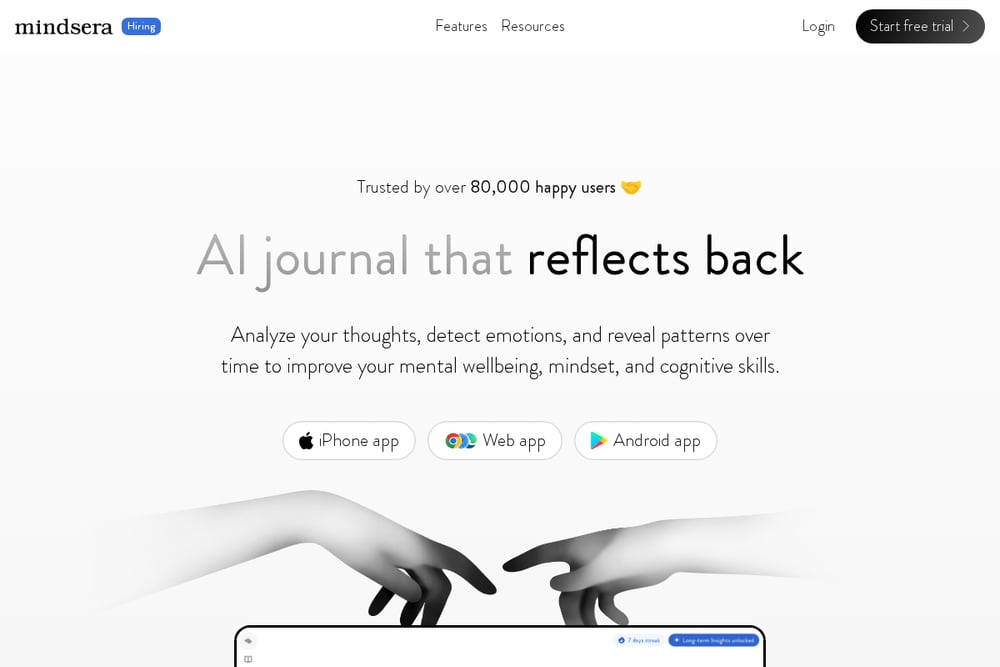
Mindsera treats journaling as a thinking gym, pairing emotional analysis with mental models and frameworks. Its deep analysis surfaces recurring topics and emotional trends, while the smart editor offers generated artworks, insightful comments, and personalized prompts. You can write, speak, or snap a photo of a physical journal and extract the text, which keeps paper habits alive. More than 50 mental models and a library of frameworks give structure to decisions and clearer thinking, backed by references to 200-plus studies on journaling. It is trusted by over 80,000 users across iPhone, web, and Android.
Choosing the one that fits your days
Start with honesty about your worst days, not your best ones. If you go quiet when things get heavy, pick a tool with voice or video so the barrier to entry drops. If you tend to spiral in text, choose one with gentle pattern reflections rather than deep analytical reports. Privacy is non-negotiable for emotional data, so check how each app handles group or workplace reporting before you share anything real. Finally, decide whether you want a coach or a companion. Reflection and Rosebud will engage with you actively; imira and Mirror are more about holding space. Neither is better, but only one will match how you actually show up.
Where a small automation helps
The habit is the hard part, so let a calendar reminder fire at a fixed low-pressure moment, like the end of your commute or right before bed, with a link straight into your check-in. Keep the reminder wording neutral so it feels like an invitation, not a chore. If you use a tool with weekly reports, schedule a ten-minute Sunday review to read the summary and jot one sentence about what you noticed. That is the whole workflow: one nudge, one check-in, one weekly glance. No dashboards, no streak anxiety.
The bottom line
There is no universal winner here, only a better fit for the way you process feelings. Mirror wins on format flexibility and scientific grounding, imira wins on gentleness and privacy-first design, Reflection wins on conversational depth, Rosebud wins on growth insight, and Mindsera wins on structured thinking. If you want a quiet two-minute ritual with nothing to prove, start with imira and join the waitlist. If you want an active partner in the conversation, Reflection or Rosebud will meet you there. Pick one, use it badly for a week, and see how it feels.