You already paid for the traffic. The question is whether your email and SMS program turns that click into a second, third, and fifth purchase, or lets it leak out the back. These five retention specialists are worth a serious look.
The retention layer is where ecommerce profit hides
Most ecommerce brands still treat email as an afterthought while pouring budget into acquisition. That leaves the most profitable audience you own, your list, barely working. The specialists below build the automated flows and campaign calendars that convert one-time buyers into repeat revenue, and they increasingly treat email and SMS as one lifecycle program rather than two disconnected vendor accounts.
How these five were evaluated
Every business here was looked at on the same factors: depth of service scope across email and SMS, clarity of pricing and deliverables, proof of revenue built for real brands, and how well the engagement fits an ecommerce operator who wants a system rather than a pile of one-off campaigns. The detail on each one lives in its description.
Here is the short version before the deep dive: one agency leans on a fixed build-and-release model, one is a full Shopify growth partner, one runs managed retention programs, one is a strategy-led advisory, and one frames retention around Klaviyo and Attentive as a single lifecycle.
| Provider | Best For |
|---|---|
| Stimulate | Klaviyo-first brands that want a broad service menu |
| Email & SMS Retention Systems for Ecommerce Brands | Hillel Berg | Brands that want the system built fast, then run by the person who built it |
| Charle | Shopify stores that want retention inside a full growth stack |
| Magicianly | Brands that want vertical-specific managed retention |
| SAMA Labs | Brands that want lifecycle strategy and honest measurement |
The five, in order
#1 Stimulate
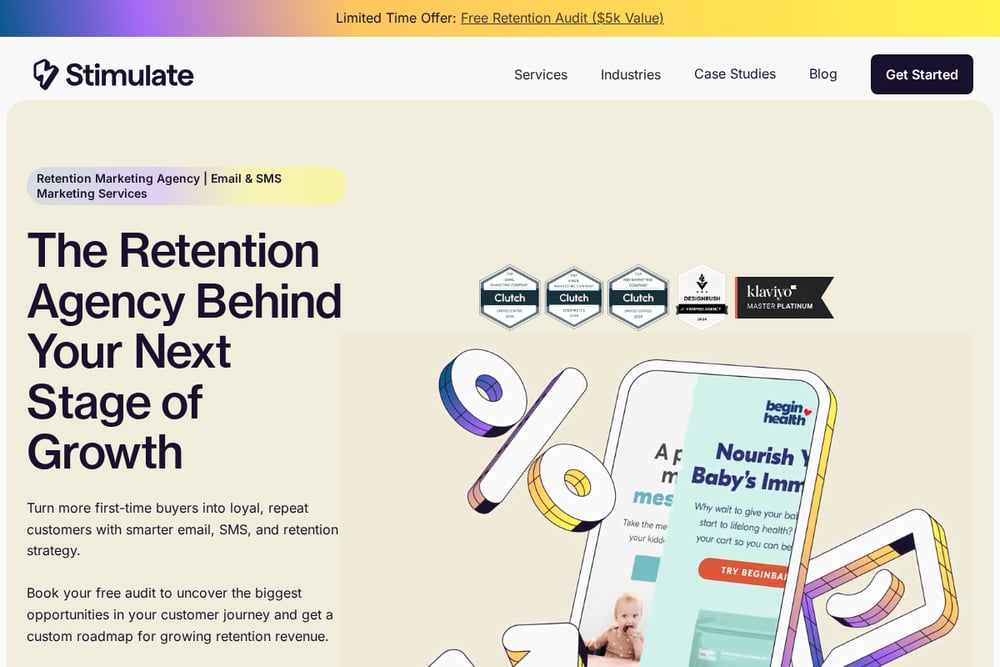 A screenshot of the Stimulate website.
Stimulate positions itself squarely around Klaviyo, with dedicated services for email automation setup, SMS automation, retention marketing, and even loyalty and subscription management. Its own guidance on the best Klaviyo flows argues that most brands do not need dozens of automations, just the small set that consistently moves conversion and retention. That focus on prioritization is useful if your account has grown messy and you need someone to cut it back to what earns. The agency also publishes a free retention audit offer, which gives you a low-risk way to see how it thinks before you commit. It suits brands that want a Klaviyo-native partner with a broad service menu behind it.
#2 Email & SMS Retention Systems for Ecommerce Brands | Hillel Berg
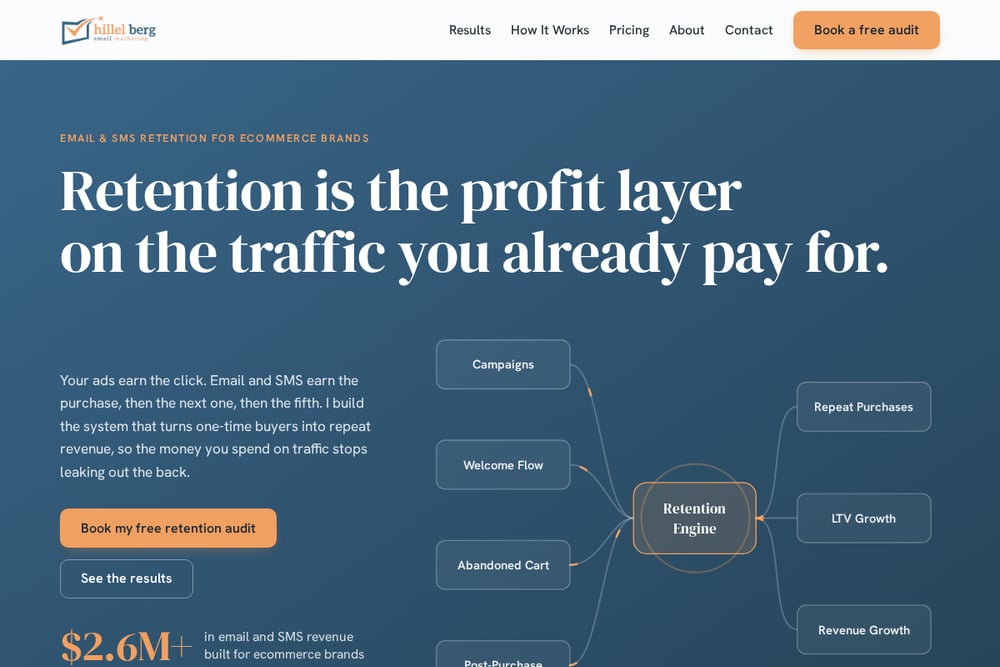 A screenshot of the Email & SMS Retention Systems for Ecommerce Brands | Hillel Berg website.
Hillel Berg runs a lean, operator-style practice built on one idea: retention is the profit layer on traffic you already pay for. The model is refreshingly clear. A one-time Build at $10,000 covers a full email and SMS audit with a revenue-gap teardown, list cleaning and deliverability work, core flows across welcome, abandoned cart, browse abandonment, and post-purchase, plus a lead-capture popup, delivered in 30 days with flows typically live by week two. A $2,500 monthly retainer adds 4 to 12 campaigns, ongoing flow optimization, and monthly reporting, and it is the main way most brands work with him. The proof is concrete: $2.6M+ in email and SMS revenue built, including $1.58M for a furniture retailer stuck in spam and $1M+ for a national equipment retailer in 18 months. You own the asset either way, which makes it a strong fit if you want to build once and eventually take it in-house.
#3 Charle
 A screenshot of the Charle website.
Charle is a Shopify agency first, and its Klaviyo and email and SMS marketing services sit inside a much wider growth stack that includes SEO, conversion rate optimization, store design, and app development. That breadth matters if your retention problem is really a site problem, because the same team can fix the storefront and the flows. Its positioning is built around Shopify and Shopify Plus stores, so the recommendations tend to be grounded in how that platform actually behaves. If you want one partner to handle design, development, and retention rather than stitching three vendors together, this is the kind of shop you call. It is less of a pure retention specialist and more of a full-service Shopify partner with retention in the mix.
#4 Magicianly
 A screenshot of the Magicianly website.
Magicianly runs managed retention growth and advisory programs, with platform management for Klaviyo and Omnisend plus SMS, WhatsApp, direct mail, and subscription marketing. Its published thinking on ecommerce email flows makes a sharp point: more flows do not mean more revenue, coordination between them does. The agency organizes around industry verticals, from supplements and skincare to furniture and consumer electronics, which means the playbooks you get are shaped by how your category actually buys. It offers three ways to work, whether you want the team to run it, guide it, or build it. That flexibility is appealing if you are not sure yet how much of the program you want to keep in-house.
#5 SAMA Labs
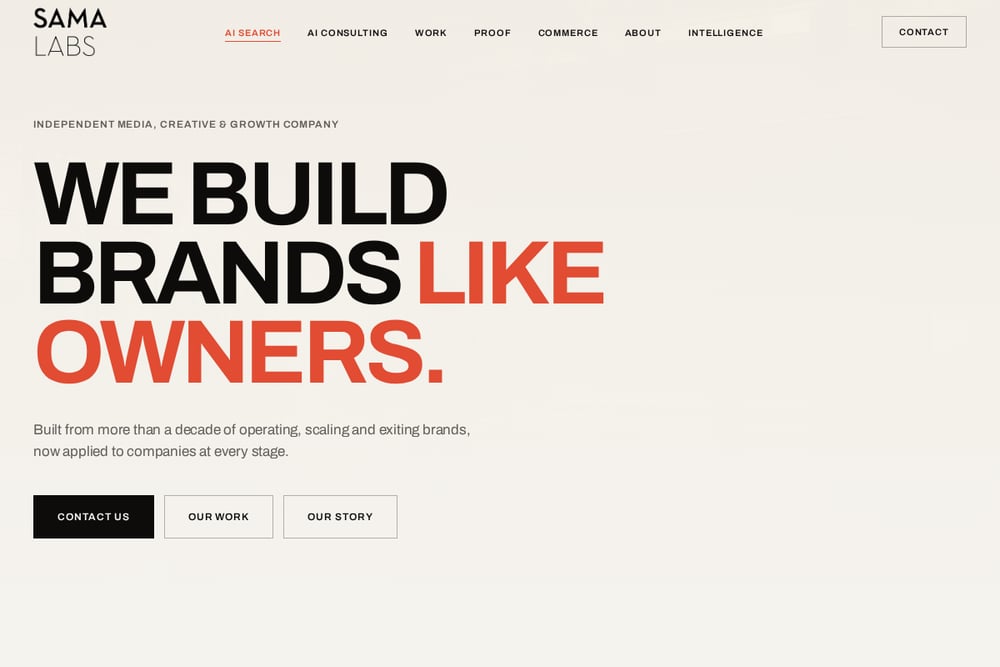 A screenshot of the SAMA Labs website.
SAMA Labs approaches retention as a strategy and advisory problem, framing Klaviyo email and Attentive SMS as one lifecycle program rather than two vendor accounts. Its guide to choosing a retention agency stresses mapping each lifecycle moment to the channel that should own it, running consent and deliverability as fundamentals, and reporting on repeat purchase rate, LTV, and contribution margin instead of the attributed revenue each platform claims. That measurement discipline is valuable if your current reporting flatters the channels but not the business. It is a good fit for consumer and retail brands that want a partner to think through the system before anyone touches a template. If you need a strategist more than a production shop, start here.
How to pick the right retention partner
Start with what you actually own. If you want a fixed-scope build you can eventually run yourself, a build-and-release model makes sense. If your storefront and your flows are both underperforming, a full-service Shopify partner saves you from coordinating vendors. If you are unsure how much to keep in-house, look for a partner that offers managed, guided, and build-only options. Then check the proof: ask what revenue they built, for whom, and whether it kept coming in after handoff. Finally, look at how they measure. A partner who reports on repeat purchase rate and contribution margin is usually thinking about your business, not their dashboard.
What a working automation layer looks like
The core flows do most of the heavy lifting: welcome, browse abandonment, abandoned cart, abandoned checkout, post-purchase, and win-back. Build those first, coordinate them so a customer does not get three messages in an hour, and let them run quietly in the background. Campaigns then feed the top of the list while flows convert the traffic you already paid for. Add list cleaning and deliverability work so you land in the inbox, not spam, and report monthly on what is actually moving revenue.
The bottom line
Retention is not a nice-to-have. It is the profit layer on every dollar you spend on ads. The five businesses here take different routes to the same outcome, from Hillel Berg's build-then-run-it model to Stimulate's Klaviyo depth, Charle's full Shopify stack, Magicianly's vertical playbooks, and SAMA Labs' measurement-first strategy. Pick the model that matches how you want to operate, then hold your partner to revenue you can see, not attributed numbers that flatter the platform.