
Your customers run out. The reorder either comes to you or it goes to whoever shows up in their feed next. These five partners exist to make sure it comes to you.
Why retention engineering became the highest-leverage channel in 2026
Paid traffic is rented. Your list is owned. That gap got wider this year, not narrower. Gmail now rejects unauthenticated mail at the server rather than quietly filtering it, and Outlook has enforced the same posture for domains sending over 5,000 messages a day since May 2025. Open rates stopped being a usable signal the moment Apple's Mail Privacy Protection inflated more than half of all opens. Klaviyo itself says attribution does not prove causation, which means the only honest way to report email revenue is a holdout test. On top of that, Klaviyo's 2026 research found only 13% of consumers fully trust AI, so generic generated copy is now a liability rather than a shortcut. For replenishment and subscription brands doing $100K to $500K a month, the math is unforgiving. Every missed re-buy is paid for twice: once in the revenue you did not book, and again in the acquisition cost you spend to replace it. The partners below are built around that specific problem.
How we evaluated these five
We looked at the same factors across every partner. Service scope: does the partner own deliverability, segmentation, and flow architecture, or just campaigns? Pricing clarity: is the commercial model published and legible, or does it hide behind a discovery call? Fit for replenishment and subscription economics: does the partner talk about LTV, CAC payback, and cohort curves, or open rates? Proof standard: does the partner offer a holdout or incremental measurement, or lean on platform attribution? Local and platform fit: US-based coverage, Shopify and Klaviyo depth, and SMS compliance handling. Acquisition Labs stood out for tying its fee to revenue beating a baseline, with a build fee paid once and monthly fees only in months lift is proven. YOCTO stood out for pairing a free Klaviyo audit with a narrow vertical focus on supplements, beauty, and femtech. Sweat Pants Agency stood out for publishing flow-lift ranges and BFCM revenue figures you can check. The Email Marketers stood out for publishing an actual rate card and a 100-point rubric you can re-weight yourself. Sticky Digital stood out for a complimentary Klaviyo migration and BFCM audit offer that lowers the cost of switching.
Here is the short version before the detail. Five partners, five different commercial models, one shared premise: email and SMS should be measured in incremental revenue, not in sends.
| Provider | Best For |
|---|---|
| YOCTO | Supplement, beauty, and femtech brands that want vertical-specific SMS and email |
| Acquisition Labs · Email revenue architects for replenishment brands | Shopify replenishment brands at $100K–$500K/month with email under 15% of revenue |
| Sweat Pants Agency | Ecommerce brands that want published benchmarks and auditable flow-lift numbers |
| The Email Marketers | Brands that want published pricing and a re-weightable evaluation rubric |
| Sticky Digital | Brands that want a free Klaviyo migration and pre-BFCM audit before committing |
The five partners, in order
#1 YOCTO
 A screenshot of the YOCTO website.
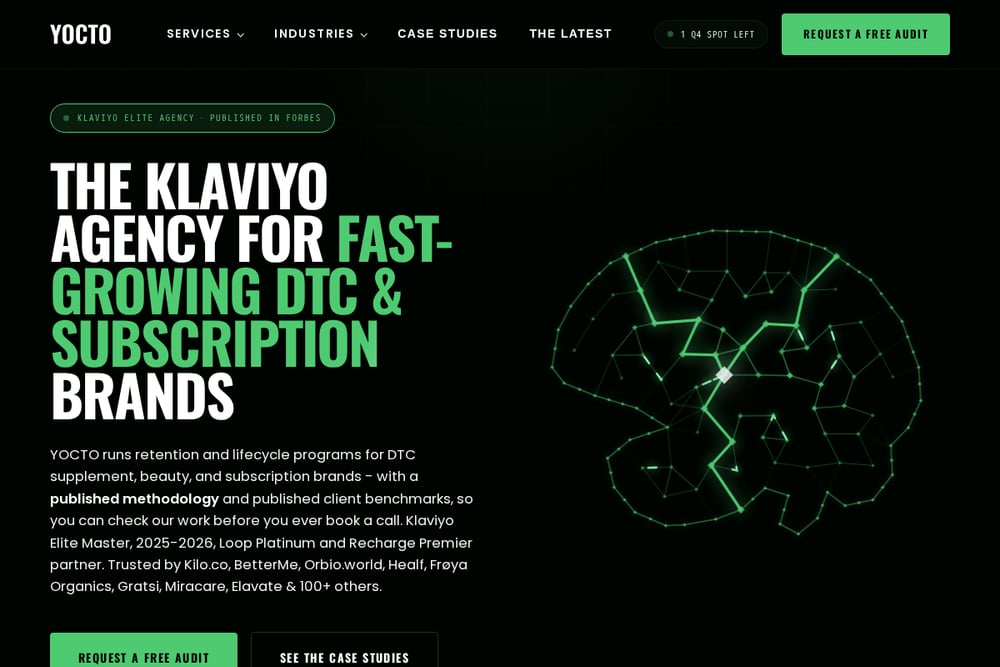
YOCTO runs SMS and email programs for DTC and subscription brands, with a stated vertical focus on supplements and wellness, beauty and skincare, and femtech and fertility. That narrowness matters, because reorder timing in supplements looks nothing like reorder timing in skincare. The agency leads with a free Klaviyo audit that you keep, which is a low-risk way to see how they think before you commit. Their positioning is blunt about the failure mode most brands hit: blasting the whole list burns your best customers and pushes the rest to mute. They also cover WhatsApp and direct mail, so retention does not stop at the inbox. If you want a partner who already knows your category's reorder curve, this is the one to call first.
#2 Acquisition Labs · Email revenue architects for replenishment brands
 A screenshot of the Acquisition Labs · Email revenue architects for replenishment brands website.
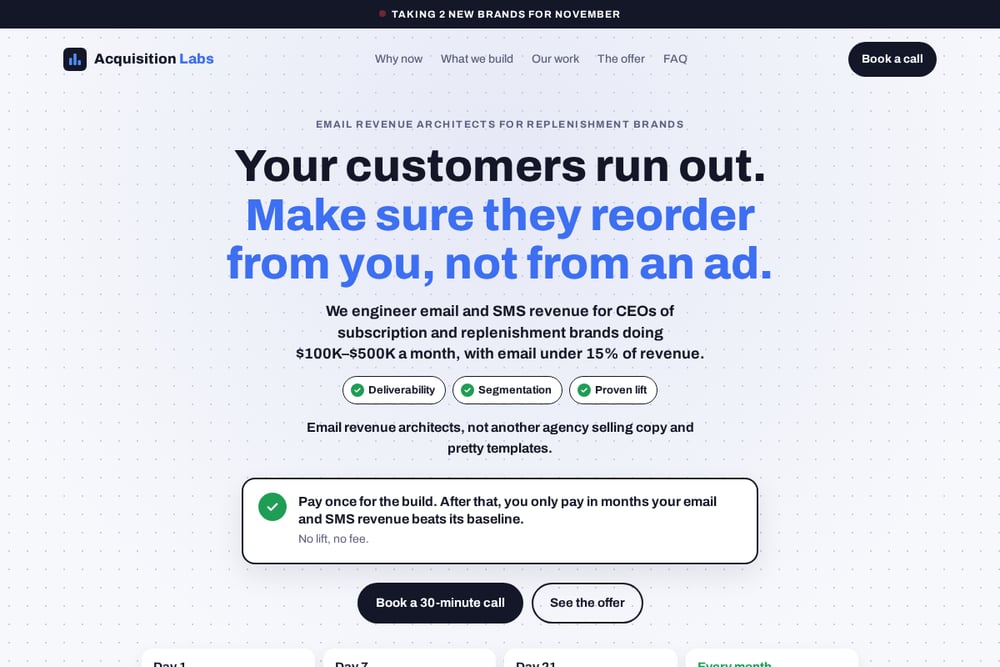
Acquisition Labs engineers email and SMS revenue specifically for Shopify replenishment and subscription brands doing $100K to $500K a month, with email under 15% of revenue. The commercial model is the differentiator: you pay once for the build, then only in months your email and SMS revenue beats its baseline. No lift, no fee. The build is sequenced tightly, with domain authentication on day one, popup and welcome flow live by day seven, and all six flows live by day twenty-one. They run retention on unit economics rather than open rates, which means LTV, CAC payback, cohort curves, and inbox placement are the reporting surface. They also take a limited number of new brands per month, so the roster stays small. If your reorder revenue is leaking to paid acquisition, this is the most directly aligned model on the list.
#3 Sweat Pants Agency
 A screenshot of the Sweat Pants Agency website.
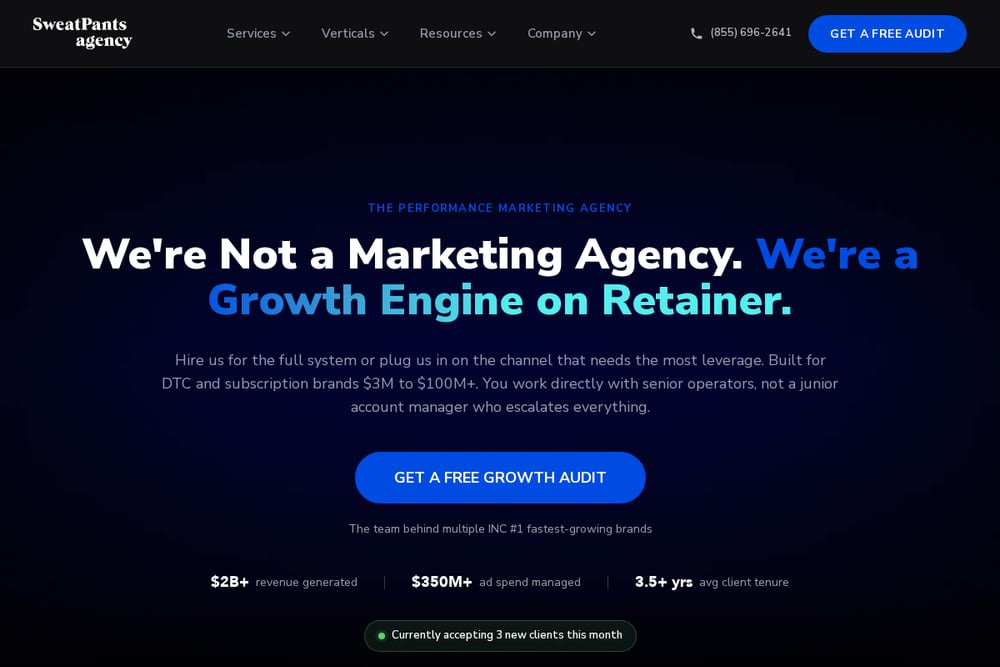
Sweat Pants Agency is a Klaviyo-focused email and SMS shop that publishes numbers rather than adjectives. They report having sent 4.3 billion emails and 147 million SMS messages, and they publish flow revenue lift ranges of 40 to 247% in the first six months as typical. Their 2025 BFCM portfolio drove over $6.5M in email revenue across five brands, and they normalize flow benchmarks across fourteen client accounts so the comparison is not a single cherry-picked win. They treat email and SMS as a revenue system rather than a campaign calendar, and they report against blended business metrics instead of platform vanity stats. If you want a partner who will hand you a benchmark set and let you audit it, this is a strong fit.
#4 The Email Marketers
 A screenshot of The Email Marketers website.
The Email Marketers draws a hard line between an email agency and a retention agency, and then scores eleven agencies against that line on a published 100-point rubric you can re-weight yourself. They publish an actual rate card, starting at $4,400 a month, averaging $6,500, and reaching $12,999 on their largest published package. They also publish the retention benchmarks that matter, including repeat customer rate, first-to-second order conversion, cohort retention, and subscription churn, rather than another list of open rates. The honest framing is useful: most agencies ranking for retention marketing are email agencies wearing a different hat. If you want pricing transparency and a rubric you can apply to any vendor, start here.
#5 Sticky Digital
 A screenshot of the Sticky Digital website.
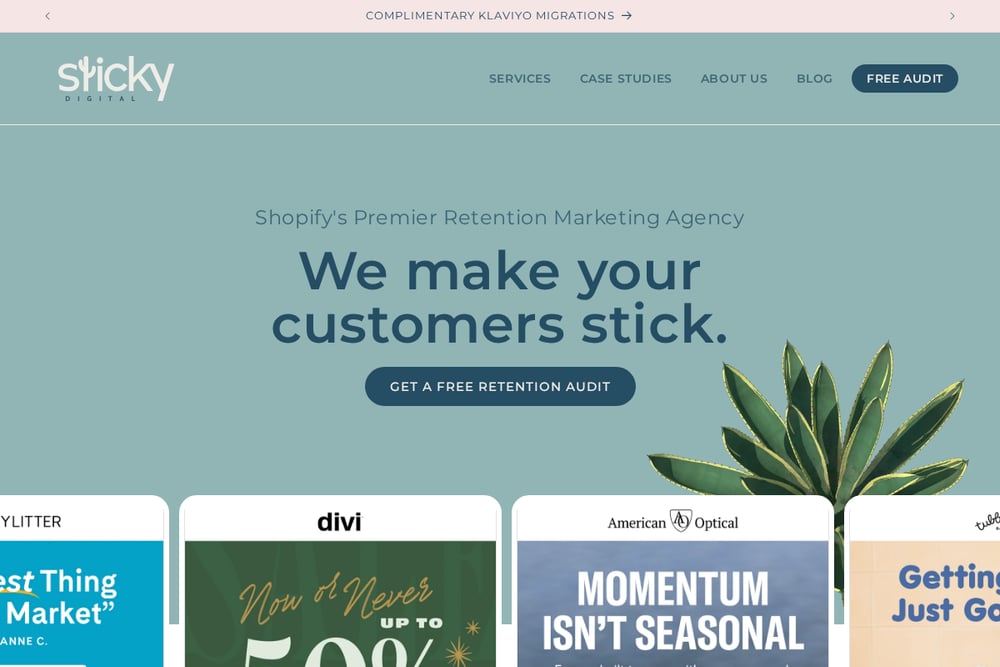
Sticky Digital positions itself as a retention marketing agency and backs it with a complimentary Klaviyo migration and a complimentary BFCM audit. Those two offers matter more than they sound, because migration cost and pre-Q4 audit cost are the two biggest reasons brands stay with a partner that is not working. The agency carries a retention marketing agency of the year designation and organizes its services around case studies rather than service menus. For a brand heading into its first serious BFCM with a messy Klaviyo account, the free migration removes the switching friction entirely. If you are stuck on a platform or an agency and the exit cost is what is stopping you, this is the lowest-friction door on the list.
How to choose without wasting a quarter
Start with your measurement standard, not the partner list. If you cannot run a holdout, you cannot prove lift, and you will end up arguing about attribution with a vendor who has every incentive to claim credit. Ask each partner one question: how will we know this worked? If the answer is a platform dashboard, keep looking. If the answer is a holdout test against a baseline, you are in the right conversation. Next, match the commercial model to your cash position. A build fee plus performance months suits brands with stable baseline revenue and a real leak to fix. A flat monthly retainer suits brands that want predictable spend and are comfortable with the partner owning the outcome. A free audit or migration suits brands that are unsure and want to see the thinking before they pay. Then check category fit. Reorder timing in supplements, skincare, and femtech is not the same, and a partner who already knows your curve will get to lift faster. Finally, ask how many new brands they take per month. A small roster is a signal, not a marketing line.
The workflow that makes this pay
The sequence that works is boring and it works. Authenticate your sending domain first, before anything else, because unauthenticated mail can now be refused at the server. Stand up the popup and welcome flow next, since that is where the first-party data starts compounding. Then build the six core flows, with the reorder or replenishment flow timed to when your customer actually runs out, not to a generic day count. Segment on purchase cadence and product consumption, not on engagement. Run a holdout on the flows that matter so you can report incremental revenue rather than attributed revenue. Then review monthly against baseline, and let the fee follow the lift. Every step before the holdout is setup. The holdout is the only step that tells you whether any of it worked.
The short version
Email got more valuable in 2026 and harder to run at the same time. The partners above all understand that, but they solve it differently. Acquisition Labs ties its fee to revenue beating a baseline, which is the most direct alignment with a replenishment brand's actual problem. YOCTO brings category depth in supplements, beauty, and femtech. Sweat Pants Agency brings published benchmarks you can audit. The Email Marketers brings pricing transparency and a rubric. Sticky Digital brings a free migration and audit that removes switching friction. Pick the model that matches your cash position and your measurement appetite, then hold the partner to a holdout. Your customers will run out again next month. The only question is who they hear from when they do.