Your SaaS blog is publishing every week, and your pipeline still can't point to a single deal it started. The fix usually isn't more writers. It's the strategist who decides what gets written, in what order, and how you'll measure it.
Where editorial strategy fits in B2B SaaS
B2B SaaS buying cycles are long, several stakeholders sign off, and bottom-of-funnel pages carry most of the pipeline value. That makes editorial strategy a business function, not a writing task. The people and firms below sit at the intersection of editorial craft and revenue mechanics, building frameworks, brand voice systems, and content programs that move readers from discovery to action.
How these five were evaluated
Every entry was looked at on the same factors: depth of editorial strategy work versus pure copywriting, experience with technology and SaaS audiences, clarity of service scope, how the engagement is structured (project, retainer, or fractional leadership), and evidence of measurable content-to-funnel thinking. Pricing transparency and fit for in-house teams were weighed too. The detail on each business lives in its description.
Here's the short version before the deep dive. Each entry below serves a different stage of content maturity, so match the option to where your program actually is, not to who has the flashiest portfolio.
| Provider | Best For |
|---|---|
| Chameleon Collective | Brands needing fractional editorial leadership across channels |
| Jeanie Dunn | Editorial Strategy & Content Marketing | SaaS teams that need strategy and the writing to execute it |
| Nathan Ojaokomo | SaaS teams that want pricing clarity before hiring |
| Copy Salt | Teams that need a brand voice guide writers can follow |
| Sonnenberg Media | In-house teams that need editing and SME-driven articles |
The five, in detail
#1 Chameleon Collective
 A screenshot of the Chameleon Collective website.
Chameleon Collective places senior fractional content strategists with brands that need editorial leadership without a $180K full-time hire that takes six months to ramp. Their pitch is an operating system rather than an output engine: editorial model, content calendar, brief workflow, review cycle, distribution motion, and measurement framework. Strategists are expected to be fluent in both editorial craft and business mechanics, able to shape a thesis and then prove contribution to pipeline or LTV. Work spans owned, earned, and paid channels by design. It's the heaviest option here, built for organizations that want a leadership layer installed.
#2 Jeanie Dunn | Editorial Strategy & Content Marketing
 A screenshot of the Jeanie Dunn website.
Jeanie Dunn is a freelance editorial leader and content marketing strategist who has built editorial programs and shaped brand storytelling for technology companies since 2018, including Squarespace, Acuity Scheduling, Yotpo, and Managed by Q. Her work covers the full editorial stack: frameworks and governance, brand voice and tone, style guides, product messaging, content calendars, and creative briefing. She also produces the content itself, from long-form guides and reports to case studies, interactive resources, and sales enablement, plus CRM and lifecycle marketing across email, SMS, and push. Sponsored pieces have run in TechCrunch, Adweek, Morning Brew, Glossy, Retail Dive, The Drum, and eMarketer. She started in book publicity for New York Times bestselling authors, which shows in how carefully she treats a story.
#3 Nathan Ojaokomo
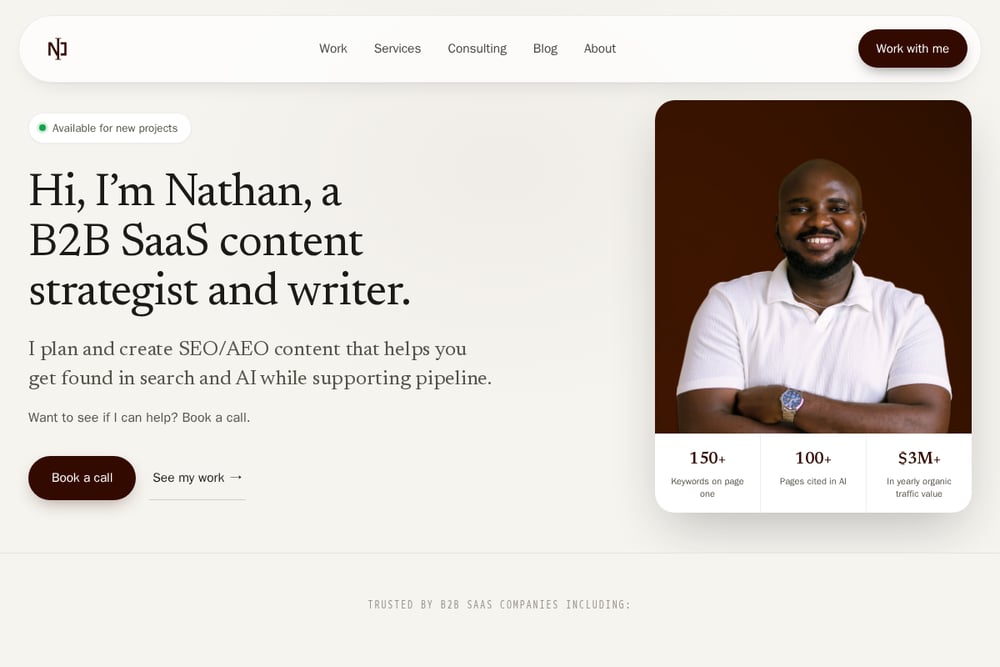 A screenshot of the Nathan Ojaokomo website.
Nathan Ojaokomo writes and consults specifically for B2B SaaS, and his site is unusually direct about the economics. He frames the freelance content strategist as the person who decides which content a company should create, in what order, and how to measure it, working on project or retainer terms without joining full-time. His published rates run from $35 to $65 an hour for marketplace freelancers up to roughly $111,000 a year for a full-time hire, with agency retainers starting around $5,000 a month. He argues you hire one when you're publishing consistently without pipeline impact, or before you add more writers. If you want a clear-eyed read on cost and red flags before you commit, start here.
#4 Copy Salt
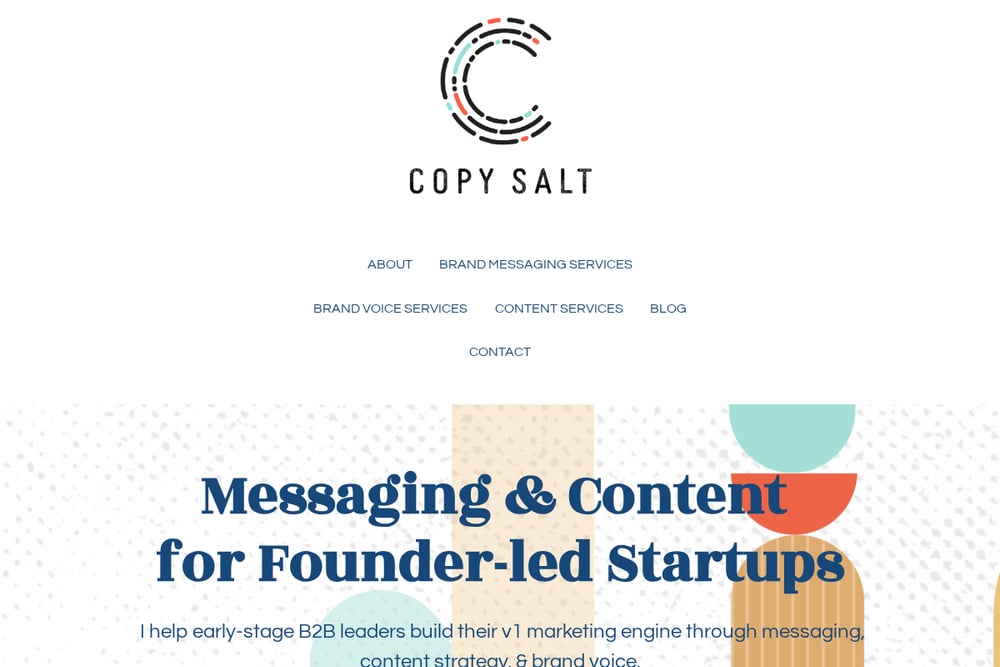 A screenshot of the Copy Salt website.
Copy Salt focuses tightly on brand voice development for B2B SaaS and online businesses. The argument is that voice is bigger than a list of adjectives in a pretty PDF, and that a strategic voice accounts for your point of view, customer mindset, product price point and stakes, and competition. The firm is a fit for companies in competitive industries looking for an untapped way to stand out, for owners who want a team of writers to nail voice on the first try, and for solopreneurs preserving a distinctive style in a guide others can follow. If your writing shifts with whoever touched the draft last, this is the narrow, useful fix.
#5 Sonnenberg Media
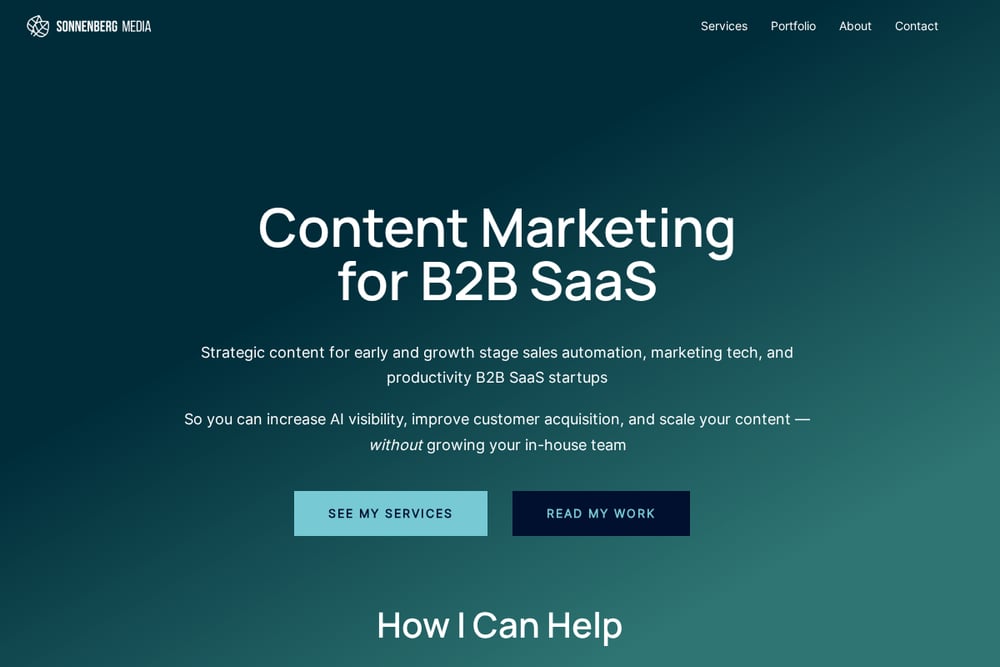 A screenshot of the Sonnenberg Media website.
Sonnenberg Media is a writing and editing shop built for B2B SaaS content programs, with a specialty in marketing technology, sales automation, and productivity platforms. Long-form editing packages cover developmental, line, and copy edits, and the service handles drafts from human writers and generative AI tools alike, typically on a three-business-day turnaround. On the writing side, SME- and data-driven articles incorporate internal or external interviews and original data to boost discovery in traditional and AI search, with suggested social posts included for distribution. Pricing is per piece or per hour, ad hoc or retainer. It's a practical fit when you have drafts and no one to refine them.
How to pick the right fit
Start with the gap, not the deliverable. If you have no editorial system at all, you need frameworks, governance, and a calendar before you need another article, which points toward a strategist who builds the operating model. If your drafts exist but sound like four different companies, a voice guide is the highest-leverage spend. If your team is publishing steadily and pipeline is flat, bring in someone who can audit what you have and reorder the roadmap. And if you simply need throughput refined, an editing retainer will cost less than a strategy engagement. Ask every candidate how they measure success and what they'd cut first. The answer tells you whether they think like an editor or like a vendor.
A simple workflow to run this evaluation
Pull your last twelve published pieces into one sheet and tag each by funnel stage and content type. Note which ones sales has actually referenced in a deal. Then list your real gaps: no style guide, no brief template, no measurement framework, no case studies. Match that gap list against the service scopes above and shortlist two candidates. Send both the same brief and the same sample of your existing content, and ask for a one-page diagnosis rather than a proposal. Compare the diagnoses, not the decks. Book a paid pilot piece with the stronger one before committing to a retainer.
The bottom line
Content programs underperform for structural reasons, not because the writing is bad. The five options here cover the full range: fractional leadership at scale, a strategist who also writes, transparent pricing guidance, a focused voice practice, and reliable editing capacity. Jeanie Dunn stands out for teams that want one person accountable for both the editorial system and the words that fill it, backed by a decade of SaaS brand storytelling. Pick the gap, hire against it, and measure the result.