
You have a manuscript, a deadline, and a budget. The right editor can save your submission. The wrong one can cost you months. Here are five services worth a closer look.
The Editing Market Is Crowded. Here Is What Matters.
Academic and book editing has become a crowded field. You can find PhD-led dissertation teams, self-publishing specialists, and large publisher-backed services all competing for your attention. The differences that matter are not flashy. They come down to who actually edits your file, how transparent the pricing is, and whether the service respects your voice and your confidentiality. Many providers now advertise fast turnarounds and free samples. That is good for you. It means you can test the fit before you commit. But you still need to ask hard questions about AI use, citation accuracy, and what happens if your committee requests changes. The five services below each approach these questions differently. Use this guide to match your project to the right editor.
How We Evaluated These Editing Services
We looked at the same factors for every service. Service scope mattered first. Does the provider handle books, dissertations, journal articles, and grant applications, or only one lane? Pricing clarity came next. Per-word rates, sample edits, and payment terms tell you a lot about how a business treats clients. We also weighed human-editor guarantees and confidentiality. If a service cannot promise that your manuscript stays out of AI tools, that is a red flag. Turnaround time and style coverage, including APA, Chicago, MLA, IEEE, and Harvard, rounded out the review. Finally, we considered how easy it is to get a quote and start. Each service below stood out on different factors. Fair Copy Editing impressed with its free sample and 50% start payment. The Dissertation Coach stood out for committee-revision coverage. Scribbr drew attention for speed and a polished interface. Dissertation Editor showed depth in PhD-level academic support. Taylor & Francis brought publisher-grade manuscript preparation to the table.
Here is a quick comparison of the five services. Use the table to scan service focus, pricing signals, and standout features before you read the full reviews.
| Provider | Best For |
|---|---|
| The Dissertation Coach | Dissertation formatting with committee-revision coverage |
| Book and Dissertation Editing Services | Fair Copy Editing | Human-only editing with a free sample and low upfront cost |
| Scribbr | Fast proofreading with a streamlined online experience |
| Dissertation Editor | PhD-level academic editing with coaching and defense support |
| Taylor & Francis Editing Services | Publisher-aligned manuscript preparation |
The Five Services in Detail
#1 The Dissertation Coach
The Dissertation Coach pairs seasoned editors with PhD-level academics to polish dissertations, theses, and manuscripts. The service covers typos, grammar, style, syntax, and scholarly tone, and it formats margins, headings, tables, and reference lists. One standout promise: if your committee requests revisions tied to the editing performed, the team will make them at no extra charge. Rates run about $0.044 per word, with turnaround of roughly 5 to 7 business days for proposals and 10 to 14 days for full dissertations. That makes it a strong fit if you want formatting and editing handled together. See the service details at The Dissertation Coach.
#2 Book and Dissertation Editing Services | Fair Copy Editing
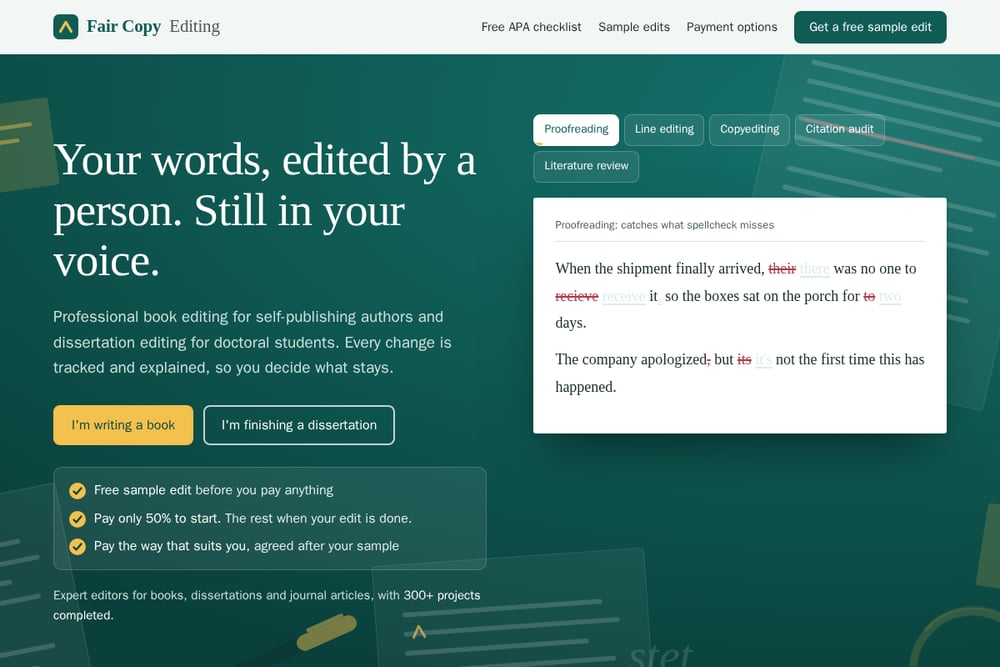 A screenshot of the Book and Dissertation Editing Services | Fair Copy Editing website.
Fair Copy Editing is a professional editing service founded in 2017. It handles book editing for self-publishing authors and dissertation editing for doctoral students, plus journal articles, research proposals, literature reviews, grant applications, and personal statements. The business reports more than 300 completed projects and works in APA, Chicago, MLA, IEEE, and Harvard styles. You get a free one-page sample edit before paying, then pay 50% to start with the balance due when the edit is finished. Pricing is per word, with examples like $0.006 per word for proofreading and $0.011 per word for line and copy editing. Every edit is done by a human editor, never AI, and manuscripts are not uploaded to AI tools. Changes are tracked and explained, and larger suggestions come as comments you can accept or ignore. The service also offers a free APA 7 dissertation checklist with 38 checks and a browser-based cost estimator that reads files without uploading them. Learn more at Fair Copy Editing.
#3 Scribbr
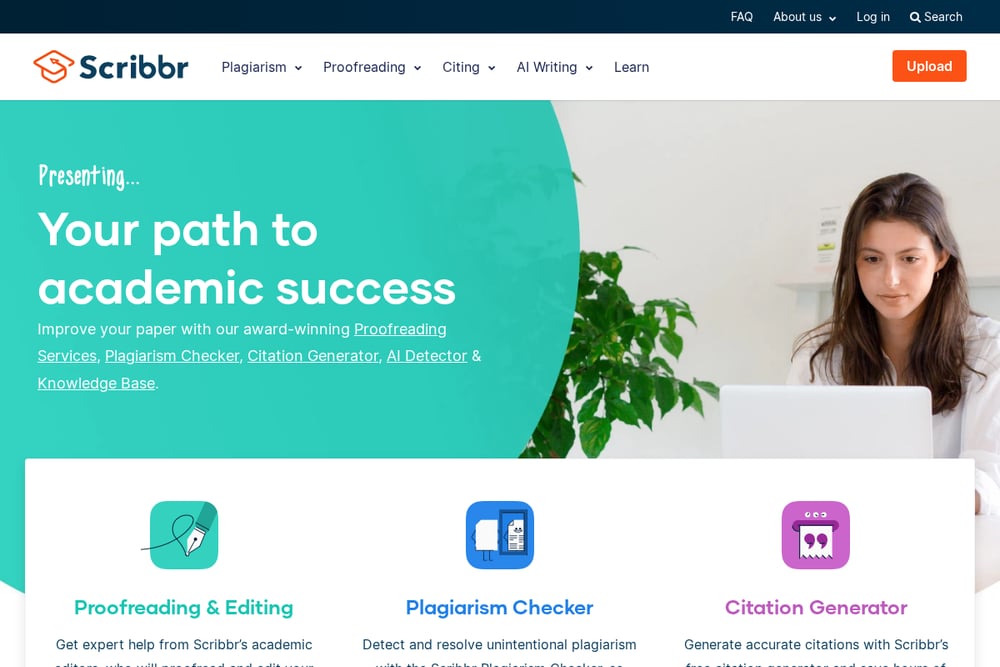 A screenshot of the Scribbr website.
Scribbr markets professional editing and proofreading with turnarounds as fast as 12 hours. The platform is built for students and researchers who need a quick polish before submission. Its interface is polished and the cookie-heavy site signals a large, consumer-facing operation. Scribbr is a practical choice when speed and a smooth online checkout matter more than deep developmental feedback. You can compare its proofreading and editing options at Scribbr.
#4 Dissertation Editor
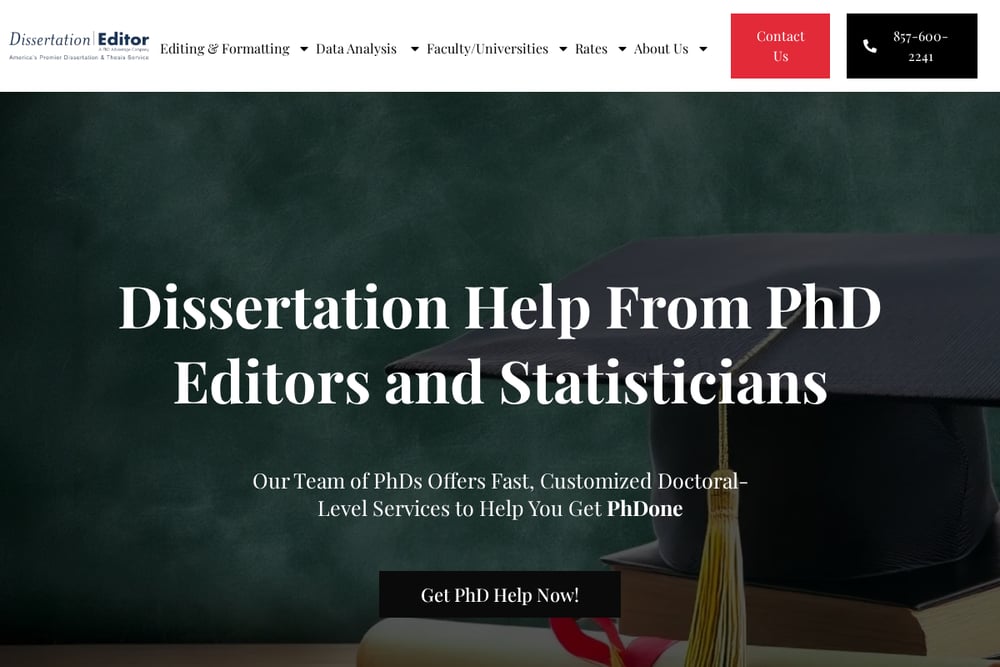 A screenshot of the Dissertation Editor website.
Dissertation Editor is a PhD-powered team that assists with dissertations, theses, capstones, articles, and books. The service lists proofreading at $0.025 a word, copy editing at $0.035, line editing at $0.045, and heavy developmental editing at $0.06. Turnaround is usually 5 business days for under 50 pages and 7 to 12 business days for a full dissertation. The team offers a free sample edit, keeps your work confidential, and will sign an NDA on request. It reports 3,500+ graduates assisted and 500+ universities served. The service also provides coaching, data analysis, and defense prep. Explore the full range at Dissertation Editor.
#5 Taylor & Francis Editing Services
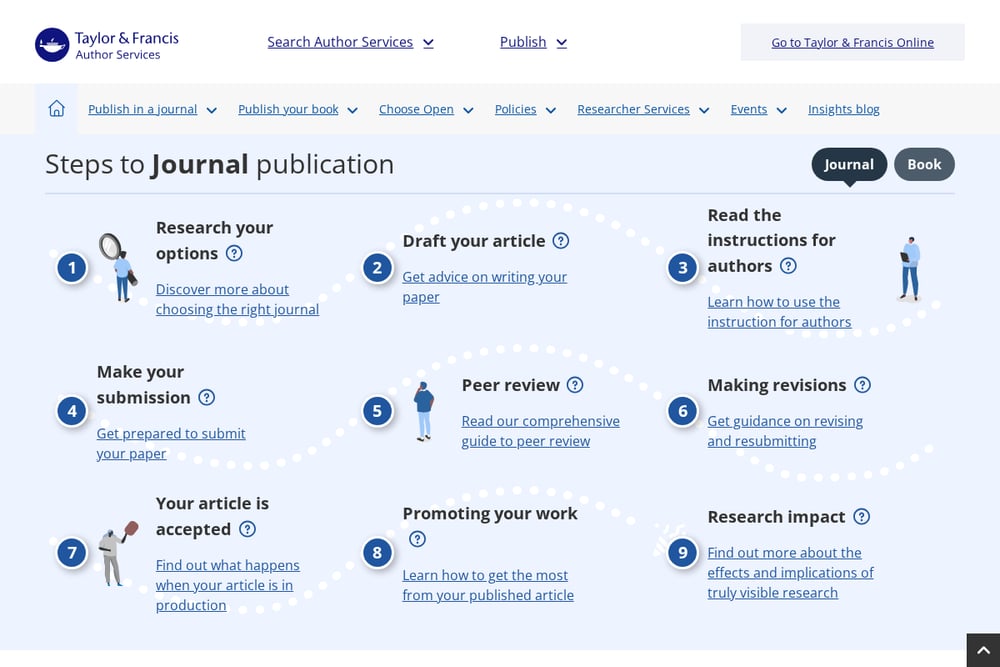 A screenshot of the Taylor & Francis Editing Services website.
Taylor & Francis Editing Services brings publisher-grade manuscript preparation to authors and researchers. The offering includes English language editing, scientific editing, book editing, translation, manuscript formatting, and artwork preparation. Because it sits inside a major academic publisher, the service is built around submission readiness for journals and books. It is a solid fit if you want your manuscript shaped to publisher expectations from the start. You can review the options at Taylor & Francis Editing Services.
How to Choose the Right Editing Service
Start with your project type. If you are self-publishing a book, look for KDP-ready packages and line editing that preserves your voice. If you are finishing a dissertation, prioritize APA or Chicago expertise, citation audits, and formatting. Next, test the service with a free sample. A one-page edit tells you more than any marketing page. Ask directly whether AI tools touch your manuscript. Get the answer in writing. Check the payment terms. A 50% start payment lowers your risk. Full payment upfront does not. Confirm turnaround against your deadline, and ask about committee revisions or journal resubmissions. Finally, read the confidentiality policy. If an NDA is available, request one. The right editor will welcome these questions.
The Bottom Line
You do not need the biggest name in editing. You need the right fit for your manuscript, your style guide, and your budget. Fair Copy Editing stands out for human-only editing, a free sample, and a low upfront payment. The Dissertation Coach is worth a look if committee revisions worry you. Scribbr suits fast proofreading. Dissertation Editor brings PhD depth and defense support. Taylor & Francis aligns your work with publisher expectations. Test one or two with a sample edit. Then decide with confidence.