You want a Zi Wei or BaZi chart you can actually trust, not a black box that spits out vague fortune-cookie lines. These five tools each take a different angle on calculated Chinese astrology, and one of them shows you the math behind every reading.
Where Eastern astrology tools stand now
Online Chinese astrology has quietly split into two camps. One camp treats the chart as the product: you enter your birth data, you get 12 palaces, 14 major stars, and Four Transformations in seconds. The other camp treats the chart as a starting point and layers AI-written interpretation on top. The best tools in 2026 do both, and the sharpest differentiator is transparency. Readers increasingly want to see the calendar convention, the true-solar-time correction, and the school of thought behind a placement, because that is what makes two charts comparable. Pricing models range from fully free calculators to paid reports, so clarity about what costs money matters as much as the chart itself.
How these tools were compared
Every tool here was looked at on four things: chart scope (does it cover Zi Wei, BaZi, and timing layers, or just one system), calculation transparency (are time corrections, day boundaries, and school rules visible), pricing clarity (what is free versus paid, and is that stated up front), and usability for someone who is not a practitioner. Educational depth and support access rounded out the picture. The detail on each tool lives in its entry below.
Here is the short version before the deep dive. Each entry below covers what the tool does well, who it suits, and where it asks you to pay attention.
| Provider | Best For |
|---|---|
| OpenFate | Verifying a chart before you trust the reading |
| Kairoscope — Eastern Astrology | Readers who want to see the rule behind each line |
| Fortune Cloud | Beginners learning to read their first chart |
| Lee Locker | Lunar-calendar births and time-zone edge cases |
| Windada | Precise birth-time and calendar reconciliation |
The five tools, one by one
#1 OpenFate
 A screenshot of the OpenFate website.
OpenFate leads with a free Zi Wei Dou Shu calculator that builds a full 12-palace chart without a signup, then keeps the rule-based chart separate from the AI explanation. That separation is the point: you can verify the Life and Body Palaces, the 14 major stars, and the Four Transformations before anyone interprets them for you. It checks 34 registered pattern and structure labels against your calculated chart and shows decade and annual layers. The site also declares its calculation conventions for historical time, True Solar Time, day boundaries, lunar leap months, and the Zhongzhou school, which is exactly what you need when comparing two charts that disagree. It reports 70,000+ users and a 4.8 rating, and the full AI report plus follow-up questions are a separate paid step.
#2 Kairoscope — Eastern Astrology
 A screenshot of the Kairoscope — Eastern Astrology website.
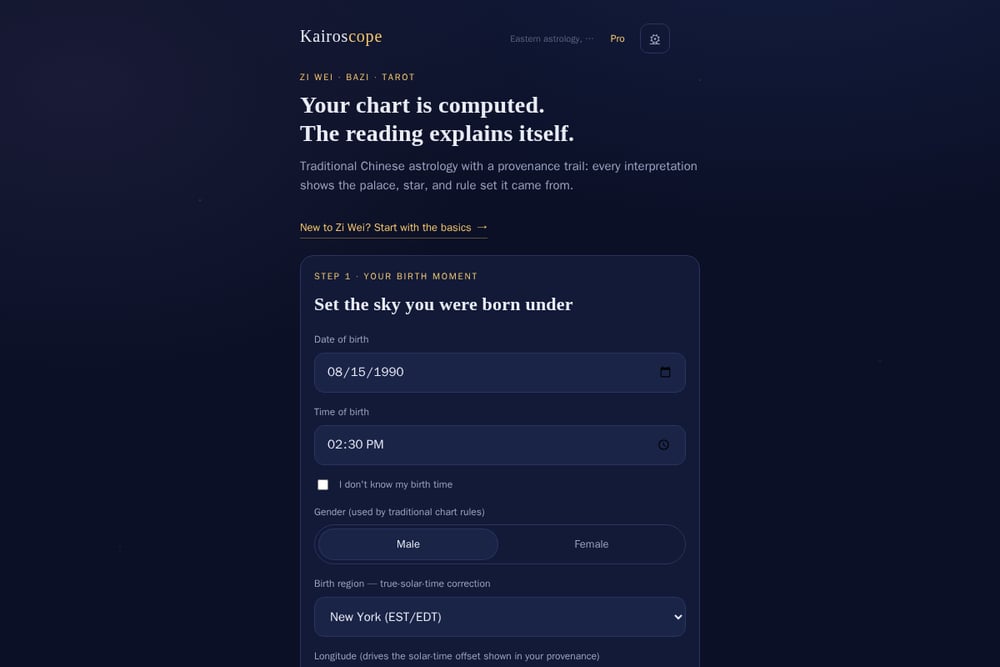
Kairoscope makes a simple promise and then backs it up: your chart is computed, and the reading explains itself. Every interpretation shows the palace, star, and rule set it came from, so you get a provenance trail rather than a confident-sounding guess. The step-by-step flow asks for your birth moment, handles an unknown birth time, and applies true-solar-time correction across regions from New York to Sydney, with longitude driving the solar-time offset shown in your provenance. It covers Zi Wei, BaZi, and Tarot in one place, and charts are calculated by the taibu-core algorithm with generated interpretation text. The site is upfront that this is for entertainment and self-reflection only, not medical, financial, or legal advice, and it offers educational resources plus a support email for questions.
#3 Fortune Cloud
 A screenshot of the Fortune Cloud website.
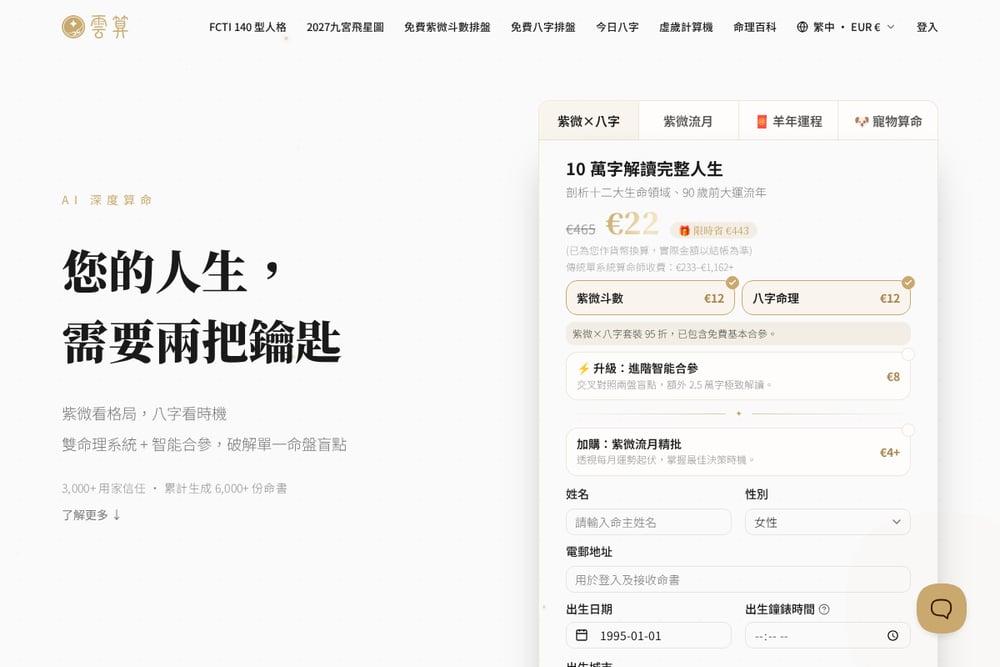
Fortune Cloud gets you a 12-palace natal chart in seconds from just a birth date, time, city, and gender, with no signup required. The free calculator shows which stars shape career, wealth, relationships, and health, and it sits alongside a free BaZi calculator and a flying-stars section. What stands out is the beginner scaffolding: step-by-step reading guides, an explanation of the 12 palaces, a breakdown of the 14 major stars, and a walkthrough of the birth-year Four Transformations. It also covers common mistakes when reading charts and decadal and annual timing forecasts, which makes it a solid place to learn the vocabulary. The interface is clean and fast, and the site is available in English with HKD pricing shown for paid features.
#4 Lee Locker
 A screenshot of the Lee Locker website.
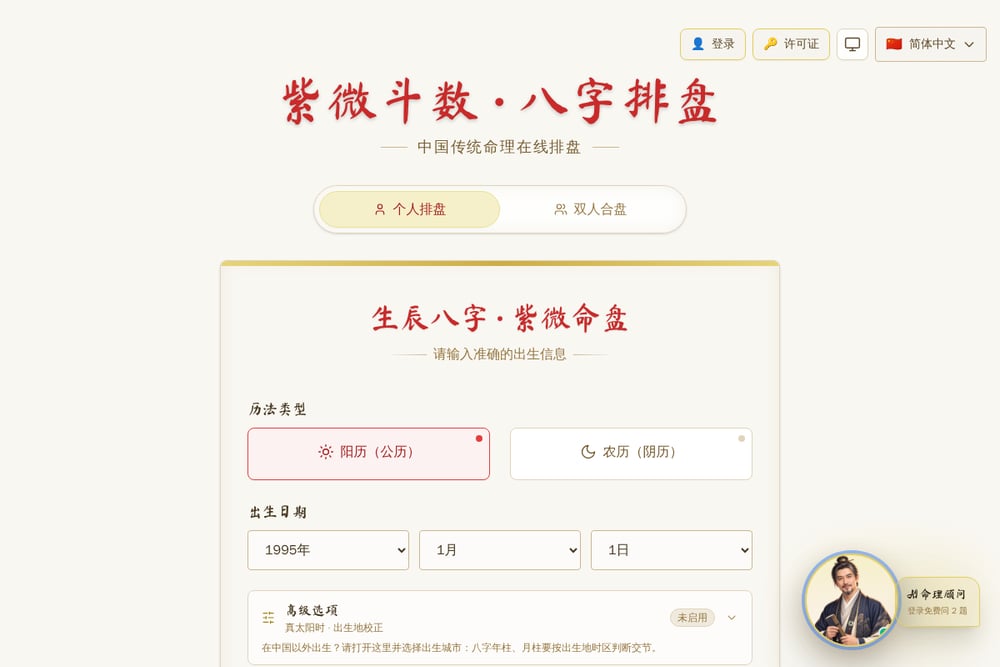
Lee Locker bundles Zi Wei Doushu and BaZi into a single free chart tool and adds an AI chart advisor with two free questions after sign-in. It supports both solar and lunar calendar input, which matters if your birth date was recorded the traditional way. The advanced options include true-solar-time and birthplace correction, and it explicitly handles births outside China by letting you pick your birth city so the BaZi year and month pillars account for your time zone. Birth hour entry uses the traditional shichen divisions, and there is a don't-know option that still produces a chart. It reports 11,356 charts generated and counting, and it states plainly that results are for reference only.
#5 Windada
 A screenshot of the Windada website.
Windada is the old-school option, and that is meant as a compliment. It offers a free Zi Wei Dou Shu chart and report with a form that goes deep: solar or lunar calendar, a year range from 1901 to 2100, and hour slots broken into the traditional two-hour periods. It also links out to a broader Chinese astrology toolkit covering calendar conversion, daylight saving time, world time, latitude lookup, IP-based location, sunrise, and solar time. If you are reconciling a birth record or chasing down a time-zone question, those companion tools save you a lot of guesswork. The interface is utilitarian and the site runs in English, Traditional Chinese, and Simplified Chinese, so it suits readers who want raw inputs handled correctly more than a polished dashboard.
Picking the right tool for your question
Start with what you actually want. If you want to check whether a chart is calculated correctly, pick a tool that exposes its conventions and keeps the chart separate from the interpretation. If you are new to Zi Wei and need the vocabulary first, choose one with structured beginner guides. If your birth record is messy, whether the time is unknown, the calendar is lunar, or you were born far from China, prioritize tools with true-solar-time correction and explicit time-zone handling. And read the pricing line before you enter anything: free calculators and paid AI reports are often the same site, and you should know where the free part ends.
A simple workflow you can run yourself
Generate your chart on two tools and compare the palaces and major stars side by side. If they disagree, check the declared settings first: time correction, day boundary, and school. Once the chart matches, read the interpretation on the tool that shows its rule set, and note which palace or star each claim traces back to. Keep your birth data and settings in a note so you can reproduce the same chart later. Treat the output as a reflection prompt, not a verdict, and revisit it when your circumstances change rather than daily.
The bottom line
The gap between these tools is not really about stars. It is about whether you can see how the chart was built. OpenFate and Kairoscope both put calculation transparency front and center, which makes them the strongest picks if you care about provenance. Fortune Cloud and Lee Locker are the friendliest on-ramps for newcomers and awkward birth records. Windada remains the reliable utility knife when the inputs themselves are the problem. Pick the one that answers your question, and remember that all five frame this as entertainment and self-reflection, not advice.