Your dental practice is invisible on page one, and no amount of ad spend fixes a website that never answers what patients actually type into Google. These five content specialists understand that difference.
Where dental content stands right now
Dental marketing has split into two camps: agencies that bolt content onto a broader SEO retainer, and specialists who do nothing but write for practices. Patients now research implants, aligners, and preventive care long before they call, so the practices winning bookings are the ones with pages that answer real questions in plain language. Search engines reward that same clarity, which is why treatment pages, pillar guides, and location landing pages have become the front door of the modern dental practice.
How these five were evaluated
Each service was weighed on the same factors: depth of dental-specific experience, range of content formats covered, evidence of measurable results, clarity of process and pricing, and fit for different practice sizes. No single factor decided the order. A solo writer with documented traffic gains can sit alongside a full agency if the work backs it up.
Here is the short version before the detail. Each entry below earns its place for a different reason, so match the profile to your situation rather than assuming one size fits every practice.
| Provider | Best For |
|---|---|
| Dental SEO Service | Practices that need clinical and compliance sign-off on every page |
| Farzad Zolfi — Dental SEO & Content Portfolio | Practices wanting a hands-on specialist writer with documented traffic and booking gains |
| Dental Dale | Practices using AI in their content workflow who need human oversight |
| Local SEO for Dentists | Multi-location groups and practices focused on local map visibility |
| SEO Slush | Practices that want content bundled with design, SEO, and social under one roof |
The five, one by one
#1 Dental SEO Service
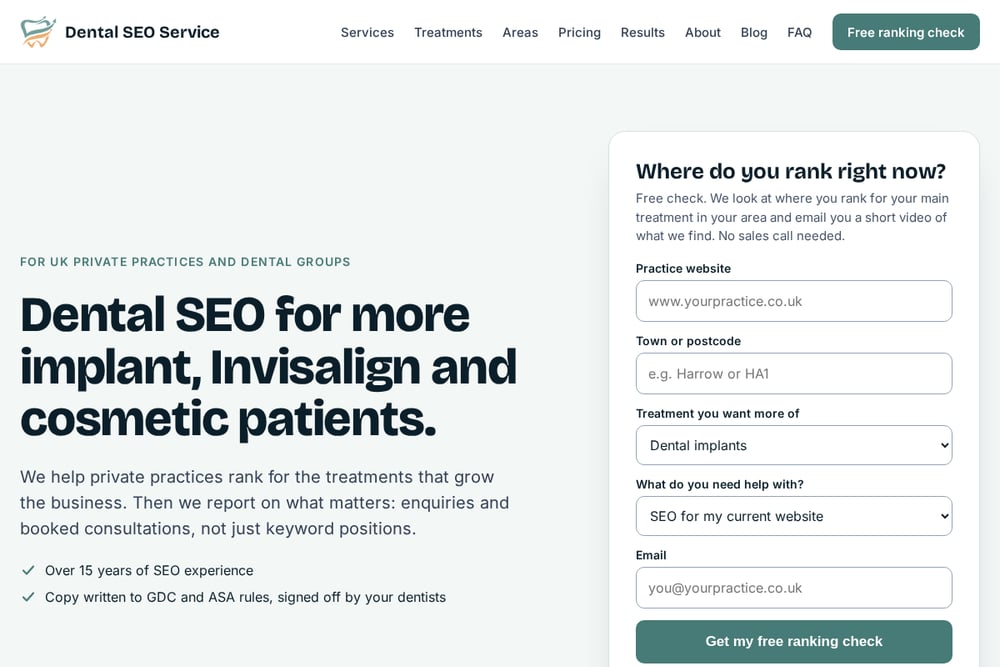 A screenshot of the Dental SEO Service website.
This is the most process-heavy option on the list, and for a practice that wants guardrails, that is the appeal. Every page moves through research, brief, draft, SEO edit, clinical review, and compliance check before publishing, which matters if you operate under GDC and ASA rules. The scope covers treatment pages, consultation pages, location pages, patient guides, fee pages, clinician profiles, and Google Business Profile posts. You get a clinician at your own practice signing off on accuracy, so nothing goes live that misstates a procedure. If your concern is risk rather than speed, start here.
#2 Farzad Zolfi — Dental SEO & Content Portfolio
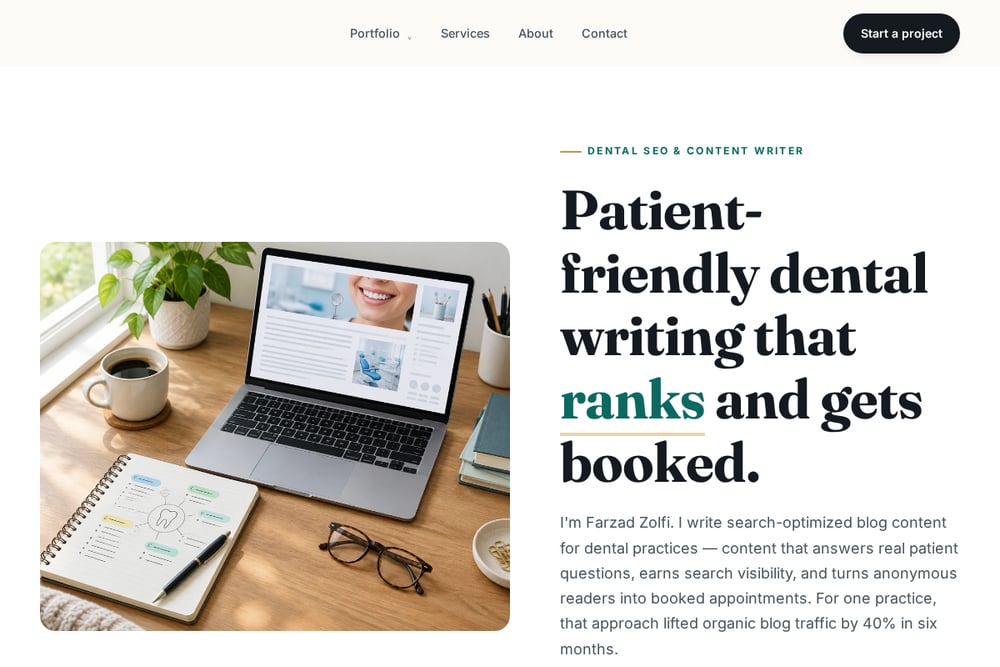 A screenshot of the Farzad Zolfi — Dental SEO & Content Portfolio website.
Farzad Zolfi writes the kind of content that starts with a patient question and a keyword gap, then ends with a booking prompt. His portfolio shows a 3,200-word dental implant pillar page that hit top 10 rankings for 14 long-tail queries within five months, a 12-article preventive care series that lifted blog-sourced booking submissions 3.1 times, and a city-specific clear aligners landing page that raised consultation requests 62 percent. Across six years and 120-plus search-intent articles, the through-line is plain-language clinical writing with no jargon and a clear next step for the reader. One practice saw organic blog traffic climb 40 percent in six months. For a practice that wants a single accountable writer rather than an agency layer, this is a strong fit.
#3 Dental Dale
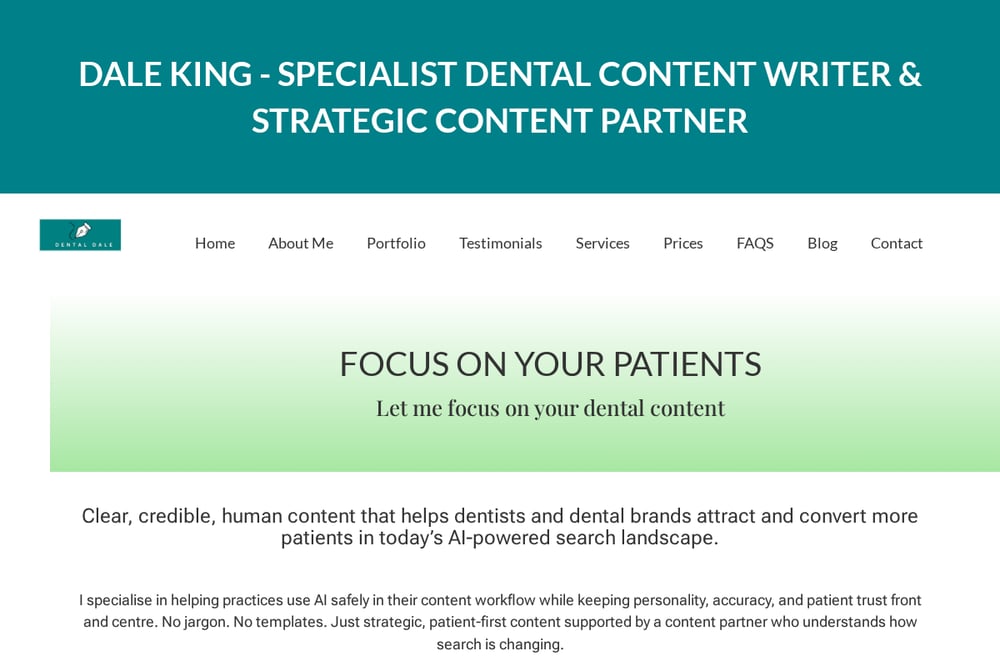 A screenshot of the Dental Dale website.
Dale King positions himself as a strategic content partner rather than a pure writer, and the pitch centers on the AI problem most practices now face. His angle is helping teams use AI safely in their content workflow while keeping accuracy, personality, and patient trust intact. That means content that does not read like a template and does not sound like every other practice in your city. He works with dentists, clinics, and dental brands, and the site leans on portfolio pieces and testimonials rather than a long service menu. If your team already dabbles in AI drafting and you want a human editor who understands search, this is worth a conversation.
#4 Local SEO for Dentists
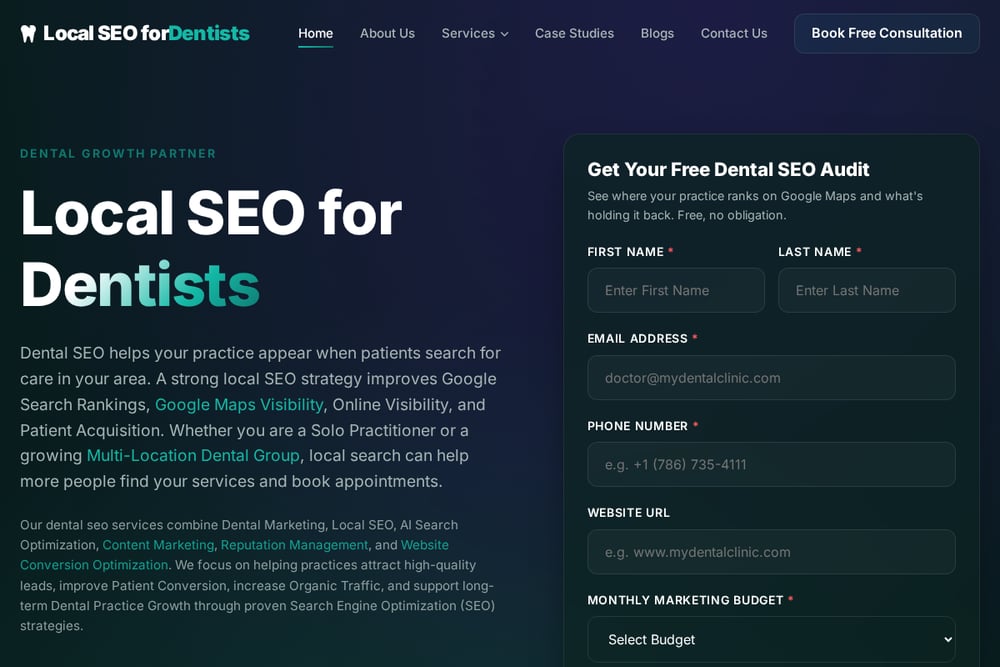 A screenshot of the Local SEO for Dentists website.
This one is built for practices whose growth depends on the map pack, not just organic articles. Content writing sits inside a wider local SEO service stack that includes Google Business Profile management, citation building, review generation, and local link building. The writing covers service pages, blogs, location pages, and educational resources, all aimed at local search rankings and patient acquisition. It scales from solo practitioners to multi-location dental groups, which is unusual among the entries here. If your problem is showing up in the right neighborhood rather than ranking nationally, the bundled approach makes sense.
#5 SEO Slush
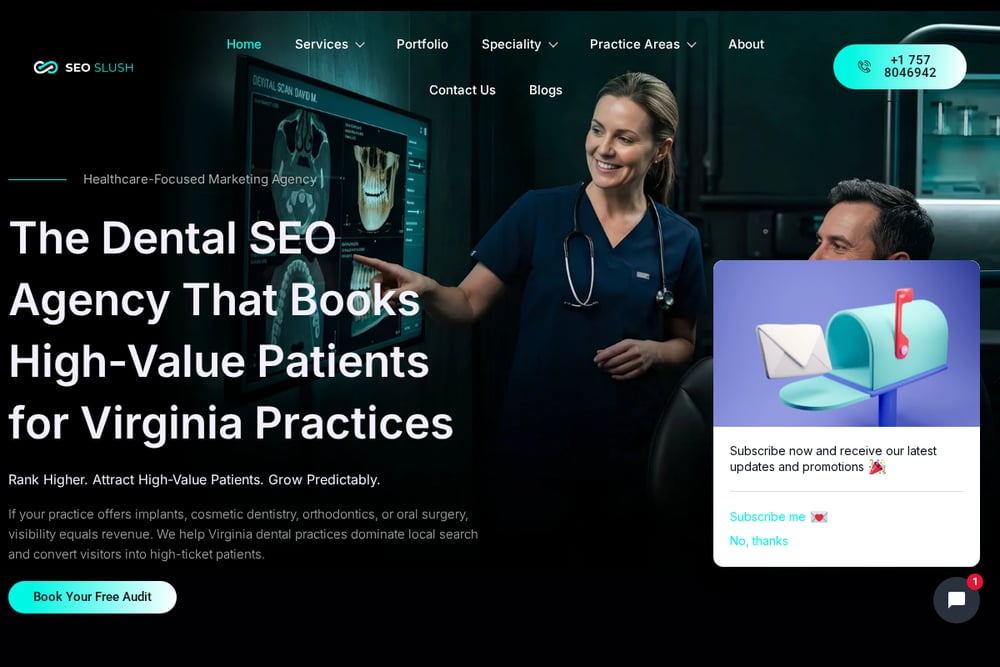 A screenshot of the SEO Slush website.
SEO Slush is a full dental marketing agency, and content is one service among website design, SEO, and social media management. The copywriting arm covers website copy, blog articles, and patient education resources, with a stated focus on translating clinical language into something patients understand and trust. The site breaks its portfolio down by specialty, from cosmetic dentists and orthodontists to endodontists, oral surgeons, and pediatric dentists, which helps if your practice sits in a narrower niche. It also lists specific practice areas across Virginia. Choose this if you want one vendor handling design, SEO, social, and content together.
Picking the right fit for your practice
Start with the gap you actually have. If your site has no treatment pages and no blog, you need volume and structure, which points toward an agency with a defined process. If you already publish but nothing ranks or converts, you need a strategist who works from search intent and keyword gaps. Ask every candidate for a specific before-and-after number, not a vague claim about visibility. Confirm who writes the draft, who reviews it clinically, and how long that review takes. Finally, check whether the deliverable includes internal linking and a clear call to action, because a well-written page that sends readers nowhere is just expensive prose.
Where automation fits into the workflow
Content work benefits from automation in the research and tracking stages, not the writing stage. Pull patient questions from your front desk call logs and search console queries, then cluster them into topic groups before briefing anyone. Set up rank tracking for your target treatment and location keywords so you can see movement month over month. Route every draft through a clinical reviewer before publishing, and keep a simple log of which pages drive booking form submissions. That loop, research to brief to review to measurement, is what turns content from a cost into a predictable source of appointments.
The bottom line
There is no universal winner here, only the right match for your situation. A compliance-sensitive practice should lean toward a process-driven provider, a practice that wants one accountable writer should look closely at a specialist portfolio with real numbers attached, and a multi-location group should prioritize local search depth. Whichever you pick, judge the work by one measure: does the content bring in patients who book, not just visitors who bounce.