Your data hall doesn't care about a slick sales deck. It cares whether the racks are plumb, the fiber is dressed, and the punch list hits zero before the doors close. Here are five contractors worth a serious look.
The State of Data Center Cabling Work
Data center buildouts are moving faster than the crews available to finish them. Hyperscale gets the headlines, but the real volume sits in colocation cage build-outs, enterprise server rooms, and MACD work inside live halls where uptime is non-negotiable. That means the contractor you pick isn't just pulling cable. They're setting racks to drawings, hanging ladder rack and basket tray, bonding pathways, terminating and testing copper and fiber, and racking hardware at turn-up. The differentiator is rarely the scope list. It's whether the crew can work a live floor without tripping a breaker or a change ticket. Look for OSHA 10 certification, First Aid/CPR coverage on every crew, background checks, and willingness to work nights and weekends around your cutover windows. Documentation matters too. As-builts, redlines, and labeled test results are what you hand the next team, and sloppy closeout costs you for years.
How We Evaluated These Contractors
We looked at the same factors across all five. Service scope: can they handle racks, pathways, cabling, and hardware, or just one slice? Data center focus: do they talk about live environments, MOPs, and containment, or is the data hall an afterthought next to office work? Quality ownership: who holds QA/QC through closeout, and do they deliver as-built documentation? Crew readiness: safety certifications, background screening, and availability for off-hours windows. Local fit: whether their footprint and market experience line up with where you're building. Multi Tech stood out for owning QA from first install through closeout and staffing every crew with a lead tech. ASD stood out for sheer installed volume and a budget calculator that gives you real numbers early. Network Cabling Services stood out for a BICSI-authorized training facility and a deep Texas public-sector contract bench. CMC Telco stood out for pairing cabling with outside plant, trenching, and OTDR testing. Dubak Electrical stood out for bringing industrial electrical and mission critical modular experience into the cabling conversation.
Here's the short version before the deep dive. Each of these five brings a different center of gravity, so match the contractor to the shape of your project rather than the length of their service menu.
| Provider | Best For |
|---|---|
| ASD | Multi-site rollouts and early budget estimates |
| Multi Tech | Data center deployment contractor | End-to-end deployment in live data centers |
| Network Cabling Services | Texas projects needing contract vehicles |
| CMC Telco | Builds that cross inside and outside plant |
| Dubak Electrical Group | Industrial sites with heavy electrical scope |
The Five, In Detail
#1 ASD
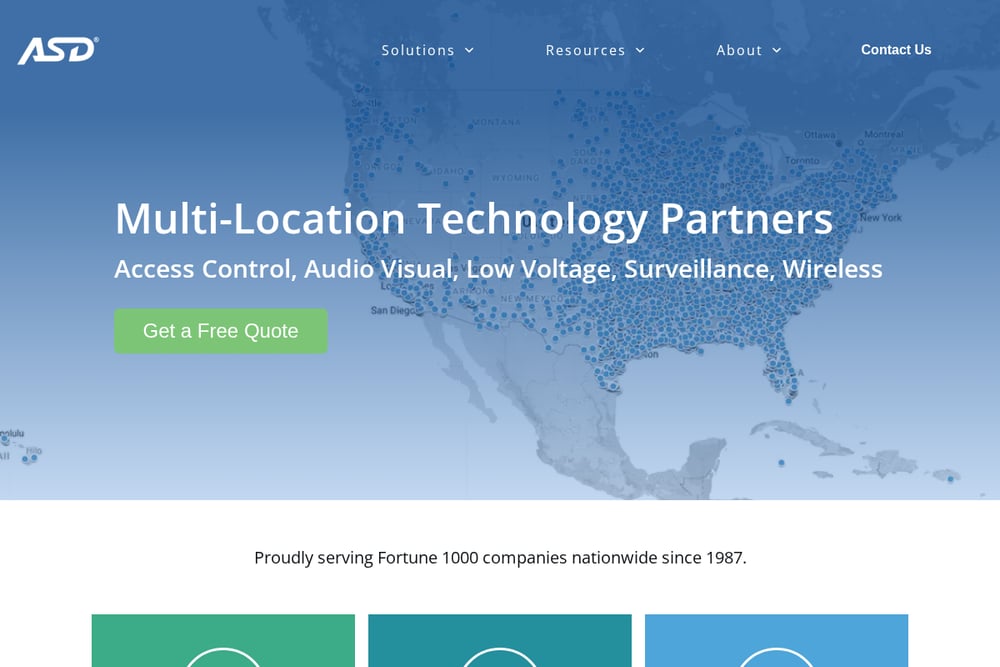 A screenshot of the ASD website.
ASD has installed roughly 50,000 miles of cable over its tenure, which is the kind of number that tells you they've seen your problem before. Their structured cabling practice spans corporate office, retail, hospitality, industrial, healthcare, government, and multi-site rollouts, so the playbook is well worn. The standout for budget-minded teams is their technology installation budget calculator, which gives you ballpark figures based on industry standards and their own project history before you ever take a meeting. They also layer in field services, staging and configuration, and depot and sparing, which helps if you're rolling out across many locations. If you want a national footprint and a fast read on cost, start here.
#2 Multi Tech | Data center deployment contractor
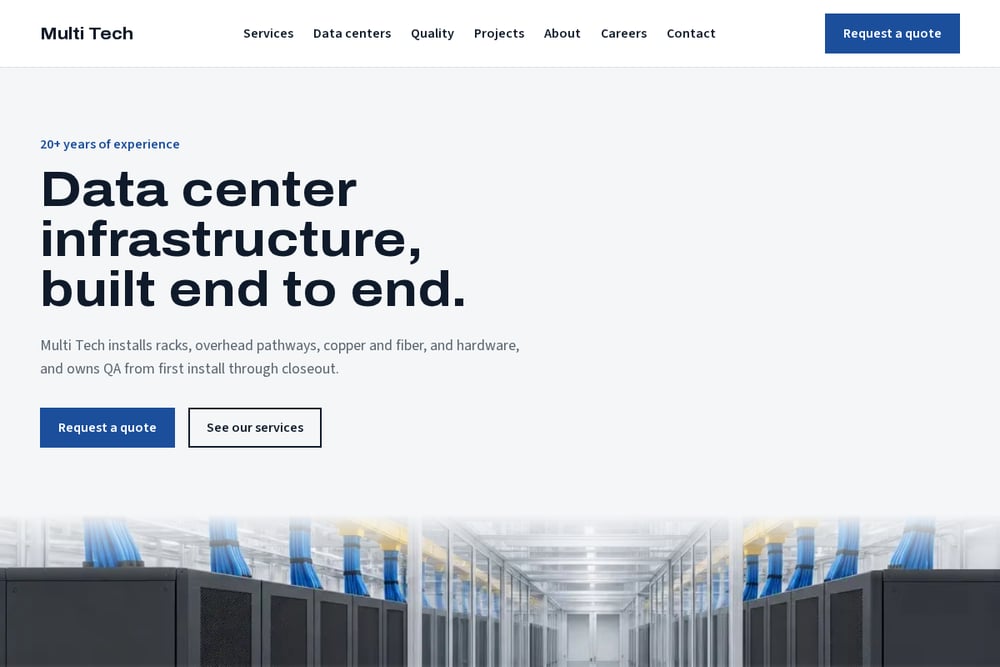 A screenshot of the Multi Tech | Data center deployment contractor website.
Multi Tech is the one on this list built specifically around the data hall. They set and align racks and cabinets to your drawings, hang and bond overhead pathways, pull and test copper and fiber, and rack servers, switches, storage, and optical transport at turn-up. The part that separates them is quality ownership: an experienced lead tech is on site checking crew work, and QA/QC stays their job until closeout, with punch lists worked to zero, labels and redlines verified, and as-built documentation delivered. Crews are OSHA 10 certified, First Aid/CPR trained, background-checked and drug-screened, and they work your nights and weekends. They cover new builds, expansions, MACD, colocation cage and suite build-outs, and owner-operated halls from a single row to a full expansion.
#3 Network Cabling Services
Network Cabling Services runs a BICSI-authorized training facility, which matters because trained installers produce cleaner terminations and fewer surprises at test time. Their service list covers Cat 5e, 6, and 6A cabling, fiber optic solutions, outside plant, wireless point-to-point, DAS, and AV, with data centers called out as a served market. They also hold a stack of public-sector contracts including Texas DIR turnkey cabling and installation, TIPS, and BuyBoard, which can shorten procurement if you're buying through a public entity. Safety gets its own page and core-values slot, and they maintain service and maintenance agreements for ongoing work. For Texas projects with a procurement wrinkle, they're a practical call.
#4 CMC Telco
CMC Telco blends inside cabling with outside plant in a way most cabling shops don't. On the data center side they list data center build cabling, rack and stack, cabling roll-outs, and test and turn-ups. On the outside they handle fiber optic trenching, underground cable, directional drilling and boring, micro trenching, and air blown fiber, plus OTDR testing. That combination is useful when your build crosses the property line and you'd rather not manage two contractors and the seam between them. They also offer network design, CAD, and RCDD services, so the design conversation can happen in-house. If your project includes any outside plant scope, put them on the shortlist.
#5 Dubak Electrical Group
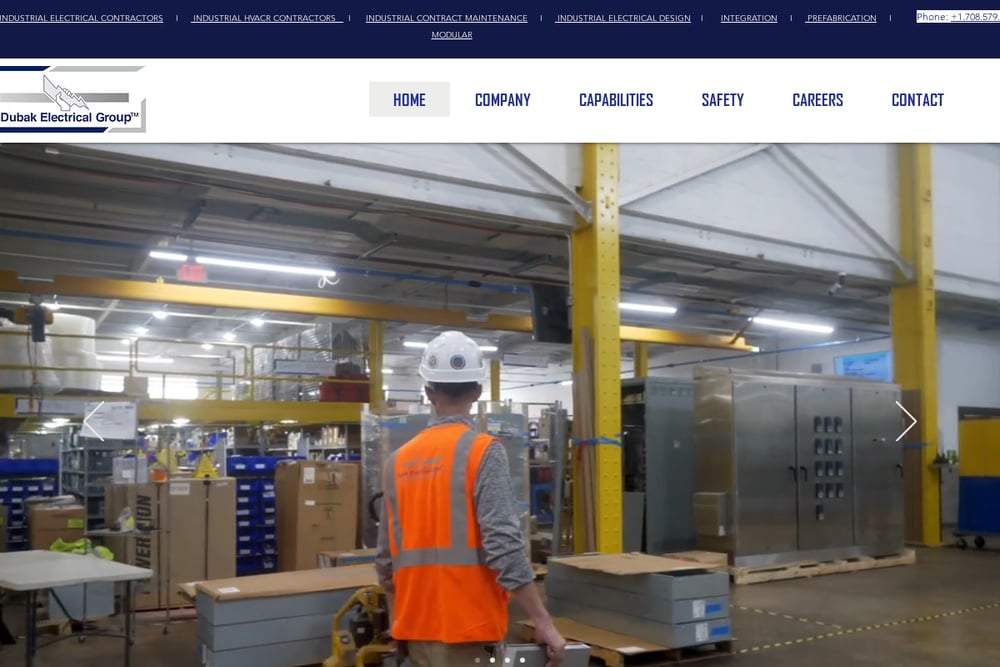 A screenshot of the Dubak Electrical Group website.
Dubak Electrical Group comes at data cabling from the industrial electrical side, and that background shows in how they talk about power, control, and integration. Their data services cover structured cabling design and diagnostics, implementation, and additions, with copper and fiber for voice, data, and video. They also list mission critical data centers and mission critical modular data centers alongside prefabrication and modular construction, which is relevant if your deployment is skid-based or fast-track. Network designers on staff can help resolve design questions before install. For industrial and manufacturing environments where the network lives next to heavy electrical infrastructure, that single-source capability is the reason to call.
How to Pick the Right Crew
Start with the shape of your project, not the contractor's logo wall. If you're building inside a live colocation hall, prioritize a firm that talks fluently about MOPs, change tickets, and off-hours windows, and confirm they'll staff a lead tech who checks crew work. If you're rolling out across dozens of sites, weight national footprint and staging capability higher. If your build crosses the property line, make sure outside plant and OTDR testing are in scope so you're not managing a seam between two vendors. Ask three questions on every call. Who owns QA through closeout, and what documentation do I get at the end? Are your techs OSHA 10 certified, First Aid/CPR trained, and background-screened? Can you work nights and weekends without a change order? Then ask for as-built samples from a comparable job. The paperwork tells you more about a crew than the pitch does.
Where Automation Fits In
You can't automate a termination, but you can automate the paper trail around it. Build a simple workflow: a shared drawing and MOP repository so crews always work the current revision, a photo capture step at each rack and pathway milestone, and a labeling check that runs against your naming convention before closeout. Route test results into the same system so copper and fiber certification data lands next to the as-builts instead of in a separate folder nobody opens. Add a punch list tracker that only closes when a lead tech signs off, and you've replicated the discipline good contractors already bring. The payoff is a closeout package you can hand to the next team without a scavenger hunt.
The Bottom Line
There's no universal winner here, and that's the point. ASD gives you national reach and a fast cost read. Multi Tech gives you a data-center-native crew that owns QA through closeout and works your maintenance windows. Network Cabling Services brings BICSI training and public-sector contract vehicles. CMC Telco covers the outside plant seam. Dubak Electrical Group handles industrial sites where the network sits next to heavy electrical gear. Match the contractor to the job, ask the three questions, and demand the closeout documentation. Do that, and your punch list hits zero on schedule.