Your model is only as good as the data you feed it, and sloppy labels will quietly cap your accuracy no matter how clever your architecture is. Here are five annotation partners worth a serious look before you sign a contract.
The annotation market, minus the hype
Every computer vision, speech, and LLM team eventually hits the same wall: you need labeled data at volume, and you need it to be consistent. The vendor landscape has split into three camps. There are the large legacy data houses with global workforces, the boutique specialists who run pilots and adapt to your tooling, and the open-source platforms that give you the annotation engine itself. Pricing models range from per-object to hourly to full project quotes, and quality guarantees vary wildly. Knowing which camp fits your workflow matters more than any single feature list.
How we looked at these providers
We weighed service breadth across modalities like image, video, text, audio, and LiDAR. We looked at how clearly each provider explains pricing and engagement models. We considered industry specialization, quality assurance practices, security certifications, and how easy it is to start with a pilot. Tool flexibility and the ability to work inside your existing stack also counted. No single factor decided the order, and your priorities will shift the weighting.
Here is the short version before the detail. Each of these five brings a different strength to the table, so scan the one-liners and then dig into the entries that match your project shape.
| Provider | Best For |
|---|---|
| Appen | Enterprise-scale, multi-modal programs with formal QA reporting |
| Data Annotation Services & Data Labeling Services For Machine Learning and Artificial intelligence Companies | QXANNOT | Teams that want industry-specific annotation across many data types |
| Label Your Data | Pilot-first buyers who want flexible pricing and their own tooling |
| Tinko Group | Projects mixing annotation with data processing and enrichment |
| CVAT | Teams that want to own the annotation tooling and workflow |
The five providers in detail
#1 Appen
 A screenshot of the Appen website.
Appen has been in the AI data business for roughly three decades, and that history shows in its process discipline. The company reports inter-annotator agreement using metrics like Krippendorff's alpha or Cohen's kappa per project, with thresholds agreed before work starts. Its scope runs from classic image and video labeling to LiDAR, robotics trajectories, speech corpora, and frontier work like RLHF and red teaming. It holds SOC 2 and ISO 27001 certifications and covers 500-plus locales. If you need a vendor that can scale across modalities and hand you the quality numbers, this is the benchmark.
#2 Data Annotation Services & Data Labeling Services For Machine Learning and Artificial intelligence Companies | QXANNOT
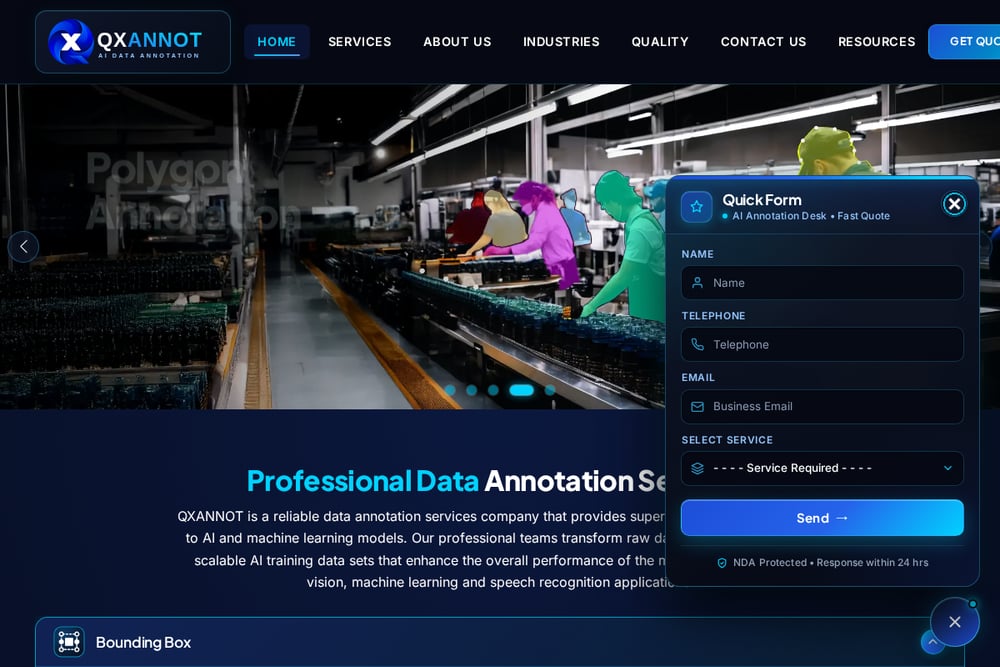 A screenshot of the Data Annotation Services & Data Labeling Services For Machine Learning and Artificial intelligence Companies | QXANNOT website.
QXANNOT positions itself as a reliable partner for turning raw data into scalable training sets for computer vision, machine learning, and speech recognition. The service menu is broad for a specialist shop: bounding box, semantic segmentation, polygon, instance segmentation, keypoint, cuboid, line, image masking, 3D LiDAR, geospatial, video, audio, and text annotation. It also covers image classification, recognition, and processing services. Industry pages target healthcare, agriculture, logistics, retail, finance, robotics, security and surveillance, sports, education, and research labs. That vertical focus is useful if your data has domain quirks a generalist would miss.
#3 Label Your Data
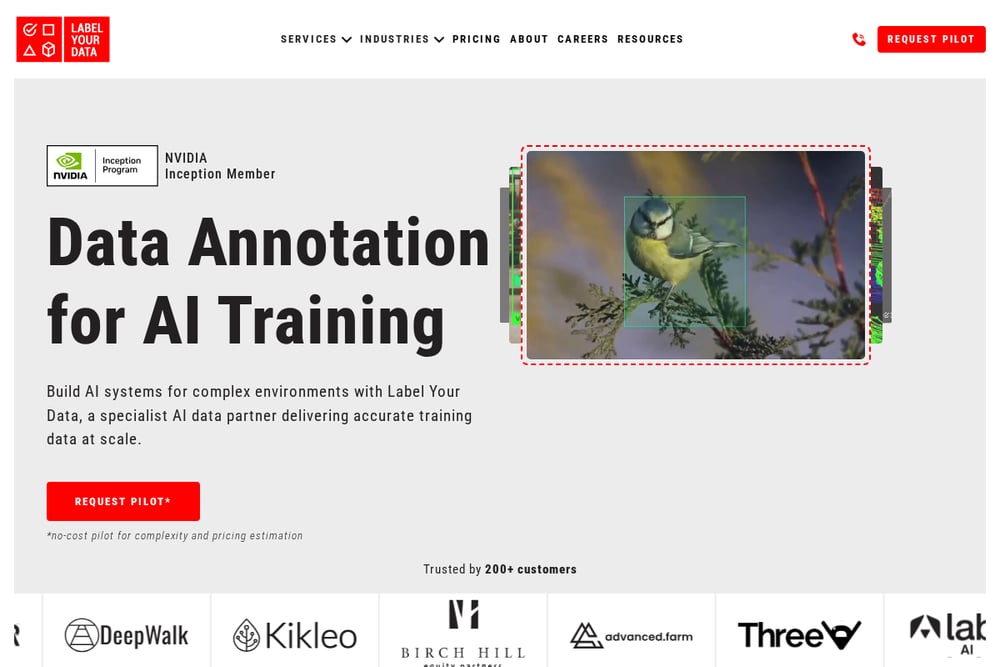 A screenshot of the Label Your Data website.
Label Your Data leads with a no-cost pilot, which is a smart way to de-risk a vendor decision before committing budget. The company runs custom QA workflows with specialists reviewing outputs for accuracy and consistency, and it is tool-agnostic, so you can work in your own platform or theirs. Security is handled through ISO 27001 certification and GDPR-compliant workflows. Engagement models flex across hourly, per-object, per-task, or project-based pricing with no long-term contracts required. Its industry coverage leans toward mobility, robotics, geospatial, manufacturing, energy, and defense tech.
#4 Tinko Group
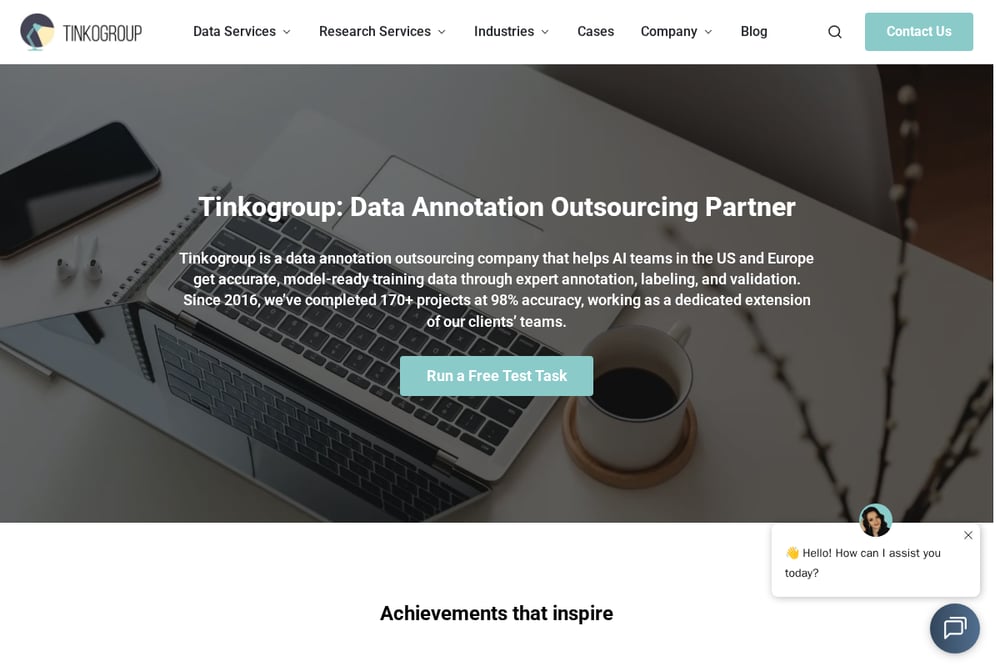 A screenshot of the Tinko Group website.
Tinko Group blends annotation with a wider data services catalog, which suits teams that need labeling plus adjacent work like data entry, classification, and enrichment. On the annotation side it covers image, video, text, and NLP labeling, along with object recognition, instance segmentation, audio classification, and text summarization. It also offers human-in-the-loop validation, verification, and evaluation services. The industry focus skews toward finance, professional services, insurance, retail, and e-commerce. If your project mixes structured data cleanup with model training data, the bundled approach can save you a second vendor relationship.
#5 CVAT
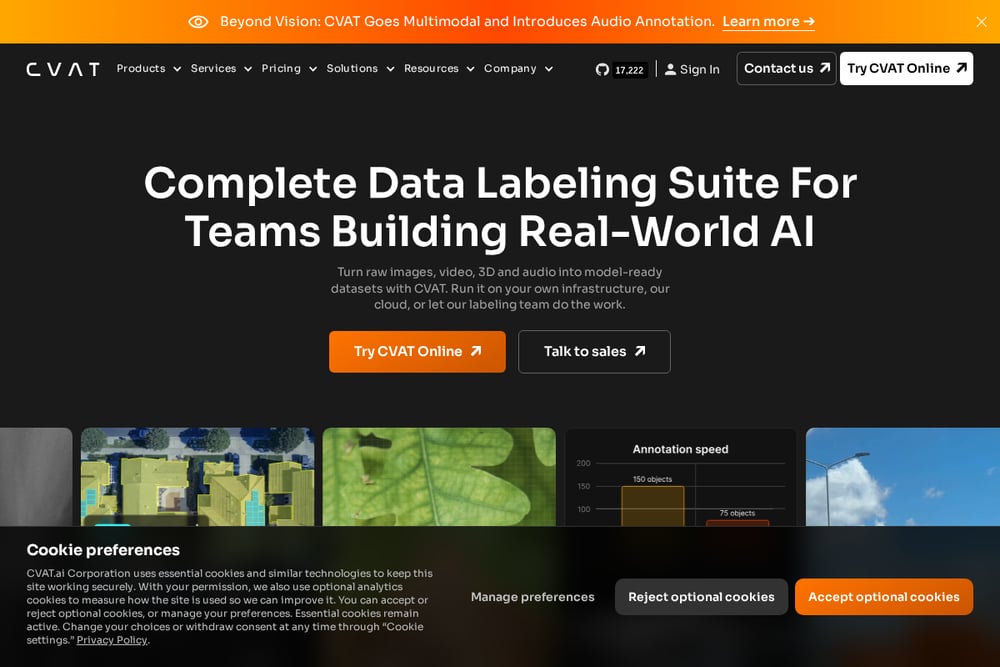 A screenshot of the CVAT website.
CVAT is the odd one out here because it is primarily an annotation platform rather than a pure services shop, and that is exactly why it earns a slot. The open-source community edition gives your team full control over the labeling environment, and the online and enterprise tiers add managed infrastructure. CVAT also offers computer vision and audio annotation services for teams that want help rather than a DIY build. Its academy is a genuinely useful resource, walking through bounding boxes, polygons, brush tools, and confidentiality practices. Choose it if you want to own the workflow and bring annotators in-house.
How to pick without wasting a quarter
Start with your data modality. If you are labeling LiDAR or video at scale, prioritize providers with proven pipelines for those formats rather than a generalist who lists them on a page. Next, ask about quality measurement. A vendor that reports inter-annotator agreement numbers is telling you something real; one that promises "high accuracy" is not. Run a small pilot with a sample of your actual data and score the output yourself. Check the security posture if you handle patient records or personal data, and confirm whether the vendor works inside your existing annotation tool or forces a migration. Finally, get pricing structure in writing early, because per-object and hourly models produce very different invoices once edge cases appear.
Where automation fits into your labeling pipeline
You do not have to choose between fully manual labeling and a black-box model. A practical workflow starts with pre-labeling: run a baseline model over your unlabeled data, then have annotators correct the predictions instead of drawing from scratch. This typically cuts labeling time substantially on repetitive object classes. Route low-confidence predictions to human review and auto-accept high-confidence ones above a threshold you set. Keep a held-out gold set that annotators never see, and re-score vendor output against it each batch to catch drift. Feed corrected labels back into retraining on a regular cadence so the pre-labeler keeps improving. Whether you build this in CVAT or hand it to a managed provider, the loop is the same.
The bottom line
There is no universal winner here, only the right fit for your project. Appen suits large programs that demand documented quality metrics. QXANNOT is a strong match when you need many annotation types with industry-specific context. Label Your Data makes sense if you want a low-risk pilot and flexible pricing. Tinko Group works well when annotation sits alongside broader data processing needs. CVAT is the pick for teams that want to own the tooling. Pick one, run a small test on your own data, and let the output decide.