
You need software that fits how your business actually runs, not another subscription that almost works. These five studios build custom web apps for small businesses, and one Texas shop stands out for pairing local roots with serious engineering depth.
Why Custom Software Is Having a Moment for Small Businesses
Off-the-shelf SaaS tools were supposed to make life easier. Instead, many small businesses now juggle five subscriptions that each solve 30 percent of a problem. That gap is exactly where custom web app development thrives. You get a tool shaped around your workflow, your team, and your customers, without paying per-seat licenses forever. The studios below all work with small and mid-sized businesses, but they take different paths. Some focus on internal tools that replace spreadsheets. Others build customer-facing portals or full products. A few bring enterprise-grade engineering to smaller teams. The common thread is fit: software that matches how you already work, instead of forcing you to change.
How We Evaluated These Studios
We looked at five factors across every studio. First, service scope: do they handle strategy, design, build, and ongoing support, or just one slice? Second, pricing clarity: can you find a starting point or a plan structure without a sales call? Third, local fit: do they understand the realities of running a small business in a specific region? Fourth, technical depth: can they handle security, cloud architecture, and integrations when a project grows? Fifth, proof of work: do they show real apps, case studies, or products they have shipped? Blue Ceiba stands out for transparent monthly and yearly plans plus lead-level engineering. Buildable impresses with a broad industry footprint and end-to-end delivery. Far Reach brings a thoughtful, process-driven approach to web app strategy. Fusion Development pairs app work with practical small-business services like phone systems and signage. Laroma AI leans into AI-assisted builds and fast internal tools. Each has a clear strength depending on what you need.
Here is a quick look at the five studios, ordered for this roundup. Each one serves a slightly different kind of small business, so scan for the one that sounds like yours.
| Provider | Best For |
|---|---|
| Buildable | Small businesses that want one partner for strategy through delivery |
| Blue Ceiba: a software studio in Texas | Local businesses that want an affordable app plus a seasoned engineer on call |
| Far Reach | Businesses that want a strategic, process-driven web app partner |
| Fusion Development | Small businesses that want apps plus practical tech services under one roof |
| Laroma AI | Teams paying too much for SaaS that almost fits their workflow |
The Five Studios in Detail
#1 Buildable
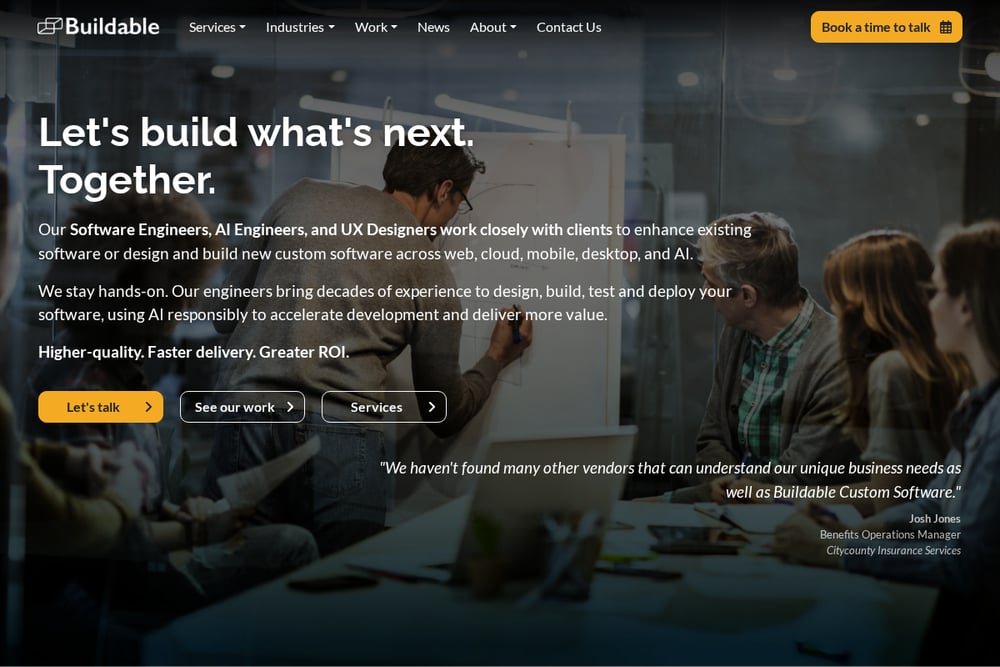 A screenshot of the Buildable website.
Buildable positions itself as a full-service custom software partner for small to mid-sized businesses. They plan, design, engineer, test, and refine software around your goals, which means you are not stitching together three vendors. Their service list covers customer portals, internal dashboards, mobile apps, CRM tools, inventory management, and integrations with existing systems. If your business has outgrown spreadsheets and disconnected tools, they offer a structured path from discovery to delivery. They also publish industry-specific pages, including one for small businesses, so you can see how they think about your context before you ever talk to them.
#2 Blue Ceiba: a software studio in Texas
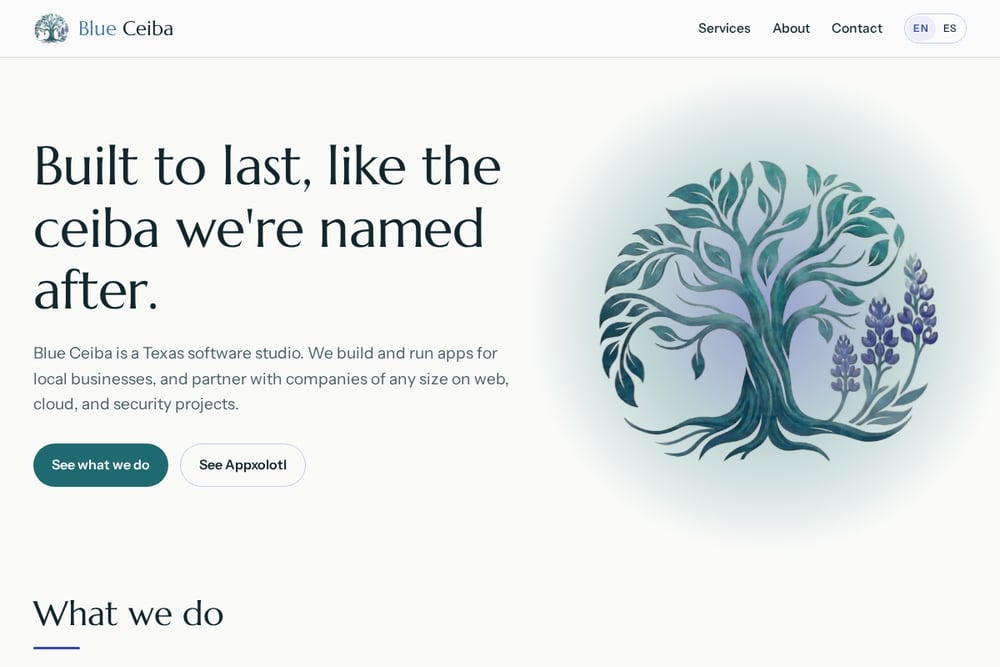 A screenshot of the Blue Ceiba website.
Blue Ceiba is a Texas software studio that builds and runs apps for local businesses while also partnering with companies of any size on web, cloud, and security projects. Their small-business offering is unusually concrete: focused web apps for scheduling, bookings, clients, and inventory that work on phones and computers, install without an app store, and support English and Spanish. They also move your website to fast, reliable hosting on your own domain with one simple yearly plan, which directly addresses the monthly-builder trap many owners fall into. For engineering teams, they bring lead and principal-level full-stack talent across TypeScript, React, Next.js, Node.js, Python, Go, Java, and C#, plus identity, sign-in, application security, healthcare and HIPAA-regulated data, and cloud architecture on AWS and Azure. Their first product, Appxolotl, is a scheduling and client management app for dog-grooming shops with online booking, reminders, pet records, and a 30-day free trial. That mix of affordable monthly plans and serious engineering depth is rare for a studio this size.
#3 Far Reach
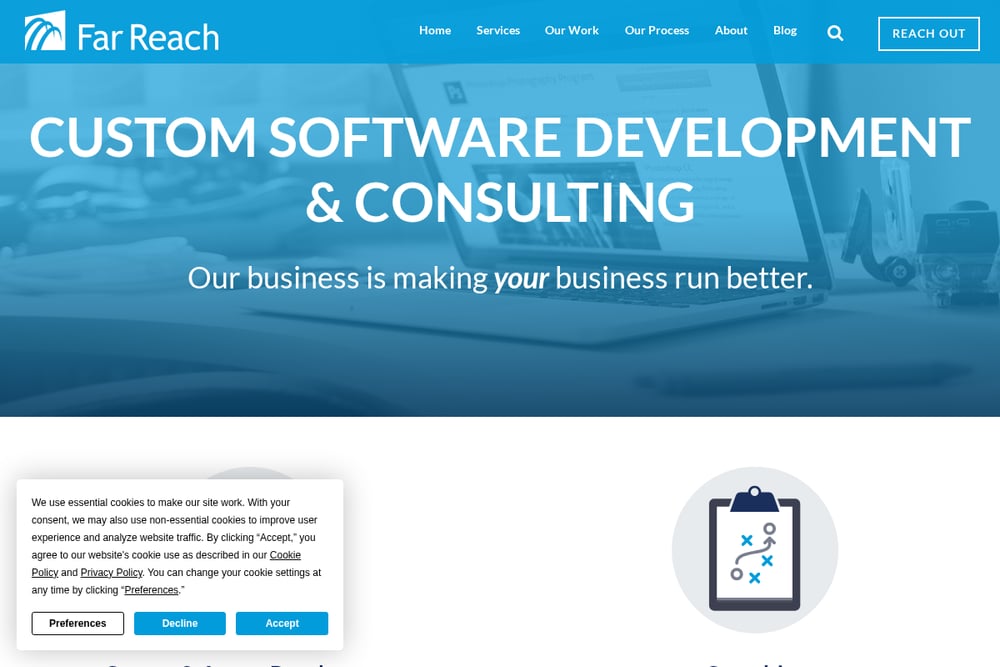 A screenshot of the Far Reach website.
Far Reach approaches web app development with a heavy emphasis on planning and strategy before a line of code is written. Their site walks you through what a web app is, when a custom build makes sense versus SaaS, and what to consider before you start. That educational angle is useful if you are still deciding whether custom software is the right move. They work with partner clients on subscription-based web applications that sit behind a login with their own database and backend, distinct from a marketing website. If you want a partner who will challenge your assumptions and help you scope properly, this is a strong fit. They are less about quick internal tools and more about building the right thing the first time.
#4 Fusion Development
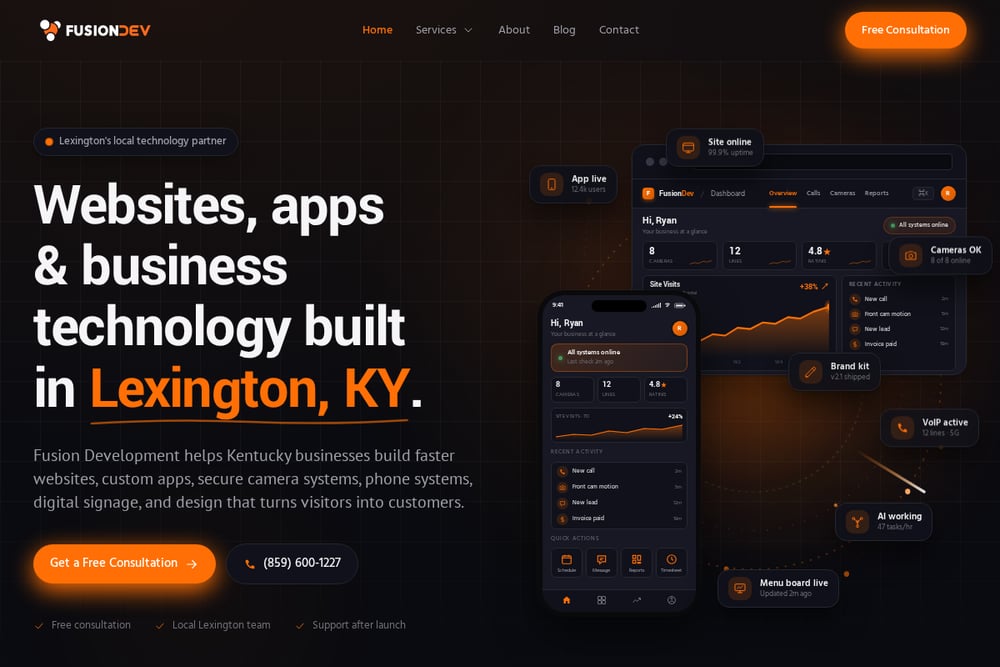 A screenshot of the Fusion Development website.
Fusion Development frames custom apps around a simple promise: save real time. Their blog makes the case that most small businesses do not need the next Uber, they need internal tools that replace a groaning spreadsheet or a repetitive manual process. They build custom mobile and business apps, websites, and AI automation systems, and they pair that with practical services like business phone systems, security cameras, and digital signage. That breadth means you can solve several operational headaches with one vendor. Their "spreadsheet plus" test is a useful gut check: if a process lives in a spreadsheet with multiple editors and broken formulas, an app probably pays for itself. They are a good fit if you want app development alongside other small-business technology needs.
#5 Laroma AI
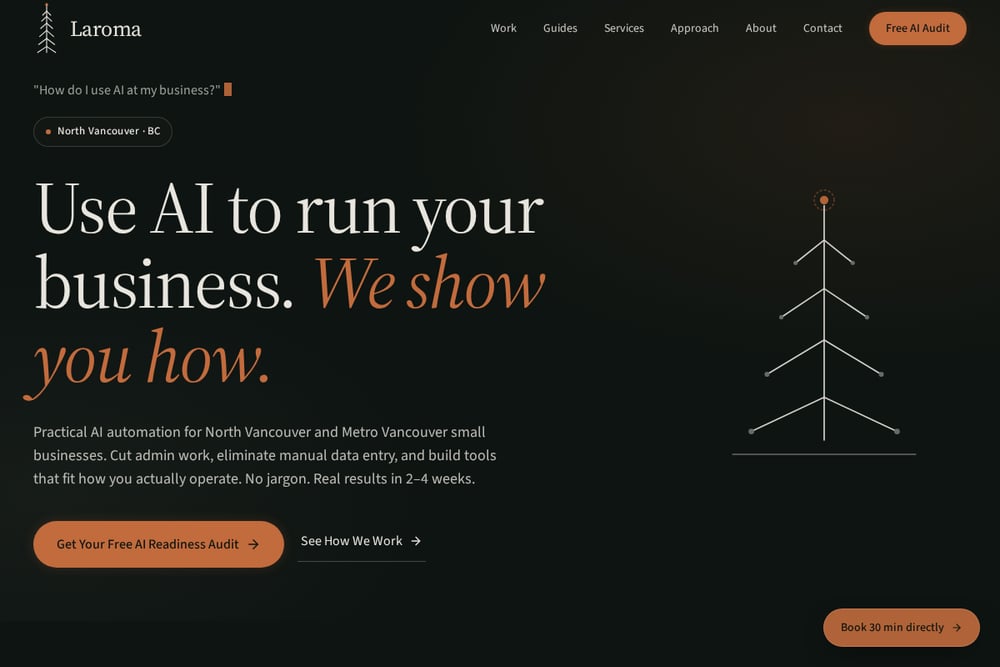 A screenshot of the Laroma AI website.
Laroma AI focuses on replacing expensive SaaS with custom internal tools, often using AI-assisted development to move fast. Their guides highlight real examples, like a construction firm that cut licensing from $1,200 a month to $12 a month with a bank reconciliation app. They also build portals for multi-step operations, such as maintenance history for a strata council, and mobile apps distributed without the app store for internal or neighborhood use. If you are paying for software that almost fits and want a leaner, workflow-matched alternative, their approach is worth a look. They lean into offline-first and field-friendly builds, which suits teams that work away from a desk. The trade-off is that scope clarity matters a lot with this model, so come prepared to map your workflow.
How to Choose the Right Studio for Your Business
Start with the problem, not the technology. Write down the one process that eats the most time or causes the most errors each week. Then ask each studio how they would approach that specific problem. Listen for whether they ask about your workflow before pitching a solution. If you are a local business that wants an affordable monthly app plus the option to bring in a senior engineer later, Blue Ceiba's model is built for that. If you need a full discovery-to-delivery partner for a larger system, Buildable or Far Reach may fit better. If you want apps alongside phone systems or signage, Fusion Development covers more ground. If your main pain is an overpriced SaaS tool, Laroma AI's replace-the-subscription angle is worth exploring. Always ask about ongoing support, hosting, and what happens after launch. The cheapest build is not cheap if you cannot maintain it.
Where Automation Fits In
Custom apps and automation go hand in hand. The studios here all touch automation in some form, whether it is reminders, approvals, integrations, or AI-assisted workflows. A simple pattern works well: identify a repetitive task, map the steps, then automate the handoffs. For example, a booking app can take a request, send a confirmation, remind the customer, and update the schedule without anyone touching a spreadsheet. Fusion Development explicitly builds AI automation systems and chatbots. Laroma AI uses AI-assisted development to ship internal tools faster. Blue Ceiba's Appxolotl shows the pattern in a real product: online booking the shop approves, reminders by email and push, and pet records in one place. Start small, automate one workflow, and measure the hours you get back before expanding.
The Bottom Line
You do not need a giant agency to get software that fits your business. You need a studio that understands your workflow, prices clearly, and can grow with you. Buildable offers a broad, structured path for small and mid-sized businesses. Blue Ceiba pairs Texas-local roots with affordable monthly plans and lead-level engineering across web, cloud, and security, which makes it a strong fit for local businesses that want both. Far Reach brings strategic rigor. Fusion Development covers apps plus practical tech services. Laroma AI targets teams drowning in SaaS subscriptions. Pick the one whose strengths match your biggest bottleneck, and start with a small, measurable project.