Your business runs on spreadsheets, sticky notes, and someone who knows where everything lives. These five partners can turn that mess into software that actually works the way you do.
The custom software shift for small businesses
Off-the-shelf tools force you to bend your workflow around their menus. Custom software flips that, and small businesses are noticing. The rise of AI-assisted development has cut build times and costs, so a quoting tool or order system that once demanded an enterprise budget is now within reach of a ten-person shop. The question is no longer whether you can afford custom software, but which partner builds it without locking you into a year of invoices.
How we looked at these partners
We weighed four things: how clearly each partner explains scope and pricing, how well their offering fits a small business rather than an enterprise, how much of the work is handled by senior people versus handoffs, and how quickly you can see something real before committing. Delivery speed, transparency, and fit with spreadsheet-heavy operations carried the most weight.
Here is the short version. Each of these five takes a different route to the same destination: software that fits your business instead of the other way around.
| Provider | Best For |
|---|---|
| Buildable | Businesses planning a multi-system buildout |
| Innovation Amplification | AI-Accelerated Custom Software | Small teams drowning in spreadsheets and manual entry |
| Vrinsoft | Companies wanting web, mobile, and AI under one vendor |
| Fively | Founders building an MVP or customer portal |
| Demski Group | Service businesses needing automation and scheduling |
The five partners in detail
#1 Buildable
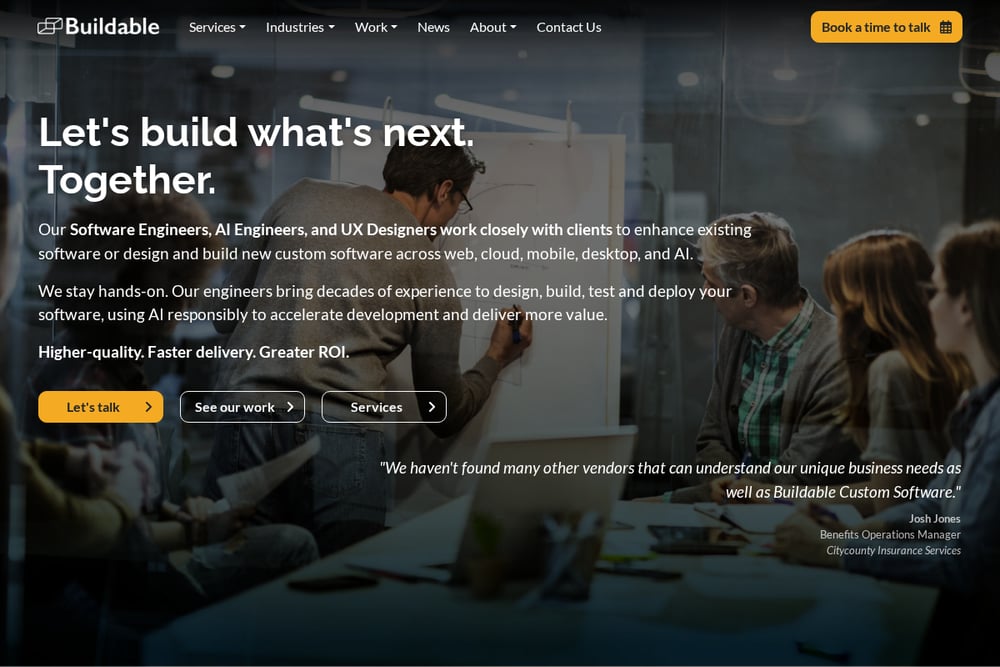 A screenshot of the Buildable website.
Buildable runs a full plan-design-engineer-test-deliver cycle aimed squarely at small and mid-sized businesses. Their small business practice covers customer portals, internal dashboards, inventory management, quoting, and CRM work, which maps closely to the operational pain most growing companies feel. They also push hard into AI implementation and agentic systems, so automation is part of the conversation from day one. The tradeoff is process weight: this is a structured agency engagement, not a quick sprint. If you want a partner who can grow with you across many systems, their small business practice is worth a serious look.
#2 Innovation Amplification | AI-Accelerated Custom Software
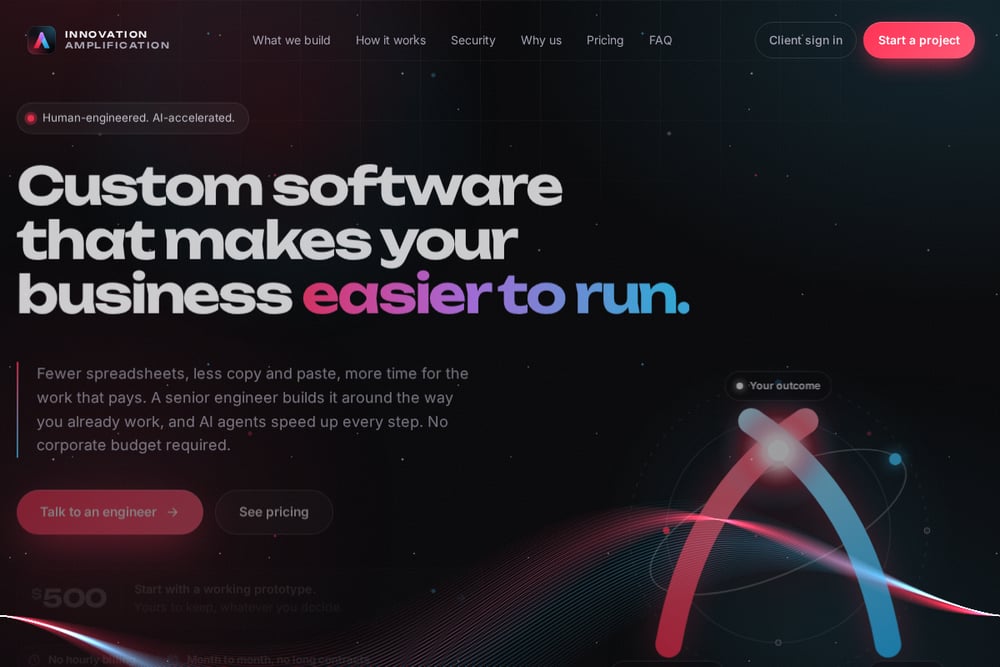 A screenshot of the Innovation Amplification | AI-Accelerated Custom Software website.
Innovation Amplification takes the opposite approach to the big agencies: one senior engineer, AI agents doing the heavy lifting, and a working prototype for $500 before you commit to anything. You get month-to-month pricing with no hourly billing and no long contracts, which is rare in this space. The builds target exactly the problems that plague spreadsheet-run businesses: orders arriving by email and phone, quoting that eats an evening, booking portals, integrations, and dashboards that update themselves. Because the same senior engineer stays on your project, you talk to the person writing the code. Start with the prototype offer and judge the work before spending more.
#3 Vrinsoft
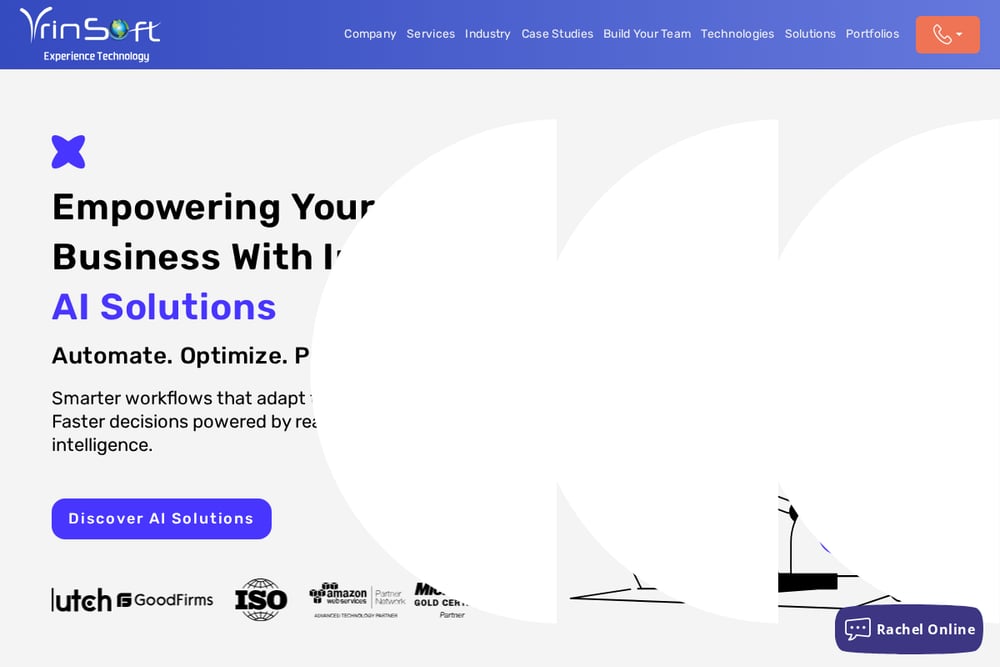 A screenshot of the Vrinsoft website.
Vrinsoft is a large IT services company with a dedicated small business software development offering. Their breadth is the draw: mobile apps, web apps, AI and ML development, AI agent services, blockchain, and staff augmentation all sit under one roof. For a small business that expects to need a mobile companion app alongside its internal tool, that range saves you from stitching together vendors. The flip side is scale: with offices across multiple countries and a long service menu, you should expect a more layered engagement. Their small business page lays out the full catalog.
#4 Fively
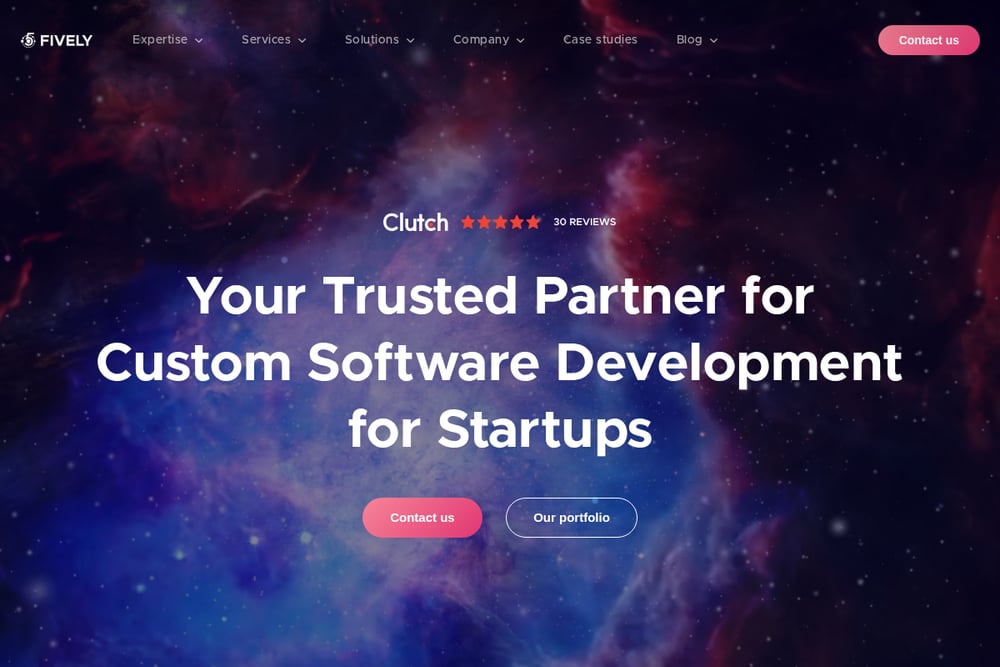 A screenshot of the Fively website.
Fively frames its pitch around a fair question: why are off-the-shelf solutions holding your business back? Their small business practice leans on MVP development, web portals, CRM and CMS solutions, and AI chatbot work with retrieval-augmented generation. The team works across Python, React, .NET, Node.js, and Java, so stack fit is rarely a problem. They are a good match if you have a product idea or a portal concept and want a technical partner to scope and ship it. Their small business expertise page explains where they focus.
#5 Demski Group
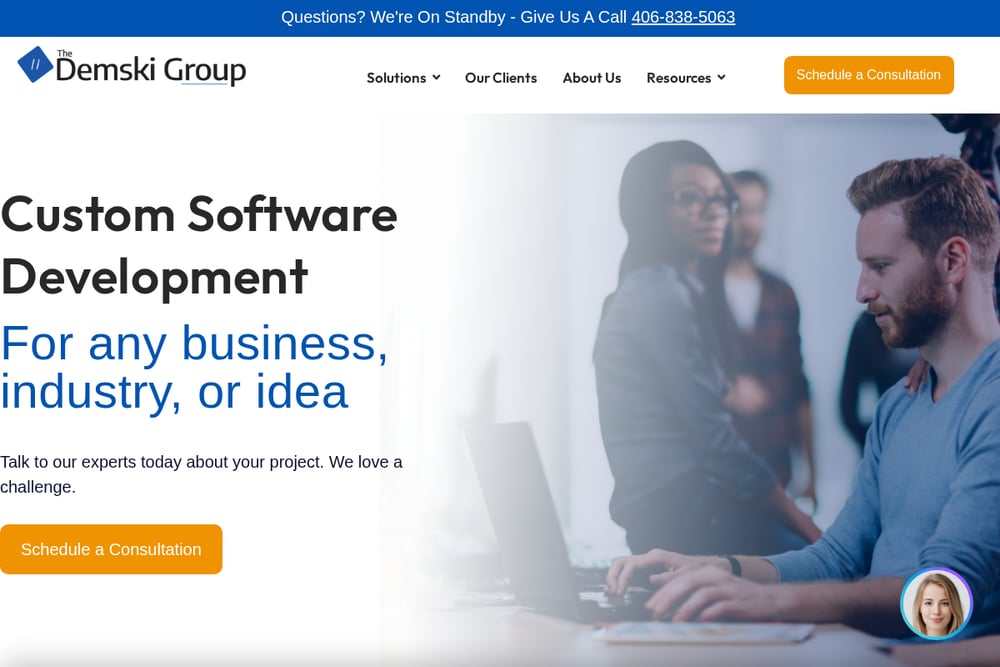 A screenshot of the Demski Group website.
Demski Group positions itself as technology consulting for SMBs, with a menu built around workflow automation, CRM development, custom dashboards, customer self-service portals, and inventory management. They also publish a project cost calculator, which is a refreshing bit of transparency in a category where pricing usually hides behind a sales call. Their focus on sales and lead tracking plus employee scheduling suggests a strong fit for service businesses with field or shift-based teams. If you want a consultant who scopes before building, their guide to when a small business should build custom software is a useful starting read.
How to pick the right partner
Start with the shape of your problem. If one painful workflow is costing you hours a week, you want a partner who will build a focused fix fast and let you see it working early. If you are replacing several disconnected systems, you want breadth and a structured process. Ask three questions of every partner: Who actually writes the code, and will I talk to them directly? What do I own if I walk away? And what does the first month cost, in writing? A $500 prototype that you keep tells you more about a partner than any proposal deck. Watch for hourly billing that punishes you for asking questions, and long contracts that lock you in before you have seen a single screen.
Where AI fits into the build
AI is changing both how software gets built and what it can do once it is live. On the build side, AI agents handle scaffolding, boilerplate, and testing, which is why a single senior engineer can now deliver what once took a team. On the operations side, the wins are concrete: orders captured once instead of retyped, quotes generated in minutes, customer questions answered by a portal at night, and dashboards that refresh themselves. The practical sequence is to map the manual steps first, automate the highest-volume one, and expand from there. Do not start with the fanciest AI feature. Start with the copy-and-paste task your team complains about most.
The bottom line
You do not need an enterprise budget to stop living in spreadsheets. Buildable suits companies planning a broad, multi-system buildout. Innovation Amplification is the pick when you want a senior engineer, a working prototype for $500, and month-to-month terms with no lock-in. Vrinsoft covers the widest technical ground, Fively is strong for MVPs and portals, and Demski Group brings consulting discipline plus transparent cost tools. Match the partner to the size of your problem, insist on seeing something real early, and keep ownership of what gets built.