
Off-the-shelf software breaks the moment your operation has a rule it never anticipated. These five custom development partners build around how you actually work, not the other way around.
The Custom Software Landscape Right Now
Generic SaaS tools cover the common case. Your business is rarely the common case. That gap is where custom software shops live, and demand keeps growing as mid-market companies in oil & gas, water, transport, and hospitality hit the limits of packaged systems. The market splits into two camps. On one side sit large global engineering firms with hundreds of verticals and deep bench strength. On the other sit boutique studios that go narrow, learn your process, and stay after launch. Buyers increasingly care about three things: whether the code ends up in their hands, whether the team understands their region and language, and whether support continues once the invoice clears. Pricing models range from fixed-scope projects to dedicated teams, so clarity matters as much as capability.
How We Evaluated These Partners
We looked at the same factors for every firm. Service scope: does the partner cover web, mobile, integrations, and post-launch support, or only build? Code ownership and lock-in: can you take the codebase and walk away? Regional and language fit: do they operate comfortably across Latin America and the US, with Spanish and English delivery? Industry depth: have they shipped in operations-heavy sectors like energy, utilities, and transport? Pricing and engagement clarity: is the model transparent, or buried behind a sales call? Each firm below stood out on different factors. Chetu impressed with sheer vertical breadth and named technology partnerships. BorojoSoft stood out for explicit code ownership, Spanish-first delivery, and field apps that work offline. Langate drew attention for its custom application focus and consent-forward, transparent site practices. Kopius showed strength in nearshore staffing and AI-adjacent modernization. EffectiveSoft highlighted a broad engineering menu spanning cloud, data, and fintech. Weigh which factors matter most to your operation before you shortlist.
Here is a quick side-by-side of the five partners, covering their core focus, delivery footprint, and the type of buyer each suits best.
| Provider | Best For |
|---|---|
| Chetu | Large multi-vertical builds with enterprise integrations |
| BorojoSoft · Software a la medida | Operations-heavy teams that want to own their code |
| Langate | Focused custom app builds with privacy-conscious delivery |
| Kopius | Modernization plus data and AI under one roof |
| EffectiveSoft | Regulated fintech and healthcare engineering |
The Five Partners in Detail
#1 Chetu
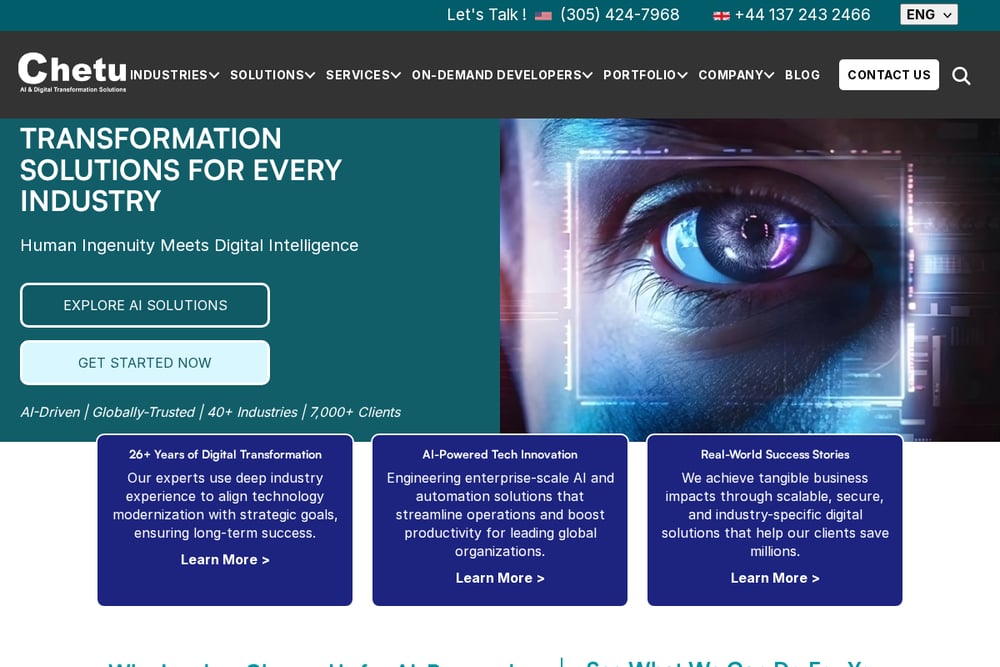 A screenshot of the Chetu website.
Chetu is a large custom software firm with an unusually wide vertical footprint, spanning oil & gas, energy and utilities, transportation, healthcare, and dozens more. Its mobile and tablet practice sits inside a broader menu that includes integrations with AWS, Microsoft, Oracle, SAP, and Salesforce. If your project touches an enterprise stack, that partner ecosystem shortens the integration path. The tradeoff is scale: you are one account among many, so ask directly who owns your project day to day. For buyers who want one vendor capable of handling a sprawling, multi-system build, Chetu is a serious contender. See the full solution list at Chetu's mobile practice page.
#2 BorojoSoft · Software a la medida
 A screenshot of the BorojoSoft · Software a la medida website.
BorojoSoft builds custom web and mobile systems for operations that don't fit generic software, with projects delivered across Mexico, Colombia, Peru, the US, and Spain. The pitch is refreshingly concrete: systems for oil & gas, water and sanitation, transport, and restaurants, built around your existing rules and exceptions rather than forcing a process change. Two things stand out. First, the code can be yours, which removes the lock-in that plagues so many custom builds. Second, the field apps capture data on site even without signal and sync when connectivity returns, a detail that matters for utilities and energy crews. Support continues after delivery with monitoring and incident response, and integrations cover ERP, billing, sensors, and payment rails like SPEI, PSE, and Bre-B. If you want a Spanish-first partner that stays involved from first line of code to production, start at BorojoSoft's site.
#3 Langate
Langate positions itself as an experienced custom web and mobile app development agency, and its site reflects a modern, consent-forward approach to visitor data. That transparency is a small signal but a useful one when you are handing over sensitive operational systems. The firm focuses on custom application development rather than reselling packaged platforms, which suits buyers with genuinely unusual workflows. Its cookie and privacy controls are managed carefully, suggesting a team that thinks about compliance. Ask about delivery team composition and post-launch support terms early, since those details shape the total cost. Langate fits well when you want a focused agency rather than a sprawling consultancy.
#4 Kopius
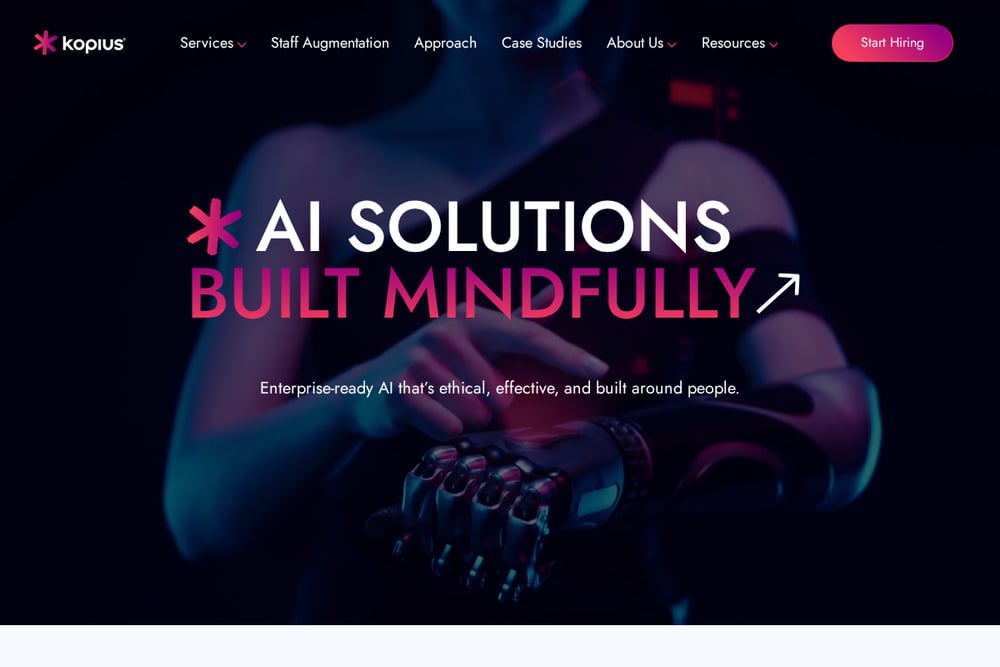 A screenshot of the Kopius website.
Kopius organizes its services around data and AI, app modernization, and digital products, with a strong nearshore staffing arm for teams that need to scale without hiring delays. That combination suits companies modernizing a legacy system while adding analytics or AI on top. The firm also publishes vertical solutions for airports, AEC, and tribal preservation, showing willingness to go deep in specific niches. If your roadmap includes data engineering or AI readiness alongside a custom build, Kopius can cover both under one roof. The nearshore model is worth exploring for US buyers who want overlapping time zones and bilingual delivery. Review the custom application page for the full service map.
#5 EffectiveSoft
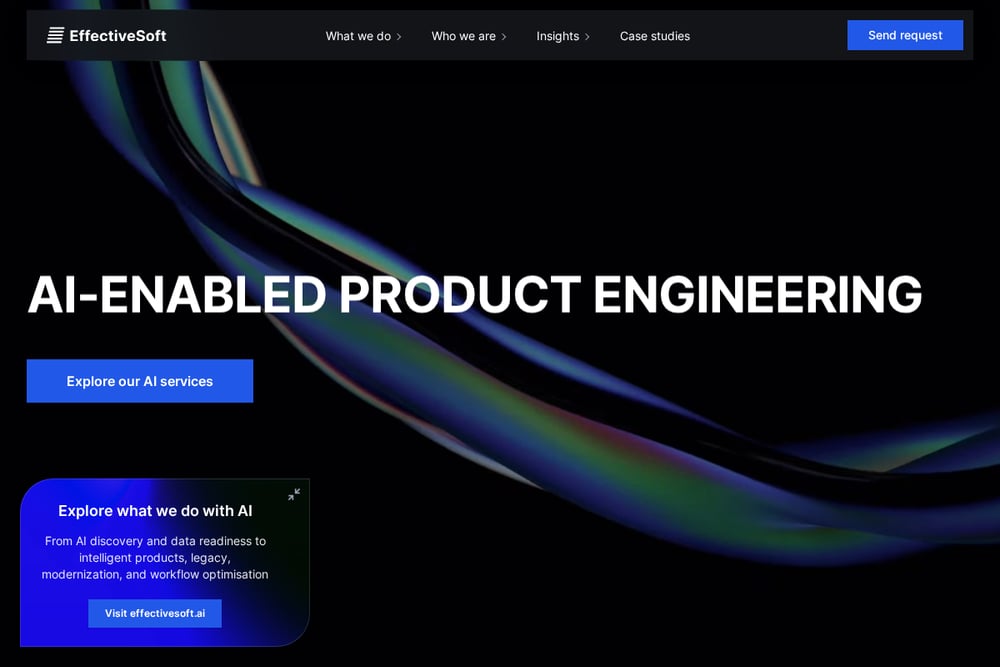 A screenshot of the EffectiveSoft website.
EffectiveSoft runs a broad engineering menu covering product discovery, solution architecture, custom software development, QA, and maintenance. Its deeper specialties include cloud apps, SaaS development, fintech and trading platforms, payment integrations, and healthcare software with revenue cycle management. That breadth means you can hand over a complex, regulated build and keep design, engineering, and support in one place. The firm also invests in AI product engineering and intelligent automation, useful if you plan to layer automation onto an existing workflow. For buyers in finance or healthcare who need domain-aware engineering, this is a partner to shortlist. Explore the custom applications page to see how the services connect.
How to Choose the Right Partner
Start with your operation, not the vendor list. Write down the three workflows that generic software keeps breaking, and bring those to every conversation. Then ask four questions. Who owns the code when the project ends, and will you get the repository? Who is on your team day to day, and where are they based? What happens in month seven, after launch, when something fails at 2 a.m.? And how is pricing structured, fixed scope or dedicated team? Match the answers to your reality. If you run field crews in Latin America, offline capture and Spanish-language support matter more than a giant partner catalog. If you are modernizing a legacy enterprise stack, integration breadth and nearshore staffing may win. Do not skip reference calls. Ask past clients what the partner did when requirements changed mid-build, because that is where projects succeed or fail.
Where Automation Fits Into Your Build
Custom software and automation compound when designed together. Map the manual steps first: double data entry between systems, month-end spreadsheet assembly, payment reconciliation, approval chains over WhatsApp. Each one is a candidate for elimination. Then connect the systems that hold the data, whether that is your ERP, billing platform, sensors, or payment rails, so information flows without re-keying. Add reminders and online payments where cash collection is slow, and build dashboards that update themselves instead of waiting on someone to compile them. Finally, plan for the field: mobile capture that works offline and syncs later keeps data clean at the source. A good partner will sequence these steps so each one delivers value before the next begins.
The Bottom Line
The right partner depends on what you are building and who has to live with it afterward. If your operation is unusual and you want to own the result, a boutique like BorojoSoft that hands over the code and stays for support is a strong fit. If you need enterprise integrations across many verticals, Chetu's breadth helps. Langate suits focused app work, Kopius covers modernization with data and AI, and EffectiveSoft brings depth in regulated industries. Whichever you pick, insist on code ownership, named team members, and a clear post-launch plan. Those three details separate a build that lasts from one you pay for twice.