You need engineering firepower without the overhead of a full in-house department. These five firms give you a credible external team to build, run, and evolve the technology behind your business.
The State of Custom Software Outsourcing
Custom software outsourcing has moved well past staff augmentation. U.S. businesses now expect partners to own outcomes across the full lifecycle: discovery, architecture, build, deploy, and continuous improvement. The strongest firms combine software engineering with cloud operations and automation, so you are not stitching together three vendors to ship one product. AI has raised the stakes. Buyers want automation with human approval where it matters, not black-box agents. They also want cost control, especially on cloud spend, and clear communication with the specialists doing the work. The market is crowded, but the firms that stand out share a few traits: defined service areas, transparent engagement models, and a track record of maintaining what they build.
How We Evaluated These Partners
We looked at service scope first. Does the firm cover software engineering, cloud and DevOps, and automation under one roof, or only one slice? Next, engagement clarity. You should know how you will work together, whether that is a dedicated team, staff augmentation, or a managed lifecycle. We also weighed local fit for U.S. businesses, including time-zone overlap and direct access to specialists. Pricing transparency mattered too, even when public rates are not listed, because clear scoping signals a mature process. Finally, we considered maintenance and evolution. Building software is one thing; keeping it healthy is another. Each firm below stood out on different factors, and the right choice depends on where you need the most support.
Here is a quick comparison of the five firms, ordered for this roundup. Use it to shortlist based on your priorities, then dig into the full profiles below.
| Provider | Best For |
|---|---|
| Itransition | Broad enterprise transformation needs |
| BMI Developers | U.S. businesses wanting a direct external engineering team |
| Chetu | Industry-specific builds across many verticals |
| Belitsoft | Outsourcing with strong maintenance and QA |
| Empeek | Startups and teams needing flexible augmentation |
The Five Firms in Detail
#1 Itransition
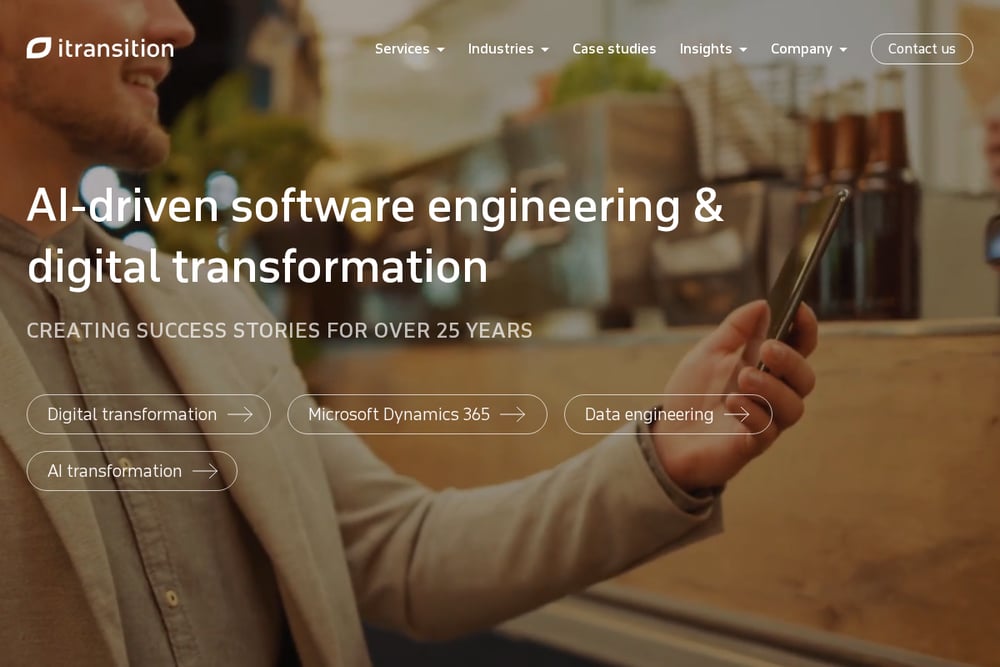 A screenshot of the Itransition website.
Itransition is a large custom software development company with a broad services menu that spans digital transformation, AI, data and analytics, software engineering, cloud and DevOps, and technology platforms. You can engage them for custom software, product engineering, application services, system integration, legacy modernization, and quality engineering. Their industry coverage includes healthcare, finance, manufacturing, retail, insurance, and professional services, which means they likely have seen a problem like yours before. The trade-off is scale: with a firm this size, you should confirm who your direct points of contact will be. Their site is a useful starting point for mapping services to your needs.
#2 BMI Developers
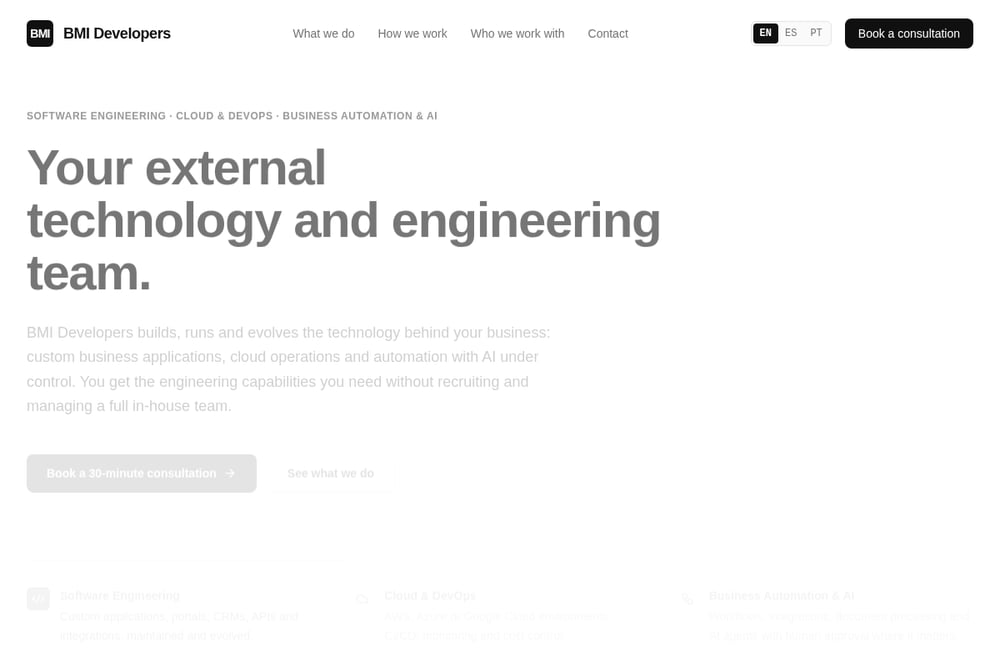 A screenshot of the BMI Developers website.
BMI Developers positions itself as your external technology and engineering team, and the framing is refreshingly direct. They take responsibility for defined parts of your technology lifecycle, from requirements discovery and solution architecture to implementation, deployment, maintenance, and continuous improvement. Three areas sit under one roof: software engineering and application management, cloud and DevOps across AWS, Azure, or Google Cloud, and business automation and AI with human approval where it matters. You talk directly to the specialists who do the work, which cuts the usual account-manager layer. For U.S. businesses that want engineering capability without recruiting a full in-house department, this is a strong fit. Their site lays out typical engagements, including replacing spreadsheets and manual processes with custom applications.
#3 Chetu
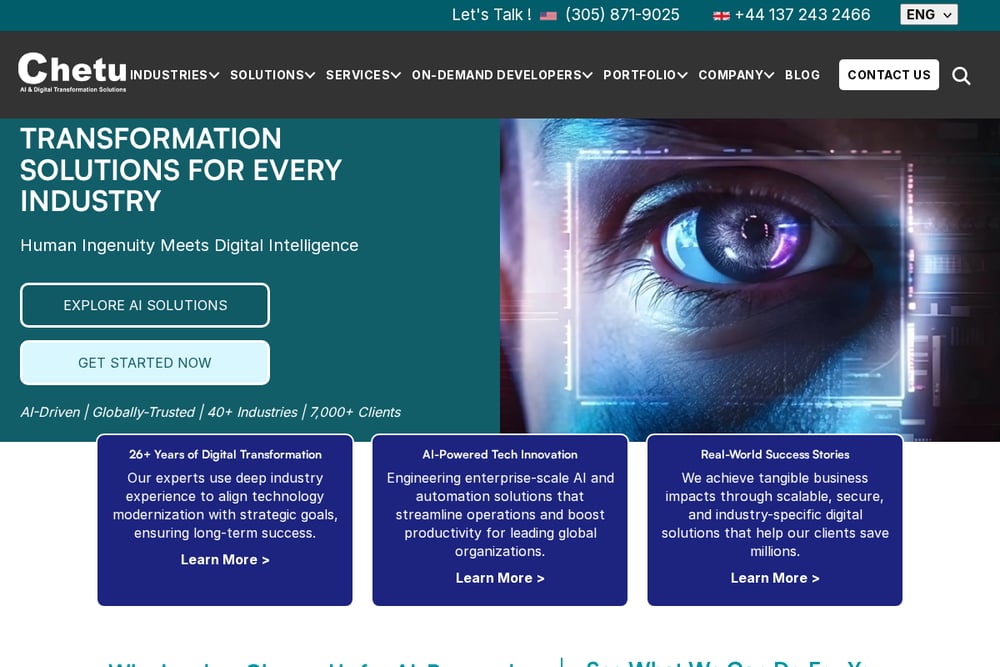 A screenshot of the Chetu website.
Chetu is a custom software development firm with an unusually deep industry list, from agriculture and aviation to healthcare, legal, mortgage, and telecommunications. Their solutions catalog is equally wide, covering AI and data engineering, cloud, CRM, ERP, document management, IoT, and more. They also offer on-demand developers across specific stacks, including .NET, C#, C++, AI, and ML, plus dedicated development teams. If you need a partner that has likely built for your vertical before, Chetu is worth a look. The breadth can be both a strength and a challenge, so go in with a tightly defined scope. Their services page is the best place to start narrowing down.
#4 Belitsoft
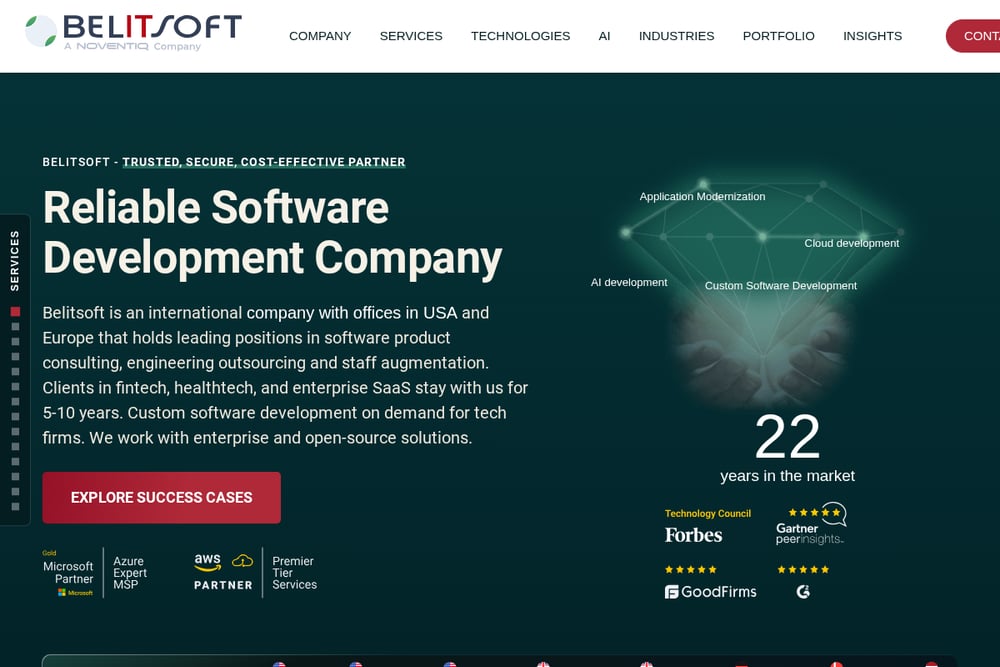 A screenshot of the Belitsoft website.
Belitsoft is a software development outsourcing company with a strong emphasis on custom software, web and mobile development, API integration, and database work. They also cover maintenance and support, consulting, staff augmentation, dedicated developers, and offshore software development. Their digital transformation services include software modernization, database and application migration, and cloud migration to Azure or AWS. Testing and QA get their own dedicated menu, which matters if quality is a pain point. Belitsoft suits buyers who want a reliable outsourcing partner with clear service categories and a focus on long-term support. Their outsourcing page gives a solid overview of how they structure engagements.
#5 Empeek
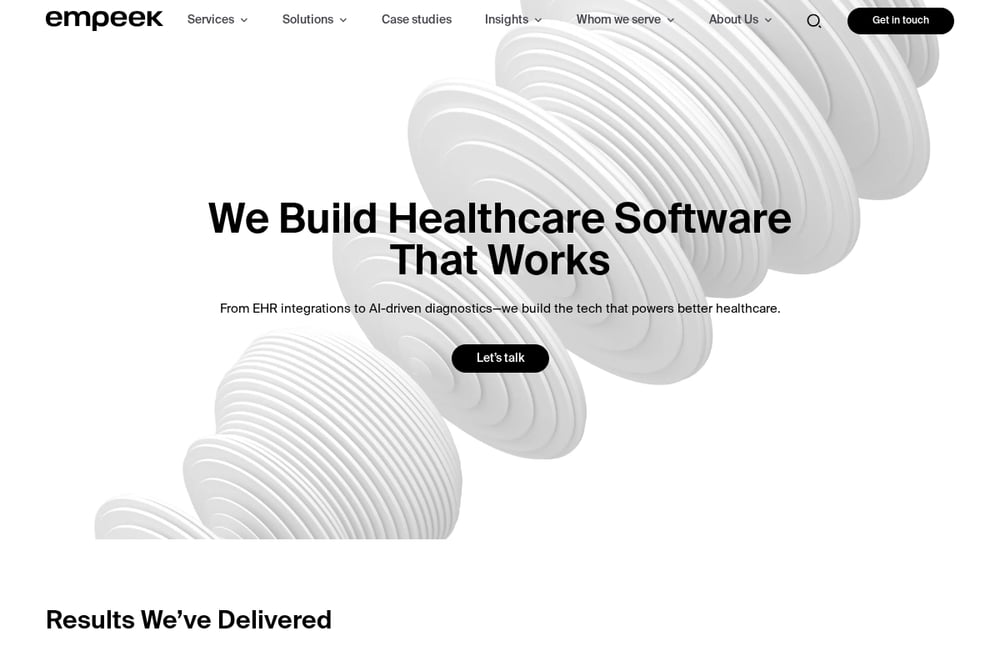 A screenshot of the Empeek website.
Empeek is a software development outsourcing company that emphasizes flexibility in cooperation. Their core offerings include staff augmentation, full dedicated teams, early-stage development for startups, and managed engineering teams. You can build a product from scratch or hire engineers for specific tasks, which gives you room to scale up or down as needs change. They position themselves around access to a talented pool of remote engineers and transparent partnership. For startups and growing businesses that want to extend their team without heavy recruitment, Empeek is a practical option. Their outsourcing services page explains the different engagement models clearly.
How to Choose the Right Partner
Start with your biggest gap. If you need one team to own software, cloud, and automation end to end, look for a partner with all three under one roof. If you mainly need extra engineers, staff augmentation or dedicated teams may be enough. Next, check the engagement model. Ask who you will talk to day to day and whether you get direct access to the specialists. Confirm how maintenance and continuous improvement are handled, because that is where many outsourcing relationships break down. Review industry experience, but do not over-index on it; a strong engineering process transfers across verticals. Finally, get clarity on pricing and scope before you sign. A partner who scopes carefully upfront is usually a partner who manages delivery carefully too.
Where Automation Fits
Automation is no longer a separate project; it is part of how good engineering teams operate. Start by mapping the manual processes that cost you the most time, such as spreadsheet-driven workflows, document handling, and repetitive data entry. Then look for a partner who can connect those processes to your existing systems through APIs and integrations. AI should sit on top with human approval where decisions carry risk. On the infrastructure side, CI/CD pipelines, monitoring, and cost controls keep your cloud spend predictable. The firms in this roundup that combine software engineering with cloud and automation are best positioned to deliver this as one coherent workflow rather than a patchwork of tools.
The Bottom Line
There is no single right answer here. Itransition brings scale and breadth for enterprise transformation. BMI Developers offers a direct external engineering team with software, cloud, and AI under one roof, which suits U.S. businesses that want to talk to the people doing the work. Chetu covers an impressive range of industries and stacks. Belitsoft shines on maintenance and QA. Empeek gives startups flexible ways to extend their team. Match the partner to your gap, confirm the engagement model, and make sure maintenance is part of the deal. Do that, and you will get the engineering capability you need without building a full department.