
Your spreadsheets are buckling, your Access database is older than some of your employees, and nobody trusts the numbers anymore. Here are five US partners who can turn that mess into systems your team will actually use.
The state of custom software and data automation in the US
Off-the-shelf tools solved the easy problems. What's left is the hard stuff: the workflow that's unique to your business, the data trapped in a dozen files, the manual steps nobody wants to own. That's why custom software and data automation demand keeps climbing across US organizations.
Buyers are also wiser now. You've watched subscription stacks pile up without fixing the core problem. So you're asking sharper questions about ownership, longevity, and whether a partner will still be around when something breaks in year three.
The market splits into a few camps. There are boutique shops that build around your exact workflow, enterprise consultancies that modernize big platforms, global engineering firms with deep benches, and specialists serving industrial or technical niches. Knowing which camp fits your problem is half the battle.
How we evaluated these five
We looked at the same factors for every company on this list.
Service scope. Does the partner cover the full arc, from discovery and prototyping through build, migration, and ongoing maintenance? Or do they hand you a deliverable and disappear?
Fit for spreadsheet and legacy data problems. Some firms shine at replacing scattered files and aging databases with one reliable source of truth. Others are built for enterprise platform work.
Pricing and engagement clarity. We noted whether a company publishes pricing, offers consultations, or keeps you guessing until a sales call.
Local and operational fit. US-based availability, industry experience, and how well the partner's model matches a mid-market organization's budget and pace all counted.
Larch Systems stood out for end-to-end ownership and a deliberate anti-subscription stance. Pell Software for data automation depth and US-based delivery. Improving for enterprise-grade modernization. Intellias for scale and multidisciplinary teams. Automated Solutions for industrial and technical niches.
Here's the short version before the deep dive. Each of these five brings a different strength to the table, so match the partner to your problem rather than the other way around.
| Provider | Best For |
|---|---|
| Pell Software | Teams buried in manual data movement between apps |
| Custom Software Development & Data Systems | Larch Systems | Replacing critical spreadsheets and Access databases |
| Improving | Enterprises modernizing legacy platforms |
| Intellias | Large-scale builds needing multidisciplinary teams |
| Automated Solutions | Industrial data logging and SCADA work |
The five, in detail
#1 Pell Software
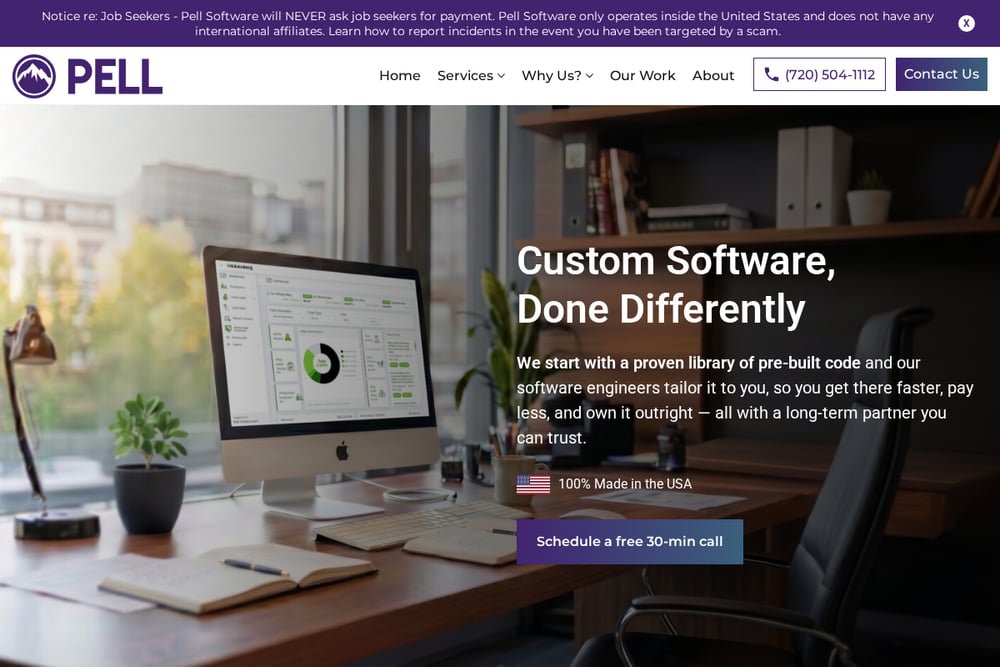 A screenshot of the Pell Software website.
Pell Software is a US-based custom software shop with a sharp focus on data automation and business process automation. Their pitch is straightforward: if your team is manually moving data between applications, you're bleeding productivity and scalability. They build integrations and automation that let your data move and transform on its own.
Their service menu covers bespoke business software, API and data integrations, app modernization, and AI software development, with consulting and discovery up front. They also offer ongoing partnerships and maintenance, which matters if you want a long-term relationship rather than a one-off build.
What stands out is the operational discipline. They're explicit about being US-only, with no international affiliates, and they publish scam warnings for job seekers, which signals a company paying attention to how it's represented. For organizations drowning in manual data handling, their automation focus is a natural fit.
#2 Custom Software Development & Data Systems | Larch Systems
 A screenshot of the Custom Software Development & Data Systems | Larch Systems website.
Larch Systems builds custom software, data management systems, and workflow automation for US organizations that want dependable systems rather than another subscription to work around. Their positioning is refreshingly blunt: software and data systems built to last.
The service range covers the full lifecycle. You get custom web applications and internal tools, data management systems that replace scattered files with one reliable source of truth, and business process automation that removes repetitive manual work. Two offerings stand out for mid-market buyers: spreadsheet-to-web-app conversion and Microsoft Access database migration, both of which preserve your data and business rules while moving you to a secure, shared application.
They also handle dashboards with role-based views and exports, plus ongoing maintenance and support so systems stay secure and useful as needs change. The emphasis on end-to-end ownership, from first prototype to production and beyond, is exactly what you want when the spreadsheet everyone depends on finally has to go.
#3 Improving
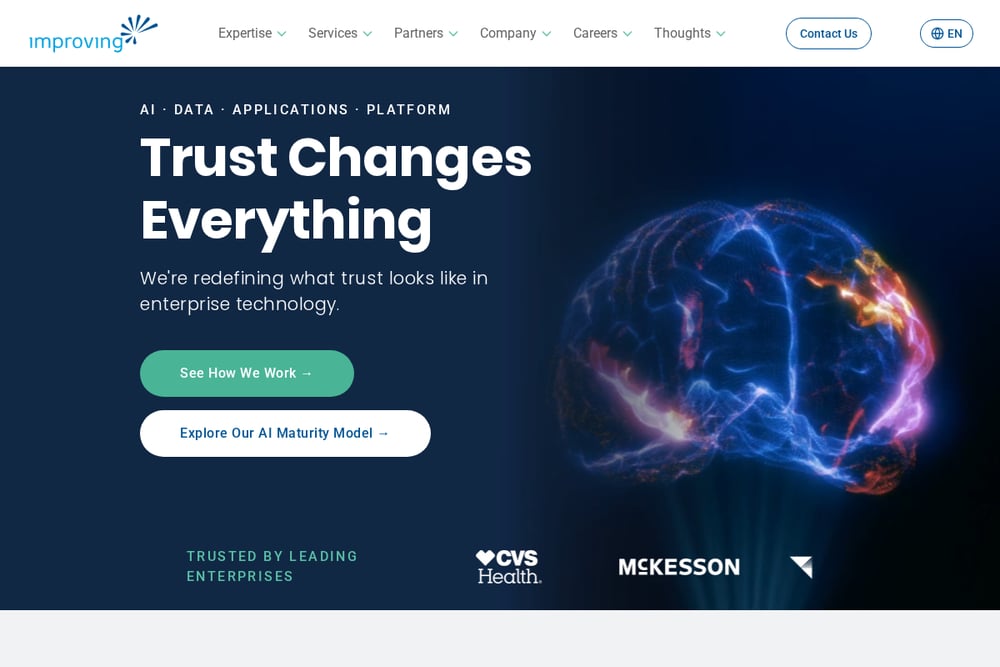 A screenshot of the Improving website.
Improving is built for the enterprise. Their custom software practice targets complex challenges: legacy systems slowing transformation, tangled integrations, security and compliance gaps, and release processes that can't keep up.
What they build spans enterprise platforms, customer and employee portals, AI-enhanced applications, data and analytics systems, integration hubs and APIs, and cloud-native applications. If your organization needs a mission-critical platform that scales and evolves, this is the kind of partner that speaks your language.
Their framing around security, compliance, and scalability will resonate if you operate in a regulated industry or carry a large user base. The tradeoff is fit: this is enterprise-grade work with enterprise-grade scope, so smaller organizations with a single spreadsheet problem may find them heavier than needed.
#4 Intellias
 A screenshot of the Intellias website.
Intellias brings scale. Since 2002 they've operated as a full-stack, multidisciplinary custom software company, supplying developers, managers, architects, designers, and DevOps engineers as one engaged team.
Their end-to-end lifecycle covers requirements gathering and consulting through continuous post-deployment maintenance. They emphasize predictable, measurable results within defined timelines, and they've built a responsible AI consulting practice on top of their core engineering work.
The challenges they frame are familiar to any operations leader: increasing efficiency, minimizing bugs and human error, and meeting regulatory requirements through rule-driven processes and automated logging. If you need a large, cross-functional team and a global delivery model, Intellias fits. If you want a small US-based partner who knows your name, look elsewhere on this list.
#5 Automated Solutions
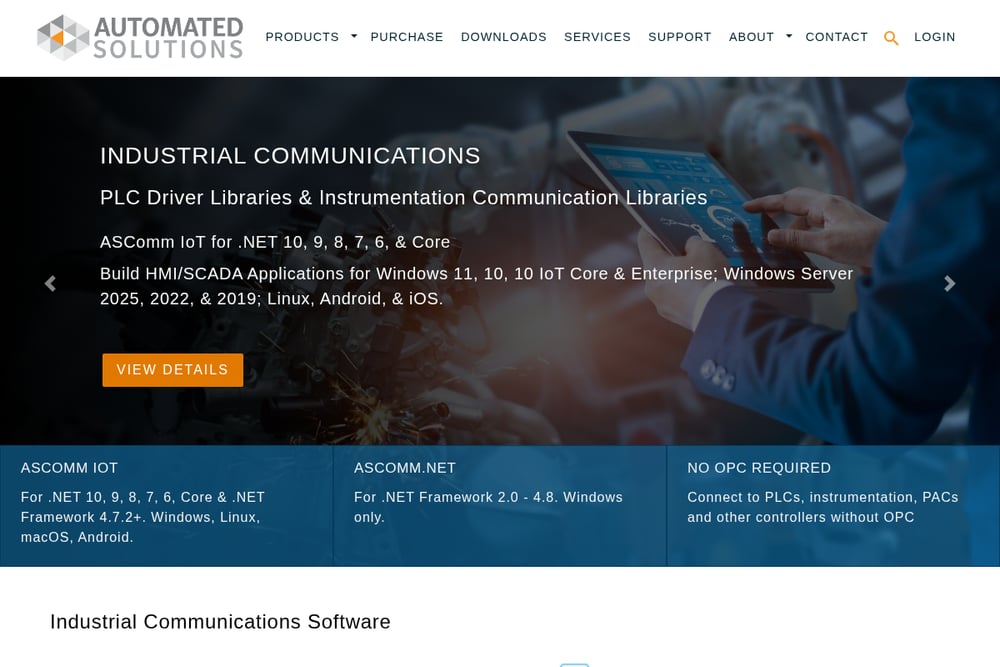 A screenshot of the Automated Solutions website.
Automated Solutions serves a specific and technical audience: industrial communications and process automation. They offer custom programming for industrial-quality applications and libraries, including Windows, Linux, and web applications.
Their work covers control and component class libraries, client/server systems, gateways, data logging, and HMI/SCADA applications. They're comfortable interfacing PLCs, instrumentation, cloud endpoints, and databases, which is a specialized skill set you won't find at a generalist web shop.
Their value proposition is practical. Custom data logging and gateway applications can beat off-the-shelf software on cost, especially when deployed across multiple PCs, and they'll quote free of charge. If you're an equipment manufacturer needing a modern interface for a legacy machine, or an industrial operation with a data pipeline problem, they're worth a conversation.
How to choose the right partner
Start with the problem, not the vendor. Write down what's actually broken. Is it a spreadsheet that three people maintain by hand? An Access database nobody can update? A manual data shuffle between five tools? A legacy platform that can't scale? The answer narrows your list fast.
Then ask about ownership. Who owns the code? What happens when you want to change something in year two? A partner who builds around your workflow and hands you a maintainable system is worth more than one who locks you into their platform.
Ask about the handoff. Maintenance and support aren't glamorous, but they're where systems live or die. Confirm who handles updates, fixes, and security patches after launch.
Finally, check the fit. A boutique US shop may move faster on a mid-market budget. An enterprise consultancy may be the right call for a regulated, large-scale platform. Neither is wrong. They're just different tools for different jobs.
Where automation fits into the picture
Automation isn't a product you buy. It's a sequence of decisions about which manual steps should disappear.
First, map the workflow. List every step a person does by hand, how often, and what happens when it's done wrong. You'll usually find two or three steps that eat most of the time.
Second, find the source of truth. Automation built on scattered files just automates the chaos. Consolidate records into one structured system first, then connect the tools around it.
Third, automate the boring middle. Data syncs, scheduled reports, status updates, and handoffs between systems are prime candidates. Leave judgment calls to people.
Fourth, build in visibility. Dashboards and logs tell you the automation is running and catch failures early. A silent automation that breaks is worse than a manual process you can see.
Fifth, plan for maintenance. Systems drift as your business changes. Schedule reviews so your automation stays accurate instead of quietly rotting.
The bottom line
You don't need more subscriptions. You need systems that fit how your team actually works and that someone will maintain when things change.
If your pain is scattered spreadsheets and aging databases, Larch Systems is built for exactly that, with end-to-end ownership from prototype to maintenance. If manual data movement is the bottleneck, Pell Software's automation focus fits. Improving suits enterprise modernization, Intellias suits large multidisciplinary builds, and Automated Solutions covers the industrial niche.
Pick the partner whose strengths match your problem. Then ask the hard questions about ownership, handoff, and support before you sign anything.