Off-the-shelf field service tools stop fitting the moment your crews, office, and billing start pulling in different directions. Here are five builders worth a serious look when you're ready to close that gap.
The state of custom contractor software
Most contractors start on commercial platforms, and that's the right call early on. But growth brings workarounds: spreadsheets patching the gaps, admin staff acting as the integration layer, and critical workflows living in texts and emails. That's the moment custom operations software earns its keep. The market has split into two camps: established platforms that bolt on custom development, and smaller shops that build around your process from scratch. Knowing which camp fits your situation is half the decision.
How these five were evaluated
Each business was looked at on four factors: depth of contractor-specific scope (field ops, job costing, AR, permits, local SEO), how clearly pricing and engagement models are presented, fit for home service and construction operations specifically, and the credibility signals a buyer can verify, like case studies, reviews, and platform ratings. The detail on each one lives in its description below.
Here's the short version before the deep dive. Each entry below earns its place for a different reason, so match the profile to your situation rather than reading the order as a verdict.
| Provider | Best For |
|---|---|
| Quadra Operations Systems | Contractors wanting one private end-to-end system |
| Custom Software for Contractors | Field Ops, AR Dashboards & Local SEO — Talha Jaleel | Home service contractors who've outgrown off-the-shelf tools |
| SCAND | Larger builds needing a full development team |
| Smart Service | Franchises and multi-location operators on a proven platform |
| Builtable Labs | Contractors scoping targeted fixes, not full rebuilds |
The five, in detail
#1 Quadra Operations Systems
 A screenshot of the Quadra Operations Systems website.
Quadra builds private contractor management systems that run from estimate to final invoice, with estimating, projects, crews, subcontractors, materials, documents, job costing, and billing connected in one environment. The pitch is control: actual cost versus budget per project, plus role-based access for owners, office staff, project managers, and crews. It's aimed squarely at construction and service contractors juggling multiple sites or clients who have outgrown spreadsheets and generic tools. If you want a single operating system rather than a stack of integrations, this is the profile to study first. Their contractor management software page lays out the full scope.
#2 Custom Software for Contractors | Field Ops, AR Dashboards & Local SEO — Talha Jaleel
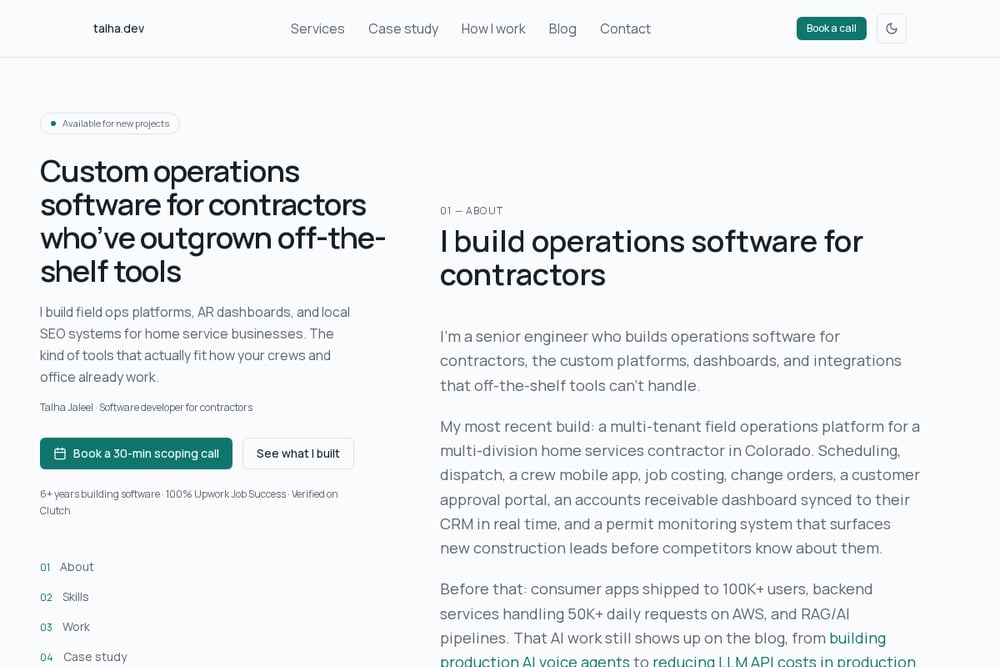 A screenshot of the Custom Software for Contractors | Field Ops, AR Dashboards & Local SEO — Talha Jaleel website.
Talha Jaleel is a senior developer running a one-person consultancy based in Lahore, Pakistan, working remotely with US home service contractors, and his focus is narrow on purpose: operations software for home service contractors. His most recent build was a multi-tenant field operations platform for a multi-division home services contractor, covering scheduling, dispatch, a crew mobile app, job costing, change orders, a customer approval portal, an AR dashboard synced to the CRM in real time, and a permit monitoring system that surfaces new construction leads early. Before that he shipped consumer apps to 100K+ users and AWS backends handling 50K+ daily requests. The credibility markers are concrete: 6+ years, 100% Upwork Job Success, and a 5.0 rating verified on Clutch. You get a free 30-minute scoping call, and the case study shows exactly what the work looks like.
#3 SCAND
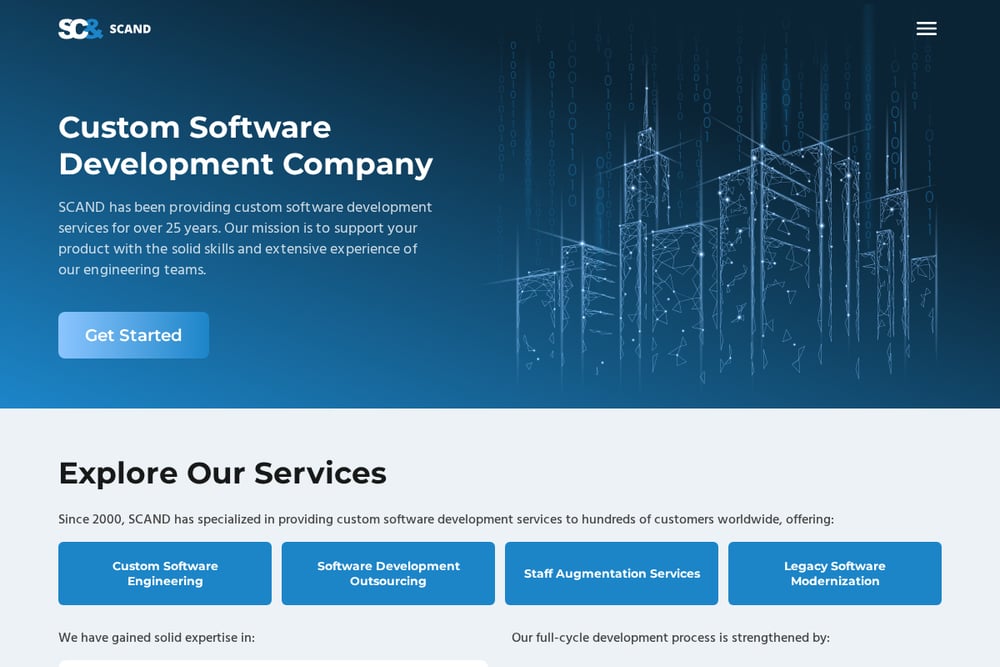 A screenshot of the SCAND website.
SCAND is a full-service software development company with a dedicated field service management practice, spanning web, mobile, backend, cloud, and AI work. That breadth matters if your build touches legacy modernization, cross-platform mobile apps, or integrations well beyond the dispatch board. You're getting a team rather than an individual, which suits larger scopes and longer roadmaps. The tradeoff is that contractor operations is one vertical among many in their portfolio, so you'll want to confirm relevant references up front. Their field service development page details the service lines.
#4 Smart Service
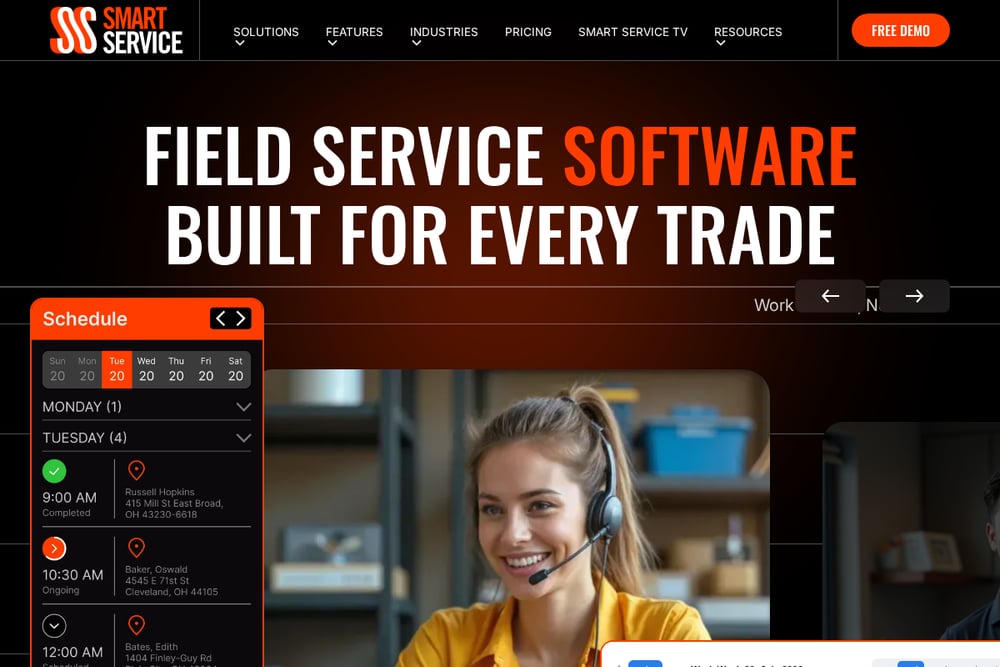 A screenshot of the Smart Service website.
Smart Service is an established field service platform with a custom development arm, split into two tracks: SmartFlow AWA for advanced workflow automation and Smart Service DSD for multi-entity architecture. That second track is built for franchises, multi-location operators, and companies with complex org structures. The advantage here is starting from a proven scheduling, dispatch, and billing foundation and customizing outward, rather than building everything from zero. If you're already on a platform and need it bent to your workflow, this is a lower-risk path. See the custom development options for the split.
#5 Builtable Labs
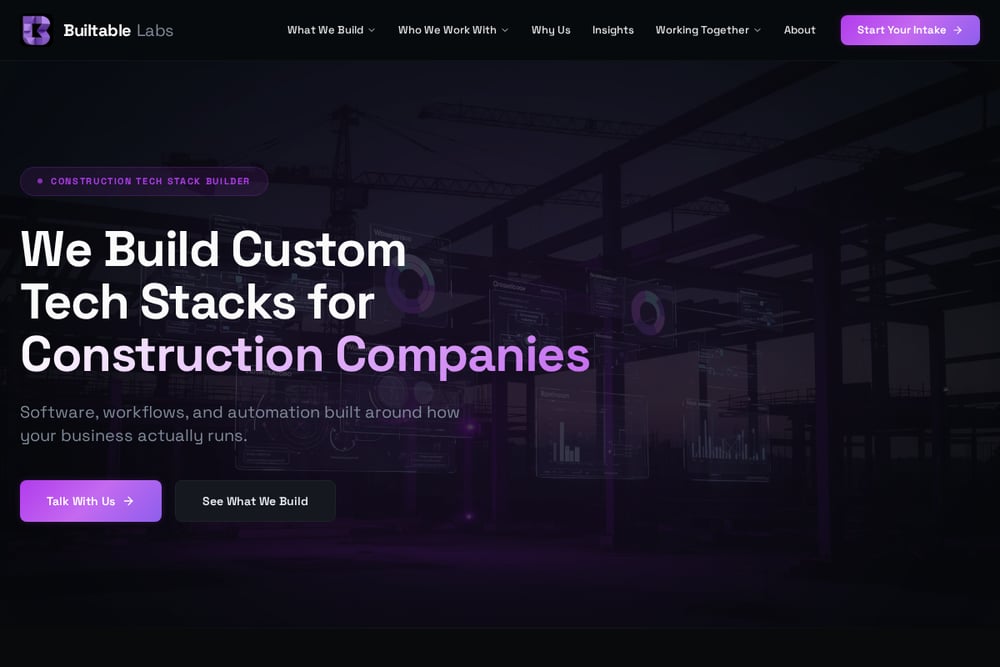 A screenshot of the Builtable Labs website.
Builtable Labs approaches the problem from the construction tech stack angle, arguing that custom software doesn't mean massive enterprise systems with year-long buildouts. Their framing is targeted solutions: a change order workflow matching your approval chain, a dashboard showing the metrics your leadership actually reviews, field reporting designed around your project types. They also spell out the warning signs that commercial software has stopped working, which is genuinely useful if you're unsure whether you've hit that point. Read their take on when and why to build before you scope anything.
Choosing the right fit
Start with the size of the gap. If a few workflows are broken, a targeted build from a small shop gets you there faster and cheaper than a platform migration. If your whole operation runs on workarounds, a private end-to-end system is the better investment. Next, decide whether you want a person or a team. A solo consultant gives you direct access and tight scope control; an agency gives you bench depth for bigger roadmaps. Then check the proof: ask for case studies in your trade, verify reviews on third-party platforms, and confirm who actually writes the code. Finally, insist on a paid or free scoping conversation before any contract. A builder who asks hard questions about your crews and billing process up front is the one you want.
Where automation fits in
The highest-return automations for contractors cluster in three places. First, accounts receivable: sync invoices and payments to your CRM so aging reports update in real time instead of monthly. Second, lead capture: monitor permit filings and new construction activity so you reach prospects before competitors know they exist. Third, field-to-office handoffs: change orders, approvals, and job costing that flow from the crew app straight into billing without a human retyping anything. Layer AI on top only after those basics are solid, and keep a human review step on anything customer-facing.
The bottom line
There's no universal winner here, only the right shape for your operation. Quadra suits contractors who want one private system from estimate to invoice. Talha Jaleel fits home service businesses that need a focused builder with verifiable results and a narrow specialty. SCAND covers large, multi-disciplinary builds. Smart Service is the pragmatic route for franchises already on a platform. Builtable Labs helps you scope targeted fixes without overbuilding. Pick based on the size of your gap, then verify the proof before you sign.