You need software that fits your business, not the other way around. These five US development partners build web, mobile, and AI solutions with real business context behind them.
The Custom Software and AI Development Landscape
Custom software development has shifted from a build-it-once mindset to a build-it-to-evolve mindset. Businesses now expect web apps, mobile apps, and internal tools to connect with AI assistants, cloud APIs, and automation workflows from day one. That means the partner you choose needs more than coding chops. They need design judgment, architectural discipline, and a clear view of how generative AI fits into everyday operations. The US market is crowded with agencies claiming AI expertise, but the strongest teams treat AI as a practical layer inside working software rather than a standalone novelty. You will see everything from large consultancies to focused product shops. The right fit depends on how much strategy, design, and engineering you want under one roof.
How We Evaluated These Development Partners
We looked at service scope first. Does the partner cover web, mobile, desktop, AI, and cloud integrations, or only one slice? Next, we examined how clearly each team explains its process, from discovery through release. We also weighed AI practicality. Some firms lead with generative AI and RAG search, while others fold AI into broader software delivery. Design and business context mattered too, because software that ignores users fails regardless of the stack. Finally, we considered delivery models and transparency around engagement. Each partner below stood out on different factors. OSDEV Systems impressed with its connected-product framing across experience, intelligence, and infrastructure. Geniusee showed breadth across AI and data services. Leobit highlighted deep .NET and AI-native lifecycle expertise. Atiba brought a pragmatic, business-first AI message. FusionHit demonstrated a wide engineering bench with nearshore flexibility.
Here is a quick comparison of the five partners, ordered for this roundup. Use it to shortlist based on your project shape, not just brand recognition.
| Provider | Best For |
|---|---|
| Geniusee | Broad AI and mobile engineering needs |
| Custom Software Development & AI | OSDEV Systems | Connected products with practical AI built in |
| Leobit | Enterprise .NET teams adopting AI-native delivery |
| Atiba | Business-first AI problem solving |
| FusionHit | Scalable teams across AI and full-stack work |
The Five Partners in Detail
#1 Geniusee
 A screenshot of the Geniusee website.
Geniusee presents a broad AI and software development menu, from generative AI and RAG to AI agents and intelligent automation. You can see the full range on its AI development services page. The firm also covers mobile app consulting, iOS and Android development, and legacy modernization. That breadth suits you if you want one partner for both AI experimentation and core product engineering. The trade-off is that a wide catalog can make it harder to know where to start, so come with a clear problem statement.
#2 Custom Software Development & AI | OSDEV Systems
 A screenshot of the Custom Software Development & AI | OSDEV Systems website.
OSDEV Systems frames its work around connected products, bringing experience, intelligence, and infrastructure together. You get web application development for SaaS, portals, and e-commerce, plus generative AI with RAG search and AI agents. The team also builds cross-platform mobile and desktop apps and handles cloud integrations and business automation. What stands out is the emphasis on design, technology, and business context in one development partner. If you want software built with intention rather than assembled from templates, this is a strong fit.
#3 Leobit
 A screenshot of the Leobit website.
Leobit leans into Microsoft stack excellence and AI-native delivery. Its generative AI software development services include corporate LLM development, agentic AI, and AI chatbot work. The firm also promotes an AI-native software lifecycle spanning QA, business analysis, and UX prototyping. That makes it a fit if your organization already runs on .NET or wants AI woven through the entire delivery process. Expect a structured, enterprise-oriented approach rather than a lightweight prototype shop.
#4 Atiba
 A screenshot of the Atiba website.
Atiba takes a grounded view of AI software development, arguing that the value comes from solving stubborn business problems rather than chasing flashy tools. Its AI custom software development page stresses custom solutions over off-the-shelf add-ons. The team also discusses AI agents moving into practical enterprise workflows. You will appreciate this partner if you want a business-first conversation before any code is written. It suits mid-sized companies looking for real-world problem solving with a local, relationship-driven feel.
#5 FusionHit
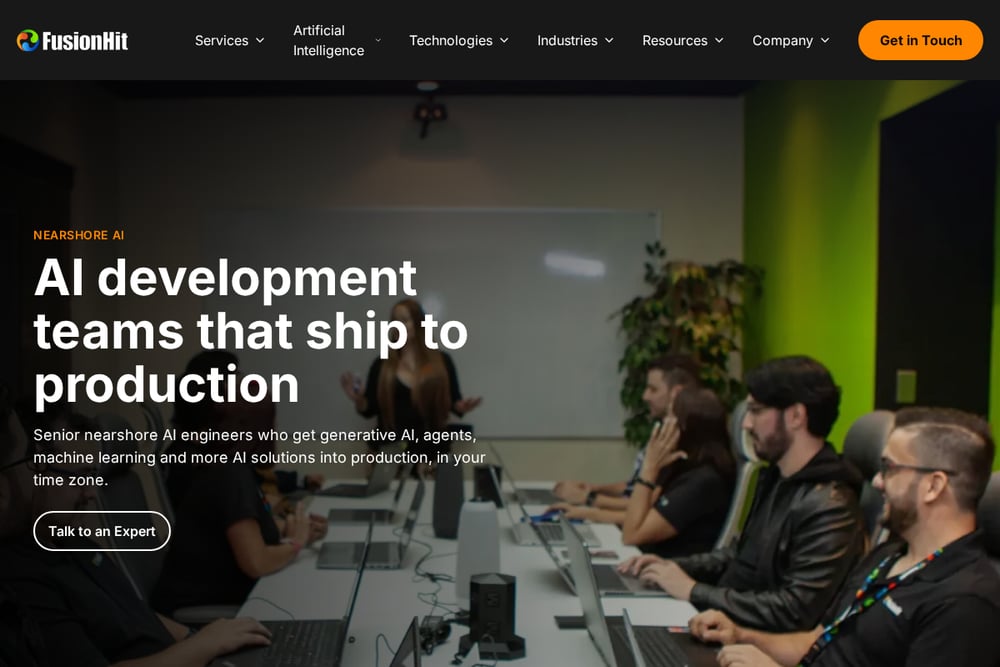 A screenshot of the FusionHit website.
FusionHit brings a wide engineering bench across custom software, full-stack, mobile, and AI development. Its guide to AI software development services in the US outlines how it thinks about production-ready AI, from generative systems to intelligent automation. The firm also offers nearshore and dedicated team models, which can help if you need to scale capacity quickly. You get flexibility in engagement style, from staff augmentation to full delivery. It is a practical option when your roadmap spans multiple technologies and timelines.
How to Choose the Right Development Partner
Start with the problem, not the technology. Write down what you need the software to do and who will use it. Then check whether a partner has built something similar. Ask how they handle discovery, design, and release. If AI is part of the plan, ask where it will sit in your workflows and how they will ground it in your data. Look for teams that talk about business context as much as frameworks. Finally, confirm the engagement model. Some firms work best as a dedicated team, while others prefer fixed-scope projects. Match that to how your organization actually buys and manages work.
Where Automation Fits Into Your Build
A practical automation workflow starts with mapping repetitive tasks across your tools. Identify the manual steps your team repeats weekly, such as pulling data between systems or answering the same internal questions. Then connect those tools through custom APIs and cloud integrations. Layer in an AI assistant grounded in your own knowledge base so answers come from source-aware retrieval. Route the results into guided workflows so people act on them instead of hunting for information. Review and refine the workflow after each release. This is the pattern OSDEV Systems describes with its custom AI assistant example, and it is a sensible model for most businesses starting with automation.
The Bottom Line
You do not need the biggest agency. You need the one that understands your business and can ship software that keeps working as you grow. OSDEV Systems stands out for connected products that blend design, engineering, and practical AI. Geniusee offers breadth, Leobit brings enterprise depth, Atiba keeps the focus on real problems, and FusionHit gives you scalable teams. Pick the partner whose strengths match your next release, and start with a clear problem statement.