You have an idea, a workflow that keeps breaking, or a backlog of manual tasks eating your week. The right partner turns that into working software and automation, not another slide deck.
The state of custom software and AI automation in 2026
Custom software and AI automation have merged into one buying decision. You no longer choose between a web development shop and an AI consultancy, because the good teams now ship both: dashboards, integrations, agents, and the workflows that connect them. Buyers want proof of production delivery, not demos. They ask how fast a first deployment lands, who maintains it after launch, and whether the team can wire AI into an existing stack without breaking it. Pricing models vary widely, from fixed-scope proposals to discovery-first audits. That makes scope clarity and communication cadence as important as technical skill. The five firms below each answer these questions differently, and the right fit depends on how much of the project you want handled end to end.
How we evaluated these partners
We looked at the same factors for every firm. Service scope: can one team cover design, development, AI, and automation, or do you need to stitch vendors together? Delivery speed and process: how quickly does a first deployment ship, and is the path from discovery to launch documented? Pricing and scope clarity: do you get a written proposal with deliverables, timeline, and price before work starts? Communication: is there a named point of contact and a predictable update rhythm? Stack and integration depth: which platforms and tools do they build on, and can they connect to what you already run? Softkora stood out for its 250-service catalog and dedicated project manager on WhatsApp. Makeitfuture stood out for its ISO 27001 framing and platform-specific builds across Make, n8n, Airtable, Zapier, and HubSpot. Geniusee stood out for enterprise-grade AI and data engineering depth. Spiral Scout stood out for custom platforms, SaaS, and legacy modernization. Agentiwise stood out for fast, production-grade AI agent delivery with a clear discovery-to-support process.
Here is the short version. Each entry below covers what the firm does, who it fits, and what to check before you sign. Use the comparison to shortlist two or three, then dig into the deep dives.
| Provider | Best For |
|---|---|
| Makeitfuture | Teams already on no-code platforms who want a security-minded automation partner |
| Softkora | Ideas to Digital Solutions | Small and mid-sized businesses that want one team for the whole project |
| Geniusee | Enterprises needing AI plus data engineering at scale |
| Spiral Scout | Companies building or modernizing a custom platform or SaaS product |
| Agentiwise | Teams that want a working AI agent shipped in weeks |
The five partners in detail
#1 Makeitfuture
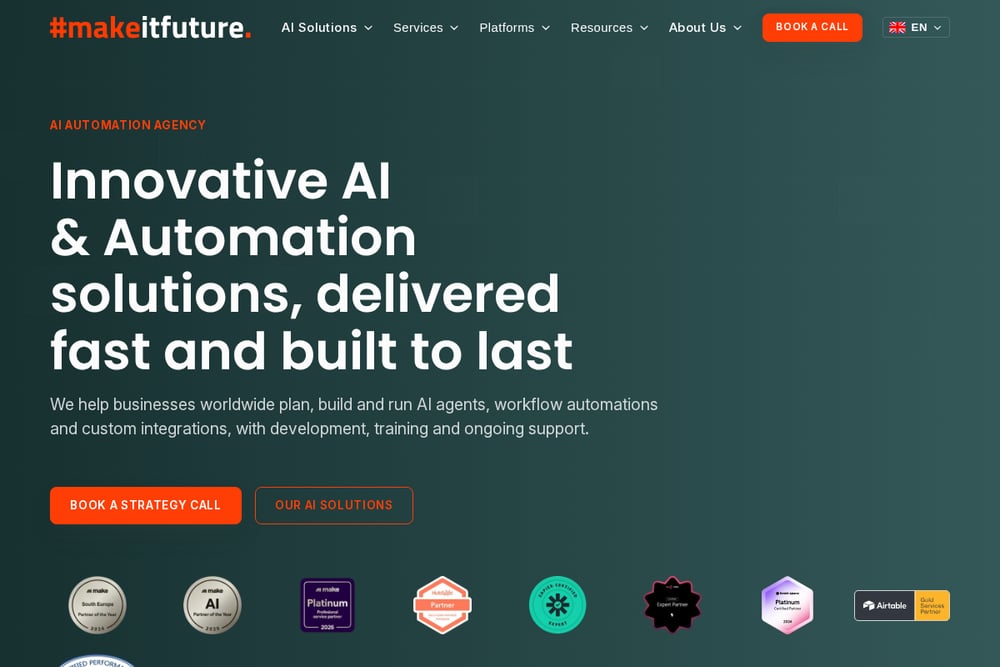 A screenshot of the Makeitfuture website.
Makeitfuture positions itself as a European AI automation agency with a strong security posture, citing ISO 27001 standards across its delivery. Its service menu is unusually specific: AI consultancy and audit, AI agents, workflow automation, conversational AI, and platform-specific development on Make, n8n, Airtable, Zapier, HubSpot, and Boostspace. That platform focus matters if your stack already runs on those tools, because you avoid a rebuild. The firm also offers automation as a service, migration support, monitoring, and training workshops, which covers the post-launch gap many agencies ignore. Its AI roadmap deliverable is framed around ROI, so you get a prioritized plan rather than a vague strategy document. See the agency's AI automation services for the full breakdown.
#2 Softkora | Ideas to Digital Solutions
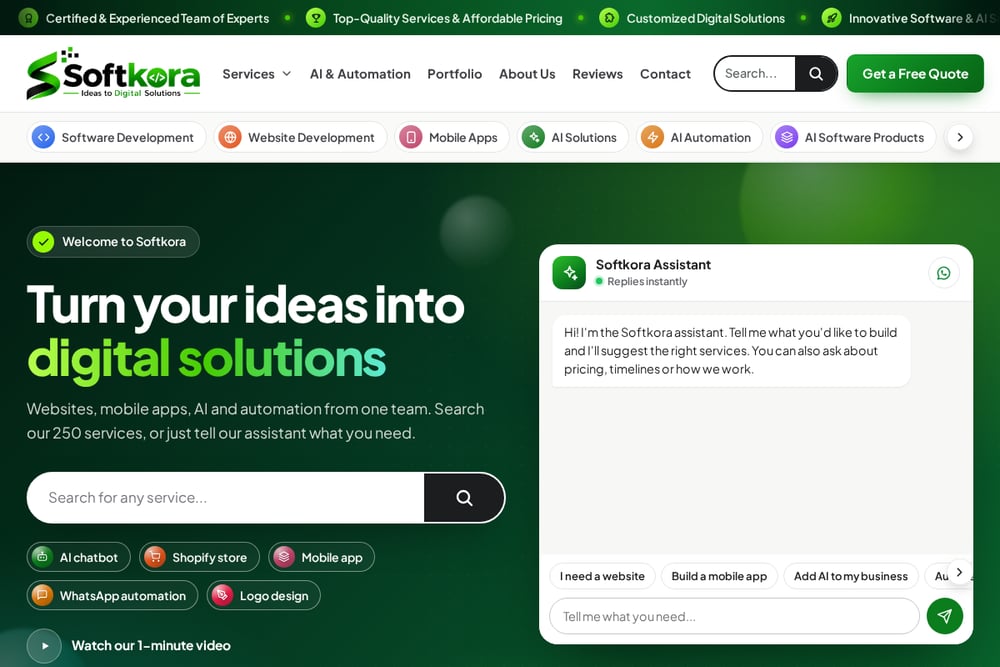 A screenshot of the Softkora | Ideas to Digital Solutions website.
Softkora is a software and AI company based in Monroe, Michigan, built around a simple promise: websites, mobile apps, AI, and automation from one team. The catalog is the differentiator. You can search 250 services across 21 categories, or describe your goal to the Softkora Assistant and let it point you to the right services. Designers, developers, and AI engineers work together, and a dedicated project manager keeps you updated on WhatsApp, which suits owners who do not want to chase status updates. Pricing is handled through a written proposal with deliverables, timeline, and price before work begins, so scope is clear up front. The AI side focuses on practical work: assistants, agents, and automations that answer customers, process documents, and keep systems current, with a person reviewing anything important. Start with the service catalog to see how your project maps to their categories.
#3 Geniusee
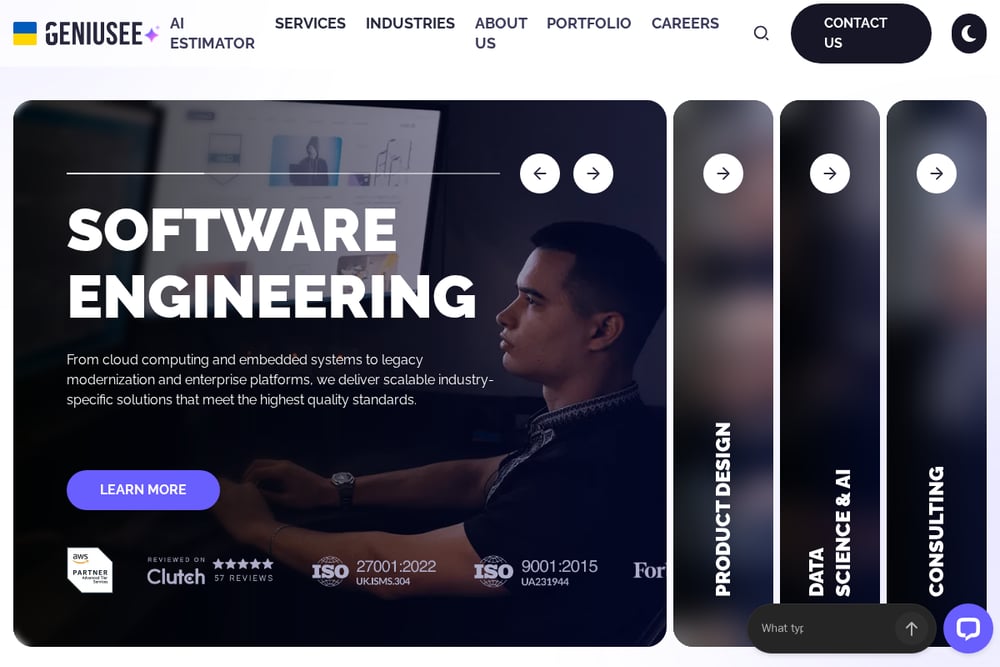 A screenshot of the Geniusee website.
Geniusee is the enterprise option on this list. Its AI and data practice covers generative AI, large language model development, retrieval-augmented generation, computer vision, AI agents, RPA, and MLOps, alongside a full software engineering arm for web, mobile, and legacy modernization. That breadth means you can run an AI pilot and a platform rebuild under one contract. The firm also offers AI consulting, ideation workshops, prompt engineering, and agentic AI transformation, which helps if your team needs alignment before code. Industry pages for EdTech, FinTech, manufacturing, and marketing show where they have repeatable patterns. If your project involves data pipelines, model operations, or compliance-heavy environments, this is the depth to evaluate. Review the AI development services to compare against your requirements.
#4 Spiral Scout
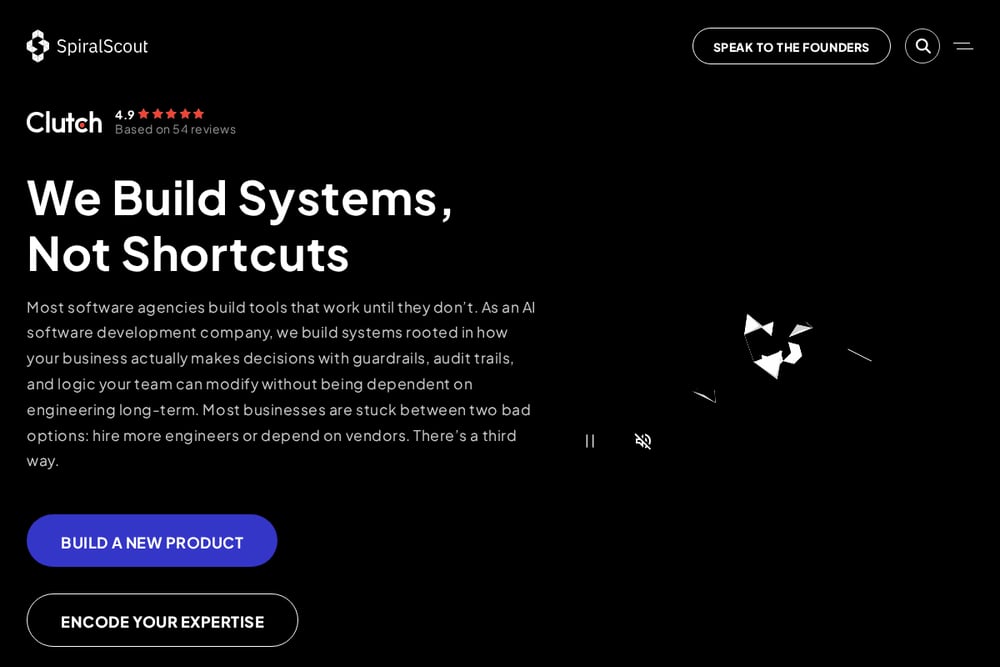 A screenshot of the Spiral Scout website.
Spiral Scout builds custom software and platforms, with a portfolio spanning SaaS products, e-commerce architecture, ERP integrations, publishing platforms, and business process automation apps. Its AI and automation practice sits alongside that engineering core, covering AI readiness audits, implementation consulting, agent automation, knowledge and rules engines, and workflow orchestration on Temporal. That combination fits companies that need a durable system, not a one-off script. The firm also offers product discovery, product design, dedicated teams, QA, and support and maintenance, so you can keep the same partner past launch. Case studies describe concrete outcomes, including supplier data automation that turned a 12,306-product workbook into a single reviewed import file. Explore the custom software development services for scope details.
#5 Agentiwise
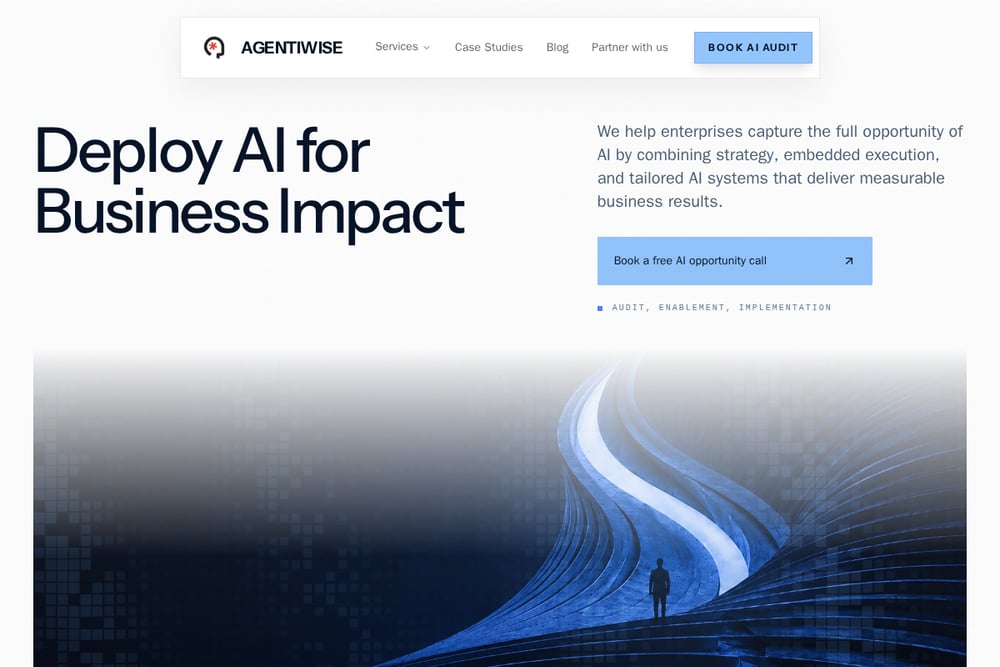 A screenshot of the Agentiwise website.
Agentiwise focuses on custom AI agents and AI-powered software, with a stated track record of 50-plus shipped agents. The pitch is production-grade delivery: dashboards, admin panels, internal tools, API integrations, and data pipelines wired into your existing stack. Its process is explicit, moving from discovery to design, build, deploy, and support, with most projects reaching a first deployment in two to six weeks. The stack leans on Claude for reasoning, Claude Code for agentic development, and n8n for orchestration, which is a sensible setup for teams that want maintainable automation. It also offers an AI audit as an entry point, useful if you need a scoped starting point before committing to a build. Read the custom AI software overview to see the delivery model.
How to choose the right partner for your project
Start with the shape of your problem. If you need a website, an app, and some automation under one roof, a broad catalog and a single project manager will save you coordination time. If your stack already runs on Make, n8n, or HubSpot, pick a firm that builds natively on those platforms. If you are modernizing a legacy system or building a SaaS product, prioritize engineering depth and long-term support over speed. If your goal is a single AI agent in production fast, look for a team with a tight discovery-to-deploy process and a short first-deployment window. Then pressure-test three things. Ask for a written proposal with deliverables, timeline, and price. Ask who your point of contact is and how often you will hear from them. Ask what happens after launch, including monitoring, handover, and maintenance. A partner who answers all three clearly is usually the safer bet, regardless of size.
Where automation fits into your build
Most projects follow the same arc. You map the workflow and find the bottlenecks, usually manual data entry, document handling, or customer replies. Then you pick the smallest automation that removes the bottleneck, such as an assistant that answers common questions or a pipeline that processes documents and flags exceptions for a person to review. You wire it into your existing tools through APIs or a platform like n8n or Zapier. You ship it, watch it for a few weeks, and expand only after it holds. The firms above differ mainly in how much of that arc they own. Some start with an audit and roadmap, some go straight to a build, and some handle the whole system including the dashboard around it. Decide how much you want to own internally before you shortlist.
The bottom line
There is no single right answer here, only the right fit for your scope. Softkora suits you if you want one team, a wide service catalog, and a project manager who keeps you posted. Makeitfuture fits platform-native automation with a security focus. Geniusee is the pick for enterprise AI and data work. Spiral Scout is built for custom platforms and long-term product engineering. Agentiwise is the fast path to a production AI agent. Shortlist two, ask each for a written scope and a named contact, and compare how clearly they explain what happens after launch. That conversation will tell you more than any feature list.