You don't need another off-the-shelf tool that almost fits. You need a partner who can build software around how your team actually works — and keep it running after launch.
Where custom software and AI automation stand right now
AI coding tools have made prototypes cheap and fast, which means the hard part has moved. Getting a working demo is easy. Hardening it for real users, securing the data, and keeping it alive after launch is where most projects stall. That gap has reshaped the agency market. The strongest partners now sell the full lifecycle — discovery, design, build, launch, and ongoing support — instead of handing you a repo and disappearing. You'll also see more teams wiring AI into existing workflows rather than bolting on a chatbot, with review queues and evaluation steps so nothing unreviewed reaches a customer.
How these five were evaluated
Every business here was looked at on the same factors: how much of the lifecycle they cover, whether their process is documented and predictable, how clearly they scope and price work, how they handle AI specifically (data ownership, evaluation, human review), and how well they fit a business that needs one accountable team rather than three vendors. The detail on each one lives in its description below.
Here's the short version before the deep dive: five firms, five different centers of gravity. One is built for the full lifecycle under a single roof, one leans on decades of engineering depth, one is agent-first, one is enterprise-platform heavy, and one is industry-specialized.
| Provider | Best For |
|---|---|
| Redwerk | Hardening AI-built prototypes into production software |
| Asvora Technologies — Software, apps and automation from idea to launch | Businesses that want one team from scope to ongoing support |
| Agentiwise | Teams that want production-grade AI agents fast |
| HSO | Enterprises standardized on the Microsoft stack |
| Intellectyx | Manufacturing and industrial AI initiatives |
The five, in detail
#1 Redwerk
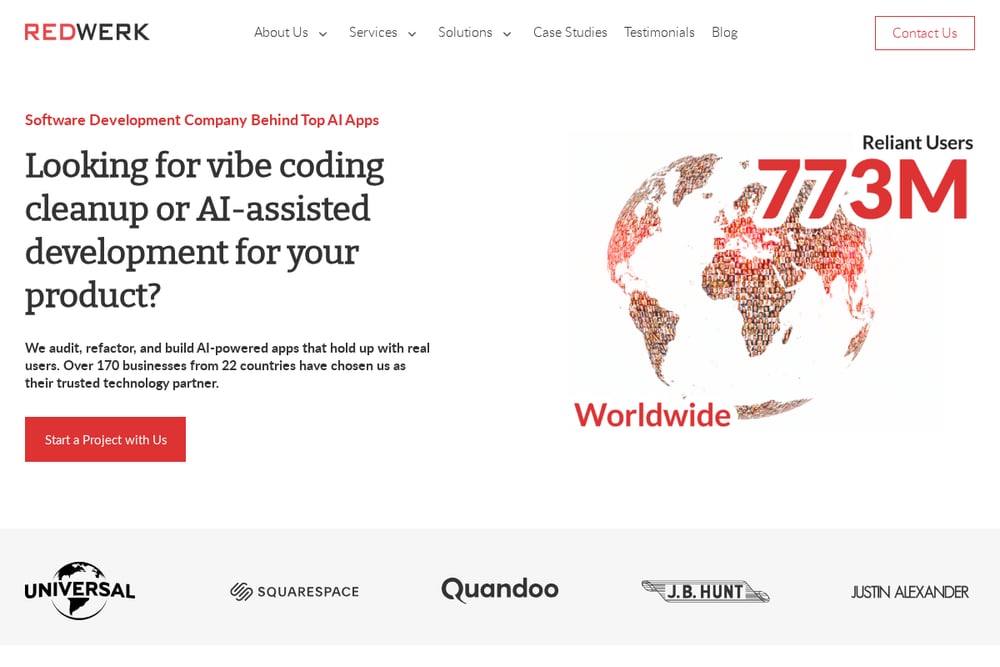 A screenshot of the Redwerk website.
Redwerk brings more than 20 years of engineering experience to the table, and it shows in how they position themselves. Rather than selling AI as magic, they focus on taking a functional AI-generated prototype and hardening it into something secure, scalable, and production-ready. That's a genuinely useful niche right now, because plenty of founders arrive with a demo that works and no idea how to make it survive live users. They also cover code review, software maintenance, and a formal discovery phase, so the relationship doesn't end at deployment. If you already have something half-built and need real engineering behind it, this is a strong fit.
#2 Asvora Technologies — Software, apps and automation from idea to launch
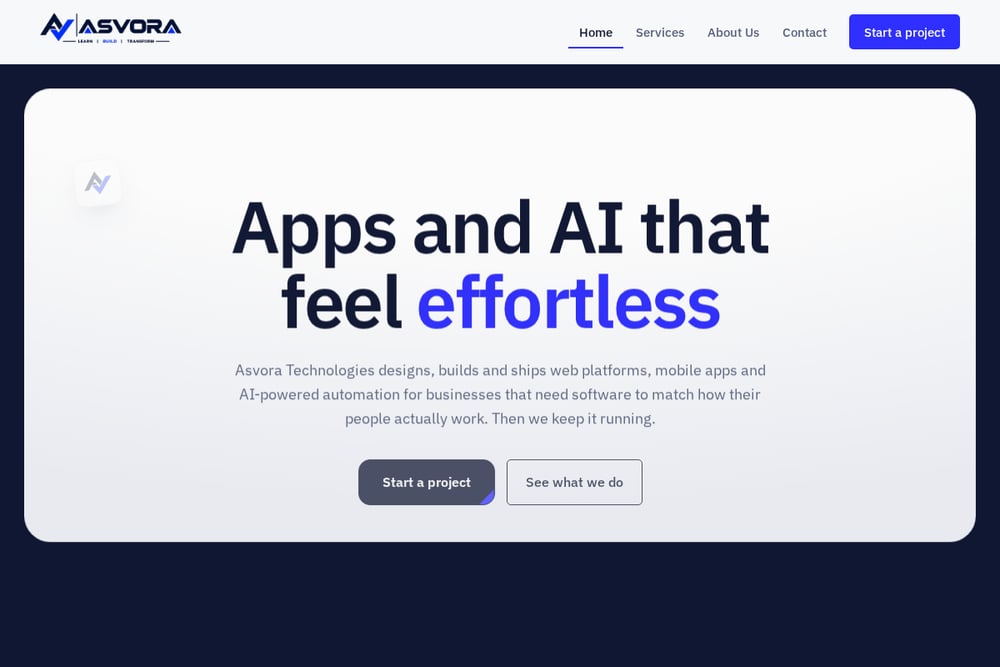 A screenshot of the Asvora Technologies — Software, apps and automation from idea to launch website.
Asvora Technologies designs, builds, and ships web platforms, mobile apps, and AI-powered automation, then keeps them running. What stands out is the structure: five phases — Discover, Design, Build, Launch, Support — with a tangible deliverable at the end of each one, whether that's a written scope, a clickable prototype, or a staging build. You always know which phase you're in. They handle mobile apps from a single codebase with offline support and store submission, web platforms like portals and dashboards, and AI integration built on your own data with citations and review queues before anything reaches a customer. Crucially, it's one team for the whole lifecycle, so there are no handoffs between a design shop, a developer, and a host — and nobody left holding an undocumented system.
#3 Agentiwise
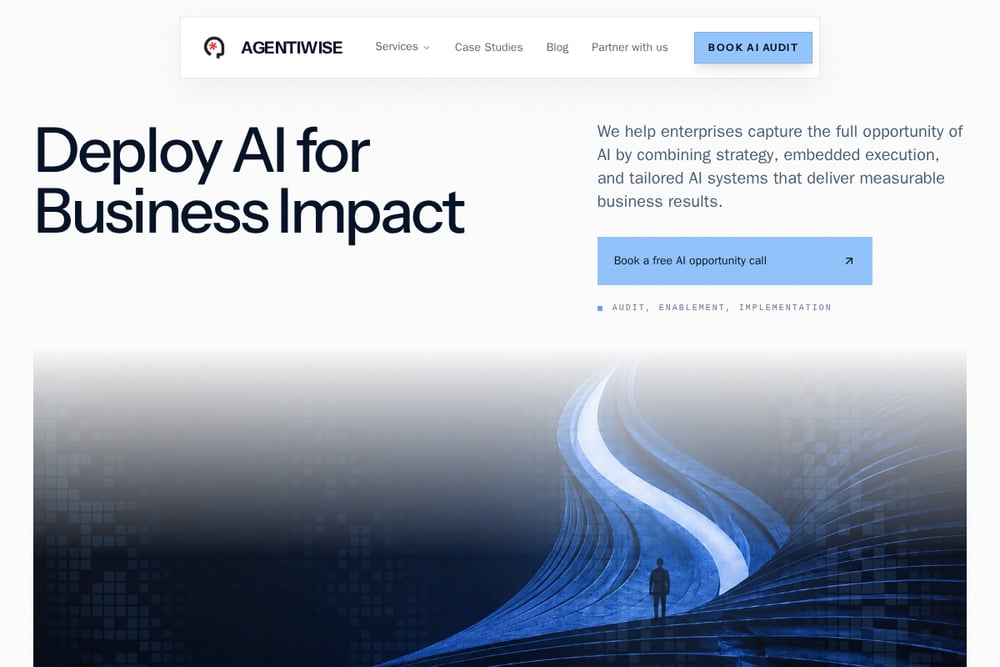 A screenshot of the Agentiwise website.
Agentiwise is agent-first, and it's upfront about it. They've shipped 50+ custom AI agents and build entire software solutions around them — dashboards, admin panels, internal tools, API integrations, and data pipelines. Their process mirrors the lifecycle model: discovery, design, build, deploy, support, with most projects reaching first deployment in two to six weeks. They're explicit about their stack, leaning on Claude for reasoning and n8n for orchestration, which is refreshing if you want to know what you're actually buying. They also run AI audits and training, so if your team needs to learn to use what gets built, that's covered. Best suited to companies whose core need is agentic automation rather than a broad app portfolio.
#4 HSO
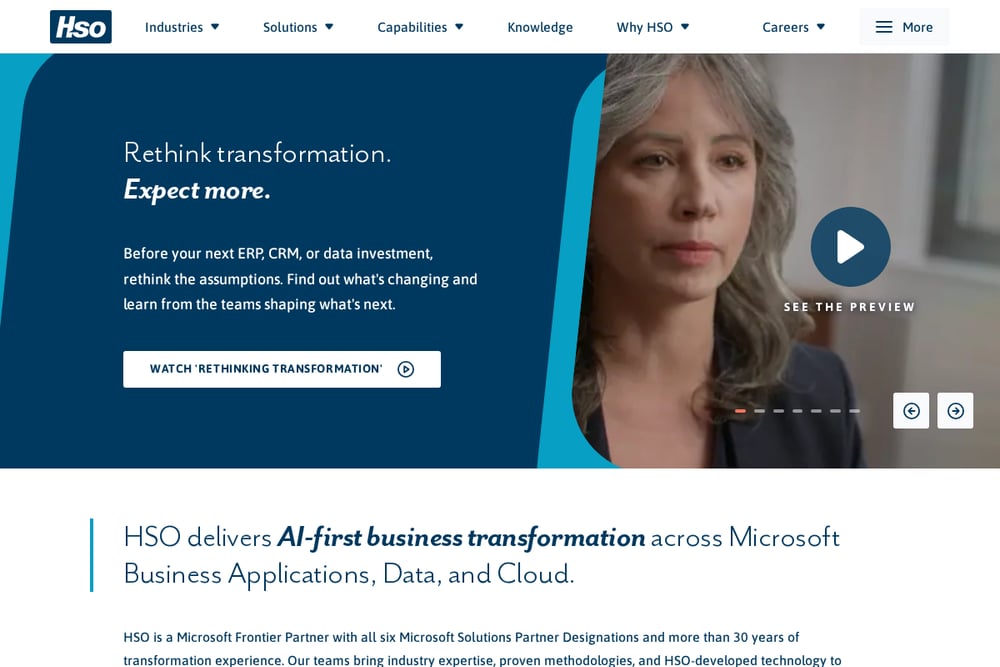 A screenshot of the HSO website.
HSO is the enterprise option on this list, with deep industry practices across manufacturing, financial services, professional services, retail, public sector, and non-profit. They build on Microsoft's cloud and AI stack, which matters if your organization already lives in that ecosystem and needs solutions that pass procurement and compliance review. Their focus is modernizing applications, automating processes, and connecting data across departments — the kind of work that spans years rather than weeks. You get real depth in regulated and complex environments. The tradeoff is scale: this is a partner for established organizations with substantial budgets, not a small team that needs a portal built by next quarter.
#5 Intellectyx
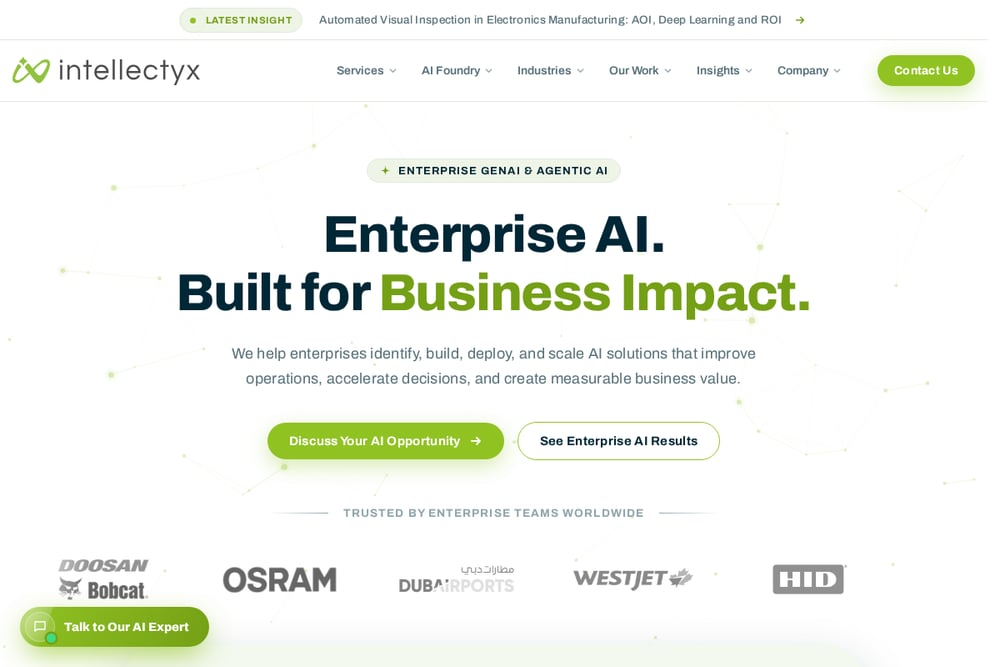 A screenshot of the Intellectyx website.
Intellectyx goes deep on AI for manufacturing, alongside financial services, healthcare, retail, and consumer goods. Their service lines run from AI consulting and readiness assessment through custom development and managed services, including observability, guardrails, and continuous tuning once something is live. They also offer a pre-built AI foundation aimed at getting enterprises from strategy to autonomous agents in production without starting from zero. If your operation involves plants, supply chains, or visual inspection, their domain knowledge is a real advantage over a generalist shop. For a smaller business outside those verticals, though, the fit is looser.
How to pick the right partner for your situation
Start with what you already have. If there's a working prototype and you need it made safe, look for engineering depth. If you're starting from a blank page, prioritize a documented process with checkpoints you can actually inspect. Ask every candidate one question: who maintains this in month seven? The answer separates firms that ship and leave from firms that stay. Then check the AI specifics — where does your data live, is there a human review step, and how do they evaluate output before it reaches a customer? Finally, match scale. A five-phase agency fits a growing business; a platform-heavy consultancy fits an enterprise with a procurement team. Neither is wrong, but the mismatch is expensive.
A simple automation workflow to start with
Pick the single workflow that eats the most team hours each week — invoice processing, lead routing, document review, whatever it is. Map it on paper: inputs, decision points, outputs, and where a human currently signs off. Hand that map to your partner as the scope for phase one, and ask for a prototype you can put in front of the people who do the work today. Insist on a review queue so nothing automated goes out unchecked, and a way to measure whether it's actually saving time. Launch it small, watch it for a month, then expand. That's how automation earns trust instead of creating cleanup work.
The bottom line
The right choice comes down to your starting point and your appetite for handoffs. Asvora Technologies is the cleanest fit if you want one accountable team across the entire lifecycle, with a process you can see at every phase. Redwerk suits you if the build exists and needs hardening. Agentiwise is the agent specialist, HSO is the enterprise platform play, and Intellectyx owns the manufacturing lane. Pick the one whose center of gravity matches your problem, and ask the maintenance question before you sign anything.