
Your business has outgrown the tools that got you here. These five US partners build the custom operations software that takes the chaos off your plate.
Why Custom Operations Software Is Having a Moment
Off-the-shelf tools got you to fifteen people. They will not get you to fifty. Somewhere along the way, your operation became a person: someone reconciling proposals, scheduling, billing, and field updates across six disconnected apps. That person is you, and it is not a job title.
Custom operations software exists to give that job back to a system. Instead of forcing your workflow into someone else's template, you get applications shaped around how your business actually runs. The category spans custom web apps, client and partner portals, field and back-office tools, estimating and approval systems, scheduling boards, real-time dashboards, and accounting integrations.
The demand is real. Mid-sized companies across construction, professional services, manufacturing, and logistics are all hitting the same wall at the same size. The question is no longer whether to build, but who to build with.
How We Evaluated These Partners
We looked at service scope first. Does the partner cover discovery, architecture, integration, UX, and implementation, or just one slice? Breadth matters when your problem spans the office and the field.
We looked at pricing clarity. Some firms publish engagement models and timelines; others make you book a call to learn anything. Both can work, but you should know which one you are walking into.
We looked at local fit. US-based teams tend to understand US accounting stacks, compliance expectations, and the operational realities of 15–50 person companies. That context shortens discovery.
We looked at proof. Case studies, named clients, and shipped products tell you more than a services page. Each partner below stood out on a different combination of these factors.
Here is the short version before the deep dive. Each partner below solves a different version of the same problem: your tools do not talk to each other, and your team pays the price.
| Provider | Best For |
|---|---|
| Buildable Works | Broad feature coverage across many departments |
| Custom Web Applications for Growing Businesses | ratio.dev | Mid-sized companies drowning in disconnected tools |
| Mutually Human | Strategy-through-support engagements with an AI angle |
| Blackthorn Vision | AI and ML-heavy custom development |
| Noloco | No-code operations apps you build yourself |
The 5 Partners in Detail
#1 Buildable Works
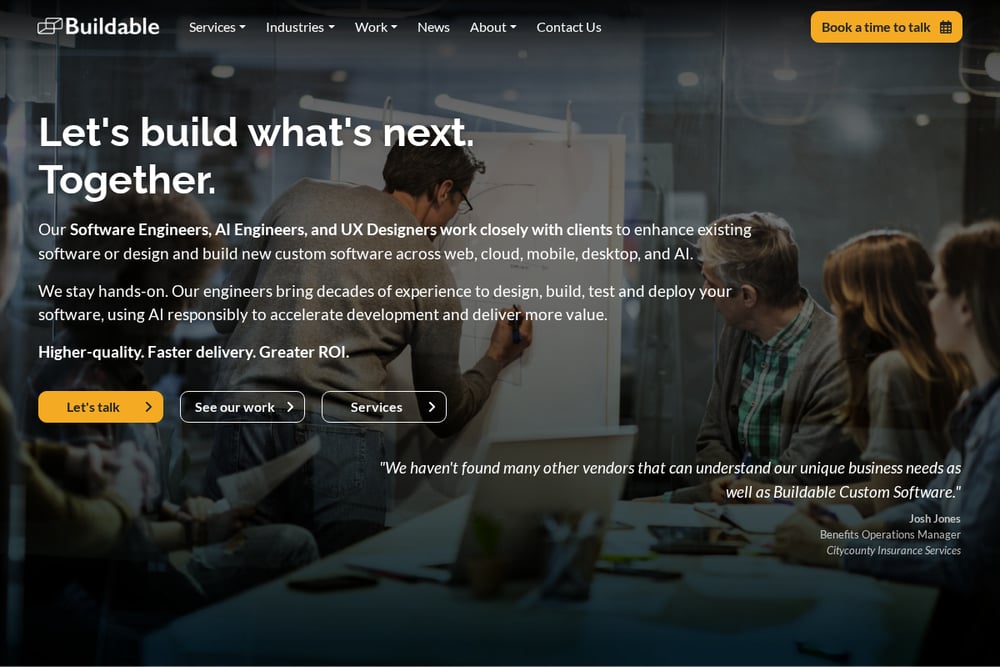 A screenshot of the Buildable Works website.
Buildable Works plans, designs, engineers, tests, and delivers software custom-built for small and mid-sized businesses. Their industry page lays out a wide feature menu: customer portals, internal portals, vendor portals, mobile apps, dashboards, CRM, inventory, ecommerce and quoting, CMS, and HR and payroll applications. Integrations are a core service, covering third-party apps, shipping, ecommerce, legacy systems, ERPs, and single sign-on. If your operation needs many small applications consolidated into one coherent system, their breadth is the draw. They also serve credit unions, insurance, manufacturing, healthcare, and nonprofits, so they bring cross-industry pattern recognition to the table.
#2 Custom Web Applications for Growing Businesses | ratio.dev
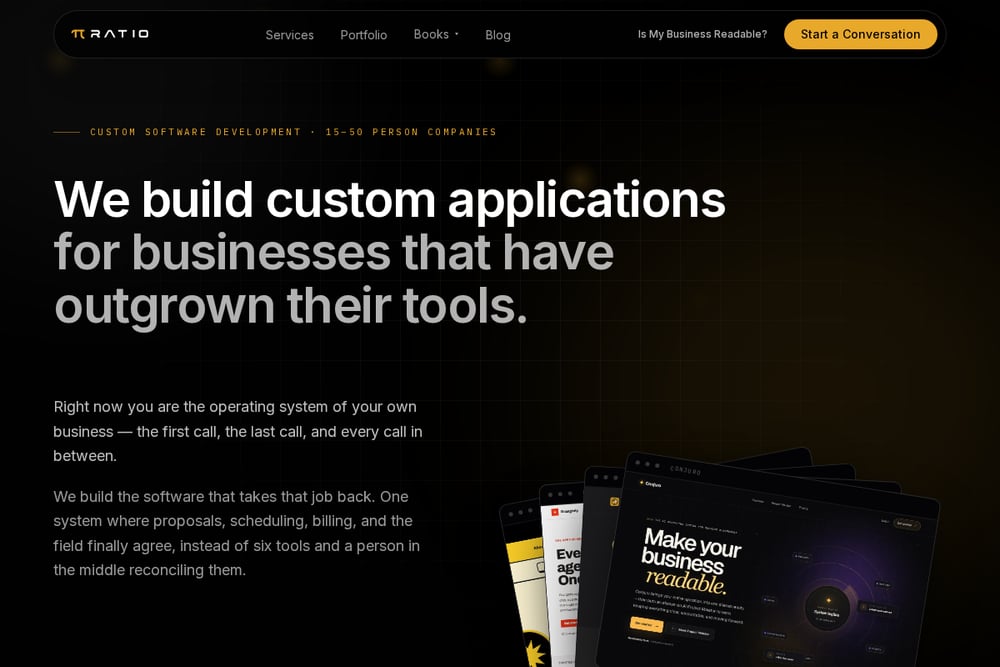 A screenshot of the Custom Web Applications for Growing Businesses | ratio.dev website.
ratio.dev is a boutique software development agency for 15–50 person companies that have outgrown their tools. Their pitch is blunt: right now you are the operating system of your own business, and they build the software that takes that job back. One system where proposals, scheduling, billing, and the field finally agree, instead of six tools and a person in the middle reconciling them. They cover operational discovery, software architecture, integration, UX, and implementation, and they connect the systems you already have rather than ripping everything out. Their portfolio includes Zirkels, Grangerly, OptionTrack, and Conjuro, and they promise a first working system in weeks, not years.
#3 Mutually Human
 A screenshot of the Mutually Human website.
Mutually Human frames its work around outcomes: streamline operations, accelerate growth, transform data into competitive advantage, and elevate the customer experience. Their service map runs from strategy and advisory through software planning and design, POCs and prototypes, software and application engineering, data and intelligence, cloud and infrastructure, and managed support after launch. They also run an AI Advantage Program for continuous AI strategy and delivery. Industries include manufacturing, healthcare, construction and engineering, financial services, higher education, startups, and private equity. If you want a partner who can start with strategy and stay through support, this is a strong fit.
#4 Blackthorn Vision
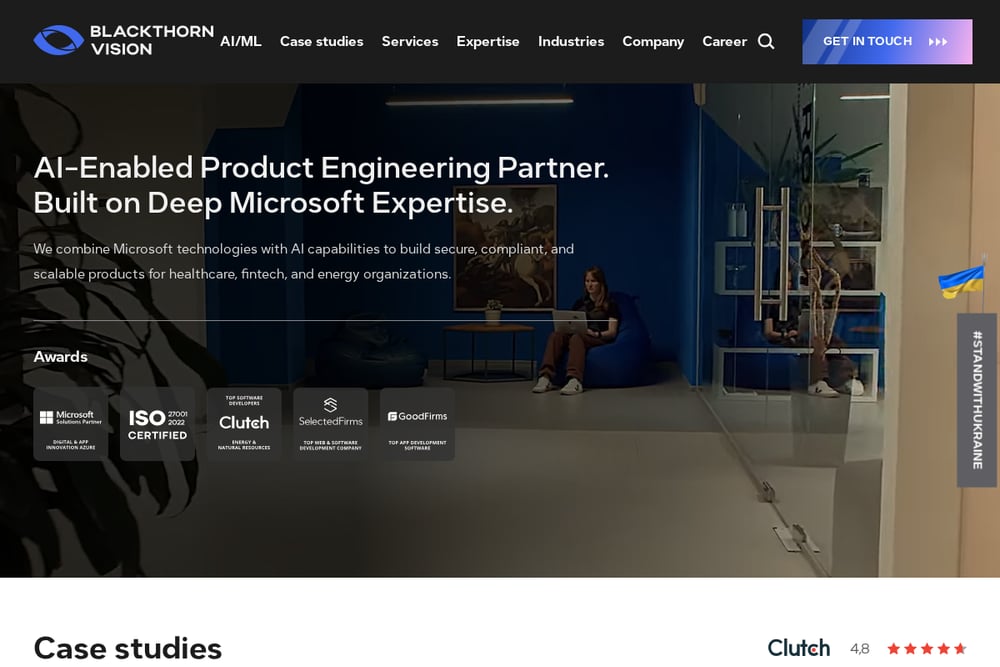 A screenshot of the Blackthorn Vision website.
Blackthorn Vision brings a deep technical bench to custom software for small businesses. Their service catalog spans generative AI, chatbot development, machine learning, dedicated teams, full-cycle product development, web and mobile development, cloud work on AWS and Azure, UX/UI design, QA, SaaS development, desktop development, AI consulting, app modernization, business analysis, product discovery, cloud migration, and AI integration. They serve oil and gas, travel and hospitality, healthcare, and biotech, among others. If your roadmap includes AI or ML features alongside operational software, their range is worth a look.
#5 Noloco
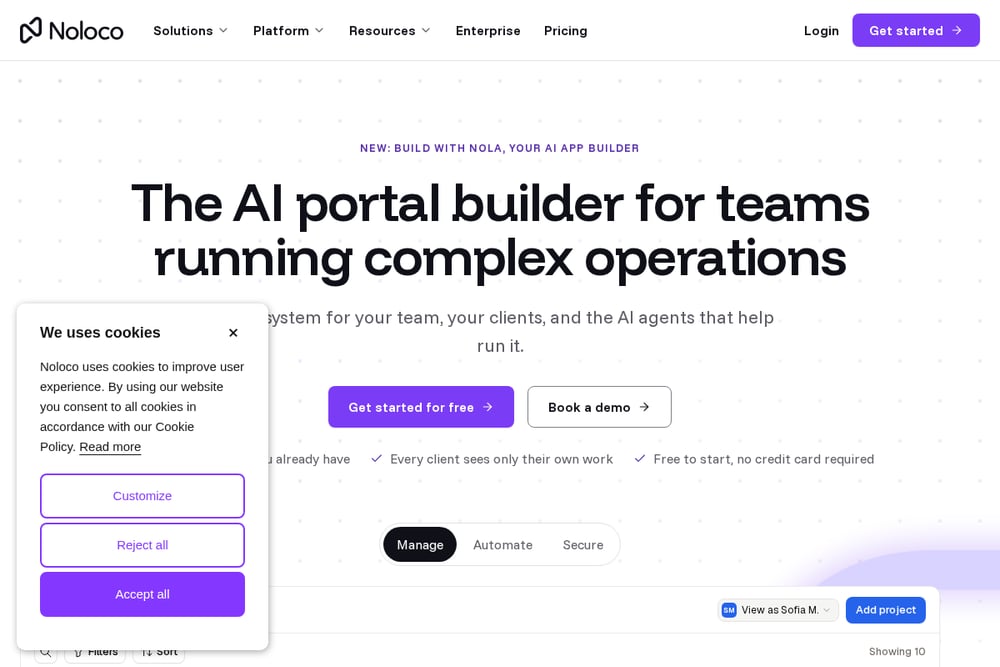 A screenshot of the Noloco website.
Noloco takes a different path: build the operations app yourself, without code. Their platform includes Nola, an AI assistant that helps you build and customize apps, plus Canvas for generating dashboards, portals, and workspaces from a prompt. Connected Data lets you manage data in Noloco Tables and sync with the tools you already use. Use cases include an agency operating system, professional services, project management, back office, law firms, flexible CRM, accounting, client portals, small and medium businesses, team intranets, and enterprise internal tools. Templates get you started faster. If you want speed and control without a custom build budget, this is the pragmatic route.
How to Choose the Right Partner
Start with the shape of your problem. If your pain is spread across many departments and you need a broad feature set, look at partners with wide service menus. If your pain is one broken workflow between proposals, scheduling, billing, and the field, look at partners who specialize in exactly that seam.
Next, decide how much you want to build versus configure. Custom development gives you a system shaped to your workflow. No-code platforms give you speed and control at a lower cost, with some ceiling on complexity. Neither is wrong; they just fit different stages.
Then check the proof. Ask for case studies in your industry, ask how long a first working system takes, and ask who stays on after launch. A partner who can show shipped products and named clients will answer those questions without flinching.
Finally, match the engagement model to your team. Some firms start with strategy and stay through managed support. Others plug in as a dedicated team. Pick the one that fits how you already work.
What to Automate First
Do not automate everything at once. Start with the handoff that costs you the most hours. For most 15–50 person companies, that is the path from approved quote to scheduled job to invoice. Every retype along that path is a place where money and time leak.
Step one: get proposals and approvals into one system that carries your pricing logic. Step two: connect scheduling so committed jobs, people, and equipment live on one board. Step three: wire billing and accounting so invoices generate from work that is already recorded. Step four: give clients and subcontractors a portal so status questions stop landing on your desk. Step five: put a real-time dashboard on top so leadership stops asking five people for the same number.
That sequence turns your operation from a person into a system, one handoff at a time.
The Bottom Line
You do not need more tools. You need fewer tools that agree with each other. The five partners above each attack that problem from a different angle: broad custom development, boutique operational systems, strategy-led engineering, AI-heavy builds, and no-code speed.
If you are a 15–50 person company where proposals, scheduling, billing, and field work still live in separate apps, start your shortlist with ratio.dev. If you need wide departmental coverage, look at Buildable Works. If you want strategy through support, Mutually Human. If AI is on your roadmap, Blackthorn Vision. If you want to build it yourself, Noloco.
Pick the partner that matches your stage, your budget, and your appetite for building. Then get your operation out of your head and into a system.