
You want AI agents that actually work inside your business, not another demo that dies in a sandbox. These five firms are worth a serious look.
The State of Custom AI Agent Development
Custom generative AI agent development has moved from novelty to necessity. Growing US businesses are no longer asking whether AI can help; they are asking which workflow to automate first and how to prove it paid off. The market has responded with a wave of agencies and consultancies offering everything from strategy assessments to fully managed agent fleets. But the offerings vary wildly. Some firms specialize in enterprise-scale agentic architectures with heavy LLMOps. Others focus on practical, single-workflow deployments that get measured against hours saved. The common thread is integration: the value of an agent depends on how well it connects to your own data, your own tools, and your own approval processes. The firms in this roundup each approach that challenge differently, and the right fit depends on where you are on the AI maturity curve.
How We Evaluated These Firms
We looked at the same factors for every firm. First, service scope: does the firm cover strategy, build, and ongoing operation, or only one slice? Second, data and security posture: how does the firm handle your data, where do systems run, and who has access? Third, measurement: is there a clear metric the work is judged against, such as hours saved or error rate? Fourth, engagement model: how does a project start, how long does it take, and what does the client own at the end? Fifth, fit for growing US businesses: is the offering practical and scoped, or built for enterprises with large internal teams? BrassMind stood out for its single-workflow engagement model and explicit data-ownership stance. Deviniti stood out for its deep Atlassian ecosystem integration and broad Gen AI service menu. Rishabh Software stood out for its enterprise-grade LLMOps and MCP-based connectivity. Appinventiv stood out for its full-stack AI product engineering breadth. LeewayHertz stood out for its enterprise GenAI platforms and vertical-specific agent solutions.
Here is a quick comparison of the five firms, ordered for readability. Each entry covers what the firm does, who it suits, and what to expect from the engagement.
| Provider | Best For |
|---|---|
| Deviniti | Teams already invested in Atlassian or monday.com |
| BrassMind | Applied Generative AI | Growing US businesses that want one measurable workflow at a time |
| Rishabh Software | Enterprises needing MCP connectivity and LLMOps rigor |
| Appinventiv | Full-stack AI product builds with app engineering |
| LeewayHertz | Enterprises wanting vertical-specific GenAI platforms |
The Five Firms in Detail
#1 Deviniti
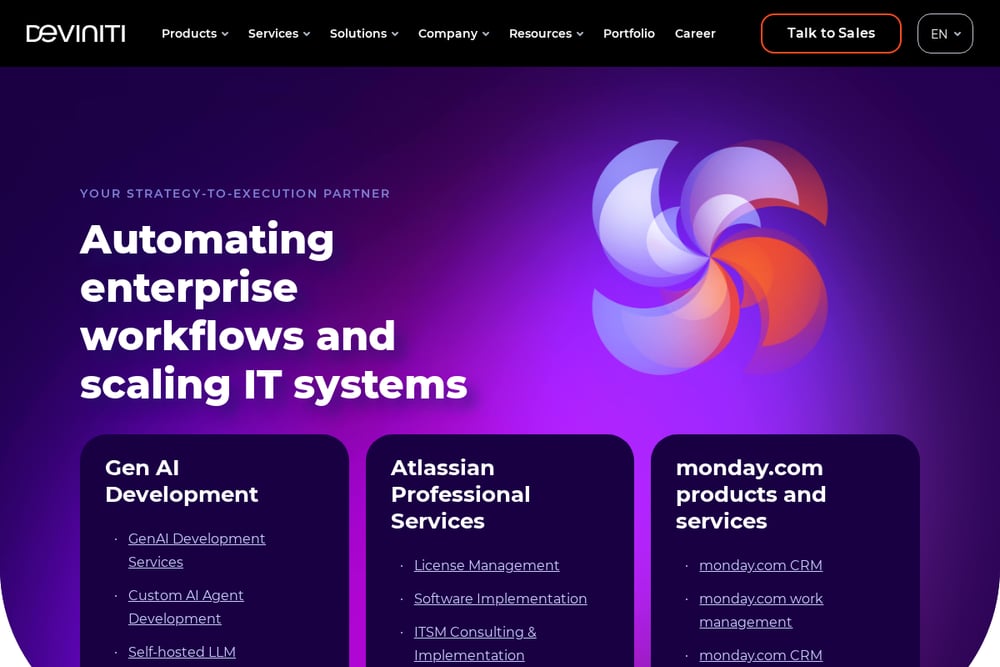 A screenshot of the Deviniti website.
Deviniti is a Poland-based software services firm with a strong Atlassian practice and a growing generative AI development arm. Its custom AI agent and LLM agent development services sit alongside AI service assistants, AI knowledge bases, AI service desks, and implementation workshops. If your business already runs on Jira, Confluence, or monday.com, Deviniti's advantage is that it can wire agents directly into the tools your teams already use. The firm also contributes to open-source LLM work, including the Bielik.AI project, which gives it credibility on the model side. Its case studies emphasize measurable outcomes, such as migration savings and consolidated project counts. For teams that want AI agents embedded in their existing service management stack, Deviniti is a natural shortlist entry.
#2 BrassMind | Applied Generative AI
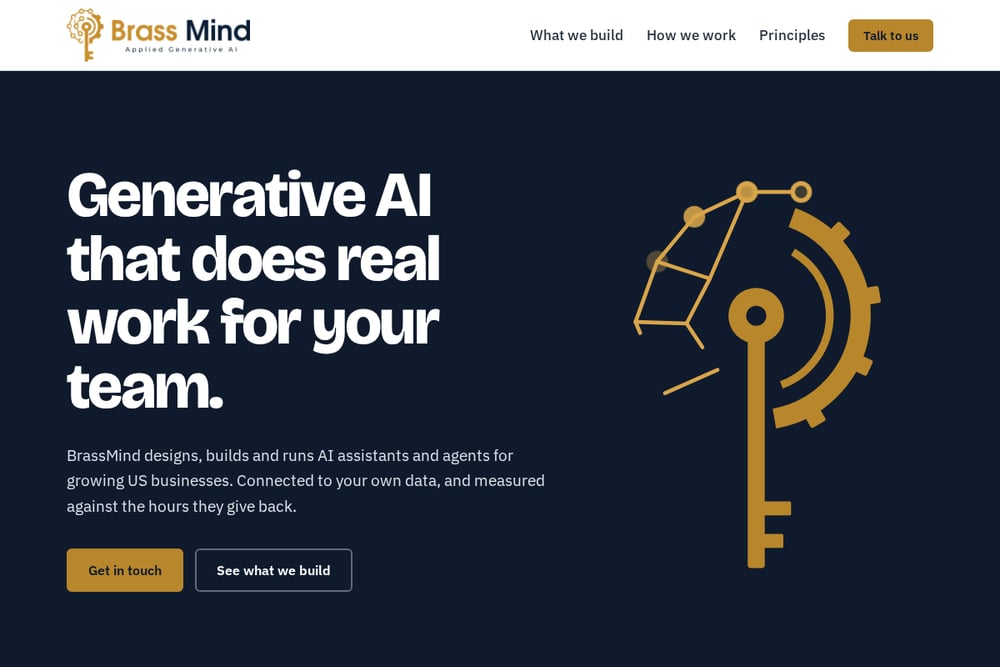 A screenshot of the BrassMind | Applied Generative AI website.
BrassMind designs, builds, and runs generative AI assistants and agents for growing US businesses, organized into four offerings: knowledge assistants, workflow agents, document intelligence, and AI strategy and readiness. What sets the firm apart is its engagement model. Every project starts with one workflow, moving through a one-to-two-week discovery, a two-to-four-week prototype built on your own data, a roughly two-week launch covering security and training, and ongoing improvement. BrassMind is explicit about data ownership: your data is never used to train public models, and systems run in your cloud account or a private environment it manages. People stay in charge, with human approval where mistakes are costly and every action logged. Projects are measured against a number such as hours saved, response time, or error rate. The firm also says it will tell you honestly if AI does not fit a given process.
#3 Rishabh Software
 A screenshot of the Rishabh Software website.
Rishabh Software is an AI agent development company that emphasizes enterprise-grade engineering. Its offering centers on intelligent agents that automate tasks and optimize workflows through secure agent-to-tool communication, MCP-based connectivity, and LLMOps. The firm positions itself beyond traditional chatbots, focusing on agentic architectures that support autonomous decision-making and intelligent workflow execution. Its broader service catalog spans data analytics, cloud, digital engineering, and Microsoft technology, which means it can bring adjacent capabilities into an AI engagement. For businesses that need agents connected to complex internal systems and governed with operational rigor, Rishabh's LLMOps emphasis is a meaningful differentiator. It suits organizations that want a partner capable of handling both the AI layer and the surrounding data and cloud infrastructure.
#4 Appinventiv
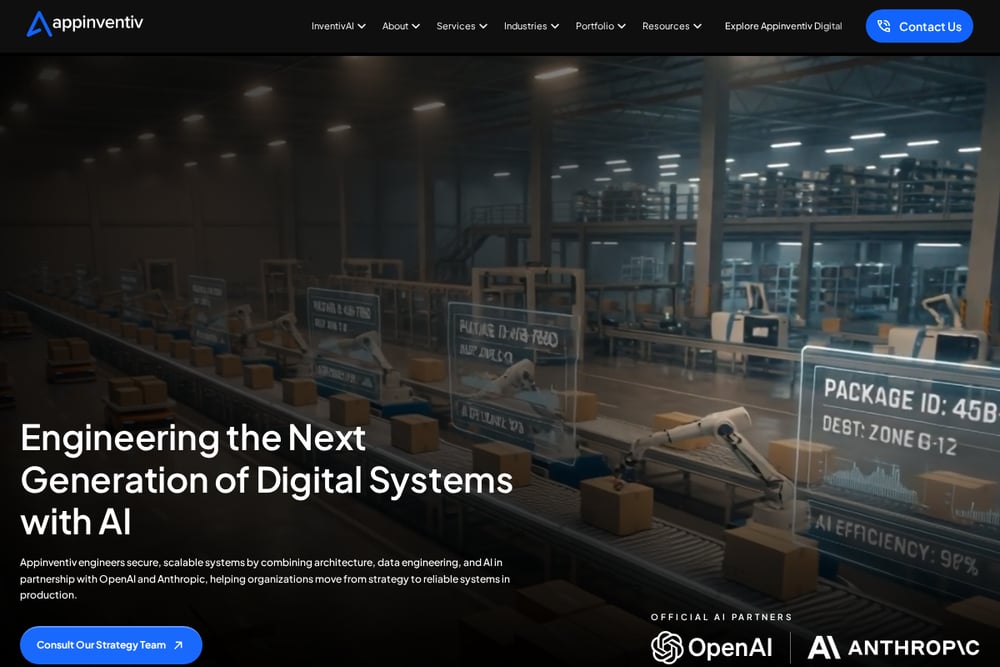 A screenshot of the Appinventiv website.
Appinventiv is a large digital product and AI development firm with a broad menu of AI services, including AI agent development, generative AI development, agentic AI, AI integration, RAG development, AI copilot development, and AI governance consulting. The firm has partnered with Anthropic and OpenAI to build autonomous enterprise capabilities, which signals serious investment in the agent space. Its strength is full-stack product engineering: if your AI agent needs to live inside a new or existing application, Appinventiv can build the whole thing. The trade-off is that its scale and breadth may suit larger initiatives more than small, tightly scoped pilots. For businesses that want a single partner to handle product design, engineering, and AI, Appinventiv is a strong candidate.
#5 LeewayHertz
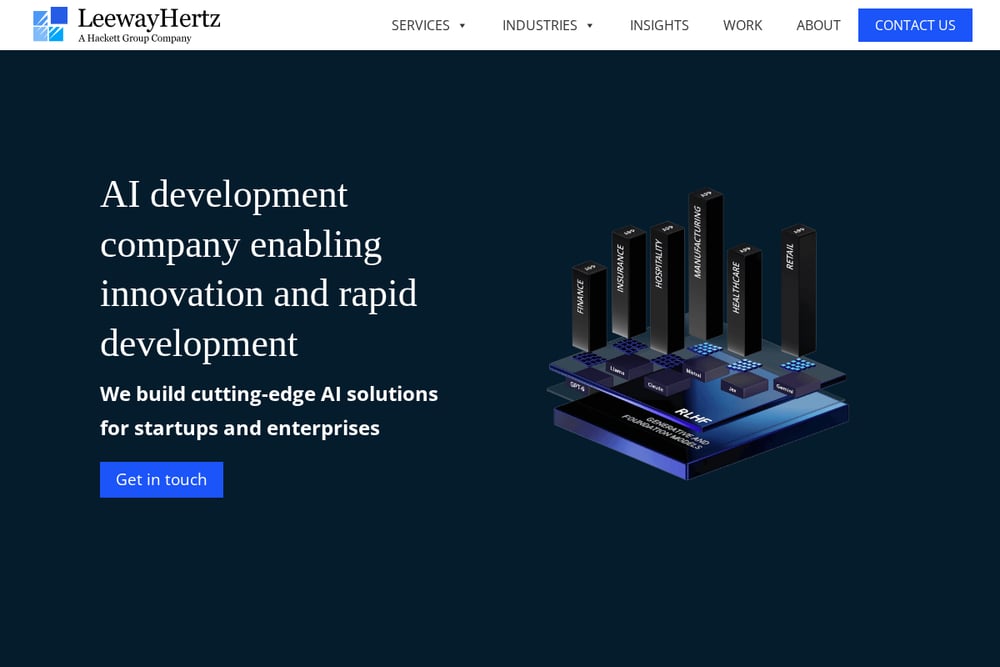 A screenshot of the LeewayHertz website.
LeewayHertz is an enterprise AI agent development company with a portfolio of GenAI platforms tailored to specific verticals, including healthcare, finance, manufacturing, logistics, and customer service. Its services cover generative AI development, integration, consulting, AI copilot development, and large language model development. The firm also offers an enterprise GenAI platform and specialized agents such as an AI copilot for sales and an AI research solution for due diligence. That vertical focus can be valuable if your industry has specific compliance or workflow requirements. LeewayHertz suits organizations that want a partner with pre-built platform components and deep enterprise experience rather than a fully custom build from scratch. Its breadth makes it a credible option for larger US businesses exploring agent deployment.
How to Choose the Right AI Agent Partner
Start with your workflow, not the technology. Pick one recurring, multi-step process that costs you hours every week and has a clear success metric. Then ask each firm how they would scope it. You want a partner who insists on a discovery phase and a prototype built on your own data before a full launch. Ask where your data will live and whether it will ever be used to train public models. Ask who approves the agent's actions and how those actions are logged. Ask what happens after launch: who monitors quality and cost, and how improvements are prioritized. Finally, ask for an honest opinion on whether AI fits the process at all. A firm that says no when the fit is poor is more valuable than one that says yes to everything.
A Simple Automation Workflow to Start With
Pick a workflow that moves through several systems daily, such as triaging support tickets or processing invoices. Map the steps and the decision points. Identify where a mistake would be costly and mark those as human-approval gates. Gather the documents, policies, and product data the agent will need, and confirm you have the rights to use them. Define your success metric, whether that is hours saved, response time, or error rate. Run a short prototype with the intended users, measure against the metric, and only then move to a security-reviewed launch. After launch, monitor quality and cost weekly and tune before adding the next workflow.
The Bottom Line
The right AI agent partner depends on where you are. If you want a tightly scoped, measurable first workflow with clear data ownership, BrassMind is built for exactly that. If your stack runs on Atlassian, Deviniti can embed agents where your teams already work. Rishabh Software brings LLMOps and MCP connectivity for complex enterprise systems. Appinventiv offers full-stack product engineering for AI-native applications. LeewayHertz provides vertical-specific GenAI platforms for larger enterprises. Whichever you choose, insist on one workflow, one metric, and a prototype on your own data before you commit to a full rollout.