You need AI that actually ships to production, not another demo that dies in a sandbox. These five studios are worth a serious look.
The Custom AI Engineering Landscape
Enterprise AI has moved past the experimentation phase. You are no longer asking whether to build custom models and agents, but how to do it without burning a year on research that never reaches production. The studios in this space sit between strategy consulting and software engineering. They assess your data, architect the system, train or fine-tune models, and deploy agents that plan, act, and self-correct inside your workflows. The market splits into three rough camps: Atlassian and workflow specialists who bolt AI onto existing platforms, SMB-focused shops that prioritize speed and budget, and frontier engineering studios that treat model development as a research discipline. Your choice depends less on who has the biggest logo wall and more on whether their methodology matches the complexity of your domain.
How We Evaluated These Studios
We looked at service scope first. Does the studio cover strategy, data engineering, model development, and deployment, or only one slice? Next, methodology transparency. A research-first process with documented architecture decisions signals a team that builds for production, not for pitch decks. We also weighed domain fit. Some studios are built for SMB speed, others for enterprise complexity, and the right match depends on your organization. Pricing clarity mattered too. None of these firms publish rate cards, but the ones that frame engagements around defined phases and KPIs give you more to work with. Finally, we considered proof. Case studies and live project counts tell you whether a studio has shipped real systems. CoCognix stands out for its end-to-end intelligence stack and research-first process, though its public portfolio is still empty. Deviniti brings deep Atlassian integration and open-source LLM credibility. ARCQ AI is tuned for SMB budgets and fast MVPs. Azumo offers embedded teams and a virtual CTO model. RTC League emphasizes production-grade LLM integration with observability and handover documentation.
Here is a quick comparison of the five studios, ordered for readability. Each entry covers what the firm does, who it fits, and what you will see on their site.
| Provider | Best For |
|---|---|
| Deviniti | Enterprises already standardized on Atlassian |
| CoCognix — AI-Native Intelligence for the Enterprise | End-to-end custom LLM and agent builds |
| ARCQ AI | SMBs needing fast, budget-conscious LLM builds |
| Azumo | Embedded AI teams and virtual CTO support |
| RTC League | Production-grade LLM integration and handover |
The Five Studios in Detail
#1 Deviniti
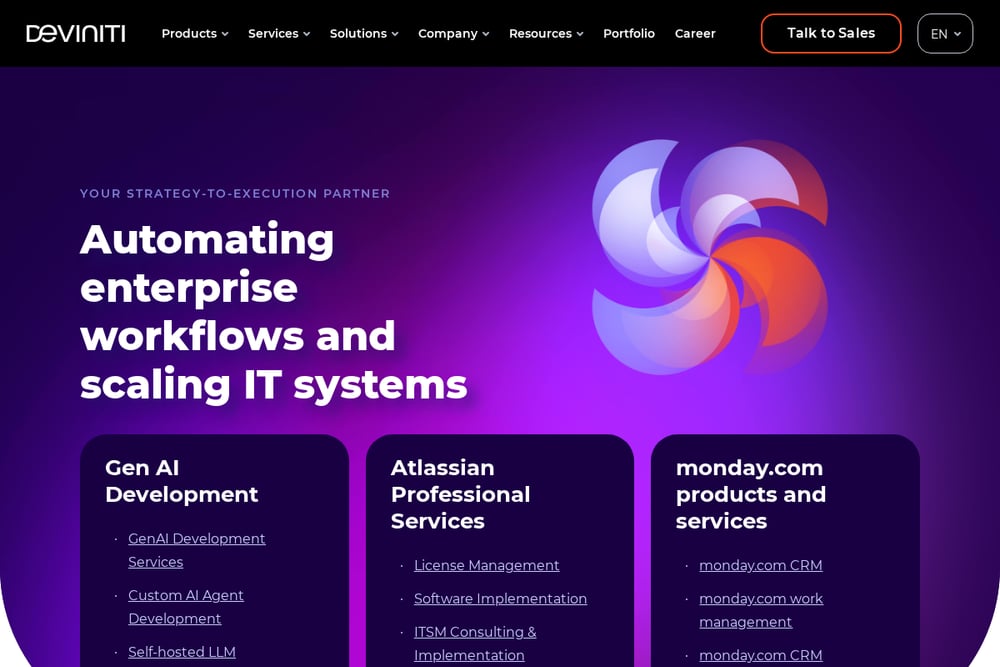 A screenshot of the Deviniti website.
Deviniti built its reputation in the Atlassian ecosystem before expanding into generative AI development. That heritage matters if your enterprise already runs Jira, Confluence, or Jira Service Management, because Deviniti can wire AI agents directly into the tools your teams use every day. Their service menu includes AI service assistants, knowledge bases, managed services, and implementation workshops. They also contribute to the open-source Bielik.AI project, which has been adopted into NVIDIA NIM microservices and Perplexity's Sovereign AI program. That open-source credibility is rare among agencies. If you want AI that lives inside your existing workflow stack rather than beside it, Deviniti is a strong starting point.
#2 CoCognix — AI-Native Intelligence for the Enterprise
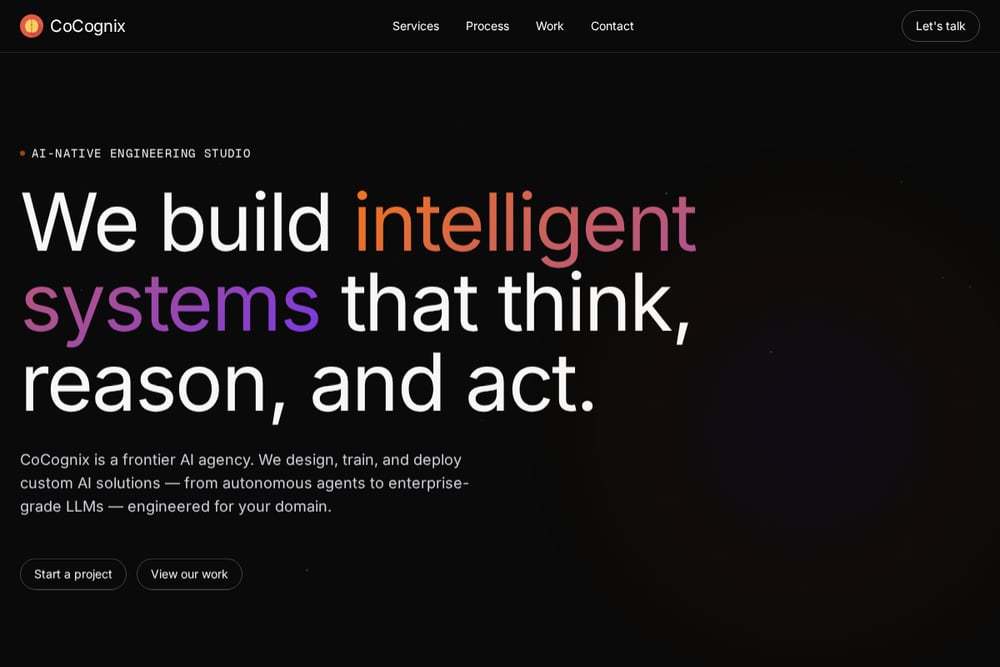 A screenshot of the CoCognix website.
CoCognix positions itself as a frontier AI agency, and the scope backs that up. They cover AI strategy and advisory, custom LLM development, autonomous agent engineering, and data engineering with synthetic data generation and knowledge graph construction. Their process runs from Discover through Design, Develop, and Deploy, with architecture decisions documented at every step and continuous benchmarking against your KPIs. What sets them apart is the research-first framing: they explicitly build for production, not demos. The caveat is proof. Their site currently lists zero projects deployed and zero custom models trained, so you will want to ask hard questions about past engagements. If you need a studio that can own the entire intelligence stack from strategy to deployment, CoCognix is built for that conversation.
#3 ARCQ AI
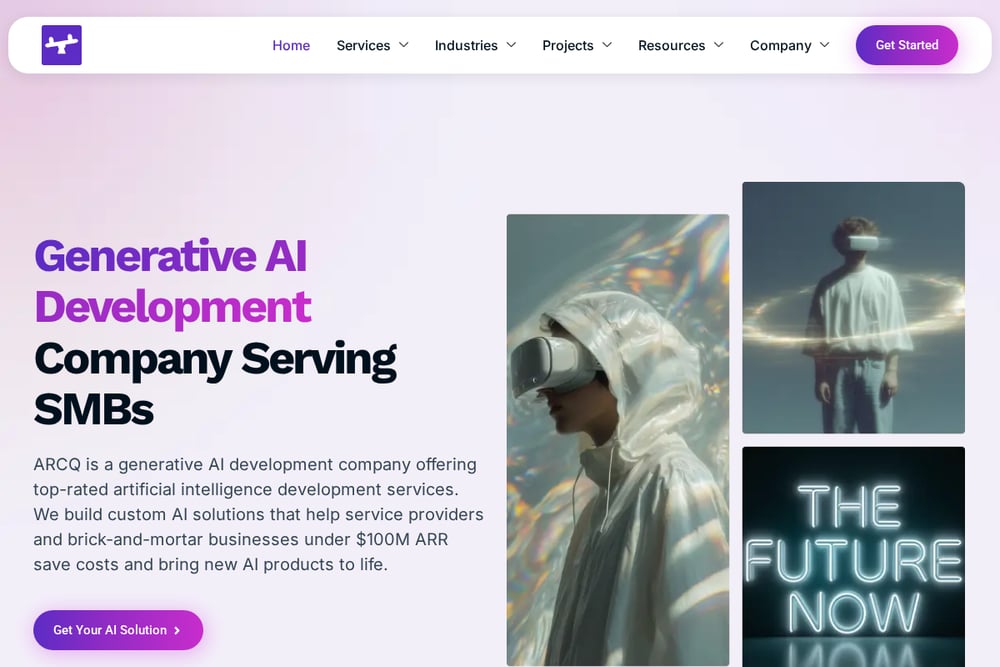 A screenshot of the ARCQ AI website.
ARCQ AI focuses on custom LLM development for small and mid-sized businesses, and that focus shows in their packaging. They offer generative AI development, custom agent development, automation, integration, chatbot work, and MVP development alongside consulting and R&D services. Their industry pages cover education, law firms, real estate, finance, marketing, retail, manufacturing, and logistics, which gives you a sense of where they have repeatable patterns. The MVP development offering is notable because it lets you validate an AI use case before committing to a full build. If you are an SMB that needs a working LLM solution without enterprise-scale overhead, ARCQ AI is worth a call.
#4 Azumo
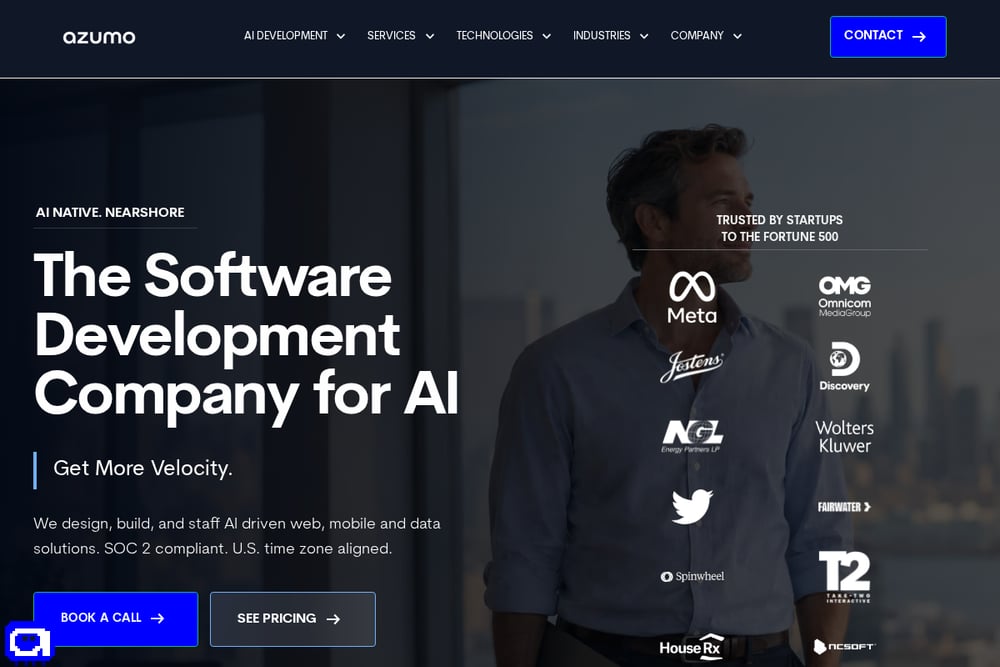 A screenshot of the Azumo website.
Azumo runs a broader AI development shop with a strong staffing and embedded-team model. Beyond AI agents, voice and chatbots, computer vision, generative AI, LLM fine-tuning, NLP, and RAG development, they offer dedicated teams, a virtual CTO service, software staffing, and project management. They also sell AI products like an AI receptionist and fine-tuned model deployments. That combination means you can bring Azumo in for a single build or embed them as an extension of your engineering org. Their split between SMB AI solutions and enterprise AI solutions signals flexibility across company sizes. If you need AI-augmented capacity more than a single project, Azumo fits that shape.
#5 RTC League
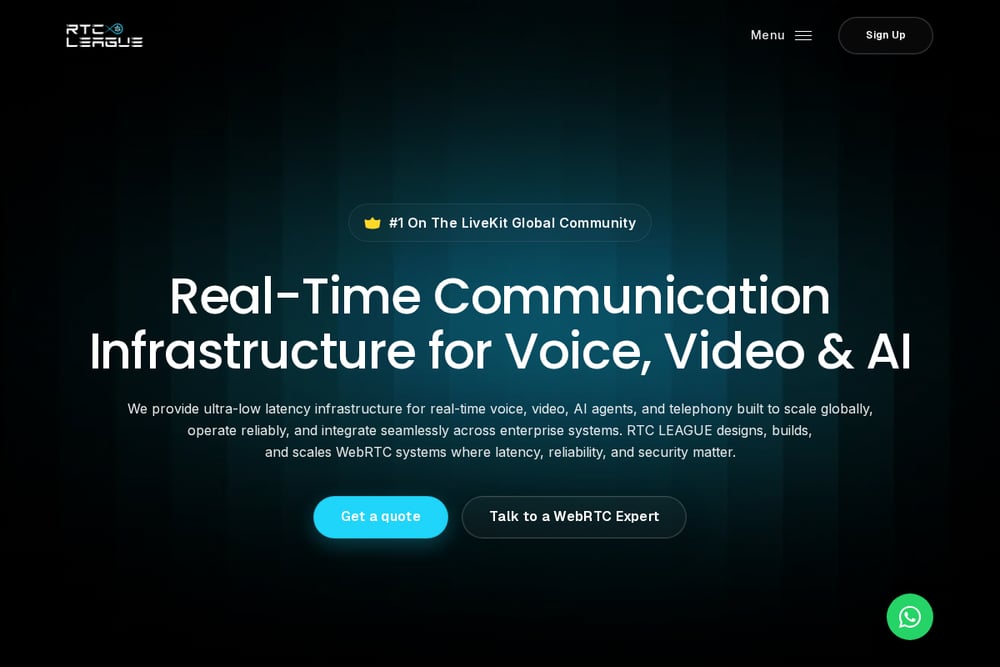 A screenshot of the RTC League website.
RTC League frames its LLM development services around one word: production. Their pitch is that general-purpose models on generic prompts produce generic results, and they build custom LLM training, fine-tuning with LoRA and QLoRA, integration with CRMs, ERPs, document stores, and voice systems, plus LLM-as-a-service hosting and monitoring. Every engagement ships with documentation and observability so your team can own the system after handover. They also offer a custom LLM audit and strategy call as entry points. If your priority is a model that performs reliably on real data inside real systems, RTC League's production-first framing will resonate.
How to Choose the Right Studio
Start with your existing stack. If you live in Atlassian, Deviniti removes integration friction. If you are an SMB that needs a working prototype fast, ARCQ AI is built for that pace. If you want one studio to own strategy through deployment, CoCognix covers the full stack. If you need embedded engineers or a virtual CTO, Azumo offers that model. And if production reliability and clean handover are your top concerns, RTC League leads with those promises. Next, ask for proof. Request case studies, live project counts, and references in your domain. CoCognix, for example, has a compelling service menu but no public projects listed, so diligence matters. Finally, clarify pricing structure. None of these firms publish rates, so ask how they scope engagements, what phases look like, and how they define success metrics before you sign.
Where Automation Fits In
The studios here all build toward the same endpoint: AI systems that act, not just answer. A typical workflow starts with a strategy assessment to map your data landscape and define KPIs. From there, you architect the system, select or fine-tune a model, and build the data pipelines that feed it. Then comes agent orchestration, where goal-driven agents plan, execute, and self-correct across workflows with human-in-the-loop oversight. Deployment includes monitoring and observability so you can benchmark against your KPIs continuously. The difference between studios is how much of that chain they own. CoCognix and RTC League emphasize the full chain. Deviniti anchors it to existing platforms. ARCQ AI and Azumo offer flexible entry points depending on your size and stage.
The Bottom Line
You have five credible options, and the right one depends on your constraints. Deviniti wins on ecosystem fit. CoCognix wins on scope and research-first methodology, provided you validate their track record. ARCQ AI wins on SMB accessibility. Azumo wins on embedded capacity. RTC League wins on production discipline and handover. Do not pick based on a logo wall. Pick based on which studio's process matches how your organization actually builds and owns software. Ask for references, demand documented architecture decisions, and make sure the engagement ends with your team able to run the system, not dependent on the agency forever.