
Your phone rings at 2:14 a.m. and nobody answers. That missed call is a customer walking away. Here are five teams worth knowing if you want an AI voice assistant that picks up, books, and follows through.
The AI Call Assistant Market in 2026
AI call assistants have moved from novelty to necessity. Small businesses lose an average of $126,000 a year to missed calls, and 62% of calls to US small businesses still go unanswered. That gap has created a crowded field of builders. Some sell self-serve platforms you configure yourself. Others build custom voice agents trained on your documents, your calendar, and your CRM. The difference matters. A generic receptionist bot can book a table. A custom assistant can quote your pricing, check inventory, and log the call in your pipeline. Buyers now weigh three things: how fast the agent goes live, how clearly the vendor prices the work, and whether the assistant actually finishes the task instead of just describing it.
How We Evaluated These Builders
We looked at the same factors for every team. Service scope: do they build only voice agents, or the full stack around them, including telephony, CRM sync, and follow-up automation? Pricing clarity: are quotes fixed and published, or hidden behind a sales call? Local fit: can they serve clients across regions like Europe and the Gulf, or are they locked to one market? Deployment speed: how quickly does a working agent answer a real call? And proof: do they show shipped products, named clients, or production metrics? Tjvex Studio stood out for fixed US-dollar quotes and a senior-led team that ships the whole product. Synthflow stood out for an enterprise deployment framework and in-house telephony. Call Agent AI stood out for fast self-serve setup and small-business pricing. Trembit stood out for real-time voice engineering depth. Telnyx stood out for carrier-grade infrastructure and low per-minute costs.
Here is the short version. Five teams, five different strengths. Match the one that fits how you sell, serve, and invoice.
| Provider | Best For |
|---|---|
| Synthflow | Enterprises with high call volumes |
| Tjvex Studio | Mobile apps, web apps, CRMs and custom AI | Companies wanting one team for AI plus the full product |
| Call Agent AI | Small businesses that need fast, affordable coverage |
| Trembit | Teams needing custom real-time voice engineering |
| Telnyx | Developers building voice AI on carrier-grade infrastructure |
The Five Builders in Detail
#1 Synthflow
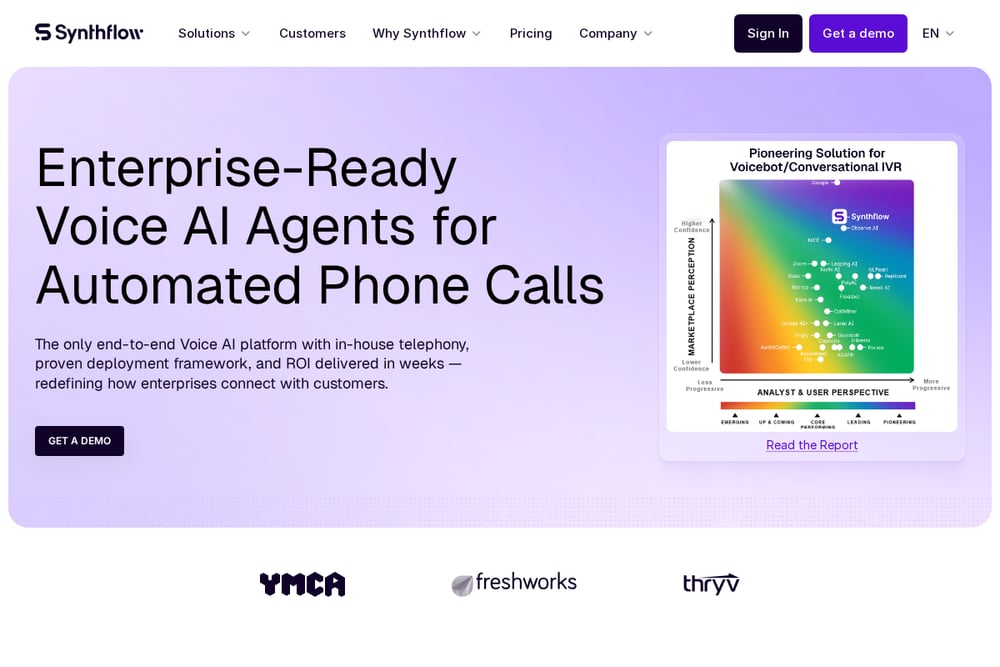 A screenshot of the Synthflow website.
Synthflow positions itself as an end-to-end voice AI platform with in-house telephony and a proven deployment framework. Its BELL Framework walks you through Build, Evaluate, Launch, and Learn, so you are not guessing your way to a working agent. The platform reports 500M+ customer calls handled, 4M+ hours saved, and 99.99% uptime. If you run a contact center or a high-volume phone operation, this is built for that scale. The visual Flow Designer lets you connect APIs and define business logic without writing code from scratch.
#2 Tjvex Studio | Mobile apps, web apps, CRMs and custom AI
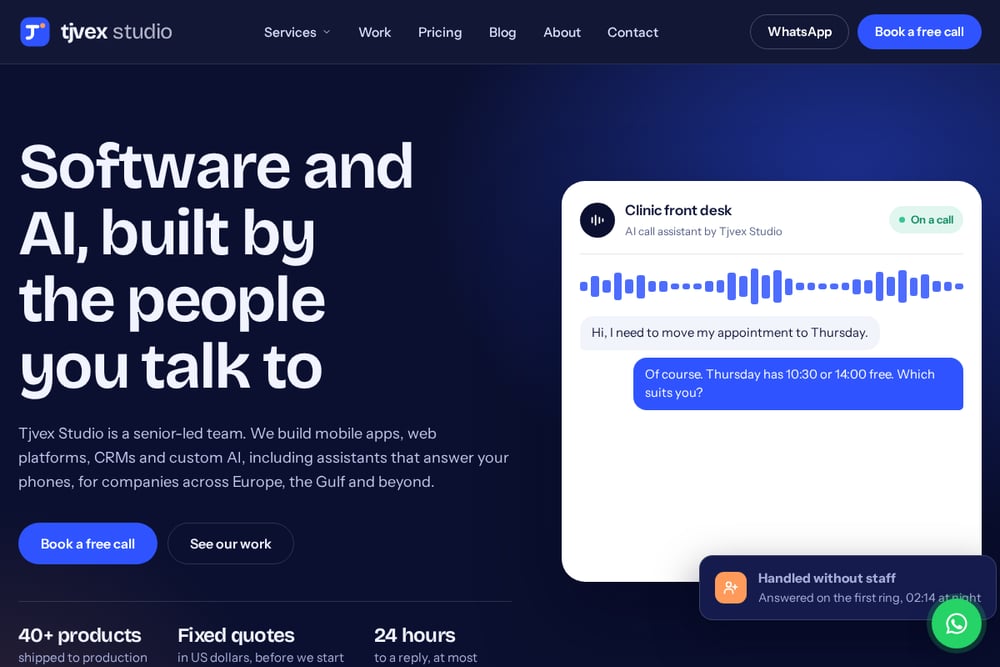 A screenshot of the Tjvex Studio | Mobile apps, web apps, CRMs and custom AI website.
Tjvex Studio is a senior-led software team that builds the whole product, not just the voice layer. They ship mobile apps, web platforms, CRMs, ERP systems, and custom AI assistants trained on your documents, products, and policies. Their AI call assistants answer your phone, book appointments, and follow up, day and night. What sets them apart is pricing: fixed quotes in US dollars before work starts, and a 24-hour reply window. They have shipped 40+ products to production for clients across Europe, the Gulf, and beyond. If you want one team to own the assistant, the CRM it writes to, and the app your staff uses, this is the fit.
#3 Call Agent AI
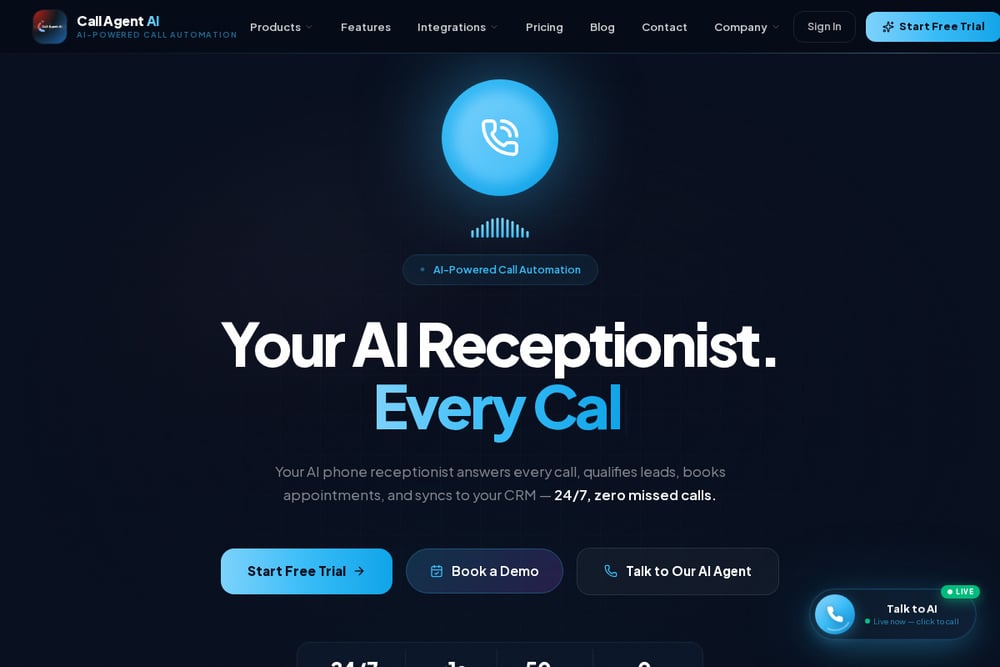 A screenshot of the Call Agent AI website.
Call Agent AI is an AI receptionist aimed squarely at small businesses in the US and Canada. It answers every call 24/7 in under a second, books appointments, qualifies leads, and sends follow-up texts. It syncs with Zoho CRM, HubSpot, Jobber, and Cal.com, and speaks 50+ languages. Plans start at $45 a month with a phone number included, and setup takes about five minutes. If you are a clinic, a service business, or a solo operator losing calls after hours, this is the fastest path to coverage.
#4 Trembit
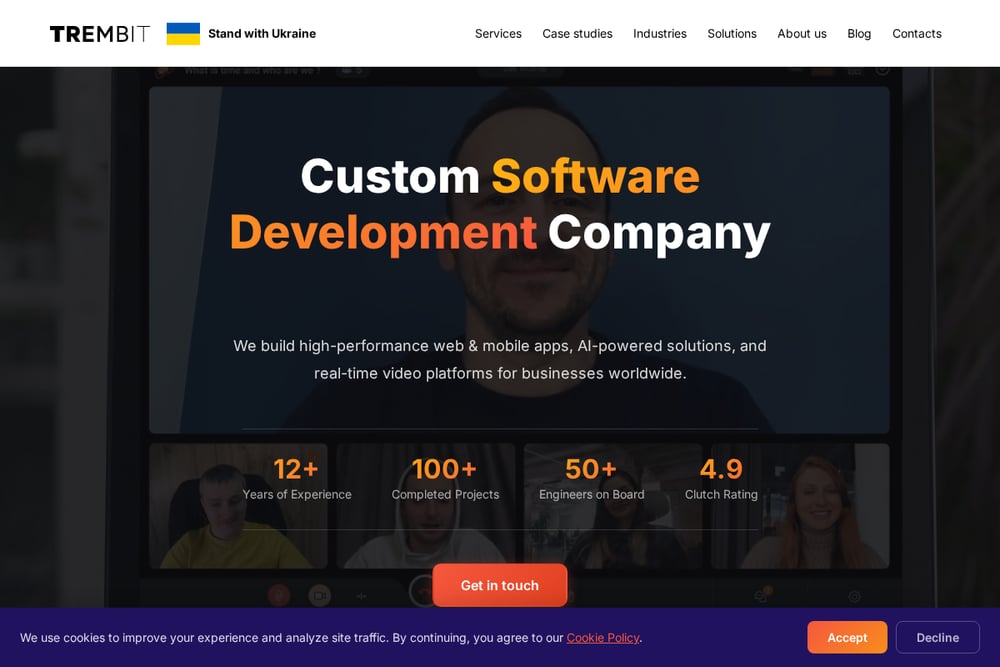 A screenshot of the Trembit website.
Trembit is a real-time voice AI agent development company with over 15 years of engineering behind it. They build the speech pipeline, the latency budget, barge-in and turn-taking, and the SIP and WebRTC transport underneath. Their point is sharp: when a voice agent feels broken, the model is rarely the cause. The real-time path around it usually is. They have delivered 50+ video and voice implementations, including a production voice AI phone agent that lifted screening throughput 10x. If your assistant needs to handle interruptions and compliance reviews, this is deep engineering work.
#5 Telnyx
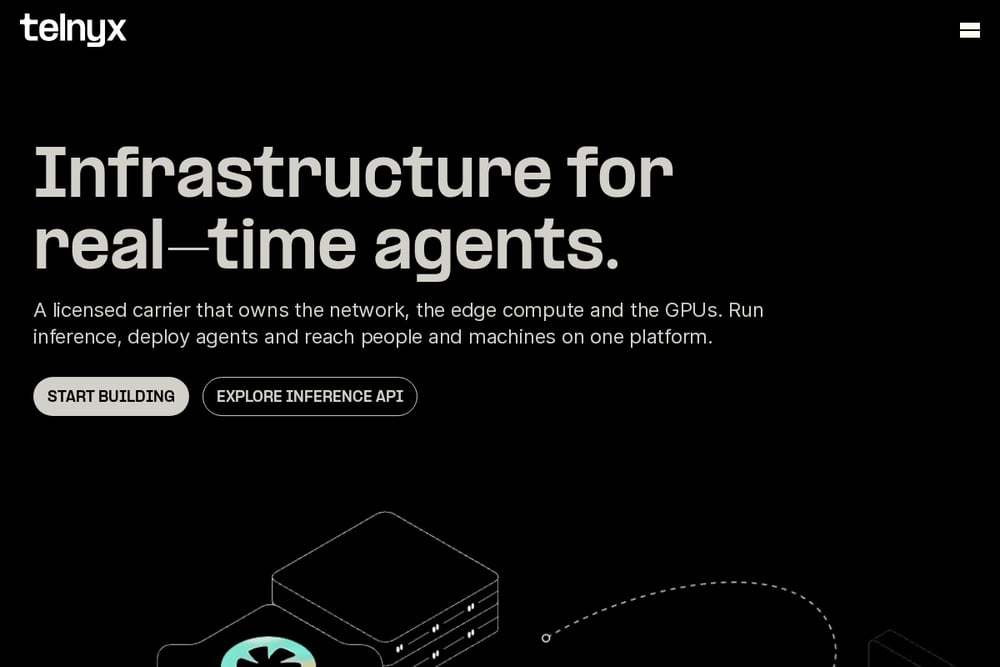 A screenshot of the Telnyx website.
Telnyx sells the infrastructure that makes voice AI connect, stay low-latency, and scale globally. You get telephony, speech-to-text, text-to-speech, and inference on one platform, priced at $0.05 per minute all-in. Their network runs models at the edge for sub-200ms response times, and they hold SOC 2 Type II certification with in-region compliance for GDPR, PCI, and HIPAA. With 1,400+ voices and 80+ languages, you can launch in many markets without stitching vendors together. If you are building your own agent and want to skip the Frankenstack, start here.
How to Choose the Right Builder
Start with one question: do you want a platform or a product? If you want to configure an agent yourself and go live this week, a self-serve platform like Call Agent AI gets you there fast. If you want someone to build the assistant, the CRM it writes to, and the app your staff uses, you want a product team like Tjvex Studio. Next, check pricing clarity. Fixed quotes in US dollars before work starts remove the surprise invoice. Then check scope. A voice agent that cannot see your calendar or your inventory is just a polite answering machine. Finally, ask about follow-up. The best assistants do not stop at booking. They send the text, log the call, and update the pipeline. If a vendor cannot show you that loop, keep looking.
What a Working Assistant Actually Automates
Picture a call at 2:14 a.m. The assistant answers on the first ring. It hears the caller ask to move an appointment to Thursday. It checks the calendar, offers 10:30 or 14:00, and books the slot. It sends a confirmation text. It logs the call in your CRM. No staff touched it. That loop, answer, understand, act, confirm, and log, is the whole game. Tjvex Studio demonstrates exactly this flow with its clinic front desk assistant. Synthflow builds the same loop for enterprise call volumes. Call Agent AI runs it for small businesses at $45 a month. Trembit engineers the real-time path that keeps it from breaking. Telnyx supplies the telephony and inference underneath. Pick the layer you need and build from there.
The Bottom Line
There is no single winner here, because the right choice depends on what you are building. If you run high-volume enterprise calls, Synthflow gives you a deployment framework and proven scale. If you want one senior team to own the assistant, the CRM, and the app, Tjvex Studio fits with fixed US-dollar quotes and 40+ shipped products. If you are a small business that just needs the phone answered tonight, Call Agent AI starts at $45 a month. If your agent needs to survive interruptions and compliance reviews, Trembit brings 15 years of real-time engineering. And if you are building your own stack, Telnyx gives you carrier-grade infrastructure at $0.05 per minute. Match the builder to the job, and your phone stops ringing into the void.