Your curriculum office is drowning in spreadsheets, email threads, and version-control chaos. These five platforms promise to fix that — here's what you need to know before you buy.
The State of Curriculum Management in Higher Ed
Higher education has never moved faster. Programs launch and retire on shorter cycles, accreditors demand more evidence, and students expect catalog accuracy in real time. Yet many institutions still run curriculum operations on shared drives and manual approvals. That gap has fueled a wave of cloud platforms that unify program design, course approvals, outcome mapping, catalog publishing, and accreditation reporting. The market now splits into broad academic-operations suites and focused curriculum tools. Integration with LMS and SIS systems is table stakes. The real differentiator is how well a platform mirrors your governance — and how quickly it turns messy curriculum data into audit-ready evidence.
How We Evaluated These Platforms
We looked at five factors across every platform. First, scope: does it cover the full curriculum lifecycle, from program design through catalog publication and accreditation? Second, workflow flexibility: can you configure multi-level approvals that match your shared governance, or are you forced into a fixed process? Third, outcome mapping: how well does it handle CLO-to-PLO alignment and institutional frameworks? Fourth, ecosystem fit: which LMS and SIS integrations are native versus bolted on? Fifth, clarity of positioning: does the vendor speak directly to curriculum offices, or bury curriculum inside a broader suite? Each platform below stood out on different factors. Lecon impressed with its focused curriculum-first design and transparent workflow configuration. CourseLeaf stood out for its deep catalog and CIM heritage. Coursedog showed strength in unifying scheduling and curriculum data. Modern Campus demonstrated breadth across catalog, syllabus, and student-facing tools. Watermark connected curriculum strategy to assessment and accreditation workflows.
Here's a quick comparison of the five platforms, ordered for this roundup. Use it to shortlist based on your institution's size, governance complexity, and existing tech stack.
| Provider | Best For |
|---|---|
| CourseLeaf | Catalog-centric institutions with complex approval chains |
| Lecon — academic operations platform | Curriculum offices that need governance and accreditation evidence in one system |
| Coursedog | Institutions unifying curriculum with scheduling and demand analytics |
| Modern Campus | Campuses seeking a broad academic and student operations suite |
| Watermark | Accreditation-driven institutions linking curriculum to assessment |
The 5 Platforms in Detail
#1 CourseLeaf
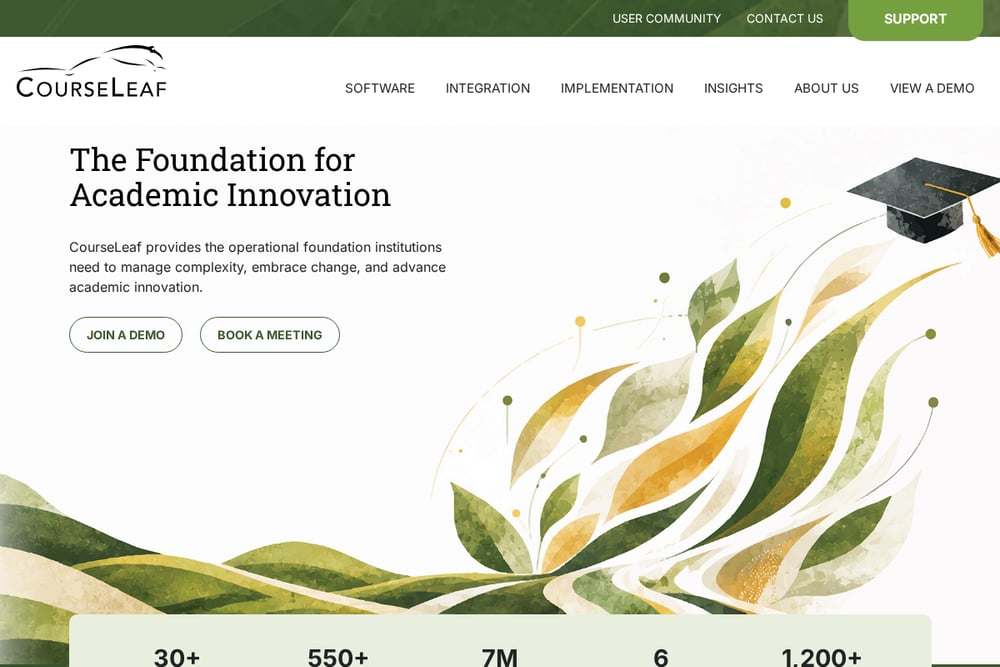 A screenshot of the CourseLeaf website.
CourseLeaf has earned a loyal following among registrars and curriculum committees. Its CIM module replaces paper forms with dynamic, pre-populated workflows that pull data from your SIS. That means fewer errors and faster approvals. The platform also covers catalog publication, learning outcomes mapping, and micro-credentials. If your catalog is the center of your academic operations, CourseLeaf is built around that reality. See how it handles curriculum management at courseleaf.com.
#2 Lecon — academic operations platform
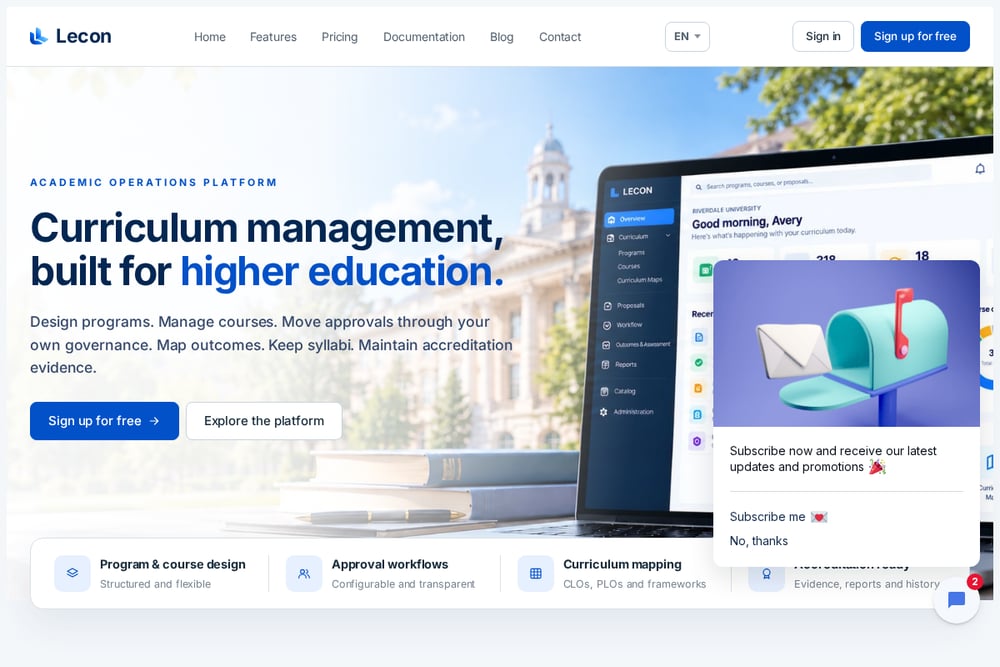 A screenshot of the Lecon — academic operations platform website.
Lecon is built specifically for higher ed curriculum offices, and it shows. You get program and course design, configurable multi-level approval workflows, CLO-to-PLO mapping, syllabi management, and accreditation evidence in one place. The platform publishes approved programs to a public catalog with edition control and version history. It integrates with Canvas, Blackboard, Moodle, RosarioSIS, OpenSIS, and more. What stands out is the focus: Lecon doesn't try to be your SIS or LMS. It aims to be the single source of truth for curriculum itself. Explore the platform at lecon.app.
#3 Coursedog
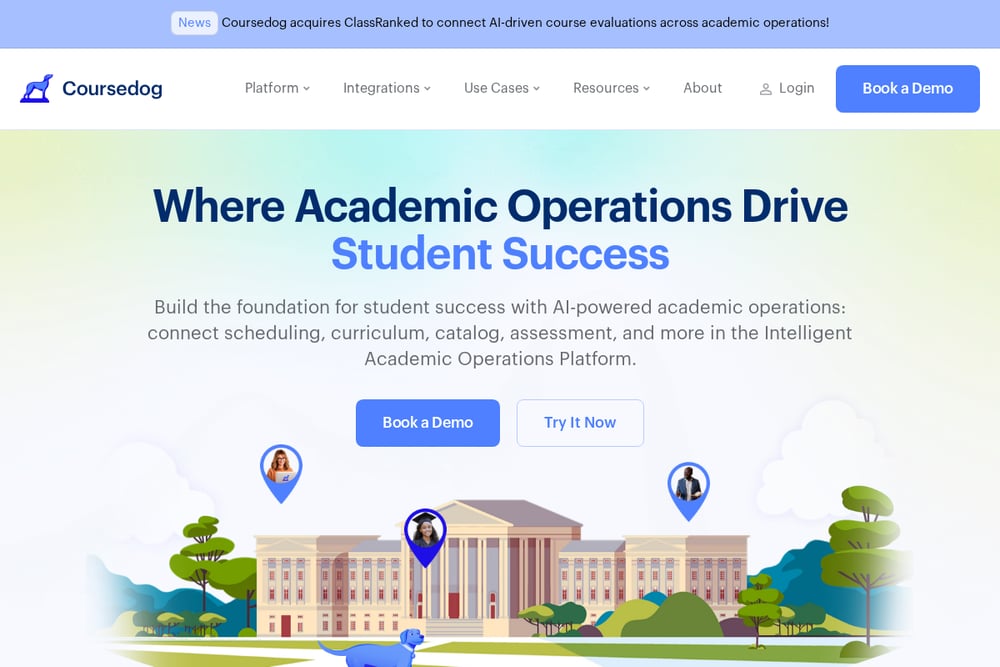 A screenshot of the Coursedog website.
Coursedog positions itself as an intelligent academic operations platform, and curriculum management is a core pillar. The platform connects curriculum data to scheduling, catalog, and assessment so changes propagate across systems. Its labor market insights help you tie program design to workforce demand. Integration coverage is broad, including Ellucian, Jenzabar, Workday Student, and PeopleSoft. If you want curriculum decisions informed by scheduling and demand data, Coursedog makes that connection explicit. Learn more at coursedog.com.
#4 Modern Campus
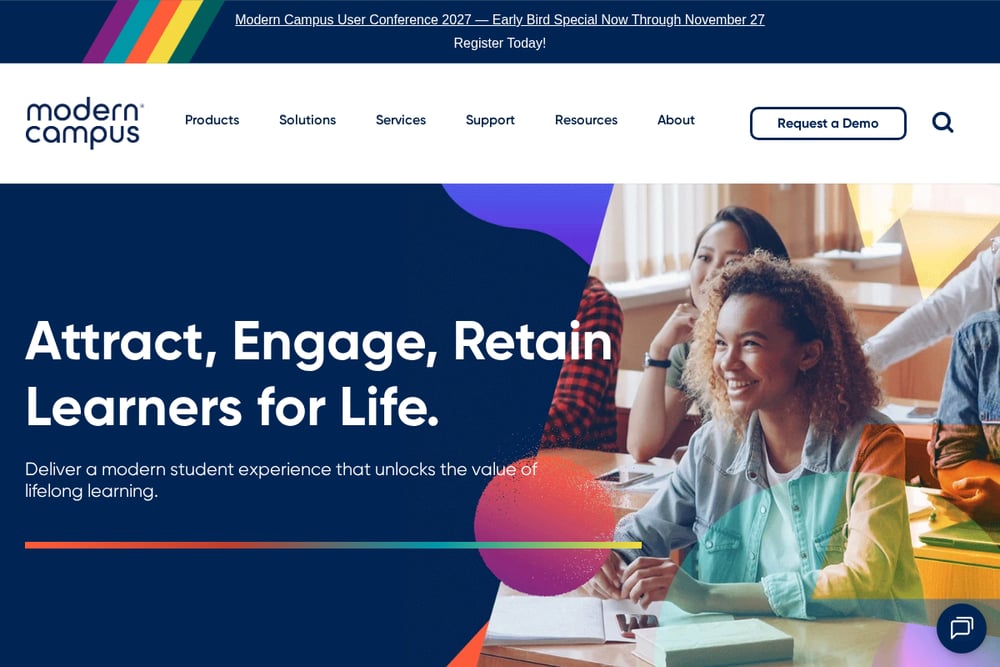 A screenshot of the Modern Campus website.
Modern Campus offers a wide suite that touches curriculum, catalog, schedule, and syllabus management. Its Curriculum module handles program and course approvals, while Concourse handles syllabus management at scale. The platform also supports co-curricular management and career pathways. For institutions that want one vendor across academic and student-facing operations, Modern Campus provides that breadth. The trade-off is complexity: you'll need to scope which modules you actually need. See the full product line at moderncampus.com.
#5 Watermark
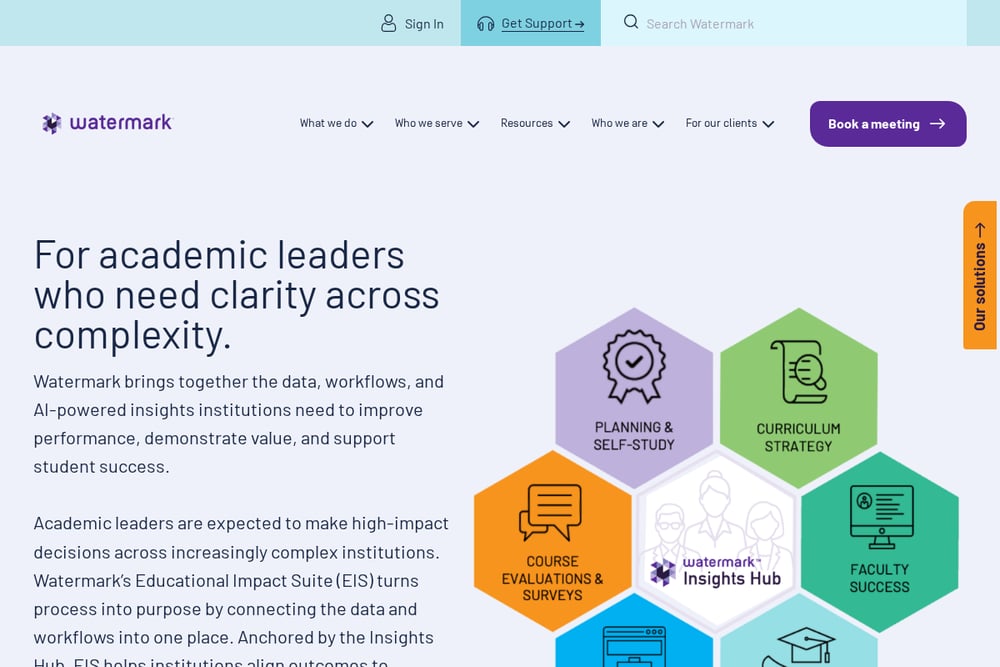 A screenshot of the Watermark website.
Watermark is known for assessment and accreditation, and its Curriculum Strategy solution brings curriculum and catalog management into that ecosystem. You can map learning outcomes, manage program changes, and connect curriculum decisions to assessment cycles. The platform also supports faculty success, planning, and self-study. If accreditation is your primary driver, Watermark's end-to-end evidence trail is a strong fit. It's less curriculum-first than some competitors, but the assessment integration is hard to match. Explore the solution at watermarkinsights.com.
How to Choose the Right Platform
Start with your governance. If your approval process involves multiple committees and faculty senates, prioritize workflow configurability. Lecon and CourseLeaf both shine here. Next, map your integrations. If you run Canvas or Moodle, check native connectors. If you're on Ellucian or Workday, verify SIS sync depth. Then consider scope. Do you need a curriculum-only tool, or a suite that also handles scheduling and catalog? Coursedog and Modern Campus offer breadth; Lecon and CourseLeaf offer focus. Finally, think about accreditation. If evidence collection is a pain point, Watermark's assessment integration may justify the broader platform. Don't buy more than you need — but don't undershoot on governance either.
Where Automation Fits
Curriculum management is full of repetitive handoffs: form routing, version tracking, catalog updates, and evidence gathering. The right platform automates those steps so your committee time goes to substance, not administration. A typical automated workflow looks like this: a department submits a course change through a pre-populated form; the system routes it to the department chair, then the curriculum committee, then the registrar based on your rules; approved changes update the catalog and push to the LMS; outcome mappings and approval history are logged automatically for accreditation. Lecon, CourseLeaf, and Coursedog all support configurable routing and audit trails. The key is to automate the handoffs without automating away the governance your faculty expect.
The Bottom Line
There's no single winner here — only the right fit for your institution. If curriculum governance and accreditation evidence are your core pain points, Lecon's focused approach deserves a close look. If your catalog is the center of gravity, CourseLeaf is battle-tested. Coursedog connects curriculum to scheduling and demand data. Modern Campus offers breadth across academic operations. Watermark ties curriculum to assessment and accreditation. Shortlist two or three, request demos, and test them against your messiest workflow. Your curriculum office will thank you.