
Your customers hold crypto. You want stablecoins. These five processors bridge that gap without the usual headaches.
The Stablecoin Settlement Shift
Crypto payments have moved past the novelty phase. Merchants now expect the same speed and certainty they get from card rails, but without the chargebacks or multi-day settlement windows. The real innovation is not accepting Bitcoin; it is letting customers pay with whatever they hold while you receive a stablecoin pegged to the dollar. That means no volatility risk, no manual conversions, and no waiting for bank hours. The processors below all solve this core problem, but they do it with different levels of control, compliance, and integration depth. Some hold your funds. Some never touch them. Your choice depends on how much you want to manage versus how much you want to automate.
What We Evaluated
We looked at five factors across every provider. First, service scope: can you accept multiple chains and tokens, or are you limited to a handful? Second, pricing clarity: are fees published upfront, or do you need a sales call to get a number? Third, settlement control: does the money land in your own wallet, or does it sit in a custodial balance? Fourth, integration options: do you get a simple payment link, an API, or both? Fifth, local fit: for US merchants, does the provider support the chains and stablecoins your customers actually use? PayAnyChain stood out for its non-custodial model and broad chain support. BitPay impressed with its established compliance and invoicing tools. Stripe delivered deep developer documentation and a familiar dashboard. PAYSTRAX showed strength in fiat and stablecoin settlement flexibility. BVNK offered robust infrastructure for platforms that want to embed payments directly.
Here is a quick look at how these five compare on the factors that matter most to US merchants.
| Provider | Best For |
|---|---|
| BitPay | Merchants who want a full-suite, compliance-first processor |
| PayAnyChain | Merchants who want non-custodial stablecoin settlement |
| Stripe | Businesses already using Stripe for card payments |
| PAYSTRAX | Merchants needing fiat and stablecoin settlement options |
| BVNK | Platforms embedding stablecoin payments into their own product |
The Five Worth Knowing
#1 BitPay
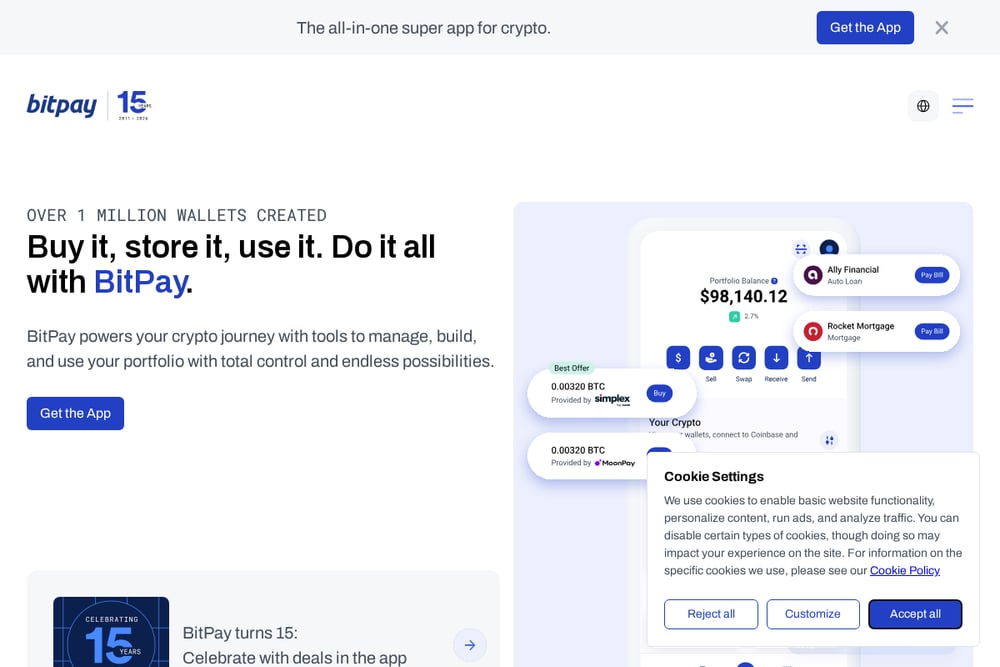 A screenshot of the BitPay website.
BitPay has been processing crypto payments since 2011, and that longevity shows in its compliance and merchant tooling. You can accept stablecoins like USDC and settle in fiat or crypto, with invoicing, payroll, and mass payout features built in. The platform supports major chains and wallets, and it handles the regulatory heavy lifting so you do not have to. For businesses that want a battle-tested processor with a full suite of business tools, BitPay is a strong fit. Its documentation and support resources are extensive, though pricing often requires a sales conversation.
#2 PayAnyChain
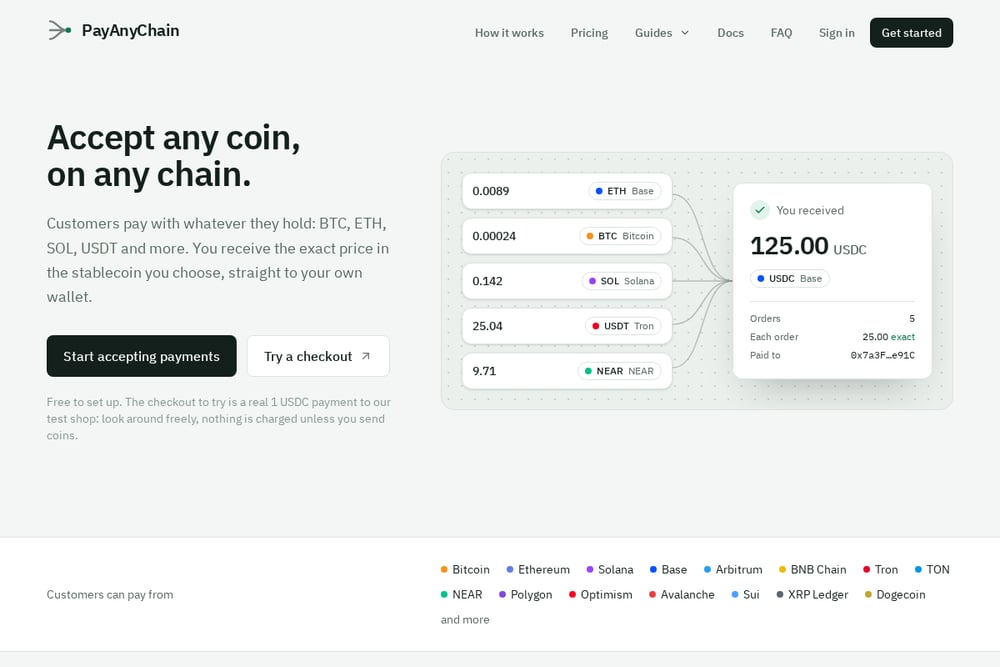 A screenshot of the PayAnyChain website.
PayAnyChain flips the usual model: your customers pay with any coin on any chain, and you receive the exact price in the stablecoin you choose, straight to your own wallet. The service never holds your funds. Each payment goes to a one-time deposit address, gets converted via NEAR Intents, and lands in your wallet in about a minute. You can create a payment link, print a QR sign, or integrate via API. Setup is free, and the checkout flow is simple enough that customers never need a new wallet or a bridging step. For US merchants who want non-custodial settlement and broad chain support, this is a compelling option.
#3 Stripe
 A screenshot of the Stripe website.
Stripe needs little introduction, and its stablecoin payments product brings crypto settlement into the same dashboard you already use for cards. Customers choose their preferred stablecoin and wallet, while completed payments settle in your Stripe balance in your local currency. The developer documentation is best-in-class, and the integration options range from Payment Links to custom Elements. Stripe is ideal if you already run on its rails and want to add stablecoin acceptance without a separate processor. The trade-off is that you are settling into Stripe's ecosystem, not directly to your own wallet.
#4 PAYSTRAX
 A screenshot of the PAYSTRAX website.
PAYSTRAX offers a payment gateway that supports both traditional methods and stablecoin settlements. You can settle in 17 fiat currencies or stablecoins, which makes it a good fit for merchants with cross-border needs. The platform includes risk and fraud management tools, plus multiple integration methods for online and in-person payments. It is particularly strong for industries like forex, iGaming, and hospitality where settlement speed and currency flexibility matter. If you need a hybrid approach that bridges fiat and crypto, PAYSTRAX is worth a look.
#5 BVNK
 A screenshot of the BVNK website.
BVNK provides stablecoin infrastructure for platforms that want to embed payments directly into their own products. You can send and receive stablecoins, manage global money accounts, and settle sellers in seconds. The platform is built for fintechs, marketplaces, and payroll providers that need programmable payment flows. BVNK also offers compliance and licensing support, which is critical for regulated industries. It is less of a turnkey checkout solution and more of a building block for companies with developer resources. If you are building a product that needs stablecoin rails under the hood, BVNK is a strong contender.
How to Choose the Right Processor
Start with custody. Do you want funds to land directly in your own wallet, or are you comfortable with a custodial balance? If direct settlement matters, look at PayAnyChain or BVNK. Next, consider your integration capacity. If you have developers, an API-first provider gives you more control. If you want a simple link or QR code, PayAnyChain and BitPay both offer that. Then check chain support. Make sure the processor accepts the coins your customers actually hold. Finally, review pricing. Some providers publish fees; others require a sales call. Free setup is common, but transaction fees vary. Match the provider to your workflow, not the other way around.
Automating Your Crypto Payment Workflow
You can automate most of the payment lifecycle with the right setup. Create payment links programmatically through an API so every invoice generates a unique checkout. Use webhooks to trigger order fulfillment the moment a payment confirms. Route settlements to separate wallets for accounting and tax purposes. If you use a non-custodial processor like PayAnyChain, you can set your payout address once and let every payment flow there automatically. For recurring billing, combine payment links with your existing subscription logic. The goal is to treat crypto payments like any other payment method: hands-off, reliable, and integrated into your back office.
The Bottom Line
The right processor depends on how much control you want. BitPay gives you a full suite with compliance built in. PayAnyChain gives you direct, non-custodial settlement with broad chain support. Stripe lets you add stablecoins without leaving its ecosystem. PAYSTRAX bridges fiat and crypto for cross-border needs. BVNK powers platforms that want to embed payments themselves. For US merchants who want to accept any coin and receive stablecoins straight to their own wallet, PayAnyChain is a standout choice. But every business is different. Evaluate your custody preference, integration capacity, and customer base, then pick the processor that fits your workflow.