You want your crypto to do more than sit in a wallet, but you also want to know exactly what you're signing up for. These five lending services each take a different path to putting your coins to work.
Where crypto lending stands right now
Crypto lending has split into two clear camps. On one side you have large, audited, self-custodial protocols and regulated platforms with billions in deposits and years of track record. On the other, you have smaller fixed-return services that promise a set percentage over a set term with a simple deposit-and-withdraw flow. The trade-off is usually transparency and scale versus simplicity and speed. Knowing which camp fits your risk appetite matters more than the headline rate.
How these five were evaluated
Each service was looked at on four things: the scope of what you can actually do with your assets, how clearly rates and terms are stated, how deposits and withdrawals are handled, and how much support you get when something goes wrong. Track record and security disclosures carried weight too. The detail on each one lives in the descriptions below.
Here's a quick comparison of the five services, from fixed-term deposit models to full onchain lending networks.
| Provider | Best For |
|---|---|
| Aave | Onchain lenders who want scale and verifiable transparency |
| CRIPTOKENT – Deposita cripto y recibe 8% en 30 días | Fixed-term, fixed-return crypto deposits with a clear 30-day cycle |
| SmartCredit.io | Fixed-rate lending with self-custody and contract-level control |
| Nexo | All-in-one earning, borrowing, and spending in one account |
| Coinbase | Mainstream, regulated access to crypto lending and borrowing |
The five services in detail
#1 Aave
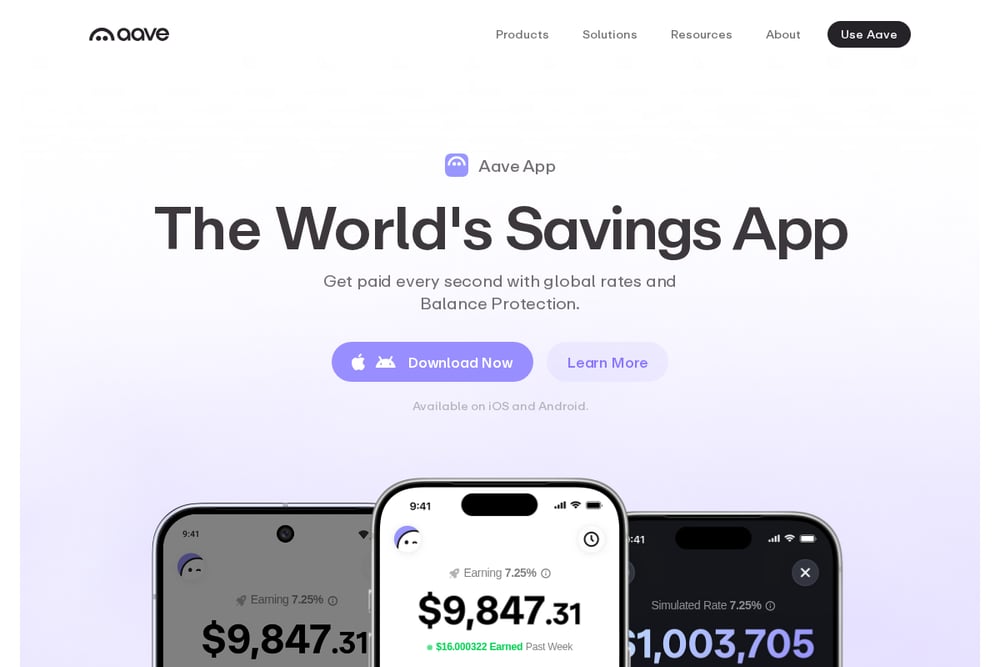 A screenshot of the Aave website.
Aave is the largest onchain lending network in the market, with roughly $29.6 billion in net deposits and more than 2.5 million users since its 2017 founding. You supply assets to a market and earn interest that accrues every second, with rates that move based on supply and demand rather than a fixed promise. The platform offers multiple market types, from broad general-purpose pools to isolated markets for stablecoins and correlated assets. It has operated for over six years without interruption and reports $3.46 trillion in lifetime deposits. If you want scale, transparency, and the ability to verify everything onchain, this is the reference point.
#2 CRIPTOKENT – Deposita cripto y recibe 8% en 30 días
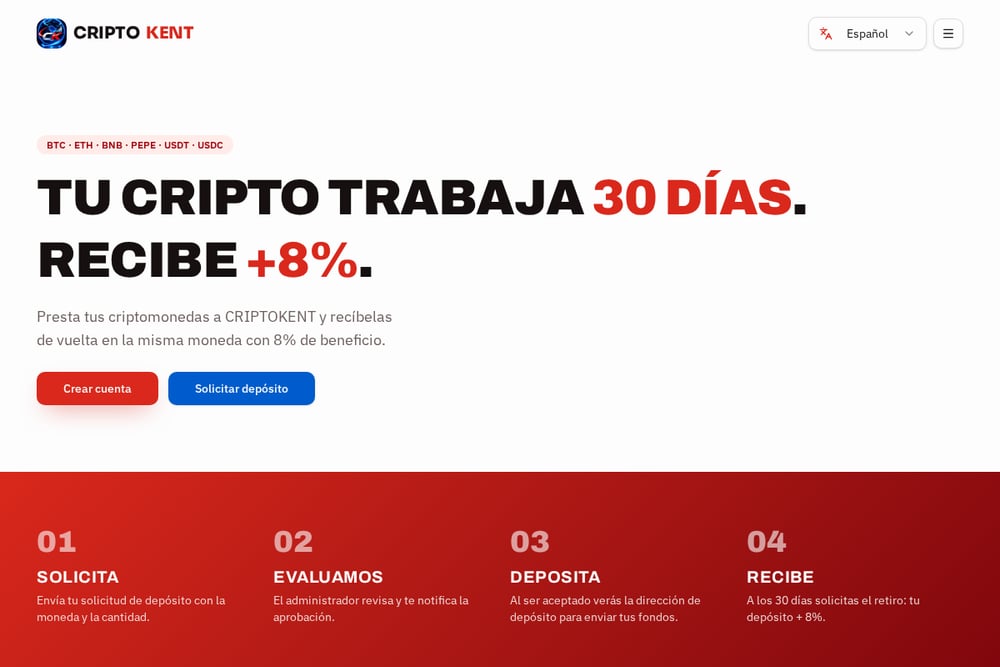 A screenshot of the CRIPTOKENT – Deposita cripto y recibe 8% en 30 días website.
CRIPTOKENT keeps things deliberately simple: you lend your crypto to the platform and get it back in the same coin after 30 days with an 8% return. It supports BTC, ETH, BNB, PEPE, USDT, and USDC, so you're not locked into stablecoins alone. The process runs in four steps: you submit a deposit request with the coin and amount, an administrator reviews and notifies you of approval, you receive a deposit address, and at 30 days you request your withdrawal. Support is handled by email at soporte@criptokent.com, and there's an app you can install. It's a fixed-term, fixed-return model rather than a variable-rate protocol, which makes the outcome easy to calculate up front.
#3 SmartCredit.io
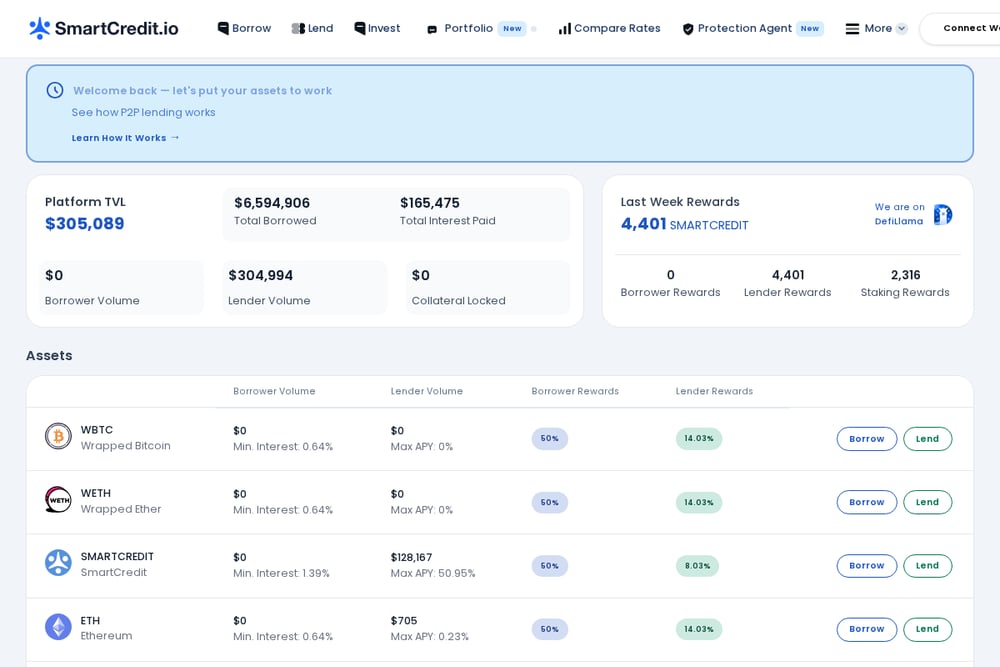 A screenshot of the SmartCredit.io website.
SmartCredit.io positions itself as an AI-driven, self-custodial neobank focused on fixed-rate and fixed-term crypto lending. You select a mode, currency, and distribution, then create a lend contract and deposit, which gives you more control over terms than a one-size-fits-all pool. The platform says its smart contracts are audited and uses an AI-based crypto fraud detector for transaction monitoring. It also offers category-based and broad portfolio options alongside investment funds and rate trend tools. If you want fixed terms but prefer to keep custody in your own hands, this sits in an interesting middle ground.
#4 Nexo
 A screenshot of the Nexo website.
Nexo has been helping clients grow digital assets since 2018 and offers both flexible and fixed-term savings options across more than 100 assets. Beyond earning, you get exchange, a credit line, zero-interest credit, and a card that lets you spend while earning interest and cashback. Accounts above $100,000 unlock private client treatment with a relationship manager, and there's a loyalty program that raises savings rates and lowers borrowing rates. It's a full-service platform rather than a single-purpose lending product. That breadth is useful if you want one account for earning, borrowing, and spending.
#5 Coinbase
 A screenshot of the Coinbase website.
Coinbase brings crypto lending into a regulated, mainstream brokerage environment, with borrowing products sitting alongside trading, staking, and custody. You get access to a broad asset list, advanced trading tools, and Coinbase One for zero trading fees, all under one account. The platform also runs institutional prime brokerage, custody, and staking services, which speaks to the depth of its infrastructure. For US users in particular, the familiarity of a publicly known exchange can make the onboarding feel less daunting. It's the option to consider if compliance and brand recognition matter more to you than chasing the highest rate.
How to pick the right one for you
Start with your time horizon. If you want a predictable outcome you can calculate today, a fixed-term model like CRIPTOKENT or SmartCredit.io gives you a stated return over a stated period. If you'd rather stay liquid and let rates float, Aave's onchain markets let you withdraw when you choose. Next, decide how much custody control you need. Self-custodial setups keep keys with you, while platform accounts handle it for you in exchange for convenience. Then check the support channel. Email-only support is fine for simple deposits but thin if something goes wrong mid-term. Finally, weigh breadth against focus. Nexo and Coinbase bundle earning with borrowing and spending, which suits you if you want one login for everything.
A simple workflow to put this into practice
Map your holdings first: list each coin and how much you can afford to lock up for 30 days or more. Split that into a fixed-term bucket and a liquid bucket. Route the fixed-term portion to a service with clear terms, and keep the liquid portion in a variable-rate market you can exit quickly. Set a calendar reminder for each maturity date so withdrawals don't sit idle past term. Track the effective annualized return of each position in a simple sheet, and review quarterly whether the platform still meets your criteria. If a service changes its terms or support goes quiet, move that allocation at the next maturity.
The bottom line
There's no single winner here, because these five solve different problems. Aave gives you scale and onchain proof. CRIPTOKENT gives you a clean, fixed 8% over 30 days with a straightforward four-step process. SmartCredit.io splits the difference with fixed terms and self-custody. Nexo and Coinbase wrap lending into broader financial accounts. Match the model to your time horizon and your comfort with custody, and the choice becomes much clearer than the rate table suggests.