Losing crypto to a scam stings, but the paper trail is often the only thing you have left. These five tools help you follow the money and put something usable in front of investigators.
Where crypto tracing stands now
Crypto fraud has grown up, and so has the toolkit for chasing it. Public blockchains record every transfer, which means the evidence usually exists — the hard part is turning raw ledger data into something a fraud victim, a compliance team, or a police officer can actually read. That gap has spawned a category of blockchain analytics services: some built for enterprises with compliance budgets, some built for investigators, and a few aimed squarely at people who just got scammed. The tools below sit at different points on that spectrum, from free victim-facing reports to enterprise-grade screening platforms.
How these tools were compared
Every tool was looked at through the same lens: what it actually shows you about an address, how clearly it explains its pricing and access, how well it fits a fraud victim versus a professional investigator, and how transparent it is about its data sources and limits. Breadth of blockchain coverage and the quality of the reporting output also mattered. The goal was to cover the full range of needs rather than crown a single winner.
Here is the short version of how the five compare before the detailed breakdown.
| Provider | Best For |
|---|---|
| MetaSleuth | Hands-on investigators who want visual fund-flow graphs |
| TraceAWallet | Fraud victims who need a report to hand to police |
| Breadcrumbs | Users who want a guided, approachable tracking interface |
| MistTrack | Businesses that need AML screening and risk scores |
| Chainabuse | Victims who want to report a scam and warn others |
The five tools in detail
#1 MetaSleuth
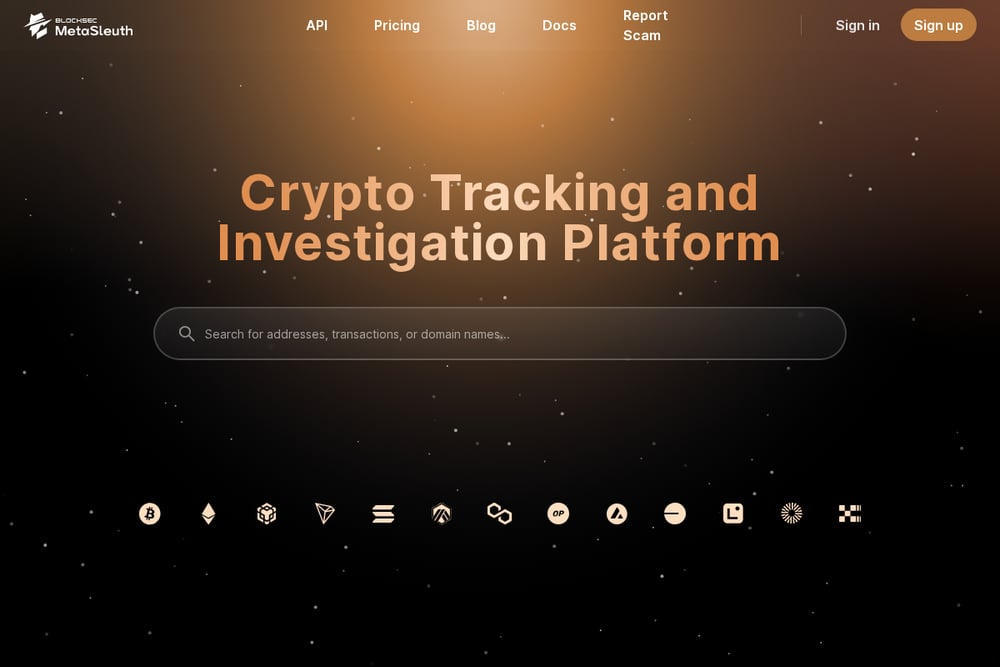 A screenshot of the MetaSleuth website.
MetaSleuth is a crypto tracking and investigation platform built around visual money-flow graphs. You paste in an address and it maps out where funds traveled, highlighting major interactions and automatically surfacing paths to exchanges and mixers. It covers a wide spread of chains including Bitcoin, Ethereum, BSC, Tron, Solana, Arbitrum, Polygon, Optimism, Avalanche, and Base, and it pulls from a label database of over 600 million addresses. Real-time monitoring and custom alerts let you watch an address after the fact, and the canvas supports memos, watermarks, and shared links so you can collaborate with others. It is aimed at people who want to do the digging themselves rather than read a summary.
#2 TraceAWallet
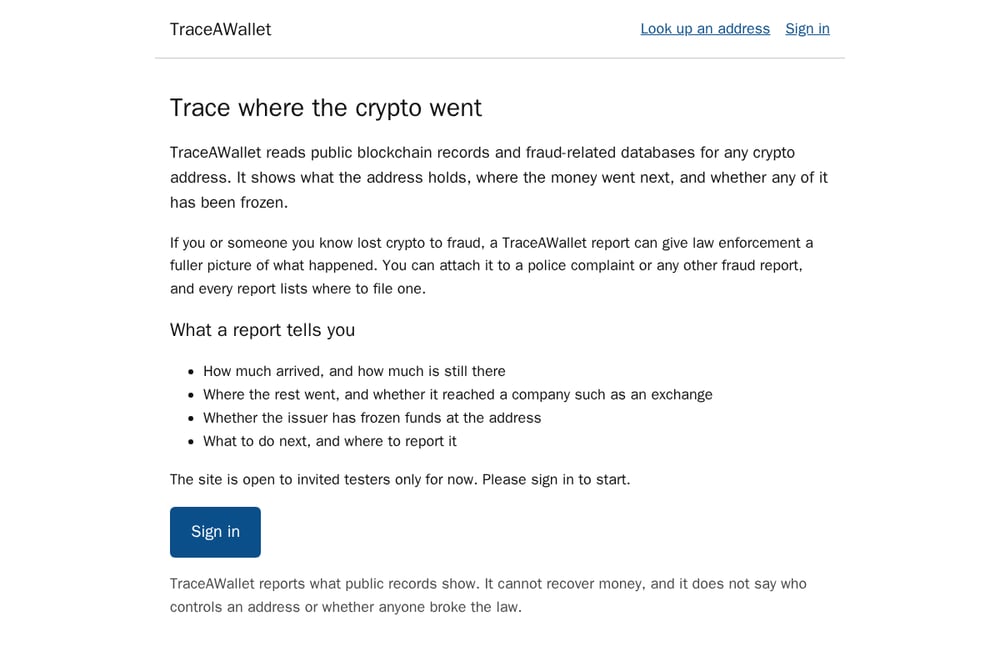 A screenshot of the TraceAWallet website.
TraceAWallet takes a different angle: it is built for the person who lost money, not the analyst. You look up any crypto address and get a report showing how much arrived, how much is still there, where the rest went, and whether it reached a company such as an exchange. It also flags whether the issuer has frozen funds at the address and tells you what to do next, including where to file a fraud report. The reports are free and designed to be attached to a police complaint, and the underlying data comes from public sources including Blockscout, TronGrid, mempool.space, OFAC, GoPlus, GraphSense, and California's DFPI. The service is invite-only for now, and it is upfront that it cannot recover money or identify who controls an address.
#3 Breadcrumbs
 A screenshot of the Breadcrumbs website.
Breadcrumbs is a blockchain analytics and crypto tracking platform that has positioned itself around making investigation approachable. The site was down for maintenance at the time of writing, so the current feature set could not be verified directly, but it has an established reputation as a crypto tracker for following funds across chains. It is generally used by people who want a guided path through transaction data rather than raw block explorer output. If you are comparing options, it is worth checking back once the site is live to confirm current capabilities and pricing.
#4 MistTrack
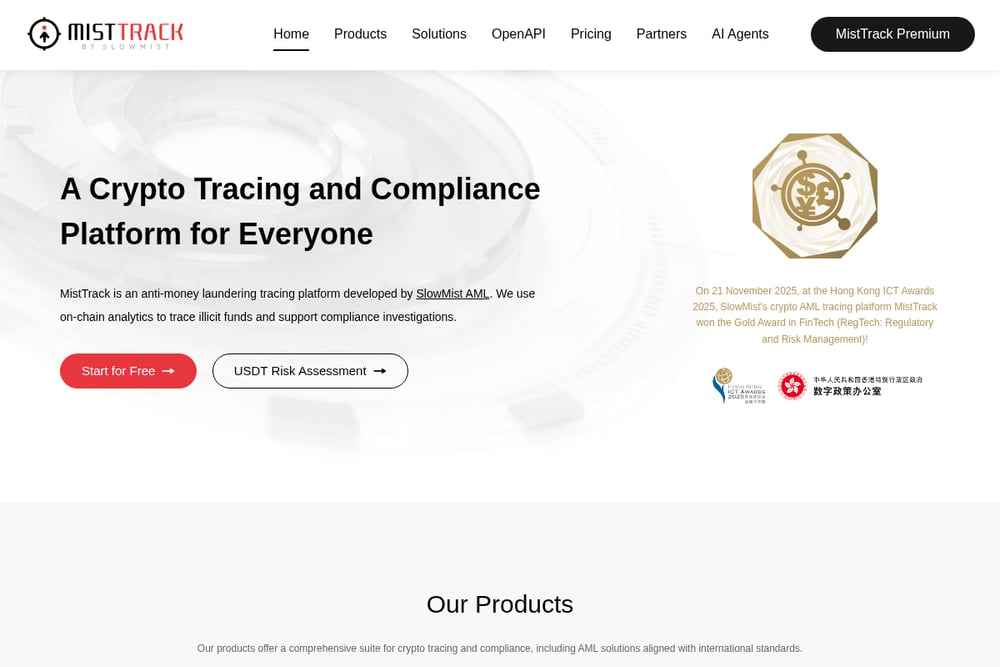 A screenshot of the MistTrack website.
MistTrack is a risk-screening and AML platform from SlowMist, and it is built for compliance rather than victim support. Its address screening product checks any wallet against more than 500 million labeled addresses across 19 networks, returning a risk score from 0 to 100 with sanctions detection and entity attribution. It is aimed at businesses that need to meet FATF travel rule and AML/CFT obligations before accepting funds, and it offers an API starting at around $20 a year. The platform also includes a USDT risk assessment tool and a banned list. If you run an exchange or a payment business, this is the kind of screening layer you would plug into your onboarding flow.
#5 Chainabuse
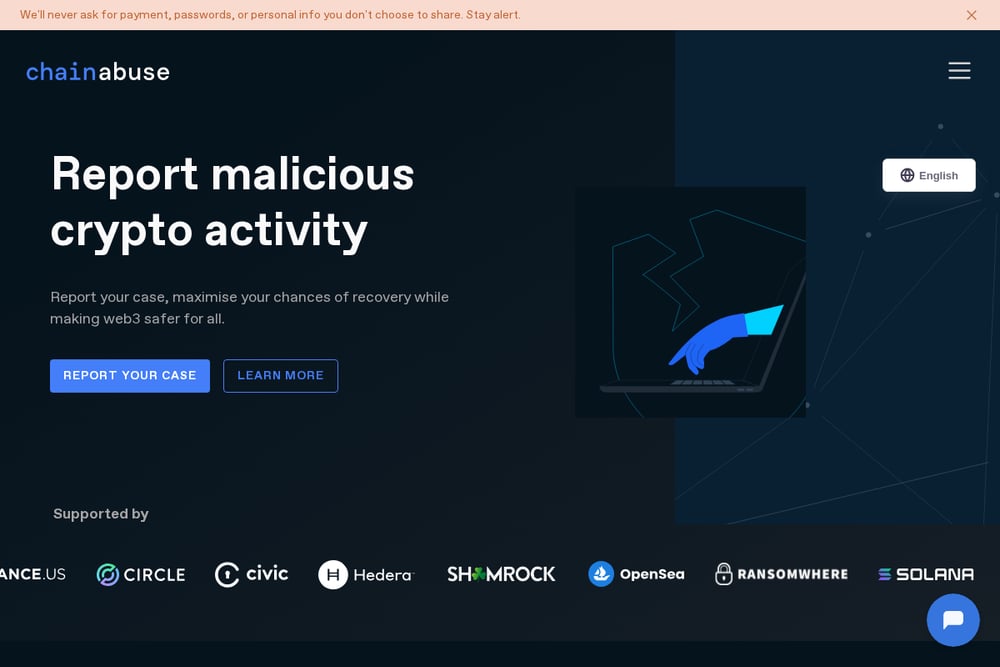 A screenshot of the Chainabuse website.
Chainabuse is a community reporting platform rather than a tracing engine, and that is exactly its value. You can report a scam and check addresses, URLs, IPs, emails, phones, or keywords against reports filed by others. Reporting is free, and opting in gives you personalized advice on immediate actions and next steps. The platform helps law enforcement across jurisdictions link multiple reports of the same scam, which can improve recovery odds when many victims are involved. It also publishes country-specific guides on who to contact and what evidence to bring, covering 73 countries. Think of it as the reporting and crowd-intelligence layer that complements a tracing tool.
How to pick the right one for you
Start with who you are. If you lost crypto and need something to attach to a police complaint, a free victim-facing report is the fastest path, and pairing it with a public scam report increases the chance that your case gets linked to others. If you are comfortable reading transaction graphs and want to chase the funds yourself, a visual tracking platform gives you more depth. If you run a business handling customer deposits, you need screening and risk scoring, not a narrative report. And if your goal is to warn the community and loop in law enforcement, a reporting platform does that job better than any analytics dashboard. Many people end up using two: one to trace, one to report.
Putting a workflow together
A practical sequence looks like this. First, pull a report on the address that received your funds so you have a documented summary of holdings, outflows, and any freezes. Second, file a report with a community platform so your case is on record and can be linked to related scams. Third, if you want to go deeper, run the address through a visual tracking tool to map where the funds landed and whether they hit an exchange. Fourth, hand the whole package to law enforcement, including the report, the flow diagram, and the list of where to file. If you are a business, replace steps one through three with an API-based screening check at onboarding and on every inbound transfer.
The bottom line
There is no single tool that recovers stolen crypto, and any service claiming otherwise deserves suspicion. What you can do is build a credible record of what happened. TraceAWallet is the most direct fit for fraud victims because it produces a free, police-ready report and tells you where to file it. MetaSleuth gives you the investigative depth if you want to follow the money yourself. MistTrack covers the compliance side for businesses, Chainabuse handles reporting and community intelligence, and Breadcrumbs is worth a look once its site is back up. Pick based on your role, not on feature lists.