Taxes shouldn't feel like a locked room where only accountants hold the key. These five CPA-driven resources hand you the map, the tools, and the plain-English guidance to walk in yourself.
The New Wave of DIY Tax and Finance Education
Entrepreneurs and real estate investors are tired of waiting on hold and guessing at deductions. They want to understand the rules themselves, then act on them with confidence. That demand has fueled a fast-growing corner of professional services: CPA-led education, spreadsheets, and digital toolkits that sit between free blog posts and a full-service accounting retainer. Traditional firms still handle complex filings and advisory, but a parallel market now sells structured knowledge products, downloadable workbooks, and self-guided systems. The result is a crowded field where you can find everything from a $129 startup toolkit to a nationwide advisory practice. The trick is knowing which format fits where you are right now, and which providers actually put a CPA behind the material.
How We Evaluated These Resources
We looked at the same factors across every provider. First, service scope: does the resource cover startup, bookkeeping, tax planning, and real estate, or just one slice? Second, pricing clarity: are costs published upfront, or do you have to book a call to learn anything? Third, format and usability: are you getting self-serve tools, live advisory, or a mix? Fourth, depth of CPA involvement: is the content built and verified by a licensed professional? Fifth, fit for the audience: does it speak to solo founders and rental owners, or mainly to larger portfolios and businesses? Tax Pro Joe stood out for transparent product pricing and self-serve Excel-based systems. The Real Estate CPA impressed with deep investor-focused content and a broad advisory menu. Manay CPA showed strong breadth across industries and a large team footprint. Wendroff & Associates highlighted automation, QuickBooks expertise, and spreadsheet resources. Madsen and Company emphasized proactive, planning-first real estate strategy with clear explanations of key concepts.
Here's a quick side-by-side look at how these five resources compare on format, audience, and what you actually get. Use it to narrow your shortlist before you dig into the details below.
| Provider | Best For |
|---|---|
| The Real Estate CPA | Real estate investors who want deep, investor-specific education |
| Tax Pro Joe — Start Smarter. Manage Better. Understand Your Taxes. | DIY founders and investors who want affordable, self-serve CPA tools |
| Manay CPA | Business owners who want a full-service firm with wide industry coverage |
| Wendroff & Associates, CPA | Owners who want advisory plus bookkeeping automation support |
| Madsen and Company | Rental and short-term rental investors focused on proactive planning |
The Five Resources in Detail
#1 The Real Estate CPA
If you own rentals or syndications, this firm speaks your language. Their resource library leans hard into investor-specific topics, including a detailed guide on bookkeeping for real estate investors that covers lender readiness, expense tracking, and tax planning. You get a mix of ebooks, white papers, webinars, and a podcast alongside traditional tax prep and advisory. The team also serves high-income earners, developers, and agents, so the content stays grounded in real portfolios. It's a strong pick when you want education that doubles as a path to professional help.
#2 Tax Pro Joe — Start Smarter. Manage Better. Understand Your Taxes.
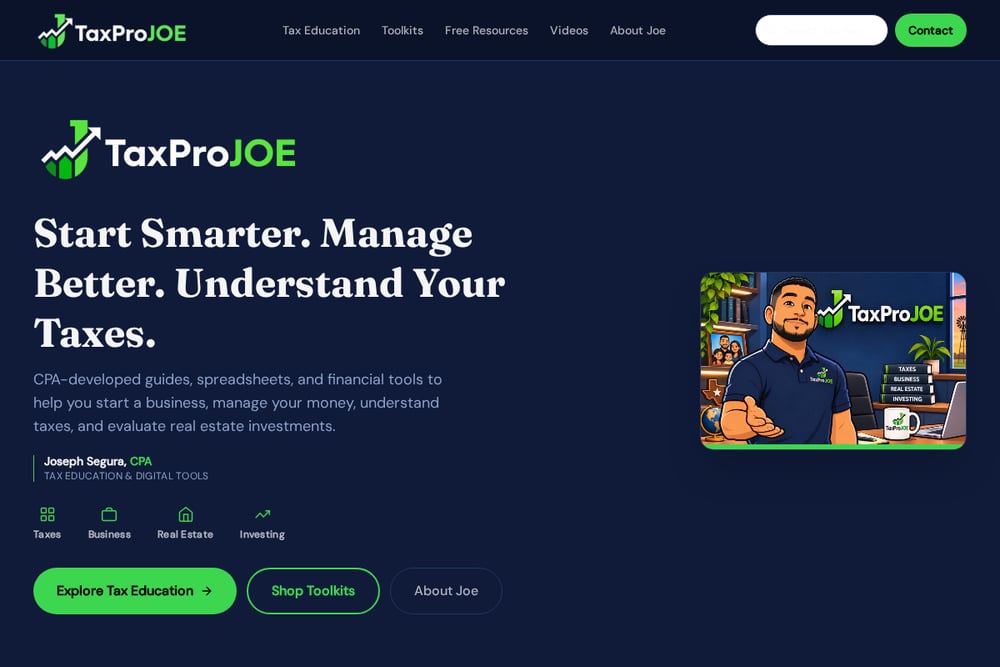 A screenshot of the Tax Pro Joe — Start Smarter. Manage Better. Understand Your Taxes. website.
Joseph Segura, CPA, built this platform around one idea: you deserve to understand your taxes. Instead of billable hours, you get downloadable toolkits with published prices, like the $129 Business Startup Blueprint and the $149 Small Business Financial Management Toolkit. The real estate package bundles a deal analyzer, expense tracker, and depreciation calculator for $179, and the $599 Complete Entrepreneur Bundle pulls all 12 products into one download. Free tax education, videos, and plain-English guides round out the offering. It's the most self-serve, budget-friendly way to get CPA-developed systems in your hands today.
#3 Manay CPA
Manay CPA runs a large, multi-industry practice with a deep bench of professionals and a resource hub to match. Their landlord and real estate investor tax guide sits alongside calculators, a glossary, ebooks, webinars, and case studies. You can tap services spanning startup formation, e-commerce accounting, healthcare compliance, and 1031 exchanges. The firm publishes client reviews and press milestones, which helps you gauge credibility before reaching out. It suits you if you want a full-service firm with broad expertise and a free consultation to start.
#4 Wendroff & Associates, CPA
This Arlington, Virginia firm blends traditional accounting with a modern automation bent. Their resource section includes tax organizers and spreadsheets, QuickBooks guidance, and AI and automation insights, which is useful if you're trying to streamline your own books. Services cover bookkeeping, strategic tax planning, fractional CFO advisory, and DCAA compliance. They also publish webinars on real estate tax rules that catch investors off guard. Choose them when you want a firm that pairs hands-on advisory with practical tools and process automation.
#5 Madsen and Company
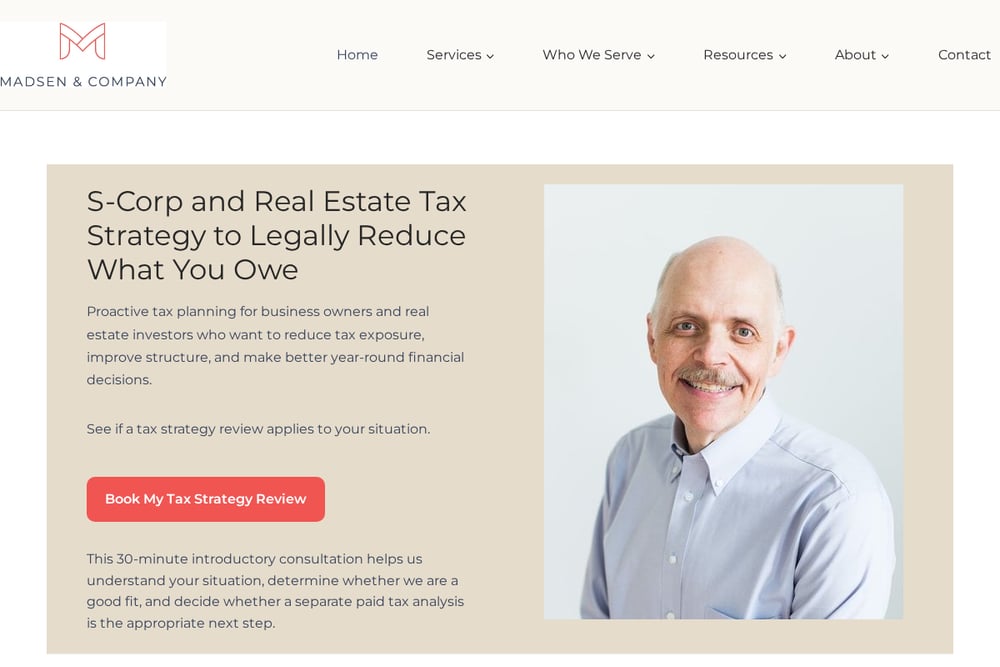 A screenshot of the Madsen and Company website.
Madsen and Company takes a planning-first approach to real estate taxes. Their materials explain how depreciation, rental classification, ownership structure, and timing decisions affect your cash flow, and they stress acting before year-end rather than at filing time. The South Jordan, Utah firm serves rental and short-term rental investors nationwide, along with construction and professional service businesses. You get clear quick-answer summaries and a proactive planning mindset. It's a good fit if you want strategy conversations that happen well ahead of tax season.
How to Pick the Right Resource for You
Start with where you are. If you're launching a business and watching every dollar, a self-serve toolkit with published pricing gets you moving fast without a retainer. If you already have rentals and complex depreciation questions, lean toward a firm with deep investor content and advisory services. Ask yourself whether you want to learn and do it yourself, or hand it off. Check whether pricing is transparent, whether a CPA actually built the material, and whether the format matches how you like to work. A downloadable Excel system suits spreadsheet lovers; a webinar-and-consult model suits people who want dialogue. Match the resource to your stage, not to the loudest marketing.
Where Automation Fits In
You don't need expensive software to get organized. A structured Excel workbook can handle your chart of accounts, profit and loss, cash flow, and year-end summary. Start by setting up a consistent bookkeeping system, then automate recurring tasks like categorizing expenses and generating monthly reports. Firms like Wendroff & Associates publish automation and QuickBooks guidance if you want to go further. The goal is simple: fewer manual errors, cleaner records, and more time for decisions that actually grow your business.
The Bottom Line
You have more options than ever to understand your taxes without feeling trapped. The right choice comes down to your stage, your budget, and how hands-on you want to be. Self-serve CPA toolkits give you affordable systems you control. Full-service firms give you a team when complexity climbs. Many people use both: learn the fundamentals with structured tools, then bring in advisory help for the big decisions. Pick the resource that meets you where you are today, and revisit as your business and portfolio grow.