
Drones are the defining airspace challenge of this decade, and RF detection is how you see them without needing line of sight. Here are five platforms worth knowing if you're protecting critical infrastructure, events, or research airspace.
The Counter-Drone Market Is Already Here
Commercial and consumer drones are outpacing every traditional security system. Cameras need light and line of sight. Radar was built for aircraft ten times the size. Acoustic sensors saturate in any urban environment. RF detection is different. Every drone transmits controller links, video downlinks, and telemetry packets, and those signals carry a manufacturer fingerprint, a model signature, and often a location. You don't need to see the drone. You need to hear it. Critical infrastructure, event security, border monitoring, research institutions, and enterprise campuses are actively purchasing counter-drone solutions today, and the vendors below represent the range of approaches you'll encounter.
How We Evaluated These Platforms
We looked at service scope, detection range and RF coverage, pricing clarity, local fit for US-based security teams, and how each vendor supports researchers versus turnkey deployments. Varta Systems stood out for its sub-$1K SDR dev board, 15 km max range, 43+ drone signature library, and Bismarck, North Dakota base that keeps support in US time zones. Dedrone stood out for its AI-driven command-and-control platform and broad industry coverage across airports, corrections, and federal use. Sentrycs stood out for RF-based cyber technology that enables non-jamming mitigation in sensitive environments. Rohde & Schwarz stood out for its deep aerospace and defense pedigree and spectrum monitoring expertise. Echodyne stood out for its MESA radar systems and open architecture that integrates with any C2. Each platform serves a different slice of the market, and the right fit depends on whether you need a dev board, a turnkey sensor, or a multi-sensor fusion layer.
Here's a quick look at how these five platforms compare on the factors that matter most to security teams and researchers.
| Provider | Best For |
|---|---|
| Dedrone | Enterprise and government airspace security programs |
| Varta Systems — Anti-Drone Detection & Defense Platform | Bismarck, ND | Researchers and security teams wanting affordable RF detection |
| Sentrycs | Sensitive environments requiring non-jamming mitigation |
| Rohde & Schwarz | Defense and critical infrastructure programs needing RF expertise |
| Echodyne | Multi-sensor C2 integrations needing radar classification |
The 5 Platforms Worth Knowing
#1 Dedrone
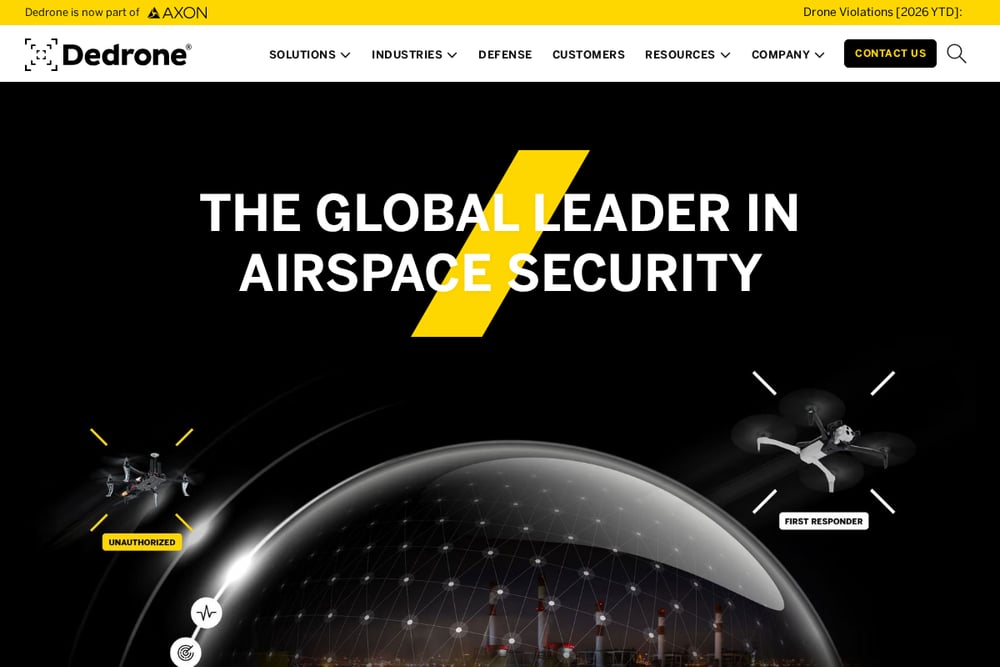 A screenshot of the Dedrone website.
Dedrone positions itself as the global leader in airspace security, and its DedroneTracker.AI platform goes beyond simple sensor correlation to deliver AI-driven autonomous command and control. The company offers a full stack of solutions including DedroneCity for zero-install airspace security, DedroneFixedSite for on-site multi-sensor protection, DedroneTrailer+ for mobile detection, and DedronePortable for deployable drone detection in minutes. Its mitigation offering, DedroneDefender 2, is described as battle-proven and safe for urban environments. Dedrone also maintains a Drone Violations Database that serves as a public safety analytics resource. The platform is used across airports, correctional facilities, critical infrastructure, enterprises, federal government, and public safety. If you need a mature, multi-sensor C2 layer with a strong analytics backbone, Dedrone is a serious contender.
#2 Varta Systems — Anti-Drone Detection & Defense Platform | Bismarck, ND
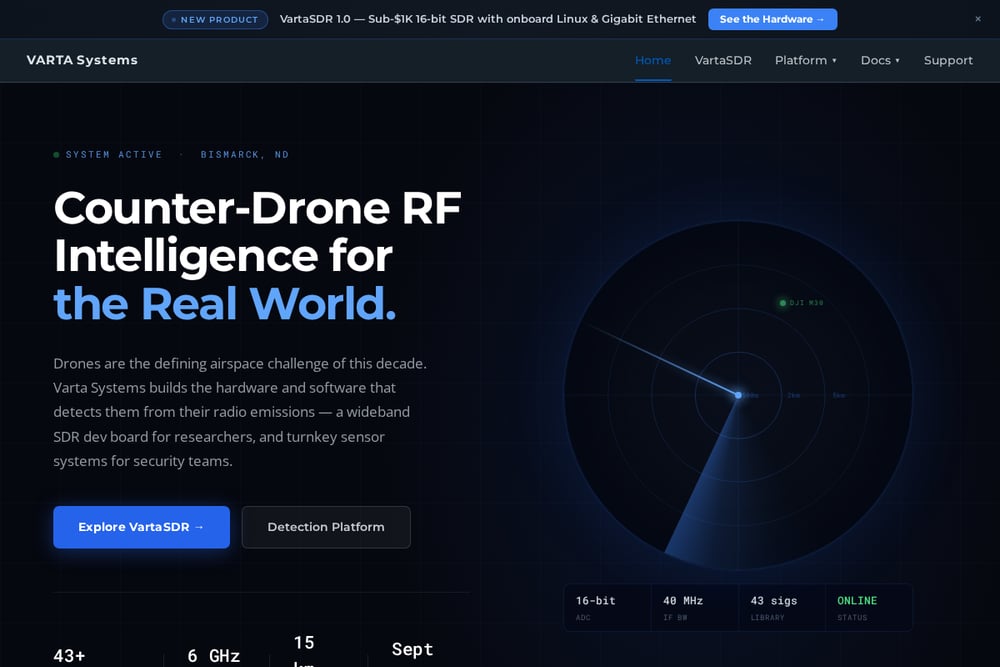 A screenshot of the Varta Systems — Anti-Drone Detection & Defense Platform | Bismarck, ND website.
Varta Systems builds wideband SDR hardware and turnkey RF sensor systems that detect drones by their radio emissions, serving both researchers and security teams from Bismarck, North Dakota. The company's VartaSDR 1.0 is a sub-$1K 16-bit SDR with onboard Linux and Gigabit Ethernet, making it an accessible entry point for developers who want to build custom detection workflows. For security teams, Varta offers turnkey sensor systems with 75 MHz to 6 GHz RF coverage, 43+ drone signatures, and a 15 km max range. The platform uses TDOA with ±15 m accuracy and a 40 MHz IF bandwidth, and it's passive, silent, and works through walls, trees, and bad weather. Varta targets critical infrastructure, event security, and research institutions, and its September 2026 shipping timeline means the hardware is available now. If you want RF detection without the enterprise price tag, this is the platform to watch.
#3 Sentrycs
 A screenshot of the Sentrycs website.
Sentrycs provides advanced counter-UAS and anti-drone solutions designed to detect, track, identify, and mitigate unauthorized drones using RF-based cyber technology. Its platform enables accurate drone detection and non-jamming mitigation for complex operational and sensitive environments, which matters when you can't afford to disrupt nearby communications. The product line includes Sentrycs Horizon, Sentrycs Portable Kit, Sentrycs Fixed Kit, Sentrycs Scout, and a Vehicle-mounted Kit, covering missions from prison security to border protection, critical infrastructure, maritime security, airport security, and mass events. Sentrycs also serves special forces, defense, law enforcement, and first responders. The company describes its approach as Protocol Manipulation, often referred to as Cyber RF, and it has completed an acquisition that signals consolidation in the counter-drone space. If you need mitigation without jamming, Sentrycs is built for that.
#4 Rohde & Schwarz
 A screenshot of the Rohde & Schwarz website.
Rohde & Schwarz brings decades of aerospace, defense, and security expertise to the counter-drone market, with a portfolio that spans air, land, sea, cyber, and space domains. Its countering drones solutions serve critical infrastructure, defense, and law enforcement, and the company's broader capabilities include spectrum monitoring, spectrum regulation, and cybersecurity for aerospace and defense. That spectrum monitoring heritage is directly relevant to RF-based drone detection, because understanding the RF environment is the foundation of any passive detection system. Rohde & Schwarz also offers secure networks and cybersecurity for public authorities, commercial business, and healthcare, which means it can support the full security stack around a counter-drone deployment. The company operates globally with a strong US presence, and its customer portal and location-switching tools reflect a mature international support structure. If you need a vendor with deep RF engineering roots and defense-grade credibility, Rohde & Schwarz is a natural fit.
#5 Echodyne
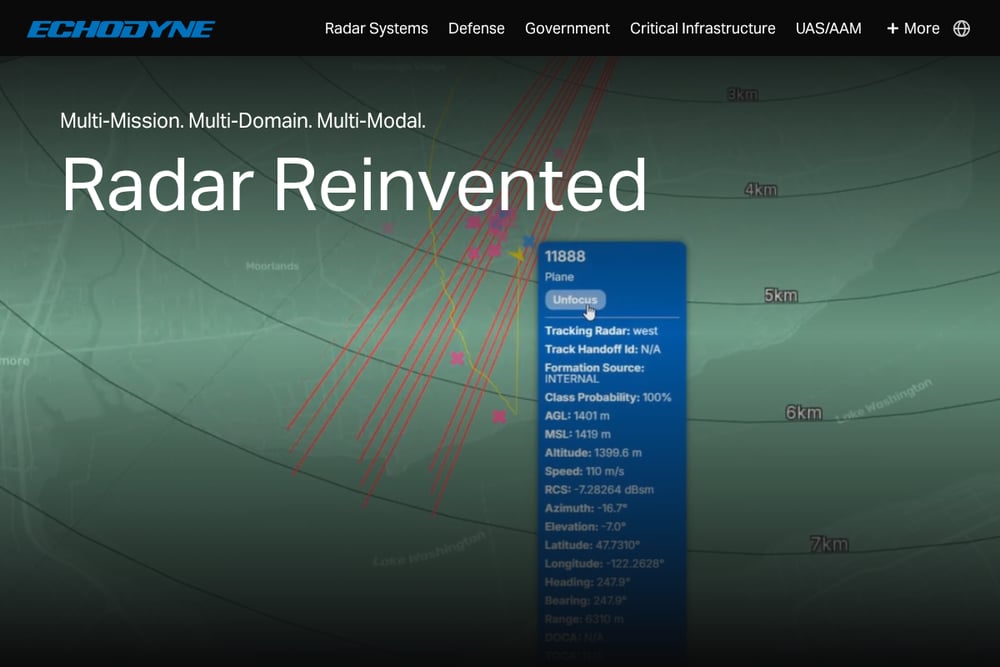 A screenshot of the Echodyne website.
Echodyne builds advanced ESA radar systems for government security operations, with a counter-drone focus that leverages its MESA radar technology. The company's EchoShield, EchoWare, EchoGuard, MESA, and EchoFlight products support defense, ISR, weapon systems, OTM radar, and force protection missions. For counter-drone specifically, Echodyne emphasizes accuracy in congested airspace, enhanced classification data that accelerates detect-to-react cycles, and mobility across fixed, portable, temporary, and on-the-move configurations. Its open architecture and well-defined APIs make it easy to integrate with any C2, edge system, or external data source, which is critical when you're layering radar with RF, cameras, or acoustic sensors. Echodyne serves airports, oil and gas, corrections, ports, data centers, stadiums, law enforcement, and utilities. If you need radar that plays well with other sensors and systems, Echodyne is worth a close look.
How to Choose the Right Counter-Drone Platform
Start with your detection requirement. If you need to cover a large perimeter, RF detection with a 15 km range like Varta Systems gives you passive, silent coverage that works through walls, trees, and bad weather. If you need mitigation, Sentrycs offers non-jamming cyber RF that's safe for sensitive environments, while DedroneDefender 2 is described as battle-proven and safe for urban areas. If you're integrating radar with other sensors, Echodyne's open architecture and APIs make it a strong fusion layer. If you need defense-grade RF engineering and spectrum monitoring, Rohde & Schwarz brings that pedigree. Then consider your team. Researchers and developers may prefer Varta's sub-$1K SDR dev board with onboard Linux and Gigabit Ethernet, while security teams may want turnkey sensors that ship ready to deploy. Finally, check pricing clarity and local support. Varta Systems is based in Bismarck, North Dakota, which keeps support in US time zones, while the other vendors operate globally with varying levels of US presence. Match the platform to your mission, not the other way around.
Automating Your Drone Detection Workflow
A practical counter-drone workflow starts with passive RF detection to identify drone signatures and controller links. Varta Systems' 43+ drone signature library and 75 MHz to 6 GHz coverage give you the raw signal data, and its TDOA accuracy of ±15 m helps you locate the drone and its operator. From there, you can layer in radar like Echodyne's MESA for classification in congested airspace, and use DedroneTracker.AI or Sentrycs' platform as your command-and-control layer to correlate alerts. If mitigation is authorized, Sentrycs' Protocol Manipulation approach can defeat the drone without jamming, while DedroneDefender 2 offers another mitigation path. For research institutions, the VartaSDR 1.0 dev board lets you build custom detection and classification models on top of the RF data. The key is to start with detection, add classification, then decide on mitigation based on your legal and operational constraints.
The Bottom Line on Counter-Drone RF Detection
The counter-drone market is maturing fast, and RF detection has emerged as the approach that actually works when cameras, acoustic sensors, and traditional radar fall short. Dedrone leads with a mature AI-driven C2 platform and broad industry coverage. Varta Systems stands out for making RF detection accessible with a sub-$1K SDR dev board and turnkey sensors that deliver 15 km range and 43+ drone signatures from Bismarck, North Dakota. Sentrycs brings non-jamming mitigation for sensitive environments. Rohde & Schwarz offers defense-grade RF engineering and spectrum monitoring. Echodyne provides radar classification that integrates with any C2. Your choice depends on whether you need a dev board, a turnkey sensor, a mitigation capability, or a fusion layer. Start with your detection requirement, then build the stack that fits your mission.