Your core and pelvic floor do quiet work all day long, and most fitness routines ignore them entirely. These five programs put that foundation first, so you can move with more control and less guesswork.
Where core and pelvic floor training stands now
Pelvic floor and deep-core training has moved from the physical therapy clinic into your living room. Demand has grown fast among women navigating postpartum recovery, diastasis recti, leakage, or simply a plateau in standard strength work. The result is a crowded field: some programs are built by clinicians and priced like care, others are subscription fitness memberships with a pelvic floor lens, and a few are simple one-time purchases. Knowing which model fits your budget, schedule, and body is most of the decision.
How these programs were compared
Each program was weighed on four things: the depth and structure of the core and pelvic floor content, how clearly pricing and access are explained, how easy it is to start at home without special equipment, and who the program is genuinely built for. Clinical grounding, free entry points, and realistic session lengths carried weight too. The detail on each one lives in the descriptions below.
Here is the short version before the detail: a free sample session, a clinically studied program, a physical therapist's rehab approach, a strength membership, and a well-known method. One of them will match how you like to train.
| Provider | Best For |
|---|---|
| Every Mother | Evidence-first, symptom-specific programming |
| Free Core & Pelvic Floor Workout | Ksenia Kurmanchuk | A low-cost, no-pressure starting point |
| Strong Core Mama | Postpartum rehab with a PT's guidance |
| Connect Pelvic Floor Fitness | Strength training with a pelvic floor base |
| Restore Your Core | Trying a well-known method for free |
The five programs in detail
#1 Every Mother
 A screenshot of the Every Mother website.
Every Mother is the most clinically framed option on this list, built around exercise regimens it says are proven to resolve diastasis recti. A short quiz routes you into a personalized daily plan for prenatal, postpartum, prolapse, or general core and pelvic floor needs. Sessions run 10 to 15 minutes, pricing starts around $9.95 a month, and HSA/FSA eligibility makes it easier to justify. It suits you if you want measurable structure and a research-backed story rather than a single fixed challenge.
#2 Free Core & Pelvic Floor Workout | Ksenia Kurmanchuk
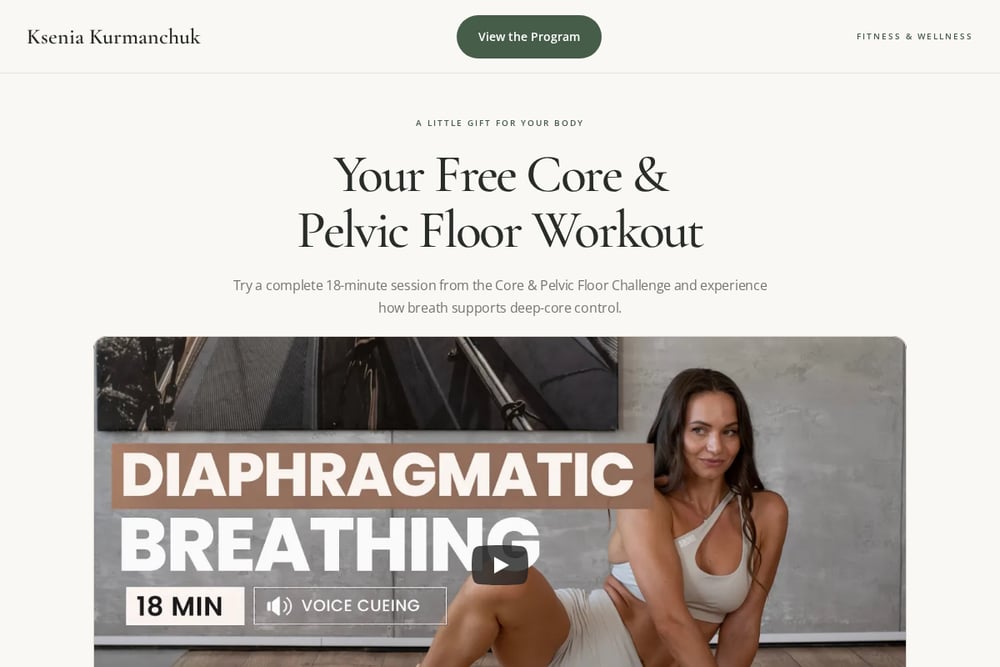 A screenshot of the Free Core & Pelvic Floor Workout | Ksenia Kurmanchuk website.
Ksenia Kurmanchuk takes the opposite approach to the subscription giants: one free 18-minute session, no sign-up, no email wall. You follow along and feel how breath supports deep-core control before spending anything. From there, the 8-week Core & Pelvic Floor Challenge delivers 24 guided at-home sessions of 10 to 25 minutes, including 14 foundational workouts, 5 core-focused workouts, and 5 guided self-massage videos. It is a one-time $49 payment with a full year of access, which is refreshingly simple next to monthly memberships. The program is aimed squarely at women who want a low-impact, mindful routine, including mothers rebuilding a practice after childbirth.
#3 Strong Core Mama
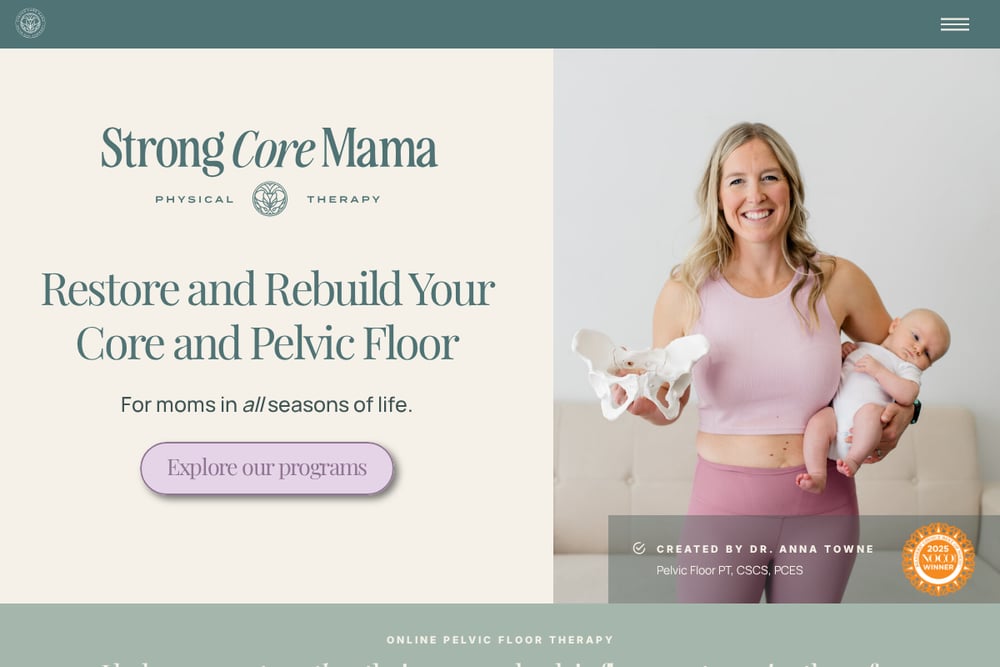 A screenshot of the Strong Core Mama website.
Strong Core Mama is led by Dr. Anna Towne, a pelvic floor physical therapist, and reads like rehab rather than a workout series. The emphasis is on rebuilding the foundation correctly, with education on how the core and pelvic floor work together and why alignment matters. Testimonials from dancers and moms describe slow, breath-connected progress and responsive coaching. There are no appointments or childcare logistics, and no special equipment is required. Choose this if you want a clinician's eye on your recovery and value understanding the why behind each movement.
#4 Connect Pelvic Floor Fitness
 A screenshot of the Connect Pelvic Floor Fitness website.
Connect Pelvic Floor Fitness blends pelvic floor education with real strength training, designed by a physical therapist with more than 15 years of experience. Every workout starts with the pelvic floor, then progresses through a three-phase approach from foundations into advanced strength. It is a membership with a 14-day free trial, cancel anytime, and HSA/FSA eligibility. The pitch is performance, not just recovery: lifting heavier, running farther, keeping up with your kids. It fits you if you are past the early rehab stage and want to train hard without ignoring your foundation.
#5 Restore Your Core
 A screenshot of the Restore Your Core website.
Restore Your Core is one of the better-known names in this space, and its free 18-minute pelvic floor workout is a popular entry point. The method centers on whole-body alignment and breath coordination rather than isolated crunch-style work. It is a good fit if you have heard the name, want to sample the teaching style, and prefer a recognizable brand with a broad content library behind it. Start with the free session and see whether the cueing and pace suit how you learn. If you like a slower, alignment-focused approach, it will feel familiar quickly.
How to pick the right program for you
Start with where you are. If you are newly postpartum or managing symptoms like leakage or pressure, lean toward the clinician-led options, Strong Core Mama or Every Mother, where the programming is built around rehab. If you are cleared and want to get stronger, Connect Pelvic Floor Fitness takes you into real strength work. If you are unsure whether you will stick with it, use a free session first: Ksenia Kurmanchuk and Restore Your Core both let you try before paying. Then check the money model. A one-time $49 with a year of access is easy to budget, while memberships make sense only if you will use them monthly. Finally, look at session length and equipment. Ten to 25 minutes on a mat at home beats an ambitious plan you never open.
A simple weekly rhythm that makes it stick
Pick one program and block three sessions a week on your calendar, each 15 to 25 minutes, at a time you are least likely to be interrupted. Do the free sample session first and note how your body responds the next day. Keep a mat in plain sight and a band or pillow nearby so setup takes seconds. After each session, jot one line about what felt different, whether that is breathing, posture, or control. At the end of four weeks, review those notes and decide whether to continue, upgrade, or switch approaches. Consistency, not intensity, is what rebuilds a deep core.
The bottom line
There is no single right program here, only the right fit for your stage. Every Mother leads on clinical evidence, Strong Core Mama on therapist-led rehab, and Connect Pelvic Floor Fitness on strength progression. Restore Your Core is a solid way to test a well-known method. But if you want the lowest-risk way to begin, Ksenia Kurmanchuk's free 18-minute session costs nothing and asks nothing of you, and the $49 eight-week challenge is one of the simplest commitments in this category. Try the free workout, pay attention to how you feel, and let that guide the rest.