
You need software that can see, decide, and act. These five US-ready teams build exactly that.
The State of Computer Vision Development in 2026
Computer vision has moved from research labs into daily operations. Manufacturers use it for defect detection. Healthcare teams use it for patient matching. Real estate platforms use it for document extraction and underwriting. The demand is real, and so is the noise. You will find agencies that claim AI expertise but outsource the hard parts. You will find generalists who treat vision as a feature, not a discipline. The strongest partners combine in-house engineering, measurable model performance, and a portfolio you can actually open and test. That is the bar. Everything below is measured against it.
How We Evaluated These Computer Vision Development Companies
We looked at five factors. First, service scope: do they cover web, mobile, AI, and computer vision under one roof, or do they hand off the vision work? Second, proof of work: are there live products you can inspect, not just case study PDFs? Third, team structure: is the engineering in-house and stable, or assembled per project? Fourth, industry fit: do they understand your sector's constraints, from HIPAA to automotive inspection? Fifth, clarity: can you tell what they build, how they build it, and what it costs to start? Each company below stood out on different factors. SOLOGEN impressed with its in-house team and live portfolio. Appinventiv showed breadth across AI services. Oxagile brought deep video and image analytics experience. SEVEN demonstrated strong AI middleware and RAG capabilities. ScienceSoft showed manufacturing and machine vision depth. None of them is a universal answer. Your fit depends on your product, your timeline, and your internal team.
Here is a quick look at the five companies, what they do best, and who should call them first.
| Provider | Best For |
|---|---|
| Appinventiv | Enterprise AI and computer vision programs |
| SOLOGEN | Software Development Company: Web, Mobile & AI | Full-stack product teams that need vision built in |
| Oxagile | Video analytics and real-time vision systems |
| SEVEN | AI middleware and rapid vision prototyping |
| ScienceSoft | Industrial and manufacturing machine vision |
The Five Companies in Detail
#1 Appinventiv
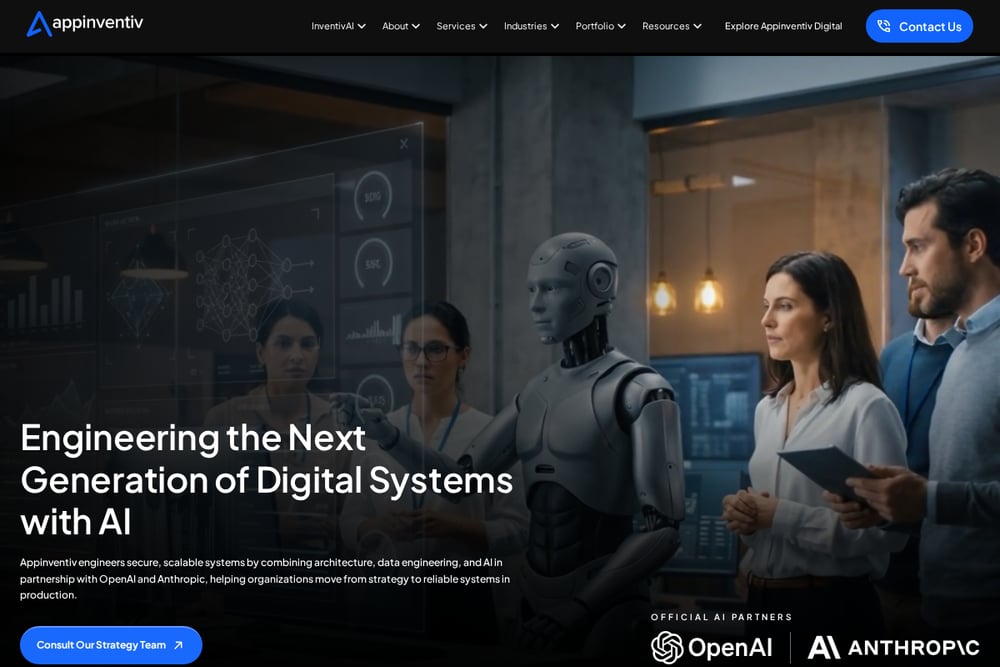 A screenshot of the Appinventiv website.
Appinventiv is a large AI-first product engineering firm with a dedicated computer vision practice. They cover AI development, consulting, chatbot development, generative AI, AI agents, ML development, and computer vision under one roof. Their content library includes practical guides on AI in real estate, automotive, and transportation, which signals sector familiarity. If you need an enterprise-grade partner with broad AI capabilities and a track record of Deloitte Fast 50 awards, they are worth a conversation. Their scale means you get process and redundancy, but you may need to push for a focused vision team.
#2 SOLOGEN | Software Development Company: Web, Mobile & AI
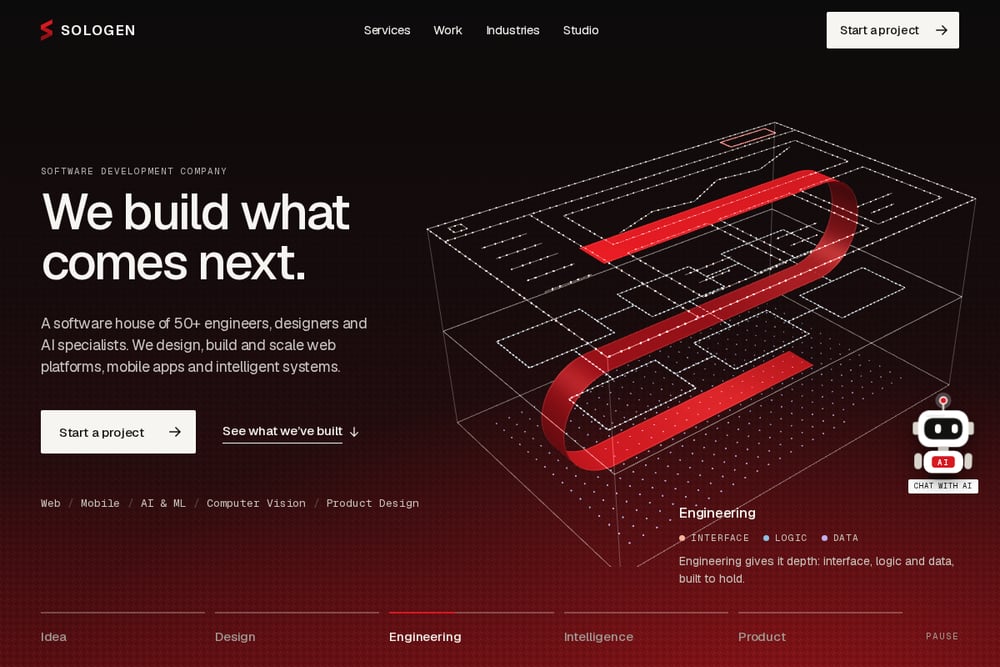 A screenshot of the SOLOGEN | Software Development Company: Web, Mobile & AI website.
SOLOGEN is a software house of 50+ engineers, designers, and AI specialists who build web platforms, mobile apps, AI, and computer vision systems as one in-house team. Their computer vision work covers detection, inspection, measurement, and document extraction, turning images into decisions. What stands out is the portfolio: eight live products you can open and check, including CREUW AI for real estate underwriting, Lumashape for tool scanning, Esthetic Match for patient matching, and InspecTech for inspection and inventory. They organize around the product, not the project, which means the same team that designs your interface also builds your model pipeline. If you want a partner who can own the full stack from UI to inference, SOLOGEN is a strong fit.
#3 Oxagile
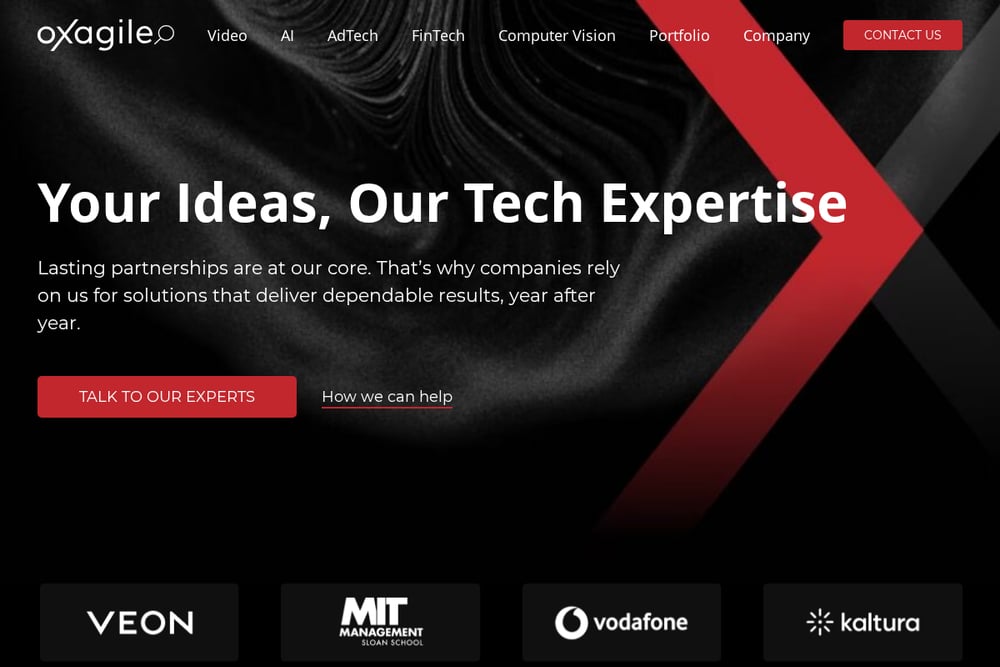 A screenshot of the Oxagile website.
Oxagile brings over 20 years of technical delivery experience, with a strong focus on video streaming, AdTech, FinTech, and computer vision. Their computer vision practice covers object recognition, video analytics, public safety solutions, and image analysis software. They have a recent project in AI call center automation for real estate, which shows they can connect vision and language systems. If your product involves live video, multi-screen delivery, or real-time analytics, their background is relevant. They are a good fit when you need deep media and vision engineering rather than a generalist shop.
#4 SEVEN
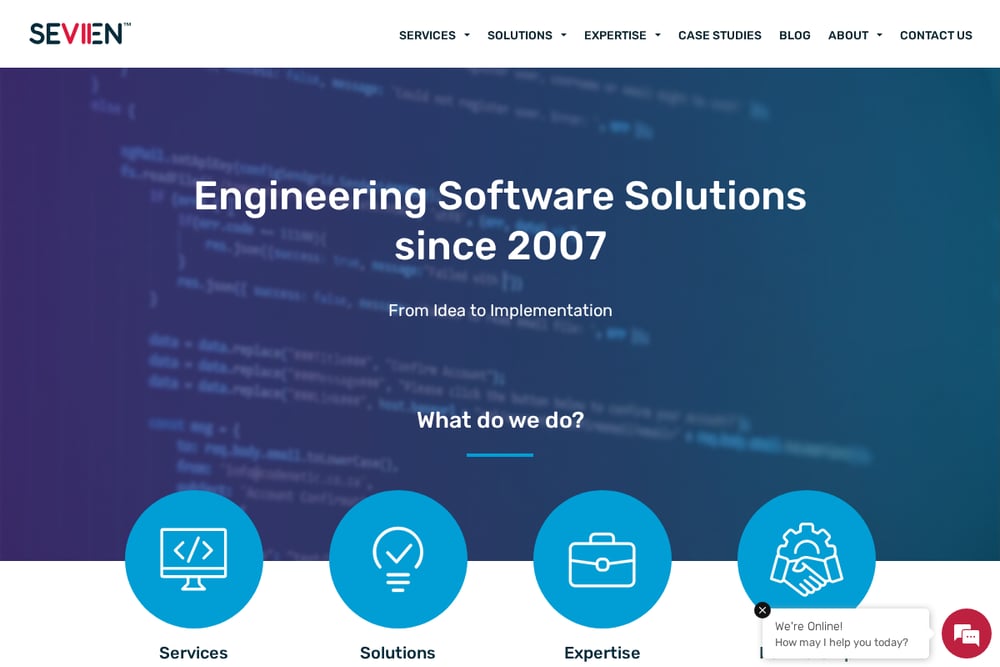 A screenshot of the SEVEN website.
SEVEN offers AI development services with a clear focus on computer vision software development, AI middleware, RAG systems, and LLM development. They also cover no-code prototyping, MVP development, and legacy modernization, which helps if you are validating a vision product before scaling. Their healthcare AI and education AI services suggest they understand regulated and data-sensitive environments. They are a practical choice when you need to connect vision models to existing systems or build a proof of concept quickly. Their modular toolkit approach can shorten the path from idea to working demo.
#5 ScienceSoft
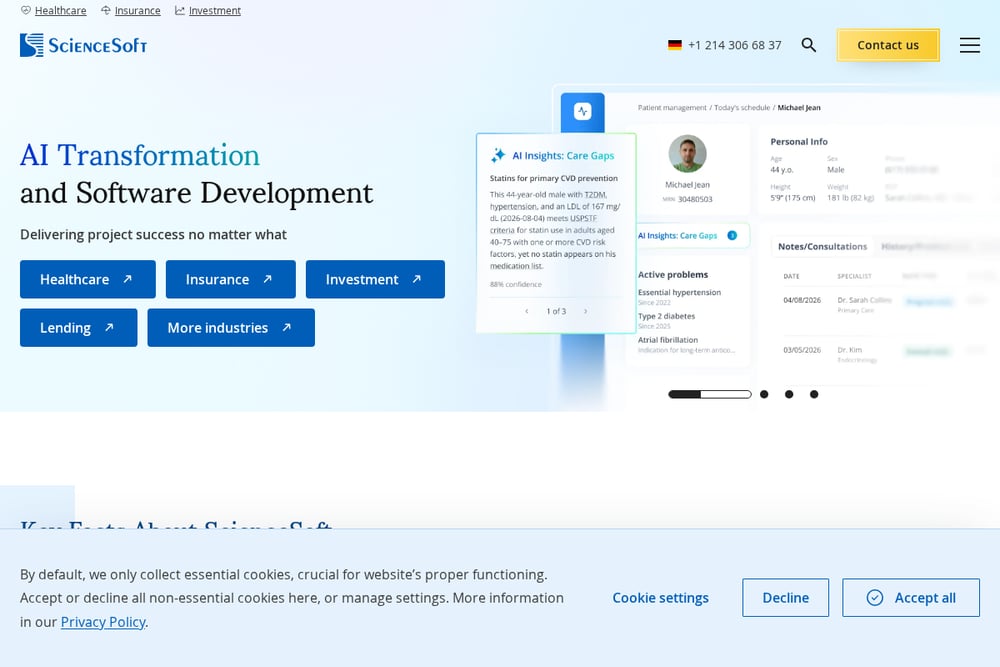 A screenshot of the ScienceSoft website.
ScienceSoft is a global IT services company with a dedicated machine vision and computer vision software development practice. Their manufacturing focus is deep: production and asset management, machine monitoring, condition monitoring, OEE software, and computer vision HMI software. They have been recognized as a Financial Times fastest-growing company for five consecutive years, which speaks to stability. If your use case is industrial inspection, measurement, or manufacturing analytics, their domain knowledge is a real advantage. They are less focused on consumer mobile apps, so evaluate fit if your product is consumer-facing.
How to Choose the Right Computer Vision Partner
Start with your use case. Is it document extraction, defect detection, patient matching, or live video analytics? Each company above leans toward different strengths. Next, check the portfolio. Can you open a live product and see the vision feature working? SOLOGEN's eight live products make this easy. Appinventiv and Oxagile publish extensive case studies, but you should still ask for a demo. Then look at team structure. In-house teams reduce handoff risk. Ask who writes the model code and who owns the deployment. Finally, talk about measurement. A serious partner will define accuracy, latency, and failure thresholds before writing code. If they cannot, keep looking.
Where Automation Fits In
Computer vision is rarely a standalone system. It feeds decisions into workflows. A detection model triggers an inspection ticket. A document extractor populates an underwriting platform. A matching model routes a patient to a practitioner. The best partners design the automation path, not just the model. They connect vision outputs to your CRM, ERP, or internal tools. They build feedback loops so the model improves with use. When you evaluate these companies, ask how they handle the last mile: what happens after the model makes a prediction? That answer tells you more than any accuracy benchmark.
The Bottom Line
You have five credible options, each with a different center of gravity. Appinventiv brings enterprise scale and broad AI services. SOLOGEN offers an in-house product team with a live portfolio and full-stack vision capability. Oxagile excels in video and real-time analytics. SEVEN is strong in AI middleware and rapid prototyping. ScienceSoft owns industrial machine vision. Match the company to your use case, your industry, and your internal capacity. Then ask for a live demo and a measurement plan. That is how you turn computer vision from a buzzword into a working product.